TEL:+86 132 6656 7067




Co-packaged optics (CPO) is an optical networking architecture that places optical engines close to a switch ASIC within a tightly integrated package. Instead of carrying high-speed electrical signals across the circuit board to front-panel optical transceivers, CPO shortens the electrical path before converting the signals into light.
This design targets the increasing bandwidth and power demands of AI data centers, cloud infrastructure, and high-capacity Ethernet networks. By bringing optics closer to the switching silicon, CPO can reduce electrical interconnect power and increase bandwidth density.
1. How CPO Works
In a conventional switch, electrical signals travel from the switch ASIC through circuit-board traces and connectors to pluggable optical transceivers. CPO places optical engines alongside the ASIC, reducing the distance those electrical signals must travel.
Switch ASIC: Processes and forwards network traffic.
Optical engine: Converts electrical signals into optical signals and converts received light back into electrical signals.
Laser source: Supplies the light used for optical transmission. Depending on the design, lasers may be integrated or located externally.
Fiber connections: Carry optical signals between the switch and connected network devices.
The optical engines use lasers or modulators to transmit data through fiber and photodetectors to receive it. Silicon photonics can integrate optical functions into compact photonic circuits, supporting high-density optical I/O.
2. CPO vs Traditional Pluggable Optics
| Feature | Pluggable Optics | CPO |
|---|---|---|
| Optical engine location | Inside a removable front-panel module | Close to the switch ASIC |
| Electrical path | Extends through board traces and module interfaces | Shorter connection between ASIC and optics |
| Power efficiency | Depends on module DSP, electrical channel, and design | Can reduce electrical interconnect power |
| Bandwidth density | Limited partly by front-panel space and electrical interfaces | Supports dense optical I/O near the switching silicon |
| Maintenance | Individual transceivers are generally replaceable | Optical engine servicing is more closely tied to the switch platform |
| Thermal design | Module cooling and chassis airflow | Coordinated cooling for ASICs and nearby optical engines |
Pluggable optics remain valuable for flexible deployment and straightforward module replacement. CPO is designed for systems where higher bandwidth density and lower interconnect power justify a more integrated architecture.
3. Why CPO Matters for AI Data Centers
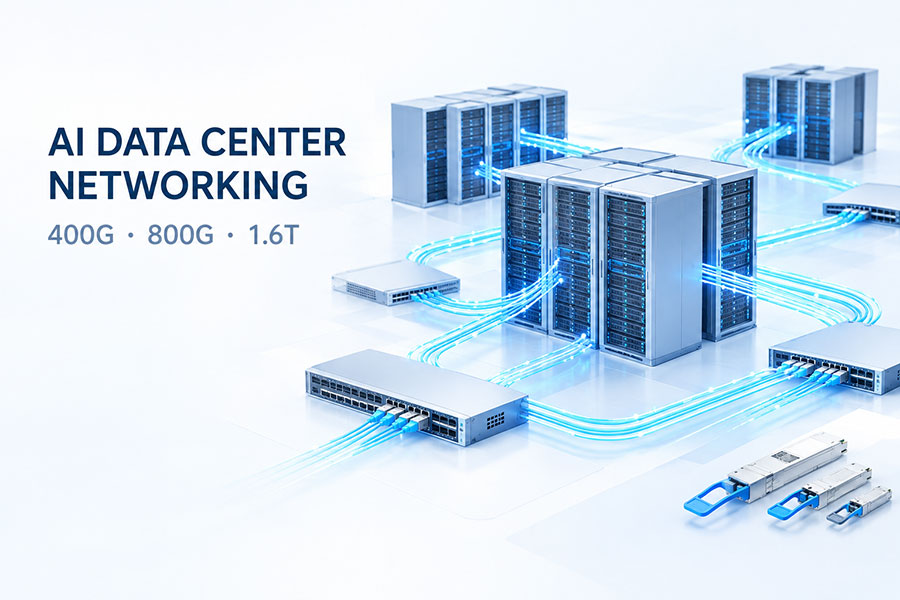
AI clusters connect large numbers of GPUs through high-capacity switch fabrics. As port speeds increase toward 800G and 1.6T-class networking, electrical signal loss and interconnect power become more challenging to manage.
Lower interconnect power: Shorter electrical paths can reduce energy spent on signal transmission and compensation.
Higher bandwidth density: Optical engines can provide more aggregate I/O capacity around switching silicon.
Improved signal integrity: Shorter electrical channels reduce the impact of PCB and connector losses.
Scalable network design: Dense optical connectivity supports high-capacity links between AI servers and switches.
The actual power savings depend on the system architecture, optical engine, laser configuration, and cooling requirements. CPO improves the ASIC-to-optics connection but does not eliminate the power consumed by lasers, optical components, or supporting electronics.
4. CPO, NPO, and LPO
| Technology | Design Approach | Main Consideration |
|---|---|---|
| CPO | Integrates optical engines close to the ASIC within a common package architecture | High integration and bandwidth density, with more complex servicing |
| NPO | Places optical engines near the ASIC but outside the same package | Shorter electrical paths with a different integration and maintenance model |
| LPO | Uses linear pluggable optics with reduced or no module DSP | Lower module power potential, with tighter host signal-integrity requirements |
| Traditional pluggable optics | Uses removable transceivers at the switch front panel | Flexible deployment and individual module replacement |
These architectures address different design priorities. CPO emphasizes close integration, while NPO retains more separation between the optical engine and ASIC. LPO focuses on simplifying signal processing within a pluggable module.
5. CPO Deployment Challenges
CPO introduces additional requirements for packaging, manufacturing, thermal management, and maintenance.
Cooling: Optical engines must operate within their temperature limits near high-power switch ASICs.
Serviceability: Replacing an integrated optical engine is generally more complex than swapping a pluggable transceiver.
Fiber attachment: Optical connections require accurate alignment and reliable packaging.
Reliability and testing: The ASIC, optical engines, laser sources, and fiber interfaces must be qualified as a complete system.
External laser sources can provide additional flexibility for certain CPO designs, including laser replacement without servicing the entire switch package. The suitable approach depends on the platform's reliability, thermal, and maintenance requirements.
6. Conclusion
CPO brings optical engines close to switch ASICs, shortening electrical interconnects and helping reduce power consumption while increasing bandwidth density. These characteristics make it an important architecture for high-capacity AI data centers and future optical networking systems.
Its adoption depends on the required bandwidth, thermal design, manufacturing maturity, and maintenance strategy. Pluggable optics remain suitable for many deployments, while CPO offers advantages where tight integration and efficient high-density optical I/O are priorities.
 >
>

 >
>
 >
>
 >
>
 >
>
 >
>
 >
>
 >
>