TEL:+86 132 6656 7067




1. RJ45 SFP+ vs Fiber SFP+: Overview
RJ45 SFP+ and Fiber SFP+ are both 10GbE pluggable solutions designed for SFP+ ports, but they use different transmission media. RJ45 SFP+ uses electrical signaling over twisted-pair copper, while Fiber SFP+ converts electrical signals into optical signals for transmission over fiber.
2. What Is an RJ45 SFP+?
An RJ45 SFP+ is a 10GBASE-T copper transceiver installed in an SFP+ port. It provides a standard RJ45 interface for Cat6A, Cat7, or compatible twisted-pair Ethernet cabling.
3. What Is a Fiber SFP+?
A Fiber SFP+ is an optical transceiver that uses light to transmit 10GbE signals over multimode or single-mode fiber. Common variants include 10GBASE-SR, LR, ER, and other optical configurations.
4. How RJ45 SFP+ Works
The RJ45 SFP+ module receives high-speed electrical data from the host SFP+ port, processes the signal for 10GBASE-T transmission, and sends the resulting electrical signal through twisted-pair copper cable.
5. How Fiber SFP+ Works
A Fiber SFP+ converts the host's electrical signal into an optical signal using a laser or VCSEL-based transmitter. At the remote end, the receiving transceiver converts the optical signal back into an electrical signal.
6. RJ45 SFP+ vs Fiber SFP+ Transmission Medium
The primary physical difference is the cable. RJ45 SFP+ uses copper twisted-pair cable, while Fiber SFP+ uses optical fiber such as OM3, OM4, OM5, or OS2 depending on the transceiver type and reach.
7. Data Rate
Both solutions can provide 10GbE connectivity when the host platform and module support the required specification. The difference is not primarily the nominal data rate, but the physical layer used to carry the data.
8. Transmission Distance
RJ45 SFP+ is generally intended for short copper links. Fiber SFP+ provides a much wider range of transmission distances, from short multimode connections to several kilometers or more with suitable single-mode optical modules.
9. Typical RJ45 SFP+ Reach
Reach depends on the specific 10GBASE-T module and cable category. Many SFP+ copper modules target short connections such as server-to-switch and adjacent-rack links, while supported distances vary by cable type and module design.
10. Typical Fiber SFP+ Reach
10GBASE-SR commonly targets short multimode links, while 10GBASE-LR is designed for longer single-mode links. Exact reach depends on the optical standard, fiber type, link budget, connectors, and network conditions.
11. RJ45 SFP+ Cable Requirements
RJ45 SFP+ modules typically use twisted-pair Ethernet cabling. Cat6A or better is commonly selected for 10GbE deployments, particularly where full copper-channel performance is required.
12. Fiber SFP+ Cable Requirements
Fiber SFP+ modules require fiber patch cables matched to the transceiver. Multimode modules normally use multimode fiber, while long-reach single-mode modules use single-mode fiber.
13. Connector Difference
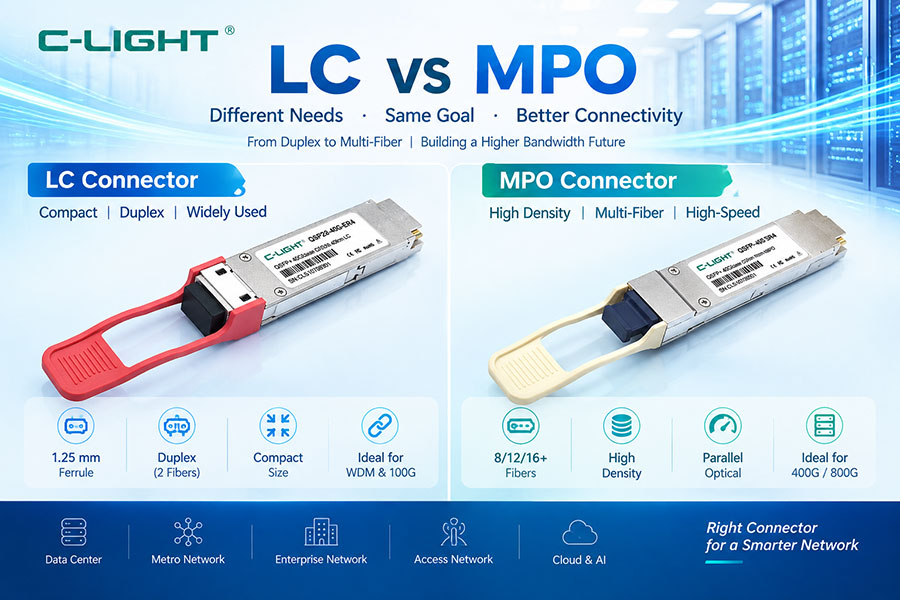
RJ45 SFP+ uses an RJ45 Ethernet interface. Fiber SFP+ modules may use LC duplex, BiDi LC, or other optical interfaces depending on the module design.
14. Power Consumption
Power consumption varies significantly by module implementation. RJ45 SFP+ modules generally require more power because 10GBASE-T involves substantial electrical signal processing. Fiber SFP+ modules can provide lower-power options, particularly for short-reach optical designs.
15. Heat Generation
Higher module power normally results in greater thermal output. This makes thermal management an important consideration when many RJ45 SFP+ modules are installed in a high-density switch.
16. Latency Considerations
Latency depends on the complete PHY and network architecture rather than the connector alone. The electrical processing required by 10GBASE-T can make copper implementations different from simpler short-reach optical links.
17. Electromagnetic Interference
Copper cables carry electrical signals and can be affected by electromagnetic interference in demanding environments. Fiber uses optical transmission and is inherently resistant to electromagnetic interference, making it useful in electrically noisy environments.
18. Installation and Cabling
RJ45 SFP+ is convenient when an existing structured copper Ethernet infrastructure is already available. Fiber SFP+ requires optical cabling and appropriate fiber management but provides greater flexibility for high-speed and longer-distance links.
19. Existing Copper Infrastructure
RJ45 SFP+ can be useful when a network already relies heavily on Cat6A or similar copper cabling. It allows an SFP+ host interface to connect to equipment with a standard RJ45 Ethernet interface.
20. Existing Fiber Infrastructure
Fiber SFP+ is a natural choice for networks that already use fiber distribution, patch panels, optical trunks, and fiber-based switch interconnections.
21. RJ45 SFP+ for Server Connections
RJ45 SFP+ can connect an SFP+ switch port to servers, network appliances, or other equipment with RJ45 10GbE interfaces. It is particularly useful when the endpoint does not provide an optical port.
22. Fiber SFP+ for Server Connections
Fiber SFP+ is commonly used when the server or network adapter provides an SFP+ optical interface. It is well suited to structured fiber connections and high-density data center environments.
23. RJ45 SFP+ for Switch-to-Switch Links
RJ45 SFP+ can support short switch-to-switch connections where copper cabling is preferred. The supported distance and cable category must be checked against the specific module.
24. Fiber SFP+ for Switch-to-Switch Links
Fiber SFP+ provides more options for switch-to-switch connectivity, including short-reach multimode links and longer single-mode connections. This makes it suitable for distribution, aggregation, and inter-rack links.
25. Compatibility
Compatibility involves more than the SFP+ mechanical form factor. The host port must support the module type, the module must support the required Ethernet standard, and the remote interface and cabling must match the deployment.
26. SFP+ Host Port Considerations
An SFP+ cage does not automatically guarantee support for every copper or optical SFP+ module. Platform documentation, supported transceiver lists, coding requirements, speed configuration, and firmware should be checked before deployment.
27. RJ45 SFP+ and Auto-Negotiation
10GBASE-T implementations can support Ethernet negotiation features depending on the module and host platform. Some copper SFP+ modules also support lower Ethernet rates, but this capability is module-specific and should not be assumed.
28. Fiber SFP+ and Optical Matching
Fiber links require matching optical characteristics at both ends. Wavelength, fiber type, transmission distance, connector configuration, and optical budget must all be considered.
29. Multimode Fiber SFP+
Short-reach Fiber SFP+ modules such as 10GBASE-SR commonly operate over multimode fiber. OM3 and OM4 are widely used in data center environments, with supported distances depending on the module and fiber specification.
30. Single-Mode Fiber SFP+
Single-mode Fiber SFP+ modules are used when longer transmission distances are required. 10GBASE-LR is a common example for approximately 10 km-class links under appropriate conditions.
31. RJ45 SFP+ vs Fiber SFP+: Cost
Total deployment cost depends on existing cabling, transceiver price, patching requirements, power consumption, and installation. RJ45 SFP+ can be attractive when copper infrastructure is already available, while fiber can provide greater scalability for longer links.
32. RJ45 SFP+ vs Fiber SFP+: Port Density
Thermal output becomes increasingly important as switch port density rises. Fiber-based SFP+ solutions can offer lower-power options, which may simplify thermal management in dense networking equipment.
33. RJ45 SFP+ vs Fiber SFP+: Reliability
Both technologies can provide reliable Ethernet connectivity when correctly specified and installed. Fiber is not affected by electromagnetic interference, while copper deployments benefit from familiar connectors and established structured-cabling practices.
34. RJ45 SFP+ vs Fiber SFP+: Security
The physical medium does not by itself determine network security. Fiber can make physical tapping more difficult in some environments, while copper provides a familiar physical infrastructure. Security should be addressed through the complete network architecture.
35. RJ45 SFP+ for Enterprise Networks
RJ45 SFP+ is useful in enterprise networks where existing copper cabling remains important. It can bridge an SFP+ switch interface with equipment using standard 10GbE RJ45 ports.
36. Fiber SFP+ for Data Centers
Fiber SFP+ is widely suited to data center switch, server, storage, and interconnection environments where high density, lower-power options, longer reach, and optical cabling flexibility are important.
37. RJ45 SFP+ for Short-Reach Deployment
Short rack-to-rack or equipment-to-equipment connections can benefit from RJ45 SFP+ when copper cabling is already installed and the required distance falls within the module's supported range.
38. Fiber SFP+ for Longer-Reach Deployment
When a link extends beyond practical copper limits, Fiber SFP+ provides a broader selection of optical reaches. Single-mode modules can support significantly longer connections than typical 10GBASE-T SFP+ deployments.
39. RJ45 SFP+ vs Fiber SFP+: Key Differences
| Feature | RJ45 SFP+ | Fiber SFP+ |
|---|---|---|
| Medium | Copper twisted pair | Optical fiber |
| Interface | RJ45 | LC or other optical interface |
| Typical application | Short 10GbE copper links | Data center and fiber links |
| Reach flexibility | Limited by copper channel | Short to long reach options |
| EMI resistance | Lower | High |
| Thermal considerations | Higher module power can be a concern | Often lower-power options available |
| Cabling | Cat6A/Cat7 or compatible copper | MMF or SMF |
40. RJ45 SFP+ vs Fiber SFP+: Which Should You Use?
The choice should be based on the existing infrastructure, transmission distance, power and thermal limits, endpoint interface, deployment density, and future network requirements. RJ45 SFP+ is practical for short copper connections, while Fiber SFP+ provides broader reach and optical connectivity options.
41. What to Check Before Buying an RJ45 SFP+
Check the supported Ethernet rates, host switch compatibility, cable category, maximum distance, power consumption, operating temperature, management functions, and vendor coding requirements.
42. What to Check Before Buying a Fiber SFP+
Check the optical standard, wavelength, fiber type, connector, transmission distance, transmit power, receiver sensitivity, link budget, operating temperature, and host compatibility.
43. Can RJ45 SFP+ and Fiber SFP+ Be Used in the Same Switch?
They can be used on compatible SFP+ ports when the switch supports the respective module types. However, each individual link must use compatible media and transceiver types at both ends.
44. Can RJ45 SFP+ Connect Directly to Fiber SFP+?
Not as a direct physical connection. RJ45 SFP+ provides an electrical copper interface, while Fiber SFP+ provides an optical interface. A network design requires an appropriate conversion or active networking device between different physical media.
45. RJ45 SFP+ vs Fiber SFP+ for Future Network Upgrades
Fiber generally provides more flexibility as link speeds and transmission distances increase. Copper remains useful where existing structured cabling, endpoint compatibility, and short-distance connectivity are the primary requirements.
46. Troubleshooting RJ45 SFP+ Links
For a failed copper link, check module recognition, host compatibility, cable category, cable length, link speed, auto-negotiation, temperature, module power, and the remote endpoint. Testing with a known-good cable and module can help isolate the problem.
47. Troubleshooting Fiber SFP+ Links
For an optical link failure, check module compatibility, fiber polarity, connector cleanliness, fiber type, wavelength, optical power, transmission distance, link budget, and remote transceiver configuration.
48. FAQ
Q1. Is RJ45 SFP+ the same as Fiber SFP+?
Q2. Does RJ45 SFP+ support 10GbE?
Q3. Is Fiber SFP+ better for long-distance links?
Q4. Does RJ45 SFP+ consume more power?
Q5. Can I replace Fiber SFP+ with RJ45 SFP+?
49. Summary
RJ45 SFP+ and Fiber SFP+ both provide 10GbE connectivity through the SFP+ form factor, but their physical-layer technologies are different. RJ45 SFP+ is designed for copper Ethernet cabling and is useful for short connections and existing structured-cabling environments. Fiber SFP+ uses optical transmission and offers greater reach flexibility, strong EMI immunity, and a wide range of data center and network applications. The right choice depends on distance, cabling, power, thermal conditions, compatibility, and the overall network architecture.
 >
>

 >
>
 >
>
 >
>
 >
>
 >
>
 >
>
 >
>