TEL:+86 132 6656 7067





DWDM and WDM-PON use wavelength-division multiplexing for different network objectives. Dense wavelength-division multiplexing (DWDM) increases the capacity of optical fiber by carrying multiple wavelength channels over a shared fiber path. Wavelength-division multiplexing passive optical network (WDM-PON) uses wavelength-based separation within a passive optical access network to connect an optical line termination (OLT) with multiple optical network units (ONUs).
The main distinction is architectural. DWDM is primarily an optical transmission and capacity technology, while WDM-PON defines an access-network architecture in which wavelengths help separate subscriber or endpoint connections. Their applications can overlap, but they are not interchangeable terms, and a WDM-PON system does not necessarily use a conventional dense DWDM channel grid.
1. What Is the Difference Between DWDM and WDM-PON?
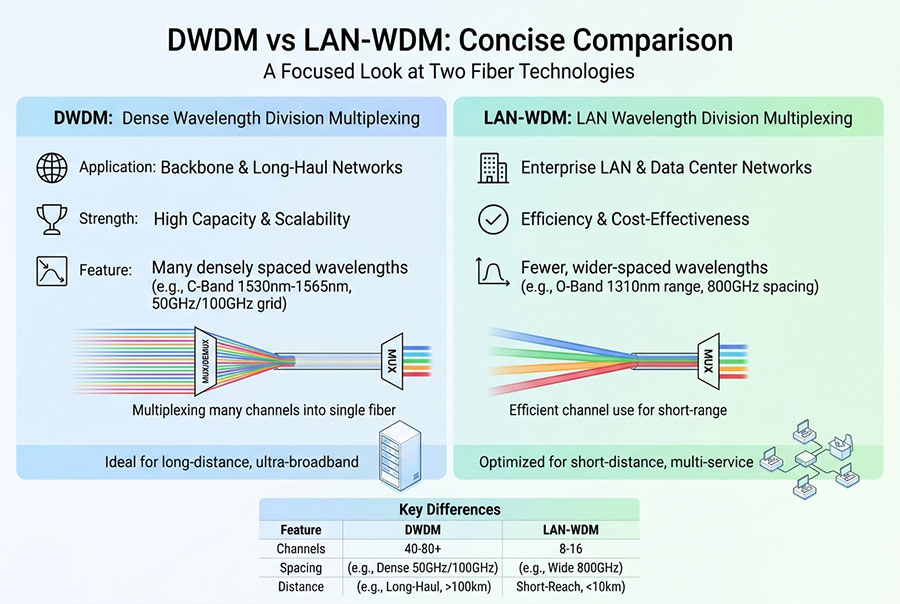
DWDM combines optical signals at different wavelengths onto the same fiber infrastructure. Each wavelength carries a separate optical channel, allowing the aggregate capacity to increase without installing a separate fiber pair for every channel.
WDM-PON applies wavelength multiplexing within a passive optical network. A wavelength-routed optical distribution network can direct specific wavelength channels between the OLT and the relevant ONU. Depending on the implementation, individual endpoints may receive dedicated downstream wavelengths, upstream wavelengths, or wavelength pairs.
The two technologies therefore address different design questions: DWDM focuses on transporting multiple optical channels efficiently, while WDM-PON focuses on organizing optical access connections using wavelength-based distribution.
| Comparison Factor | DWDM | WDM-PON |
|---|---|---|
| Technology category | Optical wavelength multiplexing technology | Passive optical access network architecture using wavelength multiplexing |
| Primary objective | Increase aggregate fiber transmission capacity | Provide wavelength-based connections between an OLT and multiple endpoints |
| Typical network role | Metro, regional, backbone, and data center transport | Fiber access, enterprise access, and other supported distribution applications |
| Channel allocation | Multiple channels assigned to wavelengths within a supported optical plan | Wavelengths assigned or provisioned for access connections according to the system design |
| Distribution infrastructure | Fiber links with compatible mux/demux and optional optical line equipment | Passive optical distribution network with wavelength-selective routing or multiplexing |
| Active equipment | May include optical transceivers, amplifiers, transponders, and optical switching equipment | OLT and ONU equipment, with active electronics at network endpoints |
| Endpoint model | Determined by the transport topology and connected equipment | Multiple ONUs or endpoints connected through a shared passive distribution network |
| Key design challenge | Channel capacity, optical budget, OSNR, and wavelength compatibility | Wavelength assignment, endpoint compatibility, ODN loss, and access-network operation |
2. How DWDM Works
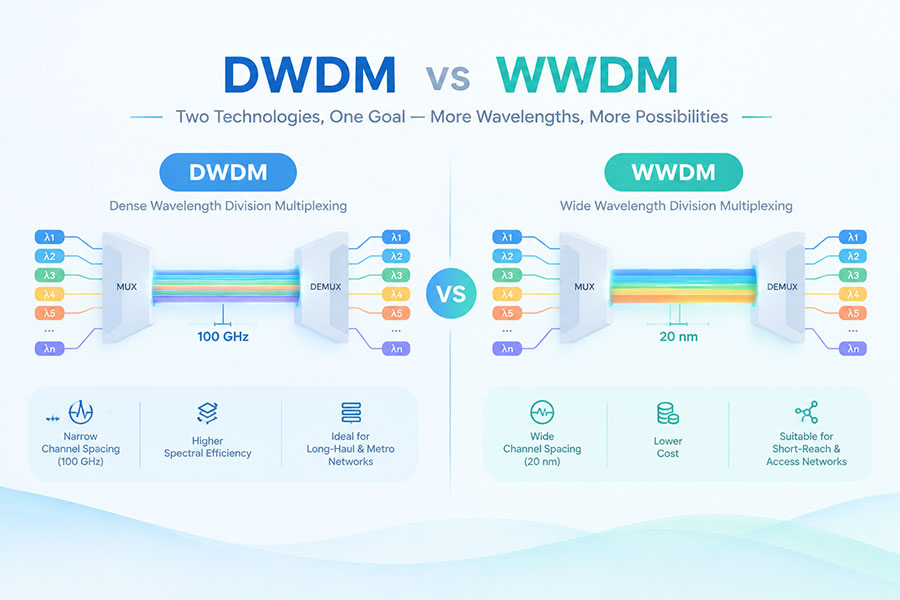
DWDM uses closely spaced optical wavelengths to transport multiple channels through the same fiber. A DWDM multiplexer combines the channels at the transmitting end, and a demultiplexer separates them at the receiving end.
Each optical channel can carry an independent data stream. The achievable aggregate capacity depends on the number of supported wavelengths, the data rate per channel, the available optical spectrum, and the performance limits of the complete line system.
Core DWDM components
DWDM optical transceivers: Generate or receive optical signals at supported wavelengths and data rates.
Multiplexers and demultiplexers: Combine or separate optical channels on the shared fiber path.
Optical amplifiers: Compensate for transmission loss when required by the link design.
Optical add/drop equipment: Adds, drops, or routes selected wavelengths in supported network configurations.
Monitoring systems: Provide visibility into optical power, wavelength channels, alarms, and other supported measurements.
DWDM is useful when a network needs to expand capacity while making efficient use of existing fiber. It can support point-to-point links as well as more complex optical transport networks. Its use does not, by itself, define how subscriber traffic is organized or how endpoints are provisioned.
3. How WDM-PON Works
WDM-PON connects an OLT to multiple ONUs through an optical distribution network (ODN). Instead of relying exclusively on time-division sharing of a common channel, wavelength-routed WDM-PON can use wavelength allocation to separate endpoint connections.
A wavelength multiplexer or wavelength router in the ODN directs the appropriate optical channels toward the intended endpoints. Depending on the architecture, the ONUs may use fixed wavelengths, tunable transmitters, wavelength-selective receivers, or other supported optical arrangements.
Typical WDM-PON architecture
OLT: Provides the service-facing and optical interfaces at the central office or access node.
Wavelength router: Routes or separates optical channels through the passive distribution network.
Feeder and distribution fiber: Connects the OLT-side equipment to the optical distribution network and endpoint branches.
ONU or ONT: Terminates the optical connection at the subscriber, enterprise, cell site, or other endpoint.
Management and provisioning: Configures endpoints and monitors supported optical and service parameters.
Because wavelength routing can provide dedicated optical channels to endpoints, WDM-PON can support predictable per-endpoint capacity and logical point-to-point connectivity within a shared physical fiber infrastructure. Actual bandwidth and service guarantees depend on the selected system, channel rates, OLT capacity, and provisioning design.
4. DWDM vs WDM-PON: Optical Channel Allocation
Both technologies use different wavelengths to carry distinct optical signals, but the channel plan serves different purposes.
In DWDM transport systems, channels are assigned within a supported wavelength grid to maximize capacity on a fiber route. Channel spacing, transceiver characteristics, optical filtering, and line-system performance determine how many channels can operate together.
In WDM-PON, wavelengths are associated with access-network connections. The system must ensure that each endpoint can transmit and receive on the appropriate wavelength or wavelengths and that the ODN routes those channels correctly.
| Parameter | DWDM Transport | WDM-PON Access |
|---|---|---|
| Wavelength planning | Optimized for supported channel density and transmission performance | Designed around endpoint wavelength assignment and ODN routing |
| Channel destination | Determined by the optical transport topology and connected interfaces | Associated with the intended ONU or access connection |
| Channel spacing | May use a dense grid such as supported 50 GHz or 100 GHz channel spacing | Defined by the WDM-PON system and its applicable wavelength plan; spacing is implementation-dependent |
| Endpoint scaling | Depends on available wavelengths, optical channels, and transport equipment | Depends on supported wavelength pairs or channels, OLT capacity, and the ODN architecture |
| Provisioning concern | Wavelength compatibility, channel power, and optical performance | Endpoint assignment, ONU compatibility, wavelength routing, and coexistence requirements |
Not every WDM-PON system uses the same wavelength grid as a conventional DWDM transport platform. The supported wavelengths, channel rates, optical budget, and endpoint requirements must be checked against the applicable system specification.
5. Fiber Architecture: Shared Transport vs. Passive Access Distribution
A conventional DWDM transport link generally connects optical equipment across a fiber route. Its architecture can range from a straightforward point-to-point connection to a multi-node network using optical add/drop equipment and line amplifiers.
WDM-PON is organized as an access network. An OLT connects through feeder and distribution fiber to a passive optical network, where a wavelength-selective device can route channels toward the appropriate ONUs. The distribution infrastructure does not require active electronic switching at every intermediate branch point.
Passive components and wavelength routing
Conventional splitter-based PONs distribute optical signals through passive power splitters, with multiple endpoints sharing the relevant optical channel according to the PON protocol. Wavelength-routed WDM-PON instead uses a wavelength multiplexer or router to distinguish and direct the optical channels.
These functions are not equivalent. A PLC power splitter divides optical power among output ports; it does not independently route each wavelength to a designated endpoint in the way a wavelength-selective router does.
| Infrastructure Element | Function in Typical Splitter-Based PON | Function in Wavelength-Routed WDM-PON |
|---|---|---|
| Passive splitter | Distributes optical power to multiple branches | Not a substitute for wavelength routing; use depends on the particular design |
| Wavelength multiplexer or router | May be used for wavelength coexistence or filtering in appropriate systems | Routes or separates supported wavelength channels in the ODN |
| OLT | Manages shared-channel services and endpoint communication | Provides interfaces and control for the supported wavelength-based access architecture |
| ONU or ONT | Shares the applicable PON channel according to system rules | Operates on the wavelength configuration supported for its access connection |
6. Bandwidth Allocation and Service Performance
DWDM expands the aggregate capacity available on an optical fiber by carrying multiple wavelength channels. Each channel has its own supported line rate, and the total carried traffic depends on channel count, rate, and usable transmission conditions.
WDM-PON can assign optical channels to different endpoints, allowing the network to provide a more deterministic per-endpoint capacity model than a shared time-division channel. This can be useful where enterprises, mobile network sites, or other access customers need dedicated optical connectivity.
| Performance Factor | DWDM | WDM-PON |
|---|---|---|
| Aggregate capacity | Scales with supported wavelength count and channel rate | Scales with supported access channels and OLT capacity |
| Per-endpoint bandwidth | Determined by the connected transport and client interfaces | Determined by the assigned channel or channels and endpoint interface rate |
| Contention | Depends on the service architecture and shared resources beyond the optical channel | Dedicated wavelength channels can reduce contention at the wavelength-sharing layer; upstream and higher-layer limits still apply |
| Latency | Depends on propagation distance, transceivers, transport equipment, and network processing | Depends on propagation distance, endpoint equipment, transmission design, and any access protocol processing |
| Traffic isolation | Depends on channel, service, and network configuration | Wavelength assignment can provide optical separation between access connections, subject to system design |
A dedicated wavelength does not automatically guarantee end-to-end throughput or latency. The OLT, ONU, upstream network, interface rate, packet processing, and provisioned service must all support the intended performance.
7. DWDM vs WDM-PON for Different Applications
DWDM is particularly useful where network operators need to carry large numbers of optical channels across metro, regional, backbone, or data center interconnect routes. WDM-PON is aimed at access architectures where wavelength-based connectivity is useful for serving multiple distributed endpoints.
| Application | DWDM Role | WDM-PON Role |
|---|---|---|
| Data center interconnect | High-capacity channels over fiber routes between facilities | Potential use in specialized access or aggregation deployments, rather than the default DCI transport choice |
| Metro optical transport | Multiplexes optical channels across metro fiber infrastructure | Can serve access links associated with metro infrastructure |
| FTTH and enterprise access | May carry aggregated traffic within the upstream transport network | Provides wavelength-based access connections where the architecture is deployed |
| Mobile fronthaul or backhaul | Can carry multiple high-capacity channels between network sites | May support suitable access or point-to-point optical connection designs, depending on system requirements |
| Wholesale optical transport | Can provide wavelength-channel capacity across a transport network | May provide dedicated wavelength access to individual endpoints in supported deployments |
| Multi-tenant infrastructure | Separates optical channels across a shared transport fiber | Can assign wavelength-based connections to individual endpoints or tenants |
8. Optical Budget, Reach and Wavelength Compatibility
Both DWDM and WDM-PON depend on a properly engineered optical path. The available link budget must account for fiber attenuation, connectors, splices, passive component loss, and the operating limits of the transmitting and receiving interfaces.
Basic optical budget:
Total link loss = Fiber attenuation + Connector loss + Splice loss + Passive component loss.
Available power margin = Transmitter output power − Total link loss − Receiver sensitivity.
This simplified calculation is an initial check. The final design must also consider the receiver's maximum input power, required engineering margin, and any additional constraints specified by the system.
DWDM-specific considerations
Channel spacing and wavelength compatibility with the multiplexer and line system.
Optical signal-to-noise ratio (OSNR) for links using coherent or amplified transmission.
Per-channel power levels and any restrictions imposed by optical components.
Transceiver specifications, fiber loss, and the need for amplification on longer routes.
WDM-PON-specific considerations
OLT and ONU wavelength compatibility.
Wavelength router passbands and insertion loss.
ODN topology, connector loss, and branch-specific optical budgets.
Supported reach, channel count, endpoint operation, and protection options.
Compatibility between the deployed ONUs and the selected WDM-PON system.
Wavelength compatibility is critical in both architectures. An optical transceiver that operates at a wavelength suitable for a generic fiber link may not be compatible with a particular DWDM grid, wavelength router, or WDM-PON endpoint configuration.
9. Equipment Cost, Power and Deployment Complexity
Cost comparison should consider the complete network rather than individual transceiver prices. DWDM systems may require multiple optical channels, mux/demux equipment, amplification, monitoring, and associated transport components. WDM-PON requires compatible OLT and ONU interfaces, a suitable wavelength-routing ODN, endpoint provisioning, and maintenance procedures.
| Cost or Operational Factor | DWDM | WDM-PON |
|---|---|---|
| Optical hardware | Transceivers and any required multiplexing, amplification, and transport components | OLT and ONU optics, wavelength-routing devices, and supported access interfaces |
| Fiber infrastructure | Can increase capacity over installed fiber where the optical system supports it | Can connect multiple access endpoints through a shared passive distribution network |
| Endpoint cost | Depends on channel rates, reach, and transceiver architecture | Depends on ONU wavelength capability, tuning approach, and system requirements |
| Installation | Requires channel planning and setup of compatible optical transport components | Requires ODN planning, wavelength allocation, endpoint configuration, and access-system validation |
| Scaling | May require additional channels, interfaces, or line-system capacity | May require additional supported wavelength channels, ONUs, or OLT capacity |
WDM-PON can provide dedicated wavelength resources to endpoints, but endpoint optics and wavelength-management requirements may affect its economics. DWDM can be efficient for high-capacity transport, but the cost and complexity depend on the number of channels and line-system features. Neither approach is universally less expensive.
10. Relationship Between WDM-PON and Conventional GPON or XGS-PON
WDM-PON and conventional GPON or XGS-PON are all passive optical access technologies, but they use different mechanisms to organize traffic and share resources.
Conventional GPON and XGS-PON use shared optical channels and time-based mechanisms to coordinate traffic among endpoints. WDM-PON instead uses wavelength separation for its wavelength-routed access connections. The required OLT, ONU, optical distribution network, and provisioning functions therefore differ.
| Feature | Conventional GPON/XGS-PON | Wavelength-Routed WDM-PON |
|---|---|---|
| Traffic sharing | Multiple endpoints share the relevant PON channel using defined access mechanisms | Different endpoints can use different assigned optical wavelengths |
| Distribution device | Commonly uses passive optical splitters | Uses wavelength-selective routing or multiplexing in the relevant ODN architecture |
| Endpoint optics | Designed for the applicable GPON or XGS-PON wavelengths and protocol | Designed for the WDM-PON wavelength plan and corresponding protocol |
| Bandwidth model | Shared channel capacity allocated through the PON access mechanism | Per-wavelength capacity can be allocated to the corresponding endpoint |
| Deployment consideration | Established access ecosystem and supported splitter-based ODN | Wavelength plan, compatible OLT/ONU equipment, and wavelength-routed ODN |
WDM-PON is not automatically a drop-in upgrade for an existing GPON or XGS-PON network. Coexistence and migration require compatible wavelength assignments, optical filtering, endpoint equipment, and explicit support from the relevant system design.
11. Related Optical Products and Access Infrastructure
DWDM and WDM-PON deployments require different optical components, although some wavelength-management and access-network products serve related infrastructure functions. Product selection should be based on the architecture and the device specifications rather than assuming all WDM components are interchangeable.
12. How to Choose Between DWDM and WDM-PON
The most useful selection criteria are the network role, endpoint model, number of channels, required bandwidth, fiber layout, and operating requirements.
| Requirement | Technology to Evaluate | Key Validation Items |
|---|---|---|
| Increase aggregate capacity between network sites | DWDM | Wavelength grid, channel rate, optical budget, and line-system compatibility |
| Provide wavelength-based access to multiple endpoints | WDM-PON | OLT/ONU support, assigned wavelengths, ODN routing, and channel capacity |
| Serve a metro or regional transport backbone | DWDM | Route length, OSNR where applicable, amplification, and protection |
| Provide dedicated optical access connections | WDM-PON | Per-endpoint capacity, wavelength availability, endpoint cost, and interoperability |
| Expand an existing GPON or XGS-PON network | Evaluate the existing PON standard first | Coexistence requirements, wavelength plan, filtering, and equipment compatibility |
| Reuse fiber for both access and other wavelength-based services | WDM coexistence or a suitable WDM-PON design | Wavelength separation, insertion loss, ODN limits, and standard-specific support |
For a transport network, start with aggregate capacity, route distance, and optical transmission requirements. For an access network, start with the OLT/ONU model, number of endpoints, per-endpoint bandwidth, ODN topology, and wavelength-assignment scheme.
13. Common Deployment Mistakes
Assuming WDM-PON always uses a dense DWDM grid
WDM-PON is an access architecture, and its wavelength plan depends on the applicable system specification. Do not assume that every DWDM transceiver can be used with a WDM-PON OLT or ONU.
Treating a power splitter as a wavelength router
A PLC splitter divides optical power across output branches. A wavelength router directs supported wavelength channels according to its optical characteristics. These components perform different functions.
Ignoring OLT and ONU compatibility
Wavelength assignment, optical interfaces, protocol behavior, and management functions must match the selected WDM-PON system. Matching only the connector or nominal data rate is insufficient.
Comparing only the aggregate data rate
DWDM aggregate capacity and WDM-PON per-endpoint capacity describe different performance dimensions. Evaluate channel count, capacity per channel, endpoint requirements, and upstream network constraints separately.
Overlooking optical loss
Multiplexers, wavelength routers, filters, connectors, and fiber branches contribute to the optical budget. Check the complete link rather than relying only on a nominal reach figure.
14. Frequently Asked Questions
No. DWDM is a wavelength multiplexing technology typically used to scale optical transport capacity. WDM-PON is a passive optical access architecture that uses wavelengths to separate access connections. The wavelength technologies may overlap, but the terms describe different concepts.
A WDM-PON implementation may use wavelength arrangements that overlap with dense wavelength technology, but compatibility depends on the specified wavelength plan, channel spacing, optical characteristics, and OLT/ONU design. It should not be assumed without system documentation.
DWDM is commonly suited to increasing optical transport capacity between data centers. WDM-PON is primarily an access-network architecture. A specialized deployment may combine access and transport technologies, but WDM-PON is not a direct substitute for a DWDM transport system.
Wavelength-routed WDM-PON can allocate dedicated wavelength channels to endpoints. The actual user throughput still depends on the channel rate, endpoint interfaces, OLT capacity, service configuration, and upstream network.
Not as a functionally equivalent replacement. A PLC splitter distributes optical power, whereas a wavelength router separates or directs wavelengths. The correct component depends on the target PON architecture.
Coexistence may be possible in a suitably designed system, but it requires appropriate wavelength allocation, filtering, optical loss analysis, and support from the relevant standards and equipment. It is not automatically supported by every OLT, ONU, or optical distribution network.
15. Conclusion
DWDM and WDM-PON both use wavelength division, but they address different network requirements. DWDM increases aggregate capacity on optical transport links, while WDM-PON applies wavelength-based separation to passive optical access connections.
For metro, regional, backbone, and data center interconnect applications, DWDM can support high-capacity transmission over shared fiber. For suitable access networks, WDM-PON can provide wavelength-based endpoint connectivity and a distinct per-endpoint capacity model.
The correct selection depends on network architecture, channel rates, wavelength allocation, fiber loss, endpoint compatibility, and operational requirements. Confirming these factors before deployment helps prevent incompatibility between optical modules, wavelength-routing devices, and access equipment.
Planning a wavelength-based optical network?
Review the required transmission capacity, wavelength plan, fiber architecture, optical budget, and equipment compatibility before selecting optical components.
Contact C-LIGHT >

 >
 >
 >
 >
 >
 >
 >