TEL:+86 132 6656 7067





DWDM and OTN serve different but complementary functions in optical communication networks. Dense wavelength-division multiplexing (DWDM) increases fiber capacity by transmitting multiple optical wavelengths over the same fiber infrastructure. The Optical Transport Network (OTN) provides digital transport functions such as client-signal mapping, framing, multiplexing, error monitoring, and transport management.
For data center interconnect (DCI), metro networks, enterprise backbones, and telecommunications infrastructure, the choice is not always DWDM versus OTN. Many deployments use OTN to organize and manage client traffic while DWDM carries the resulting optical channels across the physical fiber network.
1. What Is the Difference Between DWDM and OTN?
DWDM and OTN address different layers of the optical transport problem. DWDM focuses on using available optical spectrum efficiently, while OTN focuses on transporting digital client traffic within a structured, manageable transport framework.
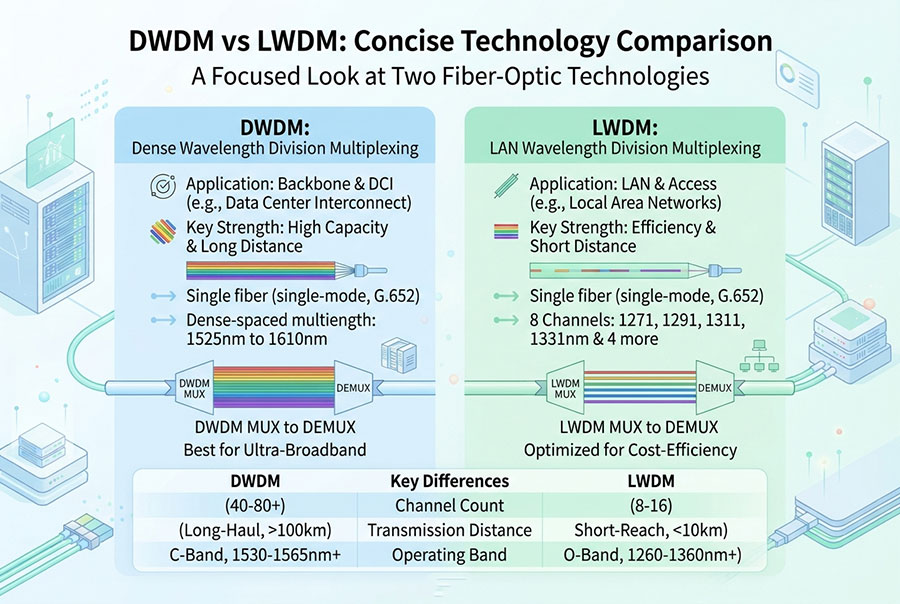
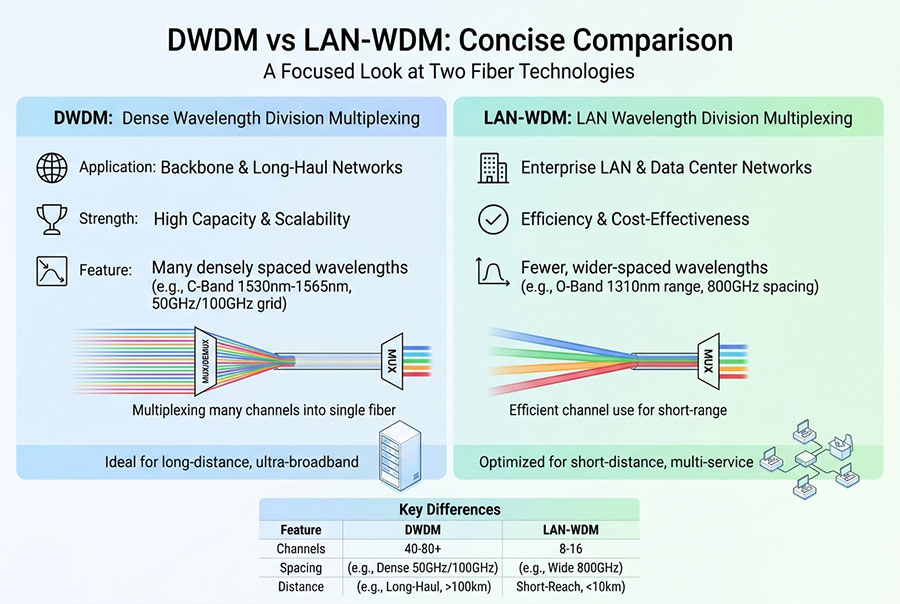
A DWDM system combines optical signals at different wavelengths onto a shared fiber path. At the receiving end, the wavelengths can be separated and directed to their destinations. Depending on the architecture, the system may also include optical amplifiers, wavelength-selective equipment, and reconfigurable optical add/drop multiplexers.
OTN organizes client data into defined digital structures. It supports signal mapping, transport overhead, performance monitoring, and multiplexing within the OTN hierarchy. OTN interfaces and framing are specified in ITU-T G.709.
| Comparison Factor | DWDM | OTN |
|---|---|---|
| Primary function | Multiplexes multiple optical wavelengths onto a shared fiber path | Frames, maps, multiplexes, and monitors digital transport traffic |
| Technology focus | Optical wavelength and fiber capacity | Digital transport and service management |
| Typical components | Optical transceivers, mux/demux units, amplifiers, and optical switching equipment | OTN transponders, muxponders, cross-connects, and OTN-capable interfaces |
| Traffic handling | Depends on the optical interfaces and line system carrying each wavelength | Maps supported client signals into standardized transport structures |
| Monitoring | Optical power, wavelength, channel performance, and line-system indicators | Digital transport overhead, signal quality indicators, and supported fault-monitoring functions |
| Capacity scaling | Add supported wavelengths or increase channel capacity | Upgrade transport interfaces or reorganize supported client traffic within the OTN hierarchy |
| Typical role | Optical fiber capacity layer | Digital transport layer |
The key distinction is that DWDM does not replace the digital transport functions of OTN, and OTN does not by itself create the additional wavelength capacity provided by a DWDM line system.
2. How DWDM Works in Optical Networks
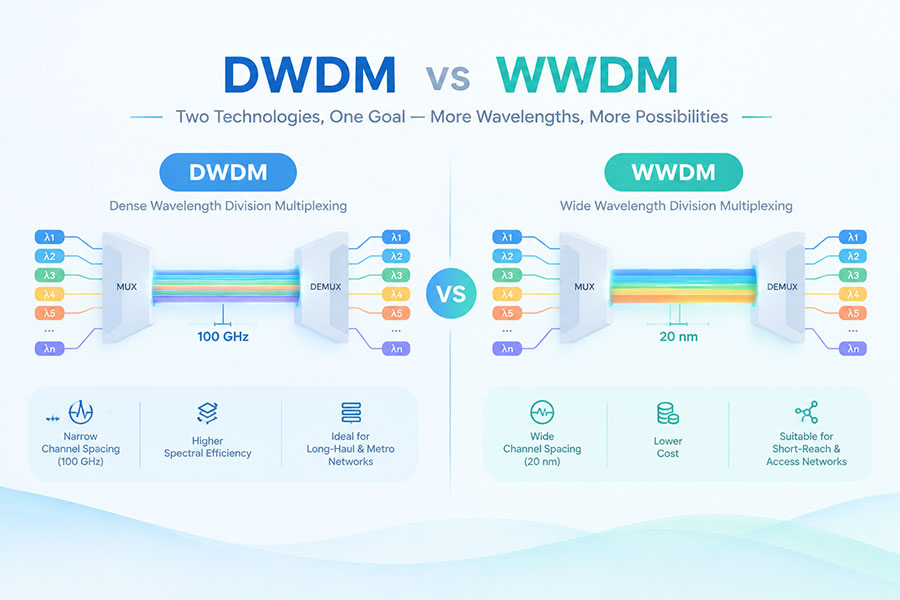
DWDM allows multiple optical channels to use the same fiber pair by assigning each channel a different wavelength within a supported optical spectrum. A multiplexer combines the channels at the transmitting end, and a demultiplexer separates them at the receiving end.
Each wavelength can carry a supported high-speed optical signal. The signals may originate from client transceivers, coherent interfaces, or transponders, depending on the network design.
Core DWDM functions
Wavelength multiplexing: Combines multiple optical channels for transmission over shared fiber.
Wavelength demultiplexing: Separates channels at the destination.
Optical amplification: Compensates for fiber and component losses when required by the link design.
Wavelength routing: Supports channel add/drop and routing functions in suitable optical line systems.
Optical performance monitoring: Helps operators track channel power and identify physical-layer issues.
The number of usable wavelengths depends on the supported spectrum, channel spacing, transceiver characteristics, line-system design, and required operating margins. More wavelengths do not automatically translate into more usable capacity if channel power, noise, or other system limitations are not addressed.
3. How OTN Works in Optical Networks
OTN provides a structured digital transport framework for carrying client signals across optical networks. Supported client traffic is mapped into an Optical Payload Unit (OPU), carried within an Optical Data Unit (ODU), and associated with an Optical Transport Unit (OTU) in common OTN transport arrangements. The exact structure depends on the interface and OTN implementation.
These structures support the transport of client signals while providing overhead for functions such as performance monitoring, fault detection, and network management. OTN also supports multiplexing and, in appropriately equipped networks, digital traffic grooming and switching.
Key OTN functions
Client-signal mapping: Adapts supported Ethernet and other client signals to OTN transport structures.
Transport framing: Places payload traffic and overhead into defined digital frames.
Multiplexing: Combines supported lower-order traffic into higher-capacity transport structures.
Performance monitoring: Provides overhead-based information for assessing digital transport performance.
Fault isolation: Helps distinguish errors or failures associated with supported transport sections and paths.
Error correction: Supports FEC mechanisms where specified by the applicable interface and implementation.
OTN is especially valuable when operators need structured transport services, managed bandwidth, digital cross-connect capabilities, and visibility into service performance across a multi-node network.
4. DWDM vs OTN: Architecture and Network Layers
A practical way to distinguish the two technologies is to examine how they fit into an end-to-end optical network.
Example transport architecture:
Ethernet switch or router → OTN client mapping and framing → optical channel interface → DWDM multiplexer → fiber transmission → DWDM demultiplexer → receiving OTN interface → destination network equipment.
This is one possible architecture, not a mandatory configuration. Integrated coherent interfaces and other optical designs can carry client traffic over DWDM without requiring a separate OTN stage in every link.
In a traditional OTN-over-DWDM deployment, OTN manages the digital transport structure, while the DWDM line system carries the optical channels across the fiber infrastructure. Each layer has its own operational responsibilities.
| Network Layer | Responsibility | Example Operational Data |
|---|---|---|
| Client service layer | Delivers Ethernet, storage, or other client services | Port status, traffic utilization, packet errors, and service availability |
| OTN digital transport layer | Frames and transports supported client signals | OTN alarms, overhead information, and supported performance counters |
| Optical channel layer | Provides optical channels over the selected line system | Channel power, wavelength, and optical signal quality indicators |
| Optical line and fiber layer | Transmits optical signals through fiber and optical components | Span loss, amplifier status, and physical-path conditions |
Layered monitoring helps operators narrow down a failure. An OTN alarm may identify a digital transport problem, while low optical power or deteriorating signal quality may indicate an issue in the optical channel or physical path. Correlating both sets of information can accelerate troubleshooting.
5. Capacity Scaling: Adding Wavelengths vs Upgrading Digital Transport
DWDM and OTN provide different ways to plan capacity growth. DWDM increases aggregate fiber capacity by using additional supported wavelengths or higher-capacity channels. OTN supports changes to client mapping, transport rate, and traffic aggregation within the capabilities of the deployed equipment.
DWDM capacity expansion
When a line system has available wavelength capacity, operators may add channels without installing a new fiber pair. Depending on the system, this may require additional transceivers, mux/demux capacity, amplifier resources, or optical planning. If the spectrum or line system is already at its limits, further upgrades may be necessary.
OTN capacity expansion
OTN capacity can be expanded by increasing supported interface rates, upgrading transport equipment, or reorganizing supported client traffic through multiplexing and switching functions. The available options depend on the OTN hierarchy, hardware, and supported interface standards.
| Expansion Requirement | DWDM Consideration | OTN Consideration |
|---|---|---|
| More aggregate fiber capacity | Add supported wavelengths or upgrade channel rates | Ensure transport interfaces have sufficient capacity for client traffic |
| Aggregate multiple client services | Provide sufficient optical channels to carry the traffic | Use supported OTN multiplexing and grooming functions |
| Increase an individual channel's rate | Verify transceiver, spectral, and line-system compatibility | Verify compatible transport frame rates and equipment |
| Scale without adding fiber | Check remaining spectrum and optical line-system capacity | Check transport switching, interface, and chassis capacity |
A network may need both types of upgrade. For example, adding higher-rate OTN interfaces increases digital transport capacity, but the DWDM line system must also support the resulting optical signal. Conversely, adding available DWDM wavelengths does not help if the client-facing or OTN equipment cannot deliver the required traffic rate.
6. OTN Switching and DWDM Wavelength Routing
OTN switching and optical wavelength routing are related but different functions. OTN switching operates on digital transport structures, whereas optical routing equipment can direct optical channels or wavelengths through a photonic network.
OTN switching
OTN-capable digital cross-connect equipment can switch or groom supported OTN traffic between interfaces. Depending on the implementation, this allows transport bandwidth to be allocated across services and network paths without requiring every client service to occupy a separately dedicated end-to-end optical wavelength.
Optical switching
Reconfigurable optical add/drop multiplexers (ROADMs) and related equipment can add, drop, or route wavelengths through a DWDM network. The traffic carried on a wavelength can remain optically transported through intermediate nodes, depending on the optical architecture and supported functions.
| Feature | OTN Switching | Optical Wavelength Routing |
|---|---|---|
| Switching domain | Digital transport signals | Optical channels or wavelengths |
| Granularity | Supported OTN transport units and traffic structures | Wavelengths or optical channels, subject to equipment capability |
| Traffic grooming | Can aggregate and switch supported digital services | Typically routes optical channels rather than grooming individual client packets |
| Primary design goal | Digital transport flexibility and service management | Optical connectivity and efficient wavelength routing |
Large transport networks may use both technologies. The optical layer provides wavelength connectivity, while the digital transport layer manages OTN services and their associated performance information.
7. DWDM vs OTN for Data Center Interconnect
Data center interconnect (DCI) links facilities that may be separated by a campus, metropolitan area, or longer-distance route. DWDM and OTN can both contribute to DCI, but their suitability depends on the traffic model and the desired network architecture.
When DWDM is useful for DCI
Multiple high-capacity optical channels must share a limited number of fiber pairs.
The operator needs to scale aggregate bandwidth through wavelengths or channel-rate upgrades.
The network already has an optical line system that supports the required transceivers and wavelengths.
Compatible coherent pluggables or transponders can deliver the required reach.
When OTN is useful for DCI
Multiple client services require structured digital transport and aggregation.
Operators need OTN-layer performance monitoring and fault-management capabilities.
Digital cross-connect functions are needed to groom or switch supported transport traffic.
The service provider requires defined transport interfaces across a managed network.
For a simple point-to-point link, compatible Ethernet or coherent interfaces may operate directly over an appropriate optical line system. An OTN layer may add useful functions, but it also requires the appropriate equipment and configuration. The deployment should be based on actual service requirements rather than assuming that every DCI link needs both systems.
8. DWDM vs OTN for Enterprise and Telecom Networks
Enterprise networks, telecom backbones, wholesale transport providers, and large cloud environments have different operating priorities. These priorities influence whether DWDM, OTN, or a combined architecture is most appropriate.
| Application | DWDM Role | OTN Role |
|---|---|---|
| Enterprise backbone | Provides additional optical capacity between major sites | Can aggregate supported services and provide transport monitoring |
| Telecom transmission network | Carries high-capacity wavelength channels across fiber routes | Provides structured transport, multiplexing, and management functions |
| Wholesale bandwidth services | Can supply optical-channel connectivity | Can supply managed digital transport services |
| Cloud and data center interconnection | Increases fiber utilization and aggregate capacity | Can support structured transport where service requirements justify it |
| Multi-node optical backbone | Supports wavelength routing and optical path planning | Supports transport switching, grooming, and digital fault monitoring |
For service providers, the choice can also depend on how services are sold and managed. A wavelength service and an OTN-based digital transport service may have different handoff, monitoring, and provisioning requirements even when they share portions of the same physical fiber network.
9. Coherent Optics, DWDM and OTN
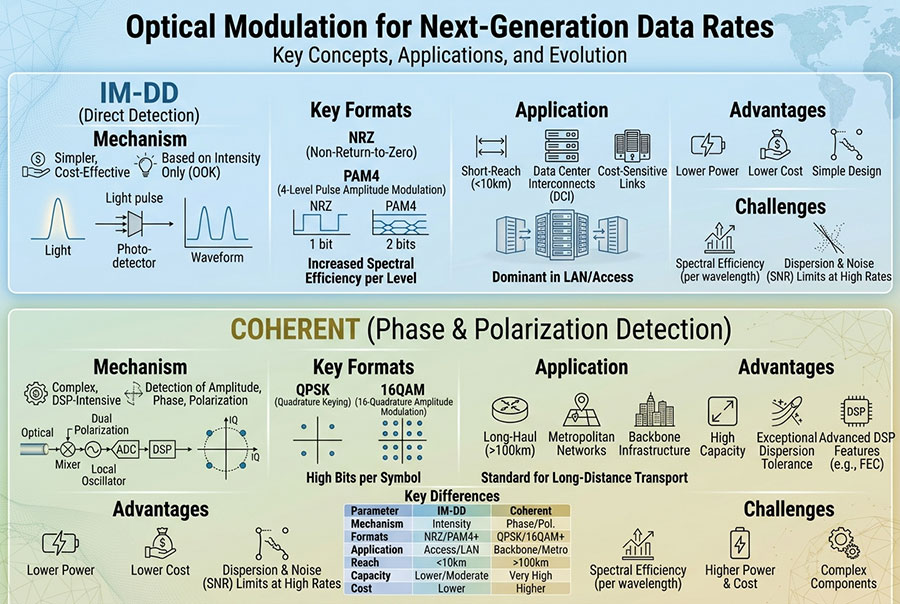
Coherent optics are an important part of many high-capacity optical transport systems. Coherent transceivers use coherent detection and digital signal processing to recover modulated optical signals. They can carry high-speed traffic over suitable optical channels and may be integrated directly into compatible routers or switches.
Coherent technology does not replace the distinction between DWDM and OTN. A coherent interface is an optical transmission technology; DWDM organizes multiple optical channels on a shared fiber system; OTN provides digital transport functions when included in the architecture.
A coherent DCI implementation may use one of the following arrangements:
Direct coherent transport: Compatible coherent pluggables connect to a supported optical line system, potentially without a separate OTN stage.
OTN over DWDM: Client signals are mapped into OTN structures and transported through a DWDM line system.
Transponder-based transport: Separate transport equipment performs client adaptation and optical transmission functions.
The appropriate choice depends on the host interface, target distance, optical signal-to-noise ratio (OSNR), wavelength plan, supported FEC, optical power range, and line-system compatibility.
10. Monitoring and Troubleshooting: Optical vs Digital Faults
One of the practical differences between DWDM and OTN is the type of information each layer can provide. DWDM-related monitoring focuses on optical channel and line conditions, while OTN overhead can provide information about the digital transport path and its performance.
| Observed Problem | DWDM and Optical Checks | OTN and Digital Transport Checks |
|---|---|---|
| Low optical power | Check transmitter power, fiber loss, connector cleanliness, and passive components | Correlate with transport alarms and downstream signal loss |
| High bit errors | Review optical signal quality, channel power, and line-system conditions | Inspect applicable FEC statistics, transport error indications, and overhead |
| Wavelength unavailable | Verify the wavelength plan, mux/demux path, and optical-channel configuration | Check whether the expected client and transport signals are present |
| Service affected but optical power appears normal | Review signal quality and channel configuration, not power alone | Check mapping, cross-connects, transport alarms, and client interfaces |
| Intermittent link degradation | Correlate power changes, amplifier alarms, and optical path events | Correlate transport errors, FEC behavior, and service alarms over time |
Normal received optical power does not prove that a link is error-free. Likewise, an OTN alarm does not automatically mean the fiber itself is faulty. Fault isolation is more effective when optical measurements, digital transport counters, and client equipment logs are correlated by time and network path.
11. Cost, Power Consumption and Operational Complexity
DWDM and OTN have different cost drivers. A DWDM implementation may require transceivers, multiplexers, amplifiers, optical switching equipment, and monitoring functions. An OTN implementation may require OTN interfaces, transponders, muxponders, digital cross-connect capacity, and transport management resources.
A combined solution may provide more comprehensive transport capabilities, but it can also introduce additional equipment and operational steps. Conversely, removing a layer to simplify the design may also remove features that the network operator requires.
Evaluate the complete system using the following criteria:
Fiber capacity: Available pairs, supported wavelength spectrum, and expected traffic growth.
Equipment cost: Transceivers, line systems, transport interfaces, and any additional chassis or modules.
Power and cooling: Combined consumption of client interfaces, optical transport equipment, and amplifiers.
Service management: Required transport monitoring, provisioning, and fault-isolation capabilities.
Upgrade flexibility: Options for adding wavelengths, increasing line rates, or changing client services.
Operational skills: Expertise needed to configure, monitor, and troubleshoot the chosen architecture.
There is no universal rule that DWDM is always less expensive than OTN, or that the combination is always preferable. The result depends on the service model, network size, required transport features, and existing infrastructure.
12. How to Choose Between DWDM and OTN
Start by defining the service that must be delivered, then determine which optical and digital transport functions are necessary. The following decision factors provide a practical framework.
| Requirement | Recommended Design Focus |
|---|---|
| More capacity over existing fiber | Evaluate DWDM spectrum, channel capacity, and optical line-system limits |
| Structured digital transport and service monitoring | Evaluate OTN mapping, overhead, supported FEC, and management capabilities |
| Aggregation of multiple client services | Assess OTN multiplexing or switching capabilities where required |
| Direct high-speed router-to-router connectivity | Check supported Ethernet or coherent interfaces and whether an additional OTN layer is necessary |
| Multi-node optical transport network | Consider DWDM wavelength routing together with OTN transport functions where appropriate |
| High availability and detailed fault isolation | Define monitoring requirements at the optical, transport, and client layers |
Before finalizing the design, confirm the required client data rates, distance, fiber type, available optical spectrum, host compatibility, transport topology, resilience requirements, and growth forecast. These factors determine whether a direct optical link, a DWDM line system, OTN transport, or a combination provides the best fit.
13. Future Development of DWDM and OTN
Optical networks are evolving toward higher channel rates, greater automation, improved fiber utilization, and more integrated optical interfaces. DWDM and OTN can both remain relevant as network capacity increases, because they solve different parts of the transport challenge.
Higher-rate optical channels: Increasing channel capacity can help meet growing data center and backbone traffic demand.
Coherent pluggables: Direct integration into supported networking platforms can simplify selected transport architectures.
Flexible wavelength routing: Optical switching can improve the flexibility of multi-node wavelength networks.
More integrated transport: Equipment designs can combine optical and digital functions while retaining the features required by the network.
Automated fault management: Correlation across optical, OTN, and client layers can improve fault localization.
Capacity-aware planning: Operators can coordinate wavelength use, transport interfaces, and service demand for more efficient upgrades.
Future network designs will continue to depend on the application. Some links will favor direct high-speed optics, while others will require managed OTN transport and a DWDM line system. The objective is to match each layer's functions to actual bandwidth, distance, monitoring, and operational requirements.
14. Frequently Asked Questions
No. They serve different functions. DWDM multiplexes optical wavelengths over shared fiber, while OTN provides structured digital transport, mapping, overhead, and monitoring capabilities. They can be deployed together.
Yes. Compatible Ethernet or coherent optical interfaces can transmit over a suitable DWDM line system without a separate OTN layer, provided the architecture meets the required interface, monitoring, and service requirements.
Yes. OTN transport can operate over a suitable point-to-point optical interface or another supported transport arrangement. DWDM is not mandatory for every OTN link.
OTN over DWDM is an architecture in which client traffic is organized into OTN digital transport structures and carried over optical channels within a DWDM system.
No. Optical monitoring focuses on channels and line-system conditions. OTN provides digital transport overhead and related performance information. The exact monitoring features depend on the equipment and configuration.
Neither is universally better. DWDM is useful for scaling aggregate capacity over fiber, while OTN is useful when structured digital transport and additional management functions are required. Some DCI designs use both; others use direct optical interfaces.
15. Conclusion
DWDM and OTN are complementary technologies that address different requirements in optical networking. DWDM expands fiber capacity by combining optical wavelengths, while OTN organizes digital client traffic into transport structures with associated monitoring and management functions.
For data center interconnects, telecom backbones, and enterprise optical networks, the choice depends on available fiber, required capacity, transport topology, service management, and equipment compatibility. A well-designed architecture uses DWDM where wavelength capacity is needed and OTN where its digital transport functions add operational value.
Planning a DWDM or high-capacity optical transport network?
Review the data rate, transmission distance, wavelength plan, optical interface, and host compatibility before selecting the required optical components.
Contact C-LIGHT >

 >
 >
 >
 >
 >
 >
 >