TEL:+86 132 6656 7067




The design of the QSFP28 100G ER4 optical transceiver fully considers the transmission requirements of metropolitan area networks (MANs). It employs 4-lane 25G NRZ Wavelength Division Multiplexing (WDM) technology, converting four 25Gbps electrical signals into four LAN WDM optical signals, which are then multiplexed into a single channel to achieve 100G optical transmission.
On the receiving end, the opposite demultiplexing process is performed. This technical approach effectively controls transceiver complexity and power consumption while ensuring transmission efficiency.
In terms of form factor, the QSFP28 transceiver size is approximately 80% smaller compared to the earlier 100G CFP package. This compact design enables a single device to support higher port density, significantly improving space utilization efficiency for MAN equipment.
Regarding key parameters, the typical power consumption of QSFP28 100G ER4 does not exceed 3.5W. Its operating wavelengths are centered on the four LAN WDM channels: 1295.56nm, 1300.05nm, 1304.58nm, and 1309.14nm. It supports a duplex LC interface, is compatible with standard single-mode fiber (G.652), and offers a maximum link budget of up to 18dB.
Performance Positioning
Within the 100G optical transceiver family, different models are optimized for various transmission distances. The ER4 transceiver's 40-kilometer transmission capability precisely meets common distance requirements within metropolitan area networks.
In contrast, the QSFP28-100G-SR4 is primarily designed for multi-mode fiber data center interconnects within a hundred meters; the LR4 transceiver has a transmission distance of 10 kilometers; and the ZR4 is designed for ultra-long-haul transmission exceeding 80 kilometers. This differentiated product positioning allows network planners to select the most cost-effective solution based on actual transmission distance requirements.
CL100GQSFPER4 |
●Compliant with QSFP28 Standard:SFF-8661 Rev 2.5, SFF-8636 Rev 2.10a ●High speed I/O electrical interface (CAUI-4) compliant with IEEE 802.3bm-2015 ●Compliant with 100GBASE-ER4 Lite standard ●Single 3.3V Supply Voltage ●Maximum power consumption 5.5 W at 70ºC Case Operating Temperature ●Single 3.3V power supply ●LAN WDM EML laser and APD Receiver ●Universal QSFP28 MSA package with duplex LC connector ●Two Wire Serial Interface with Digital Diagnostic Monitoring ●Complies with EU Directive 2011/65/EU (RoHS compliant) ●Class 1 Laser |
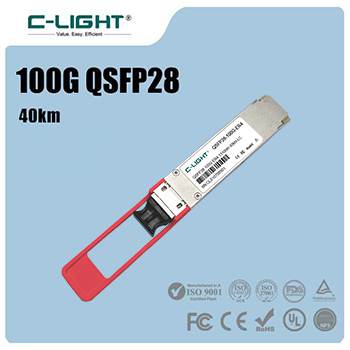
Specification | |||
| Number | CL100GQSFPER4 | Vendor | C-LIGHT |
| Form Factor | QSFP28 | Data Rate Max | 103.125Gbps (4x 25.78Gbps) |
| Wavelength | 1310nm | Distance | 40km |
| Connector | LC | Media | SMF |
| Transmitter Type | 4 x LAN WDM EML | Receiver Type | PIN |
| TX Power | -2dBm~5dBm | Receiver Sensitivity | < 21dbm |
| Power Budget | 19dBm | Receiver Overload | < -4.5dBm |
| Power Consumption | ≤5.5W | Extinction Ratio | >8dB |
| DDM/DOM | Supported | Industrial Temperature Range | 0 to 70°C |
| CDR | TX & RX Built-in CDR | FEC Function | No |
| Protocols | SFF-8661 Rev 2.5, SFF-8636 Rev 2.10a,QSFP28 MSA and IEEE 802.3bm-2015 | Warranty | 3 Years |
MAN Application Scenarios
Metropolitan area networks connect multiple data centers, enterprise campuses, and carrier network nodes within a city. The distances between these nodes typically range from a few to tens of kilometers, which is the ideal range for the QSFP28 100G ER4.
Carrier Edge Network Upgrades are a key application scenario for the ER4 transceiver. Traditional 10G networks have become insufficient in the face of surging video traffic and 5G service development.
Data Center Interconnect (DCI) is another critical application. With the growth of distributed computing and disaster recovery needs, high-speed, reliable connections are required between different data centers within the same city. The 40km transmission distance is sufficient to cover most intra-city DCI requirements.
Enterprise Private Lines and Campus Interconnects are increasingly relying on such high-performance optical transceivers. Large enterprises with offices, R&D centers, and factories distributed across different areas of a city need to build private high-speed communication networks. The ER4 transceiver provides a smooth transition capability from the enterprise core network to the carrier network.
Deployment Practices and Optimization
When deploying QSFP28 100G ER4 transceivers in practice, multiple factors must be considered comprehensively to ensure network performance and reliability. Fiber Performance Assessment is a necessary step prior to deployment. Although the ER4 transceiver supports 40km transmission, the actual distance is affected by fiber attenuation. OS2 fiber can support up to 40km, while OS1a fiber only supports 15km.
Dispersion Compensation is another technical consideration. As transmission distance increases, chromatic dispersion effects can lead to signal degradation. While the ER4 transceiver has higher dispersion tolerance compared to the LR4 transceiver, when approaching the maximum distance of 40km, it's still necessary to evaluate whether additional dispersion compensation measures are required.
Leveraging Operations and Management Features can significantly improve network reliability. The ER4 transceiver supports Digital Diagnostic Monitoring (DDM/DOM) functions, providing real-time monitoring of key parameters such as temperature, voltage, and optical power via the I2C interface. This enables network operations personnel to proactively identify potential faults and implement preventive maintenance.
Benefit Analysis and Evolution
Deploying QSFP28 100G ER4 transceivers can bring multiple benefits to MAN operators. Cost-effectiveness is the most direct consideration. By leveraging existing fiber infrastructure, operators avoid the expensive cost of laying new fiber.
Network Simplification is another significant advantage. ER4 transceivers allow operators to reduce the number of relay devices in the network, simplifying its architecture, thereby lowering operational complexity and potential points of failure.
Future Evolution Capability is also a crucial factor not to be overlooked. As MAN traffic continues to grow, networks need to evolve to higher speeds. The QSFP28 100G ER4, as a standardized product, lays the groundwork for a smooth future upgrade path to 400G and even higher speeds.
 >
>

 >
>
 >
>
 >
>
 >
>
 >
>
 >
>
 >
>