TEL:+86 132 6656 7067




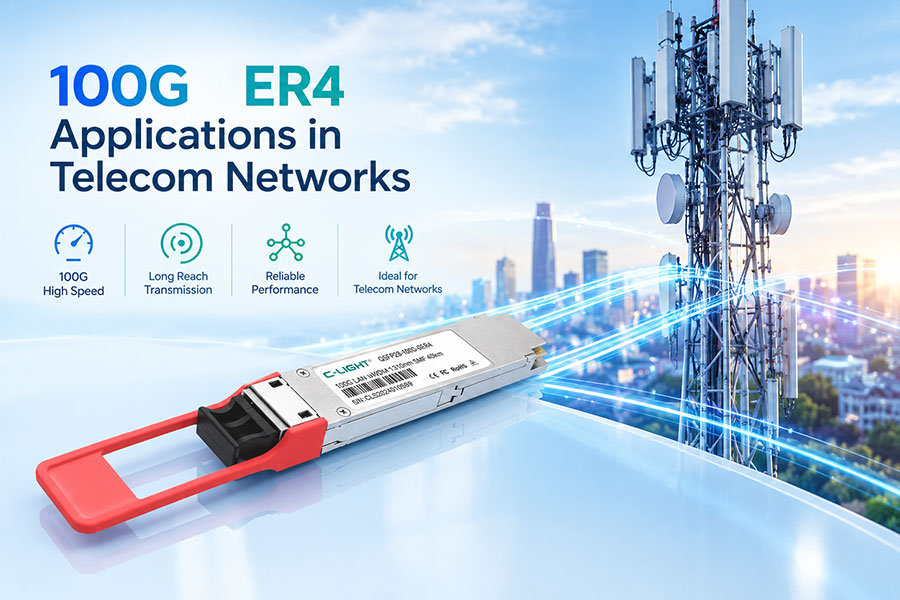
In an era where data center interconnects, metropolitan area networks, and telecom backbone networks are rapidly evolving towards 100G and beyond, long-distance, high-bandwidth, and low-power optical transmission solutions have become critical. The QSFP28 100G ER4 optical module, with its compact design and robust 40km transmission capability, has emerged as a core component enabling high-performance network expansion.
I. Achieving 40km Ultra-Long-Distance Transmission
For a 100G ER4 module to reliably transmit 40km over single-mode fiber while meeting stringent bit error rate requirements, the synergistic integration and breakthroughs of multiple advanced technologies are essential. The core challenge lies in mitigating the impact of fiber attenuation, dispersion, and nonlinear effects on high-speed signals.
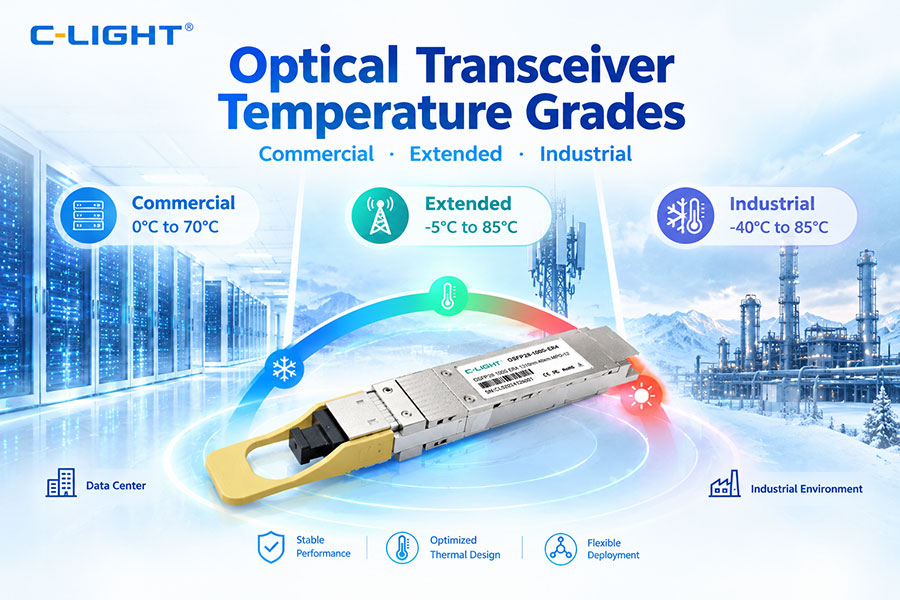
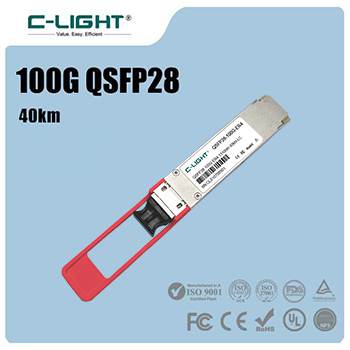
0℃~70℃ 丨 TX:-2dBm~5dBm 丨 RX < -21.4dBm 丨 < 5.5w丨Factory warranty |
CL100GQSFPER4 |
●Compliant with QSFP28 Standard:SFF-8661 Rev 2.5, SFF-8636 Rev 2.10a ●High speed I/O electrical interface (CAUI-4) compliant with IEEE 802.3bm-2015 ●Compliant with 100GBASE-ER4 Lite standard ●Single 3.3V Supply Voltage ●Maximum power consumption 5.5 W at 70ºC Case Operating Temperature ●Single 3.3V power supply ●LAN WDM EML laser and APD Receiver ●Universal QSFP28 MSA package with duplex LC connector ●Two Wire Serial Interface with Digital Diagnostic Monitoring ●Complies with EU Directive 2011/65/EU (RoHS compliant) ●Class 1 Laser |
1. High-Power, Low-Noise EML Laser Technology
ER4 modules typically employ an Electro-Absorption Modulated Laser (EML) as the core transmitter. Integrating a continuous-wave laser with an electro-absorption modulator, EMLs generate high-quality optical modulation signals with excellent extinction ratios. To achieve 40km transmission, EML lasers must output high optical power (typically above +4dBm) to compensate for losses over long fiber distances. Moreover, precise wavelength control (operating near the four CWDM wavelengths of 1271nm, 1291nm, 1311nm, and 1331nm) ensures low-loss signal propagation through the fiber.
2. High-Performance APD Receiver Technology
On the receiver side, the Avalanche Photodiode (APD) is key to achieving high-sensitivity reception. Compared to standard PIN photodiodes, APDs leverage an internal avalanche multiplication effect to significantly amplify the current from weak optical signals, greatly enhancing receiver sensitivity (as low as -16dBm or lower). This "self-gain" characteristic enables ER4 modules to effectively detect optical signals that have been greatly attenuated over 40km, forming the foundation for ultra-long-distance reception.
3. Advanced Modulation and Multiplexing Technologies: PAM4 and CWDM4
●AM4 (4-level Pulse Amplitude Modulation):At the electrical layer, 100G ER4 adopts PAM4 modulation. Compared to traditional NRZ (Non-Return-to-Zero), PAM4 carries 2 bits of information per symbol period (4 levels), thereby halving the required bandwidth. This enables achieving an aggregate 100G rate over four lanes at 25Gbaud per lane, reducing the complexity and power consumption of chip and channel design.
●CWDM4 (Coarse Wavelength Division Multiplexing): At the optical layer, ER4 follows the CWDM4 scheme. It modulates four lanes of 25Gbps PAM4 electrical signals onto four distinct CWDM wavelengths via EML lasers, then multiplexes them into a single fiber for transmission. At the receiver, a demultiplexer separates the wavelengths, and four APD receivers convert them back to electrical signals. This technique cleverly utilizes the vast bandwidth of optical fiber to achieve 100G transmission over a single fiber (effectively dual fibers).
4. Powerful Digital Signal Processing (DSP) Technology
The DSP chip serves as the "brain" of the 100G ER4 module, playing critical roles:
●Dispersion Compensation: Digitally equalizing and compensating for signal distortion caused by chromatic dispersion after long-distance transmission.
●Linearity Enhancement: Compensating for nonlinear characteristics of the transmitter EML and driver circuitry.
●Clock Recovery and Signal Retiming: Accurately extracting the clock from impaired signals and regenerating clean electrical signals.
●Forward Error Correction (FEC):Using algorithms to detect and correct bit errors in real-time during transmission, significantly improving system fault tolerance and practical transmission distance. Advanced FEC is the core assurance enabling ER4 modules to maintain extremely low bit error rates (typically better than 1E-12) even under challenging conditions.
5. Precise Thermal Management and Power Control
High-power lasers and high-speed DSP chips generate substantial heat. Within its compact QSFP28 form factor, the ER4 module integrates a precise Thermoelectric Cooler (TEC) and thermistor to provide strict temperature control and wavelength locking for the laser, ensuring stable performance across varying environmental temperatures. Concurrently, through optimized circuit design and the use of low-power chips, the module's power consumption is typically maintained between 3.5W and 4.5W, meeting the stringent demands of data centers for high density and low power consumption.
Specification | |||
| Number | CL100GQSFPER4 | Vendor | C-LIGHT |
| Form Factor | QSFP28 | Data Rate Max | 103.125Gbps (4x 25.78Gbps) |
| Wavelength | 1310nm | Distance | 40km |
| Connector | LC | Media | SMF |
| Transmitter Type | 4 x LAN WDM EML | Receiver Type | PIN |
| TX Power | -2dBm~5dBm | Receiver Sensitivity | < 21dbm |
| Power Budget | 19dBm | Receiver Overload | < -4.5dBm |
| Power Consumption | ≤5.5W | Extinction Ratio | >8dB |
| DDM/DOM | Supported | Industrial Temperature Range | 0 to 70°C |
| CDR | TX & RX Built-in CDR | FEC Function | No |
| Protocols | SFF-8661 Rev 2.5, SFF-8636 Rev 2.10a,QSFP28 MSA and IEEE 802.3bm-2015 | Warranty | 3 Years |
II. Application Scenarios
Leveraging its 40km transmission capability and the miniaturization advantages of QSFP28, the 100G ER4 optical module plays an indispensable role in the following scenarios:
1. Data Center Interconnect (DCI)
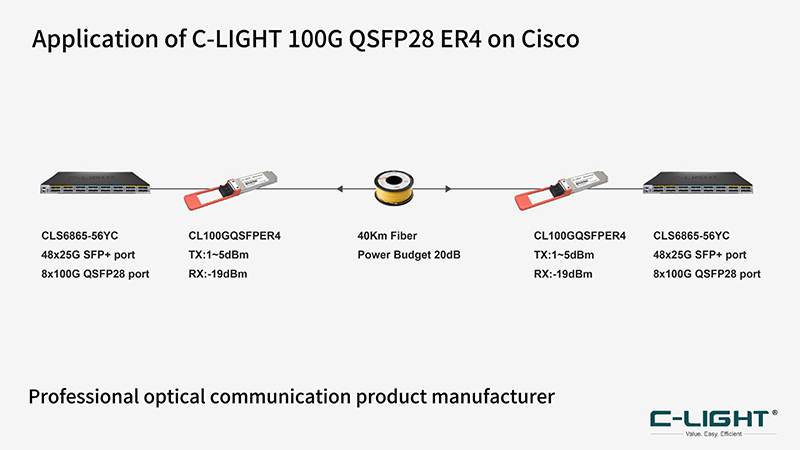
This is the primary and most typical application for ER4 modules. They are used to connect data centers located in different campuses within a city or within a 40km range, establishing high-speed, low-latency channels for data synchronization and backup. Their high port density (up to 36 ports per switch panel) and low power consumption perfectly align with the scalability and energy efficiency requirements of large cloud data centers.
2. Metro Network Aggregation and Backbone Access
In telecom operators' metropolitan area networks, ER4 modules can connect core routers to aggregation routers or link large enterprise and campus networks to the metro backbone, providing high-capacity 100G bandwidth pipelines for services such as 5G backhaul, high-definition video, and enterprise leased lines.
3. Cable Television (CATV) and Broadcast Network Upgrades
Used for long-distance distribution of ultra-high-definition (4K/8K) video content and broadcast signals, meeting the massive bandwidth demands of modern media transmission.
4. Enterprise and Campus Network Core Interconnects
For large enterprises, universities, or government agencies connecting core nodes distributed across different buildings or longer distances, ER4 provides a high-performance, highly reliable solution.
III. Conclusion
The QSFP28 100G ER4 optical module represents a culmination of optical communication technology in the 100G era. By integrating key technologies such as EML lasers, APD receivers, PAM4/CWDM4 modulation and multiplexing, advanced DSP with FEC, and precise thermal management, it successfully extends the transmission boundary of 100G high-speed signals to 40km, achieving an excellent balance among performance, density, power consumption, and cost.
With the continuous explosive growth of network traffic and the deepening deployment of technologies like 5G, AI, and cloud computing, the demand for long-distance, high-speed interconnects will only become more urgent. In the future, ER4 technology will continue to evolve alongside higher rates (e.g., 200G/400G) and more advanced coherent technologies, providing critical support for building more efficient, intelligent, and ubiquitous all-optical network foundations. When making selections, network planners must comprehensively consider factors such as transmission distance, link budget, power consumption, cost, and equipment compatibility. Undoubtedly, 100G ER4 remains one of the most competitive solutions for the critical 40km distance.
 >
>

 >
>
 >
>
 >
>
 >
>
 >
>
 >
>
 >
>