TEL:+86 132 6656 7067




Linear Pluggable Optics (LPO) and DSP-based optical modules are two different approaches to high-speed optical connectivity. Both can support high-bandwidth PAM4 links, but their signal-processing locations and system architectures are fundamentally different. A traditional DSP-based optical module performs substantial signal conditioning inside the module, while an LPO architecture removes the conventional high-speed DSP from the optical module and relies more heavily on the host ASIC, SerDes, and system-level electrical design.
This architectural difference affects power consumption, latency, electrical channel requirements, signal integrity, optical performance, interoperability, thermal design, and application range. As 800G and 1.6T connectivity expands in AI and cloud data centers, understanding the difference between LPO and DSP-based optics is increasingly important when designing high-speed network infrastructure.
1. What Is a DSP-Based Optical Module?
A DSP-based optical module contains a digital signal processor that handles high-speed signal processing between the host electrical interface and the optical engine. The DSP may perform functions such as equalization, clock and data recovery, signal conditioning, lane processing, gearbox functions, and other application-dependent processing.
A simplified signal path can be represented as:
Host ASIC → Electrical Interface → Optical DSP → Driver / TIA → Optical Engine → Fiber
On the receive side, the signal travels in the opposite direction:
Fiber → Optical Receiver → TIA → Optical DSP → Electrical Interface → Host ASIC
The exact internal architecture differs between products and generations. Not every DSP contains the same functional blocks, but the defining characteristic is that substantial digital signal processing is performed inside the optical module.
2. What Is LPO?
LPO stands for Linear Pluggable Optics. Unlike a conventional retimed optical transceiver, LPO generally removes the high-speed DSP from the module and uses linear electrical components such as high-bandwidth laser drivers and TIAs.
A simplified transmit path is:
Host ASIC / SerDes → Electrical Channel → Linear Laser Driver → Optical Engine → Fiber
The receive path is approximately:
Fiber → Photodetector → TIA → Electrical Channel → Host ASIC / SerDes
The host system therefore performs more of the signal conditioning and equalization that would otherwise be handled inside a conventional DSP-based module.
3. The Core Difference Between LPO and DSP-Based Modules
| Item | LPO | DSP-Based Optical Module |
|---|---|---|
| High-speed DSP in module | Typically absent | Present |
| Signal processing location | Primarily host ASIC / SerDes | Partly or substantially inside module |
| Optical module complexity | Lower | Higher |
| Module power | Generally lower | Generally higher |
| Module latency | Very low | Higher because of DSP processing |
| Host electrical channel requirement | More demanding | More tolerant |
| System-level co-design | Very important | Important but generally less restrictive |
| Reach flexibility | Best suited to controlled short-reach links | Broad range of short-, medium-, and long-reach applications |
| Interoperability sensitivity | Higher | Generally lower at the electrical interface |
| Thermal design | Potentially easier at the module level | More module power must be dissipated |
4. Why Was the DSP Architecture Widely Adopted?
As data rates increased from 10G and 25G to 56G, 100G and beyond per electrical lane, the electrical and optical channels became increasingly difficult to manage. High-speed signals experience insertion loss, reflections, crosstalk, frequency-dependent attenuation, and other distortions.
A DSP inside the optical module provides an additional signal-processing boundary between the host and optical link. It can compensate for electrical and optical impairments and help the system maintain acceptable signal integrity.
This became particularly valuable as PAM4 was introduced at higher Ethernet speeds because PAM4 provides two bits per symbol but has smaller eye openings than traditional NRZ signaling.
5. Why Is the Industry Exploring LPO?
The main motivation for LPO is to reduce the duplicated signal-processing functions and power consumption created when both the host ASIC and optical module contain substantial signal-conditioning circuitry.
Modern switch ASICs and AI accelerators already contain increasingly powerful SerDes engines. In a controlled short-reach optical link, moving more signal processing toward the host side can reduce the processing performed inside every optical module.
This can create a simpler optical module architecture with potentially lower power and lower latency.
6. LPO Signal Processing Moves Toward the Host
The most important concept behind LPO is not simply "removing the DSP." It is moving responsibility for high-speed signal conditioning toward the host system.
In a DSP-based architecture:
Host SerDes → Electrical Channel → Module DSP → Optical Engine
In an LPO architecture:
Host SerDes → Electrical Channel → Linear Driver → Optical Engine
The host SerDes therefore becomes much more important in determining the final end-to-end link performance.
7. Role of the Linear Laser Driver in LPO
The LPO transmitter normally uses a high-linearity laser driver rather than a conventional high-speed DSP for the module-side signal-conditioning function.
The driver receives the electrical PAM4 waveform from the host and drives the optical transmitter, such as an EML, DML, VCSEL, or silicon photonics optical engine, depending on the module architecture.
The driver must maintain sufficient linearity, bandwidth, output swing, and equalization capability to preserve the signal eye and achieve the required optical performance.
8. Role of the TIA in LPO
On the receive side, the TIA converts the photodetector current into an electrical voltage signal while providing the required gain and bandwidth.
The TIA is particularly important because the received optical signal can be weak and the receiver must preserve sufficient signal quality for the host SerDes to process.
LPO therefore still contains sophisticated analog components. Removing the DSP does not mean the module becomes a simple passive optical device.
9. Why LPO Can Reduce Power Consumption
A DSP contains high-speed digital processing circuits that consume electrical power. At 800G and 1.6T, the power required for signal processing becomes significant because multiple high-speed lanes operate simultaneously.
LPO reduces the amount of active digital processing performed inside the module. The resulting module can therefore have a lower power envelope than an otherwise comparable DSP-based optical module, although the actual system-level power savings depend on the host architecture and implementation.
Removing the DSP does not automatically make the entire system lower power. The host ASIC and SerDes may perform additional equalization or signal-conditioning work, so power must be evaluated at the system level.
10. LPO and Optical Module Latency
Digital processing introduces processing delay. The exact latency depends on DSP architecture, clocking, buffering, gearbox functions, and other implementation details.
LPO eliminates the conventional high-speed DSP processing stage from the module, which can reduce module-internal latency.
This characteristic is especially relevant to AI and high-performance computing environments where many short links operate between accelerators, switches, and servers.
11. Why Low Latency Matters in AI Networks
AI workloads often involve large numbers of processors exchanging data across high-speed fabrics. The network is therefore not simply a peripheral connection but an important part of distributed computing performance.
For tightly coupled scale-up or short-reach connections, reducing unnecessary processing stages can simplify the communication path.
LPO is consequently being evaluated for short-reach AI and high-performance computing links where power and latency are important system-level parameters.
12. The Main Challenge: Electrical Signal Integrity
The primary trade-off of LPO is that the electrical channel between the host ASIC and optical module becomes significantly more important.
A DSP-based module can compensate for some of the electrical impairments before the signal reaches the optical engine. In an LPO system, more of those impairments must be controlled through the ASIC, PCB, connector, package, module interface, and optical components as one complete channel.
As the lane rate increases, this becomes increasingly difficult.
13. PAM4 Makes the Problem More Difficult
PAM4 uses four voltage levels to transmit two bits per symbol. Compared with NRZ, each eye has a smaller vertical opening, which reduces tolerance to noise and distortion.
At 100G-class and 200G-class electrical lanes, insertion loss, crosstalk, reflections, and frequency-dependent channel response become critical design factors.
This is why LPO requires careful end-to-end signal integrity analysis instead of evaluating only the optical module itself.
14. DSP-Based Modules Provide Greater Signal Conditioning
One of the main advantages of a DSP-based module is its ability to compensate for channel impairments through digital processing.
Depending on the DSP design, this may include adaptive equalization, clock recovery, signal reshaping, lane processing, and other functions required by the application.
This additional processing allows the module to tolerate a broader range of electrical conditions than a highly optimized linear link in many applications.
15. LPO Requires System-Level Co-Design
LPO is much more dependent on the complete electrical and optical signal path.
The host ASIC, package, PCB traces, connectors, cage, module, driver, TIA, optical engine, fiber, and receiver must all work together as a controlled link.
This means LPO deployment is not simply a matter of replacing a DSP-based optical module with an LPO module. The switch or accelerator platform must also satisfy the relevant electrical requirements.
16. LPO and Host ASIC SerDes
Host SerDes performance is one of the most important factors in LPO deployment.
A modern switch ASIC or AI accelerator may already provide significant equalization and signal recovery capability. When that capability is strong enough and the electrical path is sufficiently controlled, the host can perform functions that reduce the need for a DSP inside the optical module.
The performance of the host SerDes therefore becomes part of the optical link budget at the system level.
17. LPO and DSP-Based Modules: Reach Difference
LPO is generally most suitable for relatively short and controlled optical connections, especially within data centers and AI clusters.
DSP-based modules can support a much wider variety of applications because the DSP can compensate for electrical and optical impairments. Depending on the module architecture, DSP-based products can cover short-reach datacenter connections, campus links, DCI, metro networks, and long-haul coherent transmission.
Therefore, LPO should not be considered a universal replacement for DSP-based optics.
18. LPO for 400G Optical Connectivity
400G LPO can be implemented using different optical architectures depending on the required reach and wavelength configuration.
For short-reach applications, parallel single-mode or multimode architectures may be considered. For example, WDM-based designs can use multiple wavelengths to achieve high aggregate bandwidth over duplex fiber.
The suitability of a 400G LPO implementation depends heavily on the host electrical interface, optical budget, reach, and interoperability requirements.
19. LPO for 800G Optical Connectivity
800G is one of the major application areas for LPO because the power consumed by high-speed optical DSPs becomes increasingly significant as module bandwidth increases.
An 800G LPO architecture can use eight 100G-class lanes or other optical configurations depending on the Ethernet and module implementation.
The LPO MSA released a 100 Gb/s-per-lane single-mode optical transmission specification targeting 800G-class connectivity, providing electrical, optical, and interoperability requirements for the developing ecosystem.
20. LPO for 1.6T Optical Connectivity
1.6T optical connectivity increases the challenge because many implementations use 200G-class electrical lanes.
At this level, both host SerDes performance and complete channel design become critical. LPO approaches are being developed for short-reach AI and scale-up network applications, while DSP-based 1.6T optical modules continue to be developed for applications that require stronger signal processing.
The two architectures therefore represent different engineering trade-offs rather than simply two generations of the same technology.
21. Power Comparison Between LPO and DSP-Based Modules
| Power Factor | LPO | DSP-Based Module |
|---|---|---|
| High-speed DSP power | Removed from the module in the typical architecture | Required inside the module |
| Linear driver | Required | Required |
| TIA | Required | Required |
| Host SerDes workload | Higher | Lower relative dependence |
| Module power | Generally lower | Generally higher |
| System-level power | Depends on host implementation | Depends on DSP efficiency and host architecture |
This distinction is important. A lower module power specification does not necessarily mean a proportionally lower system power consumption.
22. Thermal Design Considerations
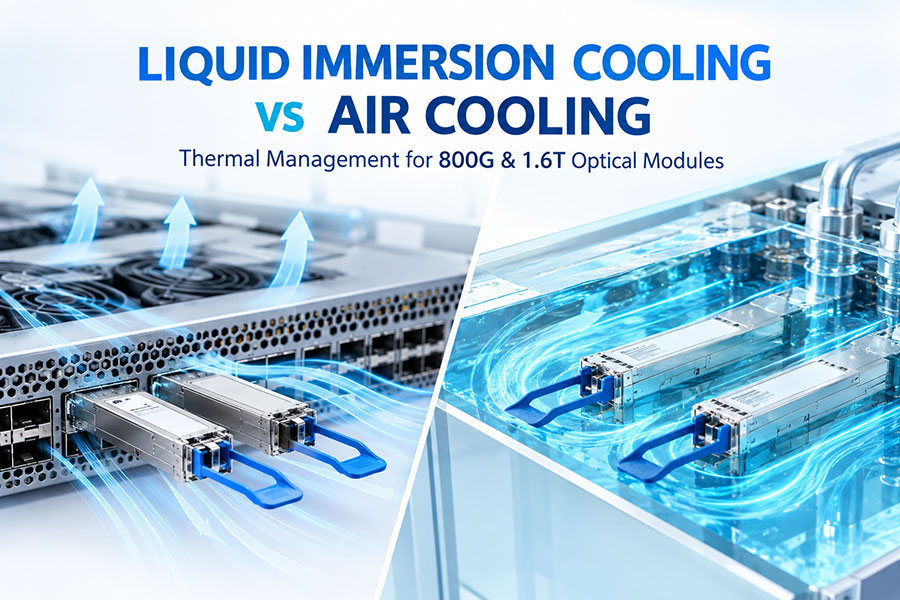
Optical modules installed in dense switches already operate in a thermally constrained environment. Higher module power creates additional heat that must be removed through the module housing, heat sink, cage, airflow, and chassis cooling system.
An LPO module with lower power consumption can reduce the thermal load at the front panel. This can be valuable when hundreds of high-speed optical modules are deployed in a system.
However, host ASICs operating at high SerDes speeds can also generate substantial heat. Therefore, LPO thermal benefits should be evaluated at the platform level.
23. Latency Comparison
| Characteristic | LPO | DSP-Based Module |
|---|---|---|
| DSP processing stage in module | Normally absent | Present |
| Module processing latency | Very low | Higher |
| End-to-end system latency | Depends on host and complete link | Depends on DSP and host architecture |
| Suitability for latency-sensitive links | Strong fit for controlled short-reach links | Broadly applicable |
24. BER and Link Reliability
Bit Error Rate (BER) is a critical parameter in high-speed optical communication.
A DSP-based module can use advanced signal processing to compensate for signal degradation and maintain the required error performance.
LPO places more responsibility on the physical channel and host SerDes. The system therefore needs sufficient margin against noise, crosstalk, reflections, jitter, loss, and optical distortion.
The required BER target and measurement method depend on the specific Ethernet standard, optical specification, host interface, and system architecture.
25. FEC and LPO
Forward Error Correction (FEC) is another area that should not be confused with the optical DSP itself.
FEC can be implemented at different layers of a network system depending on the protocol and architecture. Removing a DSP from an optical module does not automatically mean that FEC is removed from the network.
For this reason, an LPO link should be evaluated according to the complete system signal chain rather than by treating "DSP" and "FEC" as equivalent functions.
26. Interoperability Is More Important for LPO
A DSP-based module provides more signal processing inside the module, which can isolate the host electrical interface from some of the optical transmission characteristics.
LPO removes this processing boundary and consequently creates a tighter relationship between the host and module.
This makes interoperability testing particularly important. A module that works correctly with one switch or NIC may require additional validation when connected to another platform with different SerDes characteristics, PCB loss, firmware, equalization, or connector design.
27. Why LPO Requires More Than Module-Level Testing
Traditional optical qualification often focuses strongly on transmitter power, receiver sensitivity, wavelength, extinction ratio, eye diagrams, BER, temperature, and other module parameters.
LPO requires a broader testing approach because the host electrical channel directly affects the final optical performance.
Testing may therefore need to include:
Host ASIC + PCB + connector + module + optical fiber + remote module + complete system.
This system-level testing helps identify problems that may not appear during isolated module testing.
28. LPO and Optical Engines
LPO does not define one specific optical technology.
An LPO module may use silicon photonics, EML, DML, VCSEL, or another optical architecture depending on the target application.
The term LPO describes the electrical architecture and signal-processing approach rather than the specific laser or photonic integration technology.
29. LPO and Silicon Photonics
Silicon photonics can be combined with LPO to create compact and highly integrated optical modules.
A silicon photonics optical engine can integrate multiple optical functions into a compact photonic platform, while the LPO architecture removes the conventional high-speed DSP from the module.
These are therefore complementary technologies rather than competing definitions.
30. LPO and EML
EML is an electro-absorption modulated laser technology, while LPO is a module architecture.
An LPO module can use an EML transmitter when its optical performance and reach requirements are suitable. The key requirement is that the electrical driver and optical transmitter maintain sufficient linearity and bandwidth for the target signaling rate.
31. LPO vs LRO
LPO and LRO are related linear-optics architectures but are not identical.
LPO generally focuses on a linear transmit path and linear receive path connected directly to the host electrical environment. LRO, or Linear Receive Optics, focuses particularly on the receive-side architecture and can be used as an intermediate approach between fully DSP-based modules and fully linear implementations.
| Architecture | Main Concept | Typical Purpose |
|---|---|---|
| DSP-Based Optics | DSP inside module | High tolerance and broad application range |
| LPO | Linear TX/RX without conventional module DSP | Low-power, low-latency short-reach links |
| LRO | Linear receive architecture | Intermediate system architecture |
| CPO | Optics integrated close to switch ASIC | Extreme bandwidth density and electrical path reduction |
32. LPO vs HRO and Other Hybrid Architectures
As host SerDes speeds continue increasing, the industry is also evaluating architectures between conventional DSP-based modules and fully linear modules.
Hybrid or retimed approaches can retain some signal-conditioning functions while reducing the amount of processing compared with a full DSP implementation.
These approaches attempt to balance power, reach, compatibility, and signal integrity instead of optimizing only one parameter.
33. LPO vs DSP-Based Modules for AI Data Centers
| Application Factor | LPO | DSP-Based Optics |
|---|---|---|
| Short AI scale-up connections | Strong architectural fit | Can also be used |
| Very low module latency | Major characteristic | Higher due to processing |
| Lowest possible module power | Potential advantage | Higher DSP contribution |
| Variable host platforms | Requires careful validation | Generally easier to isolate electrically |
| Longer optical reach | Less suitable in many implementations | Broadly applicable |
| System co-design requirement | Very high | Moderate to high |
34. Where LPO Fits in AI Network Architecture
AI data center networks can include several layers, such as accelerator-to-accelerator connections, server-to-switch links, leaf-spine networks, backend networks, and data center interconnects.
LPO is particularly relevant when the link is short, the host SerDes is powerful, and the electrical channel can be carefully controlled.
For longer-distance networks or links with more variable electrical environments, DSP-based optical modules may remain more practical.
35. LPO and DAC
LPO is often discussed together with Direct Attach Copper (DAC) because both can target short-reach connectivity.
DAC provides a direct electrical connection and can be extremely efficient over short distances, but electrical loss increases as the data rate and cable length increase.
LPO replaces the copper transmission path with an optical path while retaining a relatively direct host-to-optics architecture.
This makes LPO an option for links that have become too long or electrically challenging for passive copper but do not necessarily require the complexity of a DSP-based optical module.
36. LPO vs AOC
An Active Optical Cable (AOC) integrates optical transceivers and fiber into one cable assembly. LPO, by contrast, normally uses pluggable optical modules and separate fiber cabling.
Both approaches can support high-speed short-reach connections, but the serviceability and deployment model are different.
LPO keeps the familiar pluggable architecture, which can be useful for systems that require replaceable optics and structured fiber connectivity.
37. LPO and Serviceability
One practical advantage of pluggable LPO is that the module remains replaceable instead of permanently integrating the optics into the system.
This preserves a major operational advantage of conventional pluggable optical networking, including easier field replacement and inventory management.
The main change is the electrical and signal-processing relationship between the module and host platform.
38. Cost Considerations
A conventional optical DSP is a relatively complex semiconductor component, so eliminating it from the module can reduce the module bill of materials and simplify the electrical architecture.
However, overall system cost is more complicated.
An LPO system may require higher-performance host SerDes, tighter PCB design, more extensive validation, controlled channel loss, and more system-level engineering.
Therefore, the correct comparison is total system cost rather than the optical module component cost alone.
39. Manufacturing Considerations
DSP-based modules typically require multiple high-speed electrical components and advanced firmware or configuration.
LPO modules can have a simpler active electrical architecture, potentially reducing integration complexity.
However, the module still requires precision optical alignment, high-speed driver and TIA design, EEPROM or management interfaces, thermal management, optical testing, and manufacturing qualification.
LPO therefore simplifies some parts of module construction without eliminating the need for advanced optical manufacturing.
40. Key Design Parameters for LPO
When evaluating an LPO implementation, the following parameters are especially important:
Electrical insertion loss: Determines how much high-frequency signal energy is lost between the ASIC and module.
Return loss: Reflections can degrade PAM4 signal integrity and reduce the available operating margin.
Crosstalk: High-density high-speed lanes can interfere with neighboring signals.
Jitter: Excessive timing variation can reduce receiver margin.
Driver linearity: The optical transmitter must reproduce the electrical PAM4 signal with sufficient fidelity.
TIA bandwidth and noise: The receiver must preserve signal integrity while detecting weak optical signals.
Optical power budget: The complete optical path must maintain sufficient receiver margin over the intended distance.
41. Why Module Specifications Alone Are Not Enough for LPO
For a DSP-based optical module, the module's electrical input specifications can hide some of the complexity between the host ASIC and optical engine because the internal DSP performs signal processing.
For LPO, that separation is reduced.
A module can have excellent optical specifications but still fail to achieve stable link performance when paired with a host that has a different electrical channel or SerDes implementation.
This is why LPO evaluation should consider the complete platform, not only the module datasheet.
42. How to Evaluate an LPO Link
A practical evaluation should begin with the host platform.
First, determine the host electrical lane rate and signaling format. Then characterize PCB insertion loss, connector loss, package loss, channel topology, SerDes equalization capability, and the expected module interface.
After that, evaluate the optical transmitter, receiver sensitivity, optical power budget, fiber type, connector configuration, temperature range, and BER performance.
The final step is system-level interoperability testing under expected operating conditions.
43. When a DSP-Based Module Is Appropriate
DSP-based optical modules remain highly relevant when the application requires greater signal-processing capability, greater reach, broader platform compatibility, or higher tolerance to channel impairments.
They are also important in optical systems where coherent processing or advanced digital compensation is required.
Longer-reach DCI, metro, and telecom applications are examples where DSP-based architectures can provide capabilities that are outside the primary target of short-reach LPO.
44. When LPO Is Appropriate
LPO is generally most relevant when the system has:
Short optical reach
High host SerDes capability
A well-controlled electrical channel
Strong requirements for low power
Strong requirements for low latency
High deployment density
A controlled hardware ecosystem
These characteristics make LPO particularly relevant to AI clusters, high-performance computing, scale-up fabrics, and other controlled high-bandwidth environments.
45. LPO Is Not Simply a Lower-Power Version of DSP Optics
It is tempting to describe LPO as a DSP-based optical module with the DSP removed. That description is incomplete.
Removing the DSP changes the distribution of signal-processing responsibility across the entire system.
The host becomes more responsible for equalization and signal recovery, while the optical module becomes more linear and transparent.
This creates a fundamentally different system design philosophy.
46. The Role of Interoperability Standards and MSAs
For LPO to scale beyond tightly controlled custom systems, interoperability is critical.
The LPO MSA was established to define electrical and optical requirements for a broader ecosystem of compatible switches, NICs, modules, and related components.
As higher lane rates are introduced, common electrical and optical specifications become increasingly important because individual vendor-specific implementations can create significant qualification challenges.
47. Future Development of LPO
LPO development is closely tied to the evolution of host SerDes technology.
As switch ASICs and AI accelerators move to higher electrical lane rates, the industry will continue evaluating whether the host can perform sufficient signal conditioning to support increasingly demanding linear optical links.
Future architectures may include combinations of LPO, LRO, partially retimed solutions, silicon photonics, advanced optical engines, and eventually larger-scale optical integration.
48. LPO vs DSP: The Engineering Trade-Off
| Factor | LPO | DSP-Based Optical Module |
|---|---|---|
| Module architecture | Linear optical architecture | Digitally processed optical architecture |
| DSP location | Primarily host side | Inside optical module |
| Module complexity | Lower | Higher |
| Module power | Generally lower | Generally higher |
| Module latency | Lower | Higher |
| Host dependency | High | Lower |
| Electrical channel tolerance | More demanding | More tolerant |
| Interoperability requirements | High | Moderate to high |
| Short-reach AI connectivity | Strong application focus | Widely deployed |
| Long-distance connectivity | Limited target area | Broad application range |
| System co-design | Critical | Important |
49. The Relationship Between LPO and the Evolution of Optical Connectivity
The development path of high-speed optical networking is not a simple transition from DSP to LPO.
Instead, the industry is developing multiple architectures for different link requirements.
DSP-based optics provide signal-processing capability and broad deployment flexibility. LPO focuses on simplifying short-reach links by moving more processing into the host. LRO and other hybrid architectures explore intermediate approaches, while CPO pushes optical integration even closer to the switching silicon.
The appropriate architecture depends on bandwidth, reach, latency, power, electrical channel quality, serviceability, cost, and system integration requirements.
50. Conclusion
LPO and DSP-based optical modules represent two different approaches to high-speed optical connectivity.
DSP-based modules place significant signal processing inside the optical module, providing greater electrical and optical signal-conditioning capability and broad application flexibility. LPO removes the conventional high-speed DSP from the module and instead relies on the host SerDes and system-level electrical design to maintain signal integrity.
The main potential benefits of LPO are lower module power, lower module latency, simpler active circuitry, and better power efficiency for high-density short-reach interconnects. The main engineering challenge is the greater dependency on host SerDes performance and the complete electrical channel.
For 400G, 800G, and emerging 1.6T AI data center networks, the choice between LPO and DSP-based optics should therefore be based on the complete system architecture rather than module power alone. The host ASIC, SerDes, electrical channel, optical engine, fiber reach, BER target, thermal conditions, interoperability requirements, and deployment model all need to be evaluated together.
 >
>

 >
>
 >
>
 >
>
 >
>
 >
>
 >
>
 >
>