TEL:+86 132 6656 7067




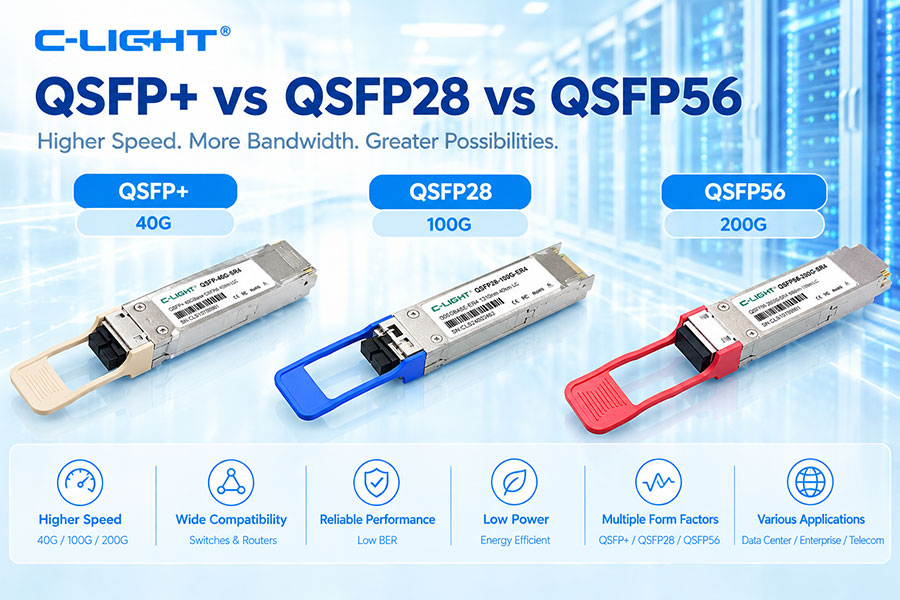
QSFP+, QSFP28, and QSFP56 are three generations of high-speed QSFP-family pluggable transceivers used in data center, Ethernet, storage, and high-performance networking. They share a similar compact mechanical concept and four-channel architecture, but differ significantly in electrical lane rate, signaling technology, aggregate bandwidth, and typical network applications.
QSFP+ is commonly associated with 40G networking using four 10G-class lanes. QSFP28 increases the per-lane rate to 25G-class to deliver 100G, while QSFP56 uses 50G-class PAM4 signaling to reach 200G through the same basic four-lane architecture. This progression illustrates how higher electrical signaling efficiency can increase network bandwidth without simply increasing the number of channels.
1. What Are QSFP+, QSFP28, and QSFP56?
QSFP+ is an enhanced version of the original QSFP form factor developed for higher-speed networking. It is commonly used for 40GbE and uses four transmit lanes and four receive lanes, with each lane operating at approximately 10G-class data rates.
QSFP28 is the next major generation in the QSFP family and was developed for 100G-class networking. It maintains four electrical and optical lanes but increases the signaling rate to approximately 25G per lane.
QSFP56 further increases the per-lane data rate to approximately 50G. Unlike QSFP+ and QSFP28, which commonly use NRZ signaling, QSFP56 uses PAM4 to transmit two bits per symbol and achieve 200G aggregate bandwidth through four lanes.
2. QSFP+ vs QSFP28 vs QSFP56: Basic Comparison
| Feature | QSFP+ | QSFP28 | QSFP56 |
|---|---|---|---|
| Typical Aggregate Speed | 40G | 100G | 200G |
| Electrical Lanes | 4 lanes | 4 lanes | 4 lanes |
| Approx. Lane Rate | 10G-class | 25G-class | 50G-class |
| Typical Signaling | NRZ | NRZ | PAM4 |
| Typical Network | 40GbE | 100GbE | 200GbE |
| Common Optical Interfaces | MPO / LC | MPO / LC | MPO / LC |
The key point is that all three form factors use four high-speed channels, while the bandwidth increases through higher signaling rates and, in the case of QSFP56, a change from NRZ to PAM4.
3. QSFP+: The 40G Generation
QSFP+ was developed to support 40G-class networking while maintaining a compact, high-density pluggable interface. A typical 40G QSFP+ interface uses four 10G-class lanes in each direction.
One common implementation is 40GBASE-SR4, which uses four parallel optical channels over multimode fiber. Other QSFP+ optical modules can use wavelength multiplexing and duplex LC connectivity for longer-reach applications.
QSFP+ modules have been widely used in data center aggregation, switch-to-switch links, server connectivity, storage networks, and high-speed Ethernet uplinks.
4. QSFP28: The 100G Generation
QSFP28 was designed for 100G-class networking and retains the four-lane architecture used by QSFP+. The major change is the increase from approximately 10G-class signaling per lane to approximately 25G-class signaling.
A conventional 100G QSFP28 SR4 module uses four 25G NRZ optical channels to provide 100G aggregate bandwidth. Other optical implementations, including CWDM4, LR4, ER4, and BiDi configurations, can use different wavelengths, connectors, and fiber arrangements.
QSFP28 has become an important interface for data center switch uplinks, server connections, spine-leaf networks, storage systems, and high-speed Ethernet.
5. QSFP56: The 200G Generation
QSFP56 extends the four-lane QSFP architecture to 200G-class networking. A typical QSFP56 implementation uses four 50G-class electrical or optical channels.
The major technical difference is the use of PAM4 signaling. PAM4 provides four amplitude levels and can transmit two bits per symbol, allowing a substantially higher bit rate at a given symbol rate compared with NRZ.
A common 200G QSFP56 implementation uses 4 × 50G PAM4 to deliver 200G aggregate bandwidth.
6. The Evolution from 40G to 200G
The development from QSFP+ to QSFP28 and then QSFP56 shows a clear increase in bandwidth density without a corresponding increase in the number of electrical lanes.
| Generation | Lane Configuration | Approx. Lane Rate | Aggregate Bandwidth |
|---|---|---|---|
| QSFP+ | 4 × 10G | 10G-class | 40G |
| QSFP28 | 4 × 25G | 25G-class | 100G |
| QSFP56 | 4 × 50G | 50G-class | 200G |
The basic four-lane structure remains recognizable across all three generations. The main evolution occurs in the electrical signaling rate and, for QSFP56, the modulation method.
7. NRZ vs PAM4
NRZ and PAM4 are two different signaling technologies used by these QSFP generations. NRZ uses two signal levels and represents one bit per symbol. PAM4 uses four signal levels and can represent two bits per symbol.
QSFP+ and QSFP28 commonly use NRZ signaling because their electrical lane rates are within the range where two-level signaling can provide the required bandwidth.
QSFP56 uses PAM4 to increase the effective data rate of each channel. This allows 50G-class transmission without requiring the host interface to double the number of lanes.
However, PAM4 also produces smaller voltage separation between its signal levels, which makes the electrical link more sensitive to noise, crosstalk, loss, and signal distortion.
8. Electrical Lane Architecture
All three module families use four high-speed transmit lanes and four high-speed receive lanes. The difference is the signaling rate handled by each lane.
For QSFP+, four 10G-class lanes provide approximately 40G aggregate bandwidth. QSFP28 increases each lane to 25G-class operation to reach 100G. QSFP56 then uses approximately 50G-class PAM4 lanes to reach 200G.
This approach demonstrates an important principle in high-speed networking: increasing bandwidth can be achieved by increasing lane speed rather than simply increasing lane count.
9. Optical Lane Configuration
The electrical lane architecture and optical lane architecture do not always have to be identical. Many parallel optical modules map each electrical lane to a corresponding optical transmit and receive channel, but wavelength-multiplexed and BiDi designs can use different optical structures.
For example, a 100G QSFP28 LR4 module uses multiple wavelengths combined onto a duplex fiber interface rather than four separate fiber pairs. By contrast, 100G QSFP28 SR4 typically uses four parallel optical channels and an MPO connector.
This means that module selection should consider both the electrical interface and the actual optical architecture.
10. QSFP+ Optical Applications
QSFP+ supports several 40G optical standards for different transmission distances and fiber systems. Short-reach solutions commonly use 850 nm multimode optics, while longer-reach solutions may use wavelength-division multiplexing over single-mode fiber.
40GBASE-SR4 is widely associated with short-reach data center links. Other QSFP+ solutions can support longer distances using single-mode fiber and duplex LC connectors.
The appropriate module should therefore be selected based on the required distance, fiber type, connector, and optical standard.
11. QSFP28 Optical Applications
QSFP28 provides a wide range of 100G optical solutions. 100GBASE-SR4 is commonly used for short-reach multimode links, while 100GBASE-LR4 provides longer transmission over single-mode fiber using multiple wavelengths.
CWDM4, PSM4, ER4, DR, and BiDi implementations are also used for different network distances and cabling architectures.
This variety makes QSFP28 suitable for both high-density data center networks and longer optical interconnects.
12. QSFP56 Optical Applications
QSFP56 is commonly used for 200G Ethernet and high-speed data center connections. A typical 200G QSFP56 optical module uses four 50G PAM4 channels.
200G QSFP56 SR4 is a common short-reach implementation using parallel multimode optics and an MPO interface. Other optical architectures can be used when different reach or cabling requirements apply.
QSFP56 is particularly relevant to environments where 100G is no longer sufficient but the network does not require the larger eight-lane architectures used by higher-speed QSFP-DD and OSFP platforms.
13. Transmission Distance
Transmission distance is determined by the specific optical standard rather than the QSFP form factor alone.
For short-distance applications, multimode modules using 850 nm VCSELs are common. For longer links, single-mode modules can use 1310 nm or other wavelengths together with different optical architectures.
In practice, link distance should be evaluated together with fiber type, connector loss, transmitter output power, receiver sensitivity, and the total optical link budget.
14. QSFP+ vs QSFP28 Compatibility
QSFP+ and QSFP28 share closely related mechanical dimensions and connector concepts, which makes them physically similar. A QSFP28 host port can often accept QSFP+ modules when the switch supports the lower-speed operating mode.
However, physical insertion does not guarantee operational compatibility. The host port must support the required data rate, electrical configuration, optical standard, firmware behavior, and module coding.
This is particularly important when upgrading existing 40G equipment with newer 100G QSFP28 infrastructure.
15. QSFP28 vs QSFP56 Compatibility
QSFP56 and QSFP28 maintain a similar four-lane mechanical concept, but the electrical signaling requirements are significantly different.
QSFP28 is based on 25G-class NRZ signaling, while QSFP56 uses 50G-class PAM4. Therefore, a host designed only for QSFP28 electrical signaling cannot automatically operate a QSFP56 module.
Full compatibility requires support for the appropriate electrical lane rate, PAM4 signaling, management interface, module power, optical application, and host platform.
16. QSFP+ and QSFP28 DAC Applications
QSFP+ and QSFP28 are widely used in direct-attach copper cable applications. QSFP+ DACs are commonly deployed for short 40G connections, while QSFP28 DACs provide short 100G connections.
DACs can reduce the complexity of short-distance links because the cable assembly directly connects the network ports without separate optical transceivers and patch fibers.
For rack-scale and adjacent-rack applications, DACs can provide a practical option when distance and physical installation conditions are suitable.
17. QSFP28 and QSFP56 AOC Applications
Active optical cables provide an alternative to copper DACs for applications requiring optical transmission within a fixed cable assembly.
QSFP28 AOCs can be used for 100G connectivity, while QSFP56 AOCs can support 200G-class connections. Because the optical engines are integrated into the cable ends, AOCs can provide a longer reach than passive copper solutions while keeping installation relatively simple.
The choice between DAC and AOC should consider transmission distance, cable management, power consumption, latency, bend requirements, and overall network design.
18. Power Consumption
Power consumption depends on the specific module architecture, optical reach, laser technology, DSP requirements, and operating conditions.
QSFP+ modules generally have relatively simple optical and electrical architectures compared with higher-speed generations. QSFP28 introduces higher electrical and optical bandwidth, while QSFP56 can require additional signal processing because of its PAM4 architecture.
For high-density switches, the cumulative power of multiple modules should be considered together with the platform's cooling capacity and airflow.
19. Signal Integrity Considerations
As the electrical lane rate increases from QSFP+ to QSFP28 and QSFP56, signal integrity becomes increasingly important.
PCB trace loss, connector characteristics, impedance discontinuities, crosstalk, return loss, via structures, and channel length can all affect high-speed electrical performance.
QSFP56 introduces an additional challenge because PAM4 has smaller signal-level separation than NRZ. The host platform and module therefore require more careful electrical design and signal conditioning.
20. Data Center Applications
QSFP+ was widely adopted for 40G data center uplinks and switch-to-switch connections. QSFP28 expanded data center bandwidth to 100G and became a common interface for leaf-spine networks, server connections, and switch uplinks.
QSFP56 provides another step in bandwidth density, enabling 200G connections through a compact four-lane form factor.
The three generations can therefore be viewed as different stages of data center network development, with each generation addressing higher bandwidth requirements while preserving the general QSFP mechanical concept.
21. Network Upgrade Path
A typical network upgrade may move from 40G QSFP+ to 100G QSFP28 and then to 200G QSFP56 as traffic requirements increase.
The upgrade is not simply a matter of replacing one module with another. Network switches, NICs, cables, fiber systems, and port configurations must be evaluated as a complete system.
For example, migrating from a 40G QSFP+ SR4 link to a 100G QSFP28 SR4 link can require changes to the host port speed and optical configuration while retaining a parallel-fiber architecture.
22. QSFP+ vs QSFP28 vs QSFP56 for Data Center Design
| Application | QSFP+ | QSFP28 | QSFP56 |
|---|---|---|---|
| Legacy / Existing 40G Network | Suitable | Not the primary choice | Not the primary choice |
| 100G Server / Switch | Not suitable | Suitable | Not the primary choice |
| 200G Server / Switch | Not suitable | Not the primary choice | Suitable |
| Short-Reach DAC | Common | Common | Available |
| Short-Reach AOC | Available | Common | Available |
| Data Center Uplink | 40G | 100G | 200G |
23. QSFP+ vs QSFP28 vs QSFP56: Key Technical Difference
The most important technical difference is the bandwidth carried by each electrical lane.
QSFP+ uses approximately 10G-class NRZ per lane to achieve 40G. QSFP28 increases this to approximately 25G-class NRZ per lane for 100G. QSFP56 uses approximately 50G-class PAM4 per lane to reach 200G.
Therefore, QSFP56 does not simply represent a faster version of QSFP28. The move to PAM4 changes the electrical signaling characteristics and introduces new requirements for signal integrity and host compatibility.
24. QSFP+ vs QSFP28 vs QSFP56 Form Factor
The three modules share the general QSFP mechanical concept, which is one reason the family has remained widely adopted across different generations of network equipment.
Although the physical dimensions are similar, the internal electronics and optical components can be significantly different. Higher-speed modules typically require more advanced electrical interfaces, optical components, and thermal design.
This means that form-factor similarity should not be confused with universal module interchangeability.
25. How to Choose the Right QSFP Module
The first step is to identify the required network speed. A 40G link generally points toward QSFP+, a 100G link toward QSFP28, and a 200G link toward QSFP56.
The required transmission distance should then be matched with the appropriate optical standard and fiber type. Multimode modules are generally used for shorter links, while single-mode solutions are selected for longer distances.
Finally, the host switch, router, NIC, or other network device should be checked for supported module types, electrical signaling, coding, power consumption, optical standards, and management functions.
26. Conclusion
QSFP+, QSFP28, and QSFP56 represent three important generations of the QSFP family. QSFP+ provides 40G-class connectivity through four 10G-class NRZ lanes, QSFP28 increases the bandwidth to 100G through four 25G-class NRZ lanes, and QSFP56 reaches 200G through four 50G-class PAM4 lanes.
The progression from QSFP+ to QSFP28 and QSFP56 demonstrates how higher lane rates and more efficient signaling can increase network bandwidth while maintaining a compact four-lane form factor.
For practical deployment, the correct choice depends on more than nominal speed. Optical standard, transmission distance, fiber type, electrical signaling, host compatibility, power consumption, cabling, and the overall network architecture should all be considered when selecting a QSFP+, QSFP28, or QSFP56 solution.
 >
>

 >
>
 >
>
 >
>
 >
>
 >
>
 >
>
 >
>