TEL:+86 132 6656 7067




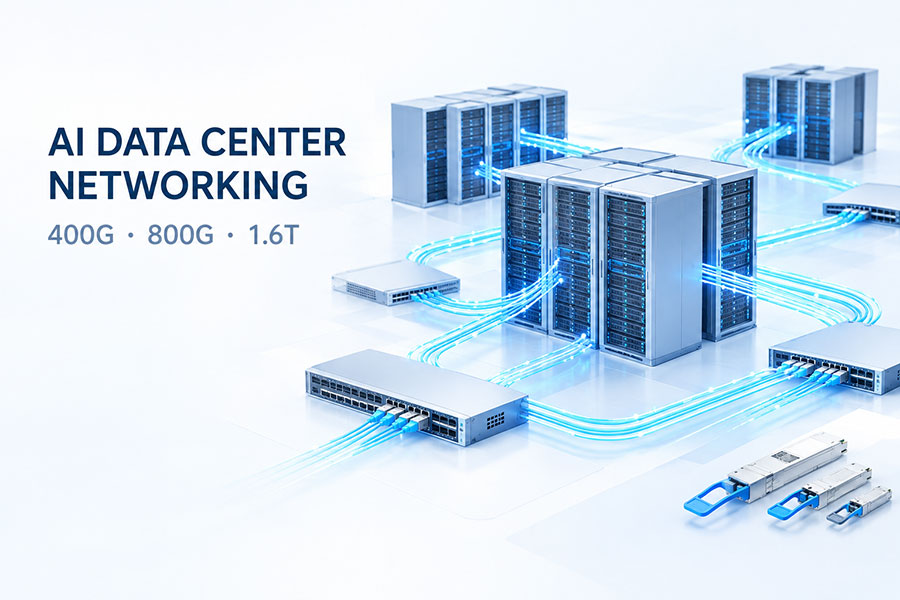
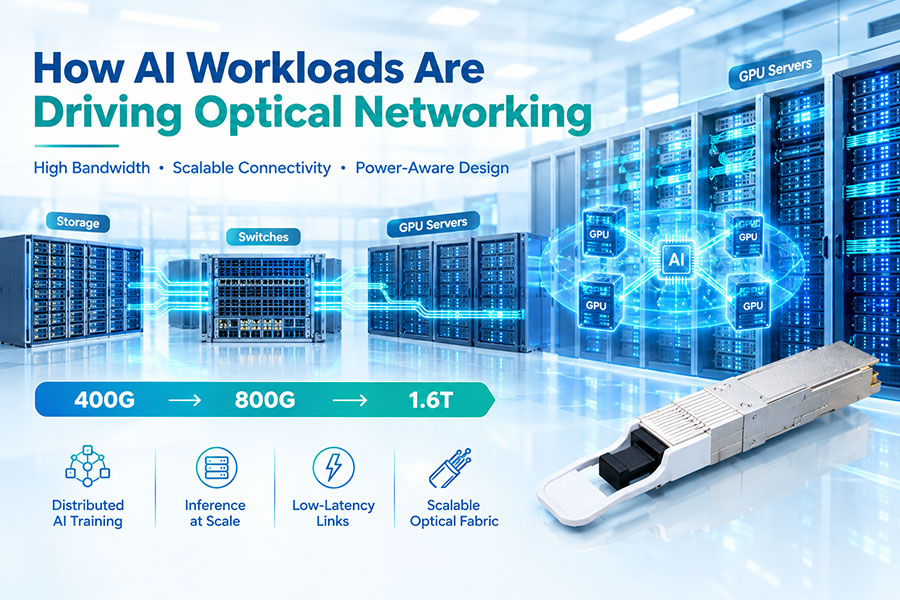
Artificial intelligence is reshaping the architecture of modern data centers. Unlike traditional cloud applications, AI workloads require continuous communication between large numbers of GPUs, accelerators, and storage systems. The performance of these systems depends not only on computing power, but also on how efficiently data can move across the network.
As AI models become larger and GPU clusters expand from hundreds to thousands of accelerators, traditional data center connectivity architectures are being pushed beyond their original design limits. Higher bandwidth, lower latency, and improved power efficiency have become essential requirements for next-generation networks.
Optical connectivity is becoming a fundamental technology for AI infrastructure. From 400G and 800G optical transceivers to future 1.6T solutions, optical technologies are enabling the high-speed communication required by AI training, inference, and high-performance computing environments.
The evolution of AI data centers is not simply creating demand for faster optical modules. It is driving a complete transformation of optical connectivity, including fiber cabling, optical engines, photonic integration, and network architecture.
1. Why AI Data Centers Require Advanced Optical Connectivity
Traditional data centers were designed around web services, enterprise applications, and distributed storage. These workloads typically generated predictable traffic patterns and moderate communication requirements.
AI workloads are fundamentally different. Large language models, deep learning systems, and generative AI applications require massive parallel processing. Thousands of GPUs must exchange information continuously during training and inference operations.
1.1 GPU Clusters Create Unprecedented Network Demand
Modern AI systems rely on GPU clusters where multiple accelerators work together as a single computing platform. The efficiency of these clusters depends heavily on communication speed between GPUs.
When network connectivity cannot keep pace with GPU performance, processors spend more time waiting for data instead of performing calculations. This reduces overall system efficiency and increases operational costs.
The growth of AI infrastructure is therefore creating demand for:
Higher bandwidth: Supporting large-scale data exchange between accelerators.
Lower latency: Reducing communication delays during distributed computing.
Higher density: Connecting more devices within limited rack space.
Lower power consumption: Improving data center energy efficiency.
1.2 Data Movement Becomes as Important as Computing Power
In previous generations of data centers, processing capability was often the primary performance limitation. AI infrastructure changes this balance because moving data efficiently becomes equally important.
A powerful GPU cluster requires an equally powerful communication system. This is why optical connectivity is moving from a supporting technology to a core component of AI computing infrastructure.
2. The Evolution of AI Data Center Network Architecture
AI data centers are evolving from traditional hierarchical networks toward specialized high-performance fabrics designed for massive parallel computing.
These architectures typically include two major communication layers: scale-up networks and scale-out networks.
2.1 Scale-Up Networks for GPU Communication
Scale-up networking connects GPUs and accelerators within a computing system. It requires extremely high bandwidth and ultra-low latency because processors exchange data frequently during AI workloads.
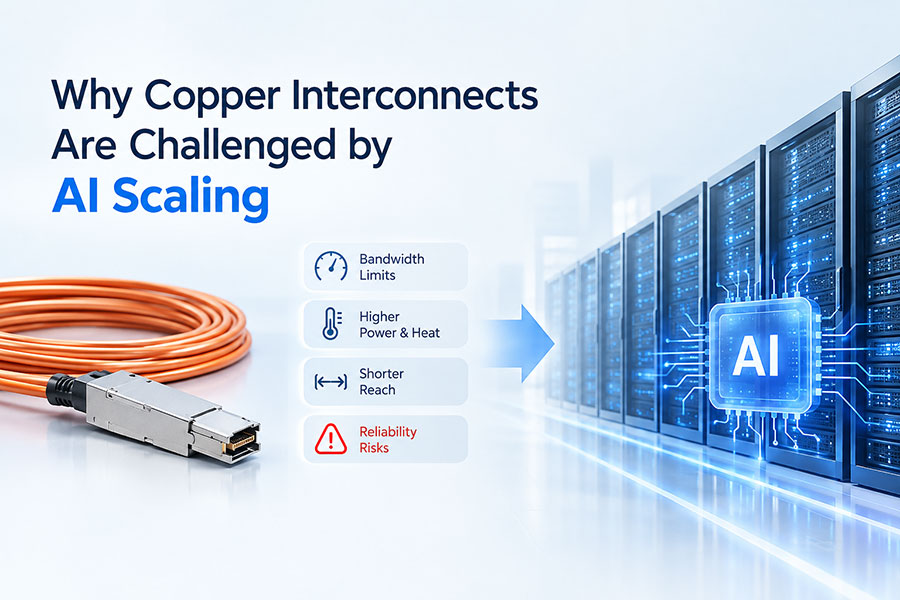
As GPU performance increases, electrical connections become increasingly difficult to scale. Optical technologies are being considered for shorter-distance, high-density connections between computing components.
2.2 Scale-Out Networks for AI Cluster Expansion
Scale-out networks connect multiple servers, racks, and data center zones. These networks require thousands of optical links to maintain communication across large AI clusters.
| Network Layer | Purpose | Connectivity Requirement |
|---|---|---|
| Scale-Up | GPU-to-GPU communication | Extreme bandwidth and ultra-low latency |
| Scale-Out | Server and rack communication | High-density optical networking |
| Data Center Interconnect | Connecting multiple facilities | Long-distance optical transmission |
3. Optical Connectivity Evolution From 400G to 1.6T
The growth of AI workloads is accelerating the optical industry roadmap. Data center networks are rapidly moving from 100G and 400G toward 800G and 1.6T optical connectivity.
Each generation improves bandwidth density while addressing the increasing requirements of AI systems.
3.1 400G Optical Connectivity as the Foundation
400G optical modules have become widely deployed in large-scale data centers. They provide the bandwidth required for modern Ethernet networks and high-performance computing environments.
Common 400G solutions include:
400G DR4 for short-reach data center connections.
400G FR4 for extended reach applications.
400G LR4 for longer-distance transmission.
3.2 800G Optical Connectivity for AI Clusters
800G optical connectivity is becoming a key technology for AI data centers because it provides the bandwidth required by next-generation GPU clusters and high-performance Ethernet networks.
Compared with 400G solutions, 800G optical modules increase bandwidth per port while reducing the number of physical connections required for large-scale deployments. This helps data centers improve rack density and simplify network architecture.
Common 800G optical solutions include:
800G OSFP: Designed for high-performance switches and AI networking platforms.
800G QSFP-DD: Supports high-density deployments while maintaining compatibility with existing infrastructure.
800G DR8: Used for short-reach parallel fiber connections inside AI data centers.
800G 2×FR4: Provides longer reach using wavelength multiplexing technology.
3.3 1.6T Optical Connectivity for Future AI Networks
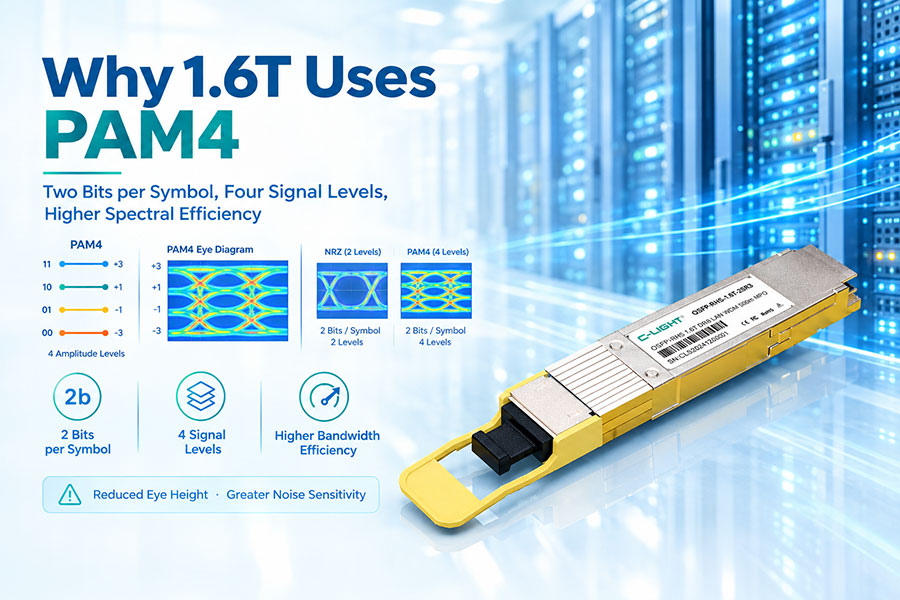
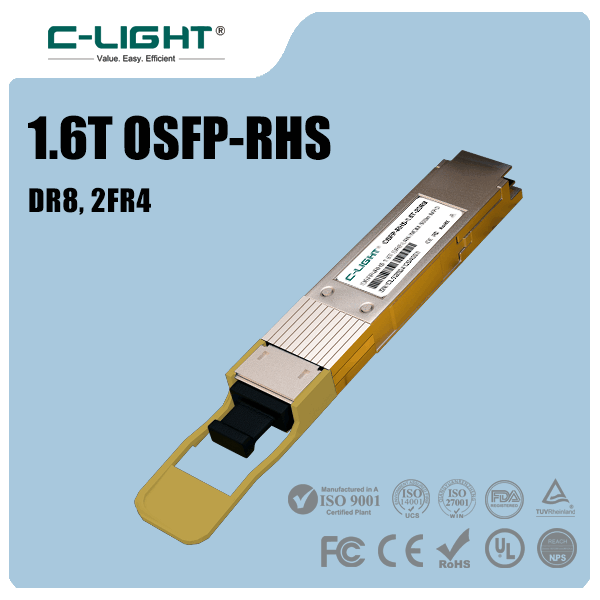
As AI clusters continue expanding, 800G connectivity will eventually face similar scaling challenges. The industry is moving toward 1.6T optical modules to support future generations of AI infrastructure.
1.6T solutions aim to provide higher bandwidth density without increasing the physical size of network equipment. This evolution is especially important for large AI factories where thousands of optical connections operate simultaneously.
| Optical Generation | Main Application | AI Infrastructure Impact |
|---|---|---|
| 400G | Large-scale cloud data centers | Established foundation for AI networking |
| 800G | AI clusters and high-performance computing | Current generation for large AI deployments |
| 1.6T | Future AI superclusters | Higher bandwidth density and lower port count |
4. The Importance of Fiber Optic Cabling in AI Data Centers
Optical modules alone cannot support AI networking growth. The fiber infrastructure connecting these devices is equally important. High-density fiber cabling systems are required to manage thousands of optical connections inside modern AI facilities.
4.1 MPO/MTP Fiber Systems Enable High-Density Connections
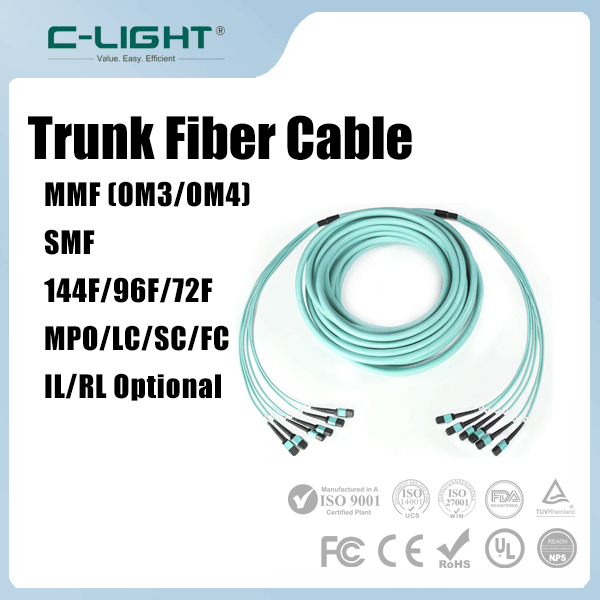
MPO/MTP fiber connectivity has become a critical component in AI data center cabling because it allows multiple fiber channels to be combined into a single connector interface.
Compared with traditional duplex patch cords, MPO/MTP solutions provide:
Higher fiber density:More channels within limited rack space.
Faster deployment:Pre-terminated assemblies reduce installation time.
Better scalability:Supports migration from 400G to 800G and future higher speeds.
Improved cable management:Simplifies large-scale AI network infrastructure.
4.2 Trunk Cable, Harness Cable, and Breakout Cable in AI Networks
Different optical cable assemblies are used depending on network architecture and connection requirements.
| Cable Type | Typical Application | Role in AI Data Centers |
|---|---|---|
| MPO Trunk Cable | High-density backbone connections | Connects switches, panels, and optical distribution areas |
| MPO Harness Cable | Connector conversion between MPO and duplex interfaces | Supports migration between different optical generations |
| MPO Breakout Cable | One multi-fiber connector to multiple duplex channels | Enables flexible GPU and switch connectivity |
5. Advanced Optical Technologies Driving AI Connectivity
Increasing bandwidth requirements are pushing optical technology beyond traditional pluggable modules. New architectures are being developed to improve power efficiency, integration, and scalability.
5.1 Linear Pluggable Optics (LPO)
LPO technology reduces optical module power consumption by simplifying digital signal processing functions. The switch ASIC directly communicates with optical components through high-speed electrical interfaces.
The main advantages of LPO include:
Lower module power consumption.
Reduced system complexity.
Improved energy efficiency for AI networking.
However, LPO requires excellent signal integrity because less compensation is available compared with traditional DSP-based optical modules.
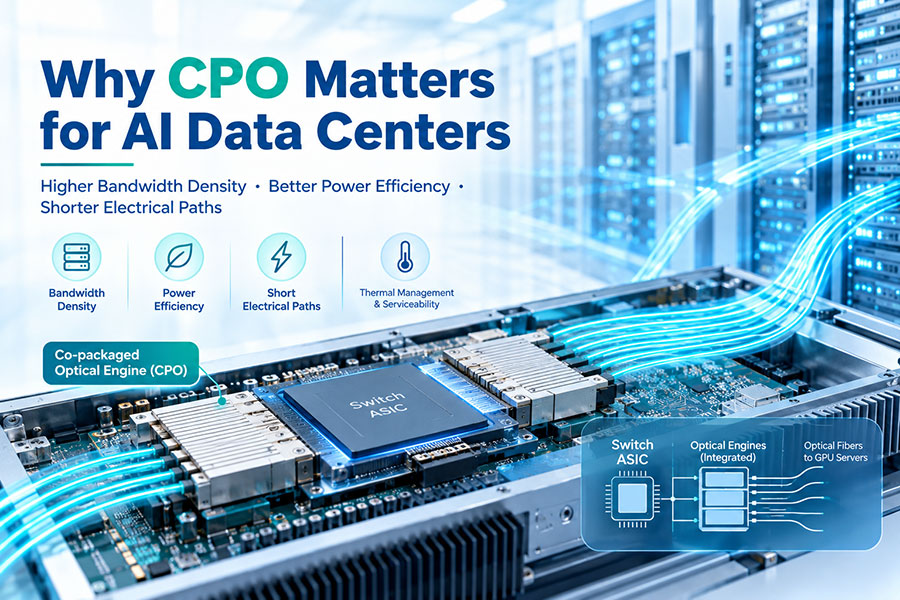
5.2 Co-Packaged Optics (CPO)
CPO integrates optical engines closer to switching ASICs, reducing electrical transmission distance between the chip and optical components.
This approach addresses one of the major challenges in future AI networking: electrical bandwidth limitations inside high-performance switches.
| Technology | Key Advantage | Main Challenge |
|---|---|---|
| Traditional Pluggable Optics | Flexible deployment and maintenance | Higher power at extreme speeds |
| LPO | Lower power consumption | Signal integrity requirements |
| CPO | Maximum bandwidth density | Complex packaging and service model |
5.3 Silicon Photonics Integration
Silicon photonics is becoming an important technology for future optical connectivity because it enables photonic components to be integrated using semiconductor manufacturing processes.
Potential benefits include:
Higher optical integration density.
Lower manufacturing cost at scale.
Improved compatibility with advanced packaging technologies.
Support for future AI computing architectures.
6. Optical Connectivity vs Traditional Data Center Connectivity
| Parameter | Traditional Connectivity | Next Generation Optical Connectivity |
|---|---|---|
| Bandwidth Scaling | Limited by electrical constraints | Supports 800G, 1.6T and beyond |
| Network Density | Lower port efficiency | High-density optical architecture |
| AI Cluster Support | Limited scalability | Designed for thousands of GPUs |
| Power Efficiency | Increasing power demand | Optimized for high-speed transmission |
| Future Evolution | Difficult scaling | LPO, CPO, silicon photonics |
7. How Optical Connectivity Enables Future AI Scaling
The future growth of AI infrastructure depends on the ability to move increasingly large amounts of data between computing resources. As GPU clusters expand, optical connectivity will become a key foundation for maintaining system performance.
Future AI data centers will require a combination of higher-speed optical modules, advanced fiber cabling, and new photonic architectures. The transition from 800G to 1.6T and beyond will not only increase bandwidth but also change how networks are designed.
Optical connectivity will support AI scaling in several important areas:
Large AI Training Clusters: High-speed optical links allow thousands of GPUs to operate as a unified computing system.
AI Inference Infrastructure:Low-latency optical networks improve response speed for large-scale AI services.
Data Center Expansion:Fiber-based architectures enable larger facilities with higher connection density.
Energy Efficiency:Optical transmission reduces power pressure compared with continuously increasing electrical bandwidth solutions.
8. C-LIGHT Optical Connectivity Solutions for AI Data Centers
The development of AI data centers is creating demand for complete optical connectivity solutions, including optical transceivers, high-speed cables, and fiber infrastructure components.
C-LIGHT provides optical connectivity products designed for next-generation data center networks, supporting bandwidth migration from 400G to 800G and future 1.6T deployments.
8.1 High-Speed Optical Transceivers
C-LIGHT offers high-speed optical transceiver solutions for AI and cloud data center applications, including 400G, 800G, and future high-bandwidth optical platforms.
400G DR4, FR4, and LR4 optical modules for data center interconnect.
800G OSFP and QSFP-DD solutions for AI networking environments.
1.6T optical transceiver solutions supporting future AI cluster expansion.
8.2 High-Density Fiber Cabling Solutions
AI data centers require reliable and scalable fiber cabling systems. C-LIGHT provides MPO/MTP trunk cables, harness cables, and breakout assemblies for high-density optical deployments.
MPO/MTP trunk cables for backbone connections.
MPO harness cables for interface conversion.
MPO breakout cables for flexible network deployment.
Custom fiber assemblies for different AI network architectures.
9. Optical Connectivity Roadmap for AI Data Centers
| Generation | Technology Focus | AI Network Requirement |
|---|---|---|
| 400G | High-speed Ethernet and cloud deployment | Foundation for large-scale AI networking |
| 800G | AI clusters and accelerated computing | Higher bandwidth with improved density |
| 1.6T | Next-generation optical transceivers | Supporting future AI superclusters |
| CPO / Silicon Photonics | Advanced optical integration | Reducing power and scaling limitations |
10. Comparison Summary
| Technology Area | Traditional Data Center | AI Data Center Optical Connectivity |
|---|---|---|
| Network Requirement | General-purpose communication | Massive parallel GPU communication |
| Optical Speed | 100G / 400G | 800G / 1.6T and beyond |
| Fiber Infrastructure | Lower-density cabling | MPO/MTP high-density systems |
| Optical Technology | Traditional pluggable modules | LPO, CPO, silicon photonics |
| Main Design Goal | Connectivity availability | Bandwidth, efficiency, and scalability |
11. Summary
AI data centers are driving a fundamental transformation in optical connectivity. The rapid growth of GPU clusters and AI workloads requires networks with higher bandwidth, lower latency, and improved power efficiency.
Optical technologies such as 800G and 1.6T transceivers, MPO/MTP high-density cabling, LPO, CPO, and silicon photonics are becoming essential components of next-generation AI infrastructure.
The future of AI computing depends not only on faster processors but also on faster and more efficient data movement. Optical connectivity will continue to evolve from a transmission technology into a critical foundation of AI data center architecture.
 >
>

 >
>
 >
>
 >
>
 >
>
 >
>
 >
>
 >
>