TEL:+86 132 6656 7067




With the rapid growth of AI large-model training, HPC (High-Performance Computing), and hyperscale data centers, 800G high-speed interconnects have become critical infrastructure for next-generation AI networks.
Today’s market is mainly divided into two major technology paths:
InfiniBand 800G
Non-InfiniBand 800G (primarily Ethernet 800G)
These two architectures differ significantly in latency, protocol design, scalability, ecosystem, and deployment cost, making them suitable for different AI data center scenarios.
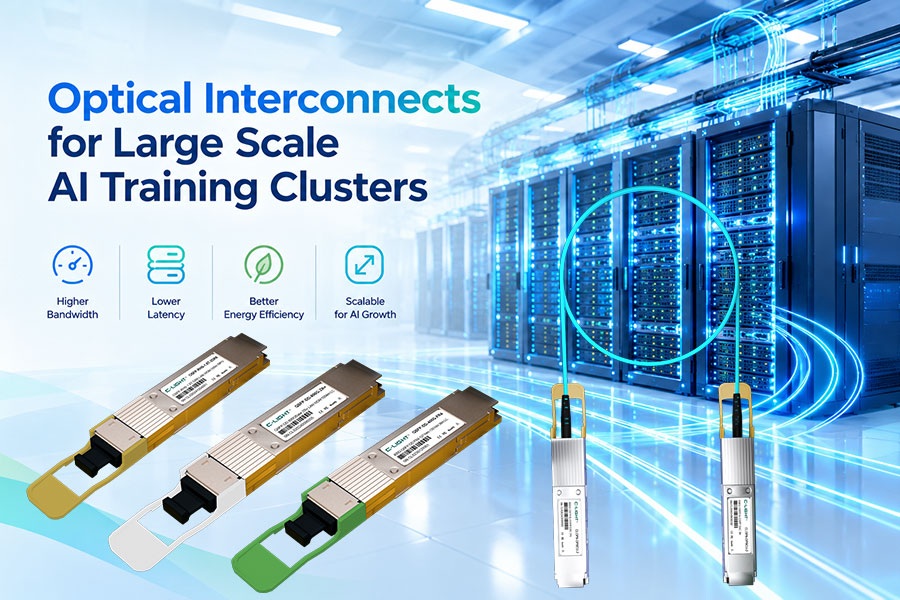
At the same time, as AI GPU clusters continue expanding, demand for high-speed optical modules, DAC, AOC, and AEC solutions is also growing rapidly. As a high-speed optical communication solution provider, C-LIGHT is actively developing complete 800G interconnect solutions for both InfiniBand and Ethernet AI infrastructures.
1. What is InfiniBand 800G?
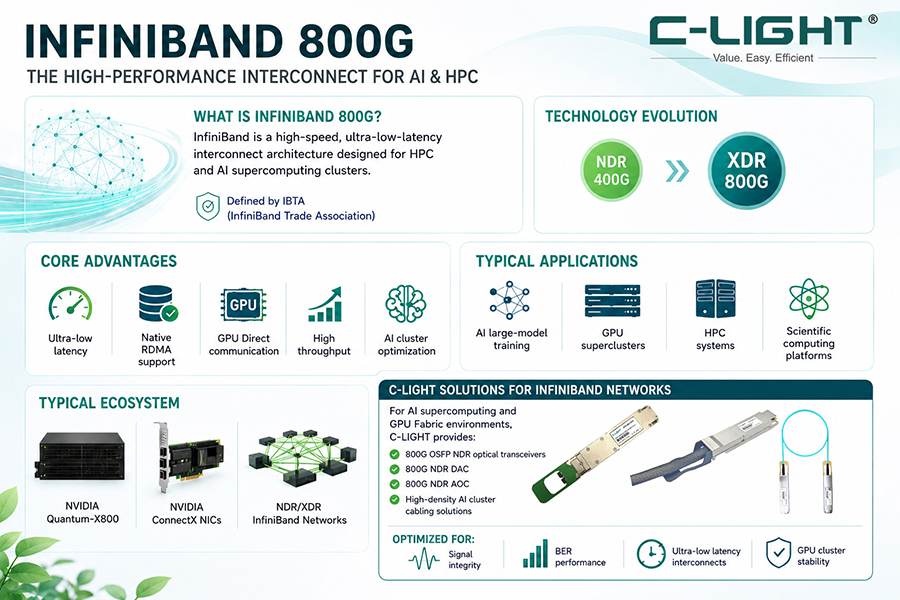
InfiniBand is a high-speed, ultra-low-latency interconnect architecture specifically designed for HPC and AI supercomputing clusters. The standard is defined by the IBTA (InfiniBand Trade Association).
Modern 800G InfiniBand networks are mainly based on:
NDR (400G)
XDR (800G)
technology evolution.
Core Advantages
Ultra-low latency
Native RDMA support
GPU Direct communication
High throughput
AI cluster optimization
Typical Applications
AI large-model training
GPU superclusters
HPC systems
Scientific computing platforms
Typical Ecosystem
NVIDIA Quantum-X800
NVIDIA ConnectX NICs
NDR/XDR InfiniBand networks
C-LIGHT Solutions for InfiniBand Networks
For AI supercomputing and GPU Fabric environments, C-LIGHT provides:
High-density AI cluster cabling solutions
These products are optimized for:
Signal integrity
BER performance
Ultra-low latency interconnects
GPU cluster stability
2. What is Non-InfiniBand 800G?
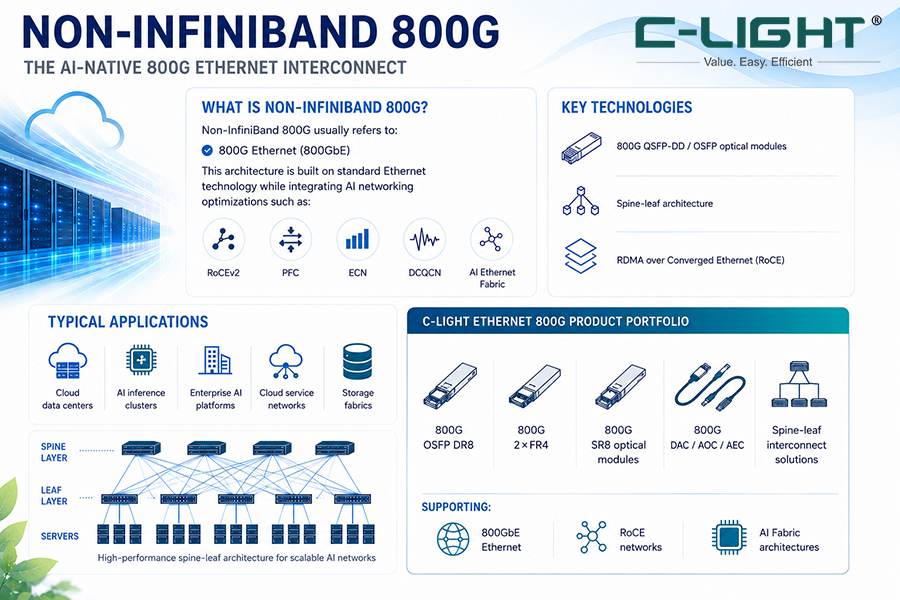
Non-InfiniBand 800G usually refers to:
800G Ethernet (800GbE)
This architecture is built on standard Ethernet technology while integrating AI networking optimizations such as:
RoCEv2
PFC
ECN
DCQCN
AI Ethernet Fabric
Key Technologies
800G QSFP-DD / OSFP optical modules
Spine-leaf architecture
RDMA over Converged Ethernet (RoCE)
Typical Applications
Cloud data centers
AI inference clusters
Enterprise AI platforms
Cloud service networks
Storage fabrics
C-LIGHT Ethernet 800G Product Portfolio
For AI Ethernet data centers, C-LIGHT provides:
800G 2×FR4
800G SR8 optical modules
800G DAC / AOC / AEC
Spine-leaf interconnect solutions
Supporting:
800GbE Ethernet
RoCE networks
AI Fabric architectures
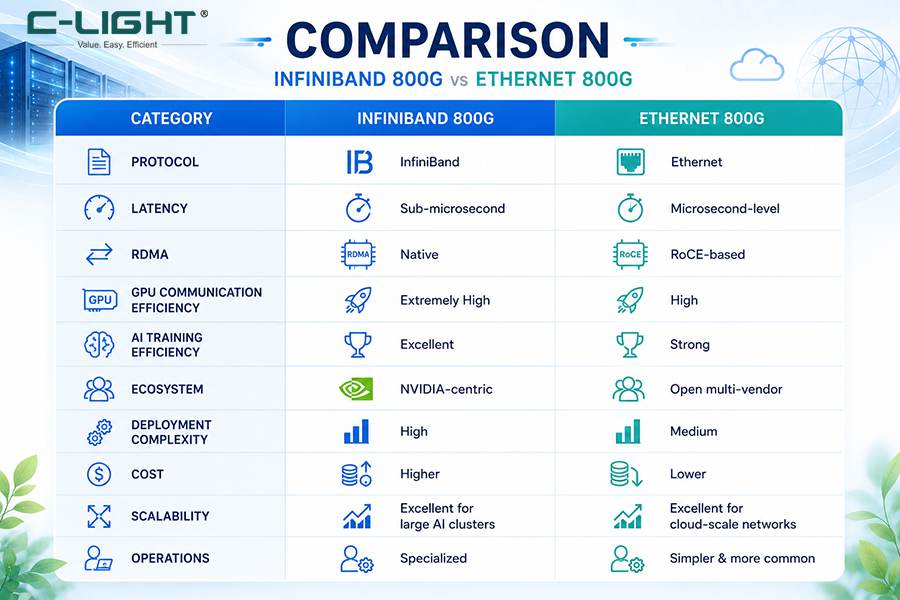
3. InfiniBand 800G vs Ethernet 800G
4. Architecture Differences
InfiniBand Architecture
InfiniBand uses a dedicated protocol stack with:
Native RDMA
Lossless fabric
GPU Direct
Efficient flow control
Advantages
Faster GPU-to-GPU communication
Better parallel training efficiency
Lower congestion latency
Higher synchronization performance
Especially suitable for:
GPT training
LLM training
Ultra-large AI models
C-LIGHT High-Speed Interconnect Support
To meet the ultra-low-latency and high-stability requirements of InfiniBand AI networks, C-LIGHT provides:
AI-optimized 800G optical modules
Low-latency DAC/AOC solutions
High-density GPU Fabric cabling
Ethernet 800G Architecture
800G Ethernet is built on the mature TCP/IP ecosystem and enhanced with RoCE technologies to support AI workloads.
Advantages
Open ecosystem
Easier deployment
Lower infrastructure cost
Strong compatibility with existing data centers
Typical AI Scenarios
AI inference
Medium-scale AI training
Cloud AI platforms
In recent years:
“AI Ethernet Fabric”
has become a major trend in hyperscale cloud networks.
C-LIGHT Ethernet AI Networking Products
C-LIGHT provides complete Ethernet AI interconnect solutions including:
800G QSFP-DD / 800G OSFP optical modules
400G & 800G DAC/AOC/AEC
High-density switch interconnect solutions
Designed for:
AI cloud infrastructure
Spine-leaf networks
Hyperscale data centers
5. Differences in AI Large-Model Training
One of the biggest challenges in AI model training is:
GPU-to-GPU Communication Efficiency
Such as:
All-Reduce
Parameter synchronization
Gradient exchange
These workloads generate massive east-west traffic inside AI clusters.
InfiniBand Advantages
In ultra-large GPU clusters:
Lower latency
Better congestion control
Higher RDMA efficiency
More mature GPU Direct support
As a result:
AI Training Performance is Typically Higher
Especially in:
Thousand-GPU clusters
Ten-thousand-GPU clusters
AI supercomputing platforms
Typical Deployments
NVIDIA DGX SuperPOD
AI supercomputers
LLM training clusters
Ethernet Advantages
As RoCE technology matures, 800G Ethernet is rapidly entering the AI networking market.
Advantages
Lower deployment cost
Open ecosystem
More switch vendor options
Easier integration
Especially suitable for:
AI inference
Enterprise AI platforms
Cloud-scale AI services
6. Optical Modules & High-Speed Cabling
Whether using InfiniBand or Ethernet, high-speed interconnect infrastructure depends on:
Optical transceivers
DAC
AOC
AEC
Common InfiniBand Solutions
Optical Modules
800G OSFP NDR
2×400G breakout modules
Cables
NDR DAC
NDR AOC
Features
Ultra-low latency
Strict signal integrity
GPU cluster optimization
C-LIGHT InfiniBand Interconnect Products
C-LIGHT provides:
800G NDR OSFP modules
High-speed DAC & AOC
AI Fabric cabling solutions
Supporting high-density AI GPU network deployments.
Common Ethernet Solutions
Optical Modules
800G OSFP DR8
800G 2×FR4
800G SR8
Cables
800G DAC
800G AOC
800G AEC
Features
Wider compatibility
Flexible cloud deployment
Spine-leaf optimization
C-LIGHT Ethernet Interconnect Portfolio
C-LIGHT Ethernet solutions support:
400G / 800G Ethernet
AI storage networks
Cloud data center fabrics
Hyperscale interconnects
7. Cost & Ecosystem Comparison
InfiniBand
Advantages
Extreme AI performance
Outstanding training efficiency
Challenges
Higher cost
Vendor concentration
More complex operations
Currently, the ecosystem is largely dominated by NVIDIA.
Ethernet
Advantages
Open ecosystem
Multi-vendor support
Lower total cost
Mature networking ecosystem
Challenges
Slightly higher latency
More complex RoCE tuning
8. Future Trends
Today’s AI data centers are evolving toward two major architectures:
Route 1: InfiniBand AI Supercomputing
Suitable for:
Ultra-large AI training
HPC
Scientific supercomputing
Characteristics:
Extreme performance
GPU optimization
Ultra-low latency
Route 2: AI Ethernet Fabric
Suitable for:
Cloud computing
AI inference
Enterprise AI platforms
Characteristics:
Open ecosystem
Flexible scalability
Lower deployment cost
More cloud providers are now promoting:
Ethernet Replacing Part of InfiniBand Deployments
9. C-LIGHT 800G High-Speed Interconnect Solutions
For AI data centers and HPC networks, C-LIGHT provides complete high-speed interconnect products including:
Product Portfolio
AI cluster interconnect solutions
Supported Architectures
InfiniBand NDR
800GbE Ethernet
RoCE networks
AI Fabric architectures
Typical Applications
AI GPU clusters
Cloud data centers
HPC networks
Spine-leaf fabrics
High-density switch interconnects
Validation & Testing
Through:
BER testing
Signal integrity validation
Compatibility testing
Thermal reliability testing
C-LIGHT solutions help ensure long-term stability for AI data centers.
10. Conclusion
In the 800G era:
InfiniBand and Ethernet are not replacing each other
Instead, they represent:
Two Different Technology Paths for Different AI Scenarios
If the priority is:
Extreme AI training performance
Ultra-low latency
Massive GPU clusters
Then:
InfiniBand is the better choice
If the focus is:
Open ecosystem
Cost efficiency
Cloud-native deployment
Flexible scalability
Then:
800G Ethernet is more suitable
In the future, AI data centers will likely adopt:
“InfiniBand + Ethernet”
Hybrid AI interconnect architectures
to jointly support the next generation of AI computing infrastructure.
 >
>

 >
>
 >
>
 >
>
 >
>
 >
>
 >
>
 >
>