TEL:+86 132 6656 7067




1. Introduction: Optical Transceiver Market Enters a New Growth Cycle
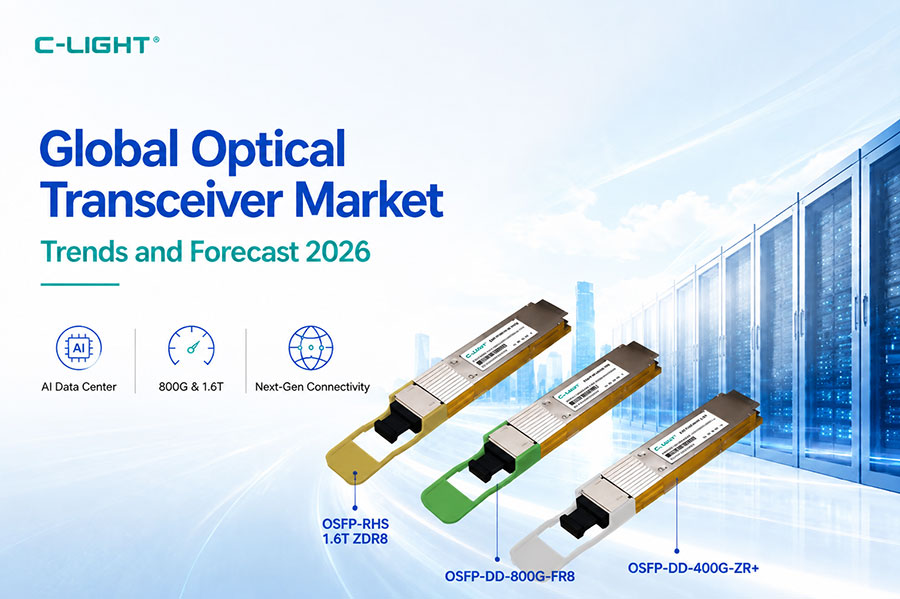
The global optical transceiver market is entering a significant transformation period in 2026, driven by the rapid expansion of artificial intelligence (AI), hyperscale data centers, cloud computing, and next-generation networking infrastructure.
For more than a decade, optical transceiver growth was mainly supported by traditional telecom networks, 5G deployment, and enterprise connectivity. However, the emergence of generative AI and large-scale AI computing clusters has fundamentally changed network architectures.
AI workloads require massive data exchange between thousands of GPUs, accelerators, and storage systems. As a result, optical connectivity has become a critical infrastructure component rather than a supporting technology.
According to industry research, AI-focused optical transceiver demand is accelerating rapidly, with high-speed modules such as 800G and 1.6T becoming the primary growth drivers in 2026.
The optical transceiver industry is moving from the traditional 100G/400G upgrade cycle into a new era dominated by:
800G optical transceivers
AI data center interconnect
Silicon photonics
LPO and CPO technologies
High-density optical networking
2. Global Optical Transceiver Market Overview 2026
2.1 Market Growth Driven by AI Infrastructure
The global optical transceiver market is expected to maintain strong growth momentum in 2026, primarily due to accelerated AI data center construction.
Traditional cloud traffic growth was mainly driven by video streaming, mobile applications, and enterprise workloads. However, AI training and inference workloads create significantly higher east-west traffic inside data centers.
AI clusters require:
Extremely high bandwidth
Ultra-low latency
High port density
Lower power consumption
Long-term scalability
This has resulted in a fundamental shift:
From:
Traditional Data Center Networking
→ 100G / 200G / 400G optical connectivity
To:
AI Data Center Networking
→ 800G / 1.6T / Future 3.2T optical interconnect
Industry forecasts indicate that optical modules operating at 800G and above are expected to become a major portion of next-generation AI infrastructure deployments by 2026.
3. AI Data Centers Become the Largest Growth Engine
3.1 Why AI Requires More Optical Transceivers
Modern AI clusters are built around large numbers of GPUs and AI accelerators.
A single AI training cluster may include:
Thousands of GPUs
Hundreds of high-speed switches
Multiple network layers
Massive interconnect requirements
The network architecture typically includes:
Scale-Up Network
Connecting processors inside servers or racks.
Scale-Out Network
Connecting multiple AI servers and GPU clusters.
Scale-Across Network
Connecting distributed AI infrastructure across locations.
Each layer creates additional demand for optical modules.
Unlike traditional applications, AI workloads generate continuous high-volume communication, making optical connectivity a fundamental bottleneck.
3.2 800G Optical Transceiver Becomes Mainstream
The year 2026 represents an important milestone for 800G optical transceivers.
Major applications include:
AI GPU clusters
Cloud data centers
High-performance computing
Ethernet AI fabrics
Data center interconnect (DCI)
800G modules typically use:
8×100G electrical lanes
PAM4 modulation
DSP-based signal processing
QSFP-DD or OSFP form factors
Common products include:
800G OSFP SR8
800G OSFP DR8
800G QSFP-DD DR8
800G optical DAC/AEC solutions
For AI networking customers, 800G provides a balance between bandwidth density, power consumption, and deployment maturity.
4. 1.6T Optical Transceiver: The Next Market Revolution
4.1 2026 Becomes the Commercialization Year of 1.6T
Following the rapid adoption of 800G, the industry is moving toward 1.6T optical connectivity.
The transition is driven by:
Increasing GPU cluster scale
Higher switch bandwidth
102.4T and future Ethernet switching platforms
AI model complexity growth
1.6T optical modules are expected to become a key technology direction from 2026 onward. Industry reports highlight that 1.6T deployments are entering an accelerated commercialization phase alongside continued 800G growth.
Typical 1.6T solutions include:
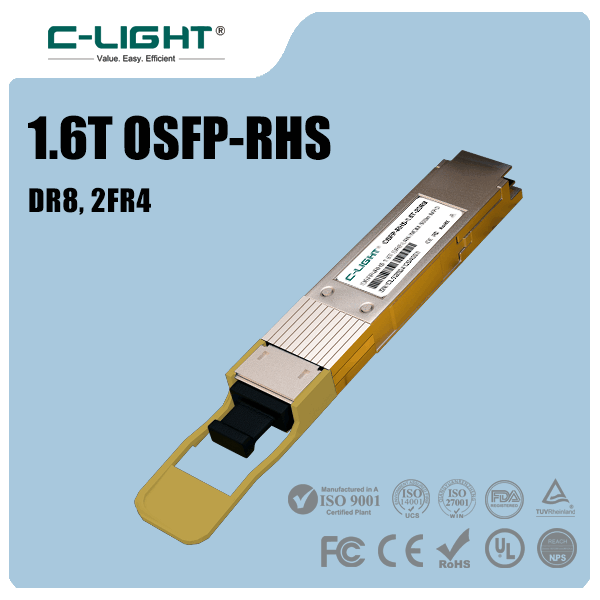
1.6T OSFP DR8
1.6T OSFP 2×FR4
1.6T optical DAC
1.6T active electrical cable (AEC)
Future roadmaps are moving toward:
400G → 800G → 1.6T → 3.2T
5. Optical Technology Evolution: From Silicon to Advanced Photonics
5.1 Silicon Photonics Accelerates
Silicon photonics is becoming one of the most important technologies in next-generation optical modules.
Compared with traditional optical designs, silicon photonics offers:
Higher integration density
Lower manufacturing cost
Better scalability
Improved power efficiency
Silicon photonics combines:
Silicon optical circuits
Laser sources
Modulators
Photodetectors
Advanced packaging
It is expected to play an important role in future 800G, 1.6T, and 3.2T optical solutions.
6. LPO and CPO: New Optical Interconnect Architectures
6.1 Linear Pluggable Optics (LPO)
LPO removes or simplifies DSP functions inside optical modules.
Advantages:
Lower power consumption
Reduced latency
Lower cost
LPO is particularly attractive for:
Short-distance AI data center links
High-density Ethernet networks
However, challenges remain:
Signal integrity
Compatibility
Host system optimization
6.2 Co-Packaged Optics (CPO)
CPO integrates optical engines closer to switching ASICs.
Benefits:
Reduced electrical loss
Higher bandwidth density
Lower energy consumption
CPO is considered a long-term solution for:
102.4T switches
AI supercomputing clusters
Future ultra-high-speed networks
However, large-scale deployment still faces challenges:
Thermal management
Maintenance complexity
Manufacturing yield
Therefore, pluggable optical modules will continue to coexist with CPO solutions for many years.
7. Optical Module Product Roadmap 2026
The optical transceiver industry is developing rapidly across different speed levels.
| Data Rate | Main Applications |
|---|---|
| 100G | Telecom, enterprise networks |
| 200G | Emerging data center applications |
| 400G | Current mainstream AI/cloud networks |
| 800G | AI clusters and hyperscale data centers |
| 1.6T | Next-generation AI infrastructure |
| 3.2T | Future AI computing networks |
For optical module manufacturers, maintaining a complete product roadmap has become a key competitive advantage.
8. Market Segments Driving Optical Transceiver Demand
8.1 Data Center Market
The data center segment is becoming the largest optical transceiver application.
Main drivers:
AI computing
Cloud services
Hyperscale expansion
GPU cluster networking
Key products:
QSFP-DD optical modules
OSFP optical modules
DAC cables
AOC cables
AEC solutions
8.2 Telecom and DCI Networks
Although AI dominates market growth, telecom remains an important segment.
Applications include:
Metro networks
Long-distance transmission
5G transport
Cloud interconnection
High-speed coherent optics are evolving toward:
400G ZR
800G coherent
1.6T coherent transmission
9. Global Optical Transceiver Supply Chain Trends
9.1 Increasing Importance of Optical Components
The rapid expansion of AI optical modules is creating higher demand for:
EML lasers
Silicon photonics chips
DSPs
Optical engines
High-performance packaging
Supply chain capacity has become a critical factor influencing market growth.
9.2 Manufacturing Competition Intensifies
The optical transceiver market is becoming increasingly competitive.
Manufacturers need capabilities in:
Optical design
High-speed signal testing
Thermal management
Automated production
Global supply support
Companies with strong engineering capabilities and flexible production capacity will gain advantages in the AI networking era.
10. C-LIGHT Optical Transceiver Solutions for AI Networking
As AI infrastructure continues upgrading toward higher bandwidth, C-LIGHT focuses on providing advanced optical connectivity solutions for next-generation networks.
C-LIGHT product portfolio includes:
High-Speed Optical Transceivers
400G QSFP-DD Optical Transceiver
400G OSFP Optical Module
800G OSFP Optical Transceiver
1.6T OSFP Optical Module
High-Speed Interconnect Solutions
800G DAC
800G AEC
1.6T DAC
1.6T AEC
Advanced Optical Applications
AI data center interconnect
Cloud computing networks
HPC clusters
Ethernet AI Fabric
C-LIGHT continues developing high-performance optical solutions to support the transition from traditional networking to AI-driven optical infrastructure.
11. Future Outlook: Optical Transceiver Market Beyond 2026
The optical transceiver industry will continue evolving rapidly.
Key trends include:
Higher Bandwidth
400G becomes mainstream while 800G and 1.6T accelerate.
More Optical Connectivity
Copper solutions face increasing limitations in AI clusters.
Advanced Photonics Integration
Silicon photonics and optical engines become increasingly important.
Lower Power Consumption
Energy efficiency becomes a core design requirement.
AI-Optimized Networking
Optical networks will become a fundamental component of AI infrastructure.
The next decade will likely witness the transformation of optical transceivers from simple communication components into strategic infrastructure technologies powering global AI computing.
12、Frequently Asked Questions (FAQ)
Q1: What is driving the global optical transceiver market growth in 2026?
Answer: The primary growth driver of the global optical transceiver market in 2026 is the rapid expansion of AI data centers. Large-scale GPU clusters require massive bandwidth, low-latency communication, and high-density optical interconnects, accelerating demand for 800G and 1.6T optical transceiver solutions.
Q2: Why are 800G optical modules important for AI data centers?
Answer: 800G optical modules provide higher bandwidth density and improved network scalability for AI clusters. They enable faster communication between GPUs, switches, and storage systems, supporting the growing data traffic requirements of hyperscale AI infrastructure.
Q3: What is the difference between 400G and 800G optical transceivers?
Answer: 400G optical transceivers are widely deployed in current data center networks, while 800G optical modules provide twice the bandwidth capacity per link. 800G solutions are designed for next-generation AI data centers, hyperscale networks, and high-performance computing environments requiring higher network density.
Q4: Will 1.6T optical transceivers replace 800G?
Answer: No. 800G optical transceivers will continue to play an important role in data center networks for years. 1.6T optical modules will gradually enter high-performance AI networking applications as bandwidth requirements continue to increase.
Q5: What technologies are shaping future optical modules?
Answer: Future optical module development is driven by several advanced technologies, including:
Silicon photonics technology
Linear Pluggable Optics (LPO)
Co-Packaged Optics (CPO)
Advanced DSP and signal processing technology
PAM4 modulation and higher-speed electrical interfaces
Q6: Why are optical modules important for AI infrastructure?
Answer: AI workloads require extremely high-speed data exchange between processors, GPUs, switches, and storage systems. Optical modules provide the bandwidth, transmission distance, low latency, and scalability required for large-scale AI clusters and advanced data center architectures.
Q7: What optical products does C-LIGHT provide?
Answer: C-LIGHT provides high-speed optical transceivers and interconnect solutions for AI data centers and advanced networking applications.
400G optical transceiver solutions
800G QSFP-DD and OSFP optical modules
1.6T next-generation optical modules
DAC, AOC, and AEC high-speed interconnect solutions
Optical connectivity solutions for AI data centers, HPC, cloud computing, and enterprise networks
Q8: What is the future speed roadmap of optical transceivers?
Answer: The optical transceiver industry roadmap is evolving from 400G to 800G, 1.6T, and eventually 3.2T optical connectivity. These higher-speed solutions are designed to support future AI computing workloads, larger GPU clusters, and next-generation data center networks.
 >
>

 >
>
 >
>
 >
>
 >
>
 >
>
 >
>
 >
>