TEL:+86 132 6656 7067




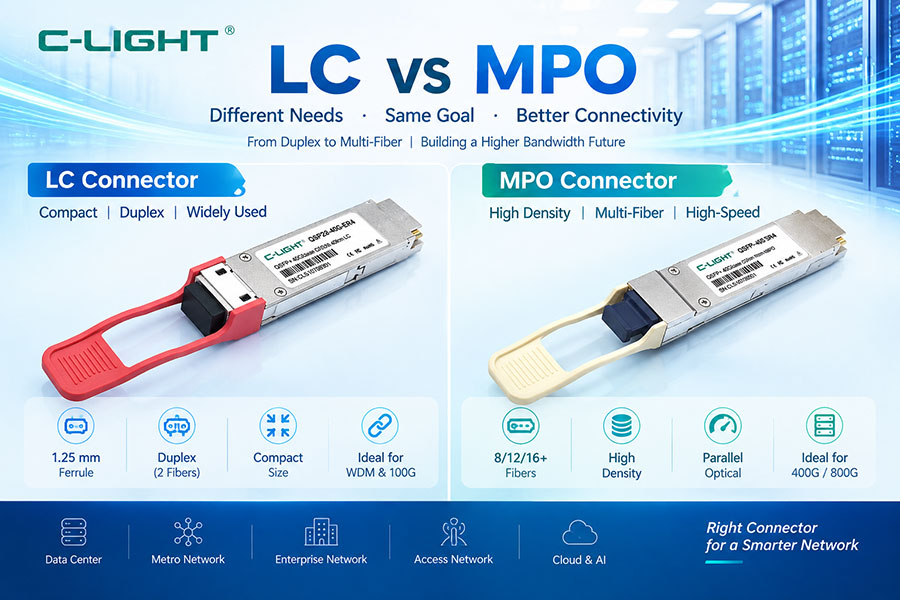
Duplex LC and MPO are two important fiber connector configurations used in modern optical networks. Duplex LC is primarily designed for a two-fiber connection, while MPO is a multi-fiber array connector that can terminate multiple fibers in a single interface.
The difference between Duplex LC and MPO is more than connector size. Their fiber counts, polarity management, cabling density, optical architectures, installation methods, testing requirements, and typical transceiver applications are different.
Duplex LC is commonly associated with two-fiber WDM optical transmission, while MPO is widely used with parallel optical architectures that require multiple fibers. However, neither connector is tied to one specific Ethernet speed, so the correct choice must be based on the complete optical design.
1. What Is Duplex LC?
Duplex LC consists of two LC connectors joined together as a pair. One fiber is normally used for transmission and the other for reception in a conventional duplex optical link.
LC uses a compact 1.25 mm ferrule and a small latch mechanism, making it suitable for high-density patch panels, transceiver interfaces, and structured fiber cabling.
2. What Is MPO?
MPO stands for Multi-Fiber Push-On. It is an array connector designed to terminate multiple optical fibers within one connector body.
Common configurations include 8, 12, and 16 fibers, with higher-count configurations also available for specialized applications.
3. Duplex LC vs MPO at a Glance
| Feature | Duplex LC | MPO |
|---|---|---|
| Connector structure | Two LC connectors paired together | Single multi-fiber array connector |
| Typical fiber count | 2 fibers | 8, 12, 16 or more |
| Typical architecture | Duplex or WDM | Parallel optics and high-density fiber connectivity |
| Fiber density | Lower per connector | Higher |
| Polarity management | Relatively simple | More complex |
| Individual fiber access | Easy | Less granular |
| Typical installation | Patch and duplex links | Trunks, cassettes and parallel links |
| Common high-speed use | WDM-based optical modules | Parallel optical modules |
4. The Fundamental Difference
The fundamental difference is how many fibers the connector interface handles at one time.
Duplex LC normally represents two fibers, while MPO groups multiple fibers into one connector. This makes Duplex LC suitable for individual duplex links and MPO suitable for high-density multi-fiber connections.
5. Fiber Count of Duplex LC
A Duplex LC connection normally contains two optical fibers.
In a conventional bidirectional link, one fiber carries the optical signal from the transmitter and the other carries the signal from the receiver.
6. Fiber Count of MPO
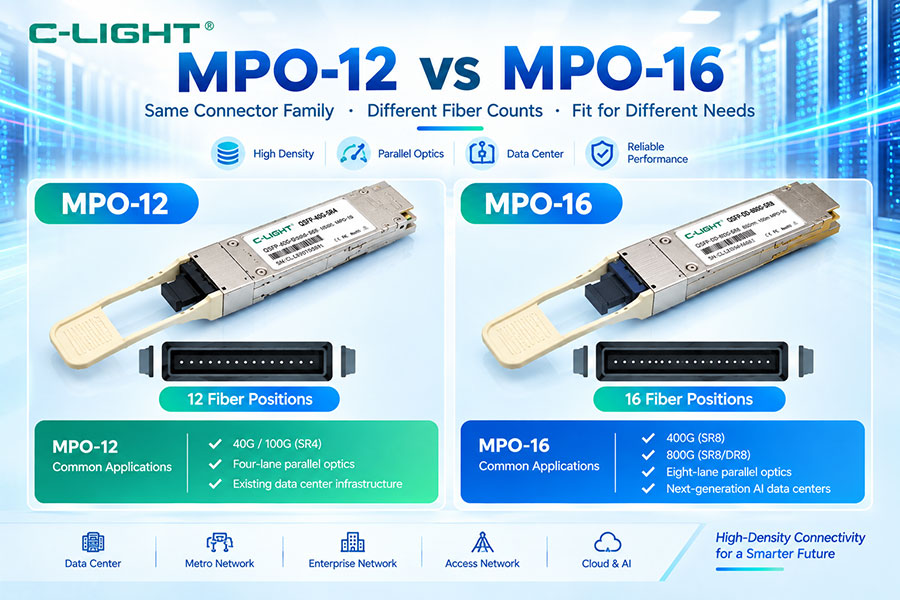
MPO connectors can contain multiple optical fibers. Common configurations include MPO-8, MPO-12, and MPO-16.
The number of active fibers depends on the optical architecture. For example, an MPO-12 connector does not necessarily mean that all twelve fibers are carrying active optical channels.
7. Fiber Count Does Not Determine Data Rate
A higher fiber count does not automatically mean a higher Ethernet speed.
Data rate depends on the optical lane rate, modulation, wavelength architecture, encoding, and transceiver design. The connector only defines the physical interface used to connect the optical paths.
8. Duplex LC and WDM
Duplex LC is particularly useful when multiple optical wavelengths are multiplexed onto a two-fiber connection.
A transceiver can combine several wavelengths internally and transmit them through one fiber pair, reducing the need for a separate physical fiber for every optical channel.
9. MPO and Parallel Optics
MPO is particularly suited to parallel optical transmission.
Multiple optical lanes can be distributed across multiple fibers, with the MPO connector providing a compact way to connect all of these fibers at once.
10. Optical Architecture Comes First
Connector selection should normally begin with the optical transceiver architecture.
If the module uses duplex WDM transmission, Duplex LC may be appropriate. If the module uses multiple parallel optical fibers, MPO or another multi-fiber interface may be required.
11. Duplex LC in 100G Networks
Duplex LC is widely used with 100G WDM optical modules.
Other 100G architectures can use multi-fiber interfaces, so the connector should always be selected according to the specific transceiver standard.
12. MPO in 100G Networks
MPO is also used for 100G parallel optical systems.
For example, a parallel 100G architecture can distribute multiple optical lanes over several multimode fibers and use a multi-fiber connector at the module interface.
13. Duplex LC in 400G Networks
Duplex LC is common in several 400G WDM architectures.
For example, 400G FR4 and LR4-type modules use multiple wavelengths over single-mode fiber and can use duplex LC interfaces.
14. MPO in 400G Networks
MPO is common in 400G parallel optical architectures.
400G DR4 uses four transmit and four receive optical lanes, creating eight active optical fibers. This is why an MPO-8 interface can be a natural fit for such a parallel architecture.
15. 400G SR8 and MPO
400G SR8 uses eight transmit and eight receive optical lanes in a typical parallel multimode architecture.
This results in sixteen active optical fibers, making an MPO-16 style interface a natural connector configuration for the optical link.
16. Duplex LC in 800G Networks
Some 800G optical architectures use WDM transmission and can therefore retain a duplex LC interface.
The use of LC at 800G demonstrates why Ethernet data rate alone cannot determine connector type.
17. MPO in 800G Networks
Parallel 800G optical architectures can use multi-fiber interfaces such as MPO-family connectors.
The exact fiber count depends on the optical lane architecture. Not every 800G optical transceiver uses MPO.
18. Parallel Optics vs WDM
| Architecture | Fiber Strategy | Typical Connector Direction |
|---|---|---|
| Parallel optics | One or more fibers per optical lane | MPO-family or other multi-fiber interface |
| WDM optics | Multiple wavelengths over fewer fibers | Duplex LC or related duplex interface |
This distinction explains why Duplex LC and MPO can both appear in the same data rate generation.
19. Connector Density
MPO provides much higher fiber density per connector than Duplex LC.
For a system containing many optical fibers, using one MPO connector can be more compact than using many individual LC pairs.
20. Rack-Level Cabling
High-density data centers often have large numbers of optical connections between switches, servers, patch panels, and distribution points.
MPO trunks can consolidate many fibers into fewer physical cable assemblies, helping reduce cable congestion.
21. Duplex LC Cable Management
Duplex LC cables are straightforward to route and identify for individual links.
However, as fiber counts increase, large numbers of separate LC duplex cables can occupy more rack space and require more individual patching operations.
22. MPO Cable Management
MPO trunk cabling can reduce the number of individual cable assemblies required for a high-fiber-count connection.
This can simplify backbone cabling, although breakout points, polarity, fiber mapping, and cassette configurations require careful planning.
23. Polarity in Duplex LC Systems
Duplex LC polarity is relatively straightforward because each duplex pair has a defined transmit and receive relationship.
Swapping the two fibers in a duplex pair can often correct a simple polarity reversal, provided the rest of the optical system is correctly mapped.
24. Polarity in MPO Systems
MPO polarity is more complex because many fibers share one connector.
The system must maintain the correct relationship between fiber positions at both ends. Connector key orientation, pin configuration, fiber numbering, trunk design, cassette mapping, and breakout configuration can all affect the final polarity.
25. Why MPO Requires More Planning
With MPO, an incorrect fiber mapping can affect specific optical lanes instead of simply reversing one duplex pair.
For this reason, MPO systems should be designed as complete connectivity channels rather than treated as independent connectors.
26. Connector Gender and Keying
MPO systems can involve connector gender, guide pins, key orientation, and other mechanical configuration requirements.
These details must match the corresponding trunk, cassette, adapter, and transceiver components.
Duplex LC systems generally have fewer such multi-fiber configuration issues.
27. Testing Duplex LC
Duplex LC links are relatively simple to test because each connection contains a small number of fibers.
Typical measurements include insertion loss, return loss where applicable, continuity, polarity, and optical power.
28. Testing MPO
MPO testing can involve multiple fibers and therefore requires more systematic testing of continuity, polarity, insertion loss, and fiber mapping.
Specialized multi-fiber test equipment and suitable reference procedures may be used for high-density MPO links.
29. Cleaning Duplex LC
LC connectors still require inspection and cleaning because contamination can increase insertion loss or reflection.
The individual fiber structure makes it relatively convenient to inspect and clean one connection at a time.
30. Cleaning MPO
MPO connectors contain multiple optical end faces within a compact array.
Contamination on one or more fiber positions can affect specific optical channels, making inspection and cleaning particularly important before mating.
31. Single-Mode Duplex LC
Duplex LC is widely used with single-mode fiber and is particularly common in WDM-based optical transceivers.
This architecture is frequently used for 100G, 400G, 800G, and other high-speed optical links where multiple wavelengths share a fiber pair.
32. Multimode Duplex LC
Duplex LC can also be used with multimode fiber.
It remains practical for two-fiber multimode links where a parallel multi-fiber interface is not required.
33. Single-Mode MPO
MPO is not limited to multimode fiber.
Single-mode MPO assemblies are widely used with parallel single-mode optical architectures, including high-speed DR-type applications.
34. Multimode MPO
MPO is also widely used with multimode fiber.
High-speed SR-type parallel optical systems can use multiple multimode fibers through a single MPO interface.
35. LC Does Not Mean Single-Mode
LC is a connector type, not a fiber type.
Both single-mode and multimode fibers can use LC connectors, so the fiber specification must always be checked separately.
36. MPO Does Not Mean Multimode
MPO is a multi-fiber connector family rather than a multimode-only interface.
It can be used with single-mode or multimode fiber depending on the optical architecture.
37. Duplex LC vs MPO for Data Center Backbones
Duplex LC is practical for individual optical links and WDM-based connections.
MPO can be advantageous for backbone and trunk cabling where many optical fibers need to be transported between racks or distribution areas.
38. Duplex LC vs MPO for High-Density AI Networks
AI data centers can contain large numbers of high-speed optical links.
MPO can provide efficient multi-fiber connectivity for parallel optical architectures, while Duplex LC remains important for WDM-based single-mode links that can carry multiple optical channels over a two-fiber connection.
39. Breakout Connectivity
MPO is frequently used in breakout architectures.
An MPO trunk can be divided into multiple LC duplex connections through a breakout harness or cassette, allowing a high-density backbone to connect to equipment with individual LC interfaces.
40. Duplex LC Breakout
Duplex LC itself is normally the individual connection at the end of a breakout assembly rather than the multi-fiber trunk interface.
This creates a common migration structure in which the MPO side provides high-density consolidation and the LC side provides individual equipment connections.
41. MPO-8 vs Duplex LC
An MPO-8 connector contains eight fiber positions, equivalent to four duplex fiber pairs in a simple pair-based interpretation.
For a parallel optical architecture using four transmit and four receive fibers, MPO-8 can consolidate those eight fibers into one connector instead of using four separate duplex LC connections.
42. MPO-12 vs Duplex LC
MPO-12 provides twelve fiber positions.
It can be used for parallel optical systems, structured cabling, and breakout configurations. In some applications, not all twelve fibers are active, so the actual optical architecture must be checked before assuming twelve active channels.
43. MPO-16 vs Duplex LC
MPO-16 provides sixteen fiber positions and is useful for architectures requiring a larger number of parallel optical fibers.
A typical eight-transmit plus eight-receive architecture uses sixteen active fibers, which is a natural match for an MPO-16 interface.
44. Duplex LC vs MPO Installation
| Installation Factor | Duplex LC | MPO |
|---|---|---|
| Connector handling | Simple | Requires array alignment |
| Fiber mapping | Simple | More detailed |
| Polarity | Relatively simple | Requires careful planning |
| High-density trunking | Less efficient | Highly efficient |
| Individual channel access | Easy | Less convenient |
| Breakout use | Usually individual endpoint | Common trunk interface |
45. Duplex LC vs MPO Cost
Connector cost alone does not determine the total cabling cost.
MPO assemblies can reduce the number of physical connectors and cable assemblies required for high-fiber-count systems. Duplex LC can be more economical and straightforward for smaller numbers of individual links.
46. Duplex LC vs MPO and Maintenance
Duplex LC provides convenient access to individual fiber pairs.
MPO simplifies high-density consolidation but may require more structured procedures for polarity verification, fiber mapping, inspection, and troubleshooting.
47. Duplex LC vs MPO Selection Guide
| Requirement | Duplex LC | MPO |
|---|---|---|
| Two-fiber optical link | Highly suitable | Possible but unnecessary in many cases |
| WDM transmission | Highly suitable | Possible in specific architectures |
| Parallel optics | Possible | Highly suitable |
| High-fiber-count trunk | Less efficient | Highly suitable |
| Individual fiber maintenance | Easy | More complex |
| Breakout cabling | Common endpoint | Common trunk interface |
| 400G FR4 | Common | Not typical |
| 400G DR4 | Not typical | Common |
| 400G SR8 | Not typical | Common |
48. Duplex LC vs MPO: Core Comparison
| Category | Duplex LC | MPO |
|---|---|---|
| Typical fiber count | 2 | 8, 12, 16 or more |
| Connector concept | Two individual LC connectors | Single multi-fiber array |
| Typical optical architecture | Duplex and WDM | Parallel optics and high-density trunking |
| Density | Lower | Higher |
| Polarity complexity | Lower | Higher |
| Testing complexity | Lower | Higher |
| Individual fiber access | Easy | More difficult |
| Breakout architecture | Individual endpoint | Common trunk interface |
| Typical high-speed use | WDM optical modules | Parallel optical modules |
49. Common Selection Mistakes
One common mistake is selecting LC or MPO according to Ethernet speed alone.
Another is assuming that MPO always means multimode or that LC always means single-mode. Both assumptions are incorrect.
It is also important not to select an MPO assembly without checking fiber count, polarity, key orientation, gender, connector type, and the optical transceiver specification.
50. How to Choose Duplex LC or MPO
Start with the optical transceiver. Determine whether it uses duplex WDM transmission or multiple parallel optical lanes.
Then match the connector to the required fiber count, fiber type, polarity, optical loss, transmission distance, cabling density, and maintenance model.
51. Conclusion
Duplex LC and MPO are designed around different connectivity requirements. Duplex LC provides simple two-fiber connectivity and is widely used with WDM optical modules where multiple wavelengths can share a fiber pair. MPO provides high-density multi-fiber connectivity and is particularly well suited to parallel optical architectures.
Neither connector is inherently tied to a specific fiber type or Ethernet speed. Duplex LC can be used with both single-mode and multimode fiber, while MPO can also support both. The actual selection should be based on the optical transceiver architecture, number of optical lanes, wavelength plan, transmission distance, polarity, and cabling topology.
For modern 400G and 800G networks, both connector types remain important. LC is common in duplex WDM architectures, while MPO-family connectors are widely used for parallel optical links and high-density fiber trunking.
 >
>

 >
>
 >
>
 >
>
 >
>
 >
>
 >
>
 >
>