TEL:+86 132 6656 7067




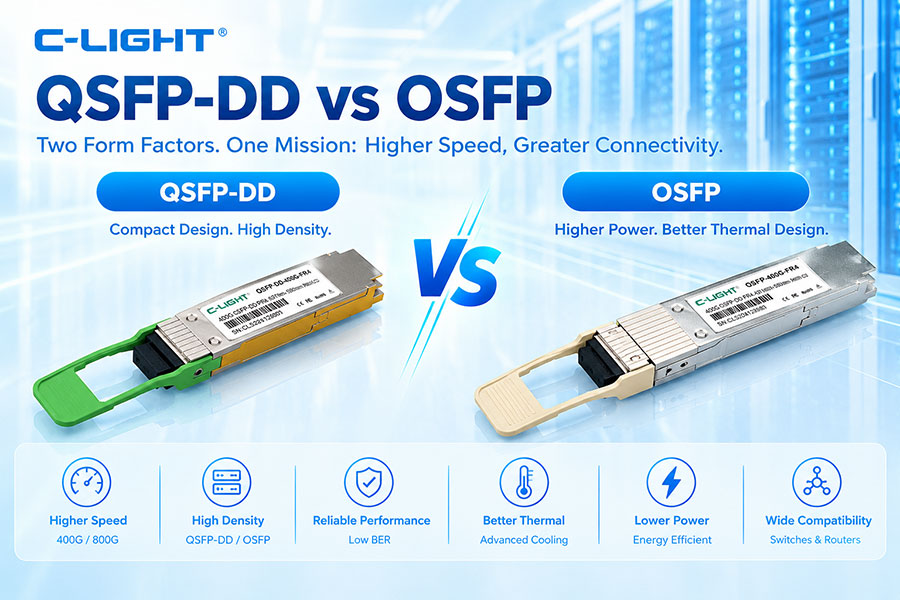
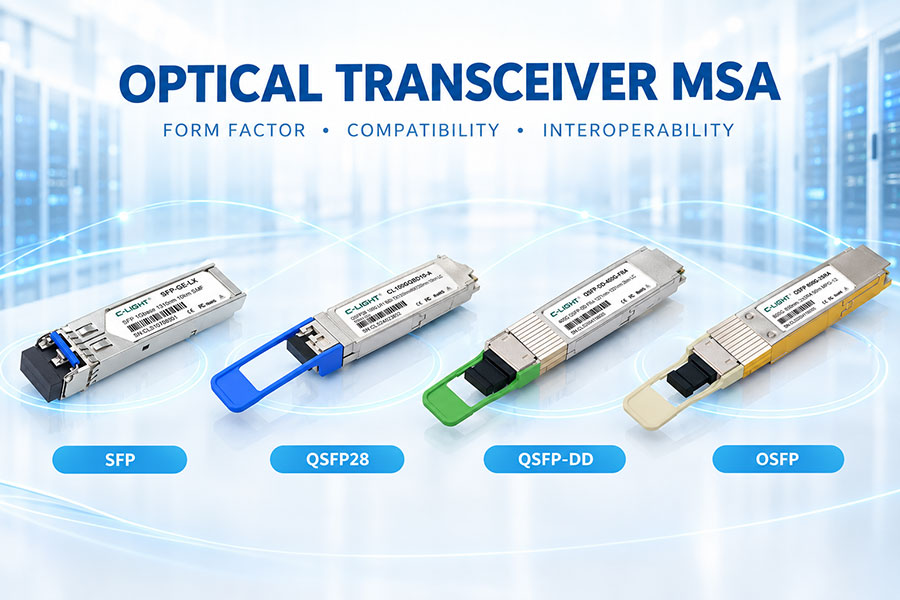
QSFP-DD and OSFP are two major high-density pluggable form factors used in modern high-speed networking. Both were developed to support bandwidth levels well beyond traditional 100G interfaces and are now used for 400G, 800G, and 1.6T optical connectivity.
Although both platforms use an eight-lane high-speed electrical architecture, they take different approaches to mechanical design, thermal management, port density, and module compatibility. Understanding these differences is important when selecting modules for high-speed Ethernet, data center interconnects, AI networks, and high-performance computing systems.
1. What Are QSFP-DD and OSFP?
QSFP-DD stands for Quad Small Form-factor Pluggable Double Density. It extends the established QSFP family by providing up to eight high-speed electrical lanes while maintaining a compact mechanical structure derived from the traditional QSFP ecosystem.
OSFP stands for Octal Small Form Factor Pluggable. It was designed as a new high-speed pluggable architecture with eight high-speed electrical lanes and a larger mechanical package that provides additional room for thermal management and high-speed components.
Both form factors are intended to provide a scalable path from 400G to 800G and 1.6T. The main difference is therefore not the number of electrical lanes alone, but how the two standards implement the mechanical, electrical, thermal, and system-level requirements around those lanes.
2. QSFP-DD vs OSFP: Basic Comparison
| Feature | QSFP-DD | OSFP |
|---|---|---|
| Electrical Architecture | Up to 8 high-speed lanes | 8 high-speed lanes |
| 400G Support | Yes | Yes |
| 800G Support | Yes | Yes |
| 1.6T Support | Yes | Yes |
| Higher-Speed Signaling | 112G-PAM4 and 224G-PAM4 generations | 112G-PAM4 and 224G-PAM4 generations |
| Mechanical Approach | Compact QSFP-derived design | Larger dedicated high-speed design |
| Standard Thermal Approach | Module and host thermal solutions | Integrated heat sink on standard OSFP |
| Backward Compatibility | Compatible QSFP-family support | Different mechanical ecosystem |
| Typical Applications | Data center, Ethernet, AI, HPC | Data center, Ethernet, AI, HPC |
From a bandwidth perspective, the two form factors have become increasingly similar. Their main differentiation is now found in mechanical design, thermal implementation, ecosystem compatibility, and platform architecture.
3. Eight-Lane Electrical Architecture
Both QSFP-DD and OSFP use eight high-speed electrical lanes for their current high-bandwidth generations. This common architecture allows both platforms to scale bandwidth by increasing the rate of each lane rather than continually increasing the number of electrical connections.
For 400G, both form factors can use eight 50G-class electrical lanes. For 800G, the architecture advances to eight 100G-class lanes. For 1.6T, the electrical interface scales to eight 200G-class lanes.
| Generation | Lane Rate | Aggregate Bandwidth | Typical Signaling |
|---|---|---|---|
| 400G | 50G-class × 8 | 400G | 56G-PAM4 |
| 800G | 100G-class × 8 | 800G | 112G-PAM4 |
| 1.6T | 200G-class × 8 | 1.6T | 224G-PAM4 |
The latest QSFP-DD and OSFP specifications both define this progression. QSFP-DD800 supports up to 112 Gb/s per electrical lane, while QSFP-DD1600 supports up to 224 Gb/s per lane. The OSFP specification defines corresponding 800GAUI-8 and 1.6TAUI-8 interfaces using 112G-PAM4 and 224G-PAM4 signaling.
4. 400G QSFP-DD vs 400G OSFP
At 400G, both QSFP-DD and OSFP can provide eight 50G-class electrical lanes. The actual optical implementation may vary considerably depending on the selected optical standard.
A 400G module can use parallel optical channels, wavelength-multiplexed optics, or other architectures depending on the transmission distance and fiber infrastructure.
The difference at this generation is therefore more visible in the physical platform than in the basic electrical bandwidth. QSFP-DD provides a compact QSFP-derived package, while OSFP uses a larger mechanical structure with integrated thermal capability.
5. 800G QSFP-DD vs 800G OSFP
800G is where the similarities between the two form factors become particularly clear. Both can use eight 100G-class PAM4 electrical lanes to achieve 800G aggregate bandwidth.
800G optical modules can support configurations such as 8 × 100G electrical lanes on the host side, with optical implementations including DR8, 2 × 400G-class solutions, and other application-specific architectures.
The choice between QSFP-DD800 and OSFP800 is therefore often determined by the switch platform, mechanical design, power budget, cooling system, module ecosystem, and optical requirements rather than by bandwidth alone.
6. 1.6T QSFP-DD vs 1.6T OSFP
Both ecosystems have also evolved toward 1.6T pluggable solutions. QSFP-DD1600 uses eight 200G-class electrical lanes, while OSFP1600 uses the corresponding eight-lane 224G-PAM4 electrical interface.
At this speed, the host electrical channel becomes substantially more demanding. PCB loss, connector performance, module contacts, package parasitics, thermal design, and signal conditioning all become important factors in system implementation.
The 1.6T generation also places greater emphasis on the mechanical and thermal design of the host system because module power is significantly higher than in earlier generations.
7. Mechanical Size and Port Density
One of the most visible differences between QSFP-DD and OSFP is their mechanical size. QSFP-DD follows a compact QSFP-derived form factor, while OSFP uses a larger package.
The smaller QSFP-DD footprint can provide an advantage when front-panel density and compatibility with existing QSFP-based switch architectures are important.
OSFP uses additional physical volume to support a larger thermal structure and high-speed components. Despite the larger module, the OSFP MSA specifies support for up to 36 OSFP ports on a 1U front panel, depending on system implementation.
Therefore, the choice is not simply "smaller is better." The appropriate mechanical architecture depends on the required bandwidth density, power level, cooling system, and host platform.
8. Thermal Design
Thermal management is one of the most important differences between QSFP-DD and OSFP.
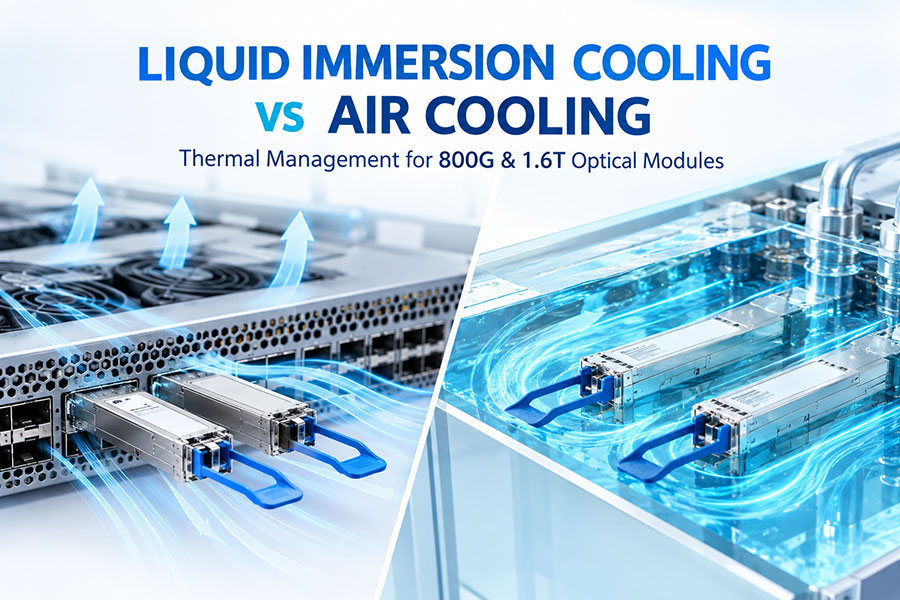
Standard OSFP modules incorporate an integrated heat sink as part of the module. The heat sink can use open-top or closed-top structures depending on the implementation. The OSFP specification also defines OSFP-RHS variants that use a separate riding heat sink supplied by the host system.
QSFP-DD uses a more compact architecture with module and host thermal solutions designed around the specific module generation. The QSFP-DD specification includes dedicated thermal considerations and additional heat-sink and mechanical enhancements for higher-power generations.
At 800G and especially 1.6T, thermal design must be considered at the module, cage, PCB, and chassis levels rather than treating the transceiver as an isolated component.
9. Why OSFP Uses a Larger Package
The larger OSFP package provides additional usable volume for thermal management and high-speed electronics. This is particularly useful for modules with relatively high power consumption.
A larger heat sink provides more thermal surface area and can simplify heat transfer from the module into the system airflow. This approach is one of the defining characteristics of the OSFP architecture.
The trade-off is that the module occupies more physical space than QSFP-DD. Network equipment designers therefore need to balance cooling capability against front-panel density and chassis layout.
10. QSFP-DD Backward Compatibility
One important advantage of QSFP-DD is its relationship with the existing QSFP ecosystem. The QSFP-DD and QSFP-DD800 cage and connector designs with eight lanes are compatible with four-lane QSFP+ modules. QSFP-DD1600 also provides backward compatibility with QSFP-DD and compatible QSFP+ modules.
This allows equipment manufacturers to create high-speed platforms that can support different generations of QSFP-family modules where the host design and software support the required modes.
However, compatibility does not mean that every QSFP, QSFP+, QSFP28, or QSFP56 module will operate automatically in every QSFP-DD port. Electrical mode, firmware, module coding, power, and supported standards must still be verified.
11. OSFP Compatibility
OSFP does not use the same compact mechanical interface as QSFP-family modules. Standard OSFP modules therefore should not be treated as mechanically interchangeable with QSFP-DD modules.
OSFP platforms can be designed with different host architectures and may support certain lower-speed applications or compatible QSFP solutions through specific system mechanisms or adapters, but this should not be confused with native mechanical compatibility.
For deployment, the exact switch platform and cage design should always be checked before selecting an OSFP module.
12. Host-Side Signal Integrity
Both QSFP-DD and OSFP rely on very high-speed host electrical channels. The channel extends from the switch ASIC to the module and includes PCB traces, vias, connectors, contacts, and module electronics.
At 112G and 224G electrical signaling, even small losses or impedance discontinuities can affect link quality. Insertion loss, return loss, crosstalk, connector performance, PCB material, and routing length must therefore be controlled carefully.
Although the two form factors use similar eight-lane signaling concepts, the mechanical structure of the cage and module can affect the practical implementation of the host channel.
13. PAM4 Signaling
Both modern QSFP-DD and OSFP generations rely heavily on PAM4 for higher electrical lane rates.
PAM4 uses four signal levels and transmits two bits per symbol. This allows a higher bit rate at a given symbol rate than conventional NRZ signaling.
The trade-off is reduced signal-level separation, which increases sensitivity to noise, distortion, crosstalk, reflections, and channel loss.
As a result, both QSFP-DD and OSFP require increasingly sophisticated equalization and signal-integrity techniques as they move toward 800G and 1.6T.
14. Optical Architecture
Neither QSFP-DD nor OSFP defines a single optical transmission method. Both form factors can accommodate different optical architectures according to the target standard.
Short-reach modules may use parallel multimode optics. Single-mode applications may use parallel optical channels, wavelength multiplexing, or other architectures depending on the transmission distance.
For example, an 800G module can use an 8-channel parallel optical architecture, while other designs can divide an 800G electrical interface into multiple optical ports or wavelengths.
This allows the same general form factor to address different network distances and cabling environments.
15. Optical Connectors
Connector selection depends on the optical implementation rather than the form factor alone.
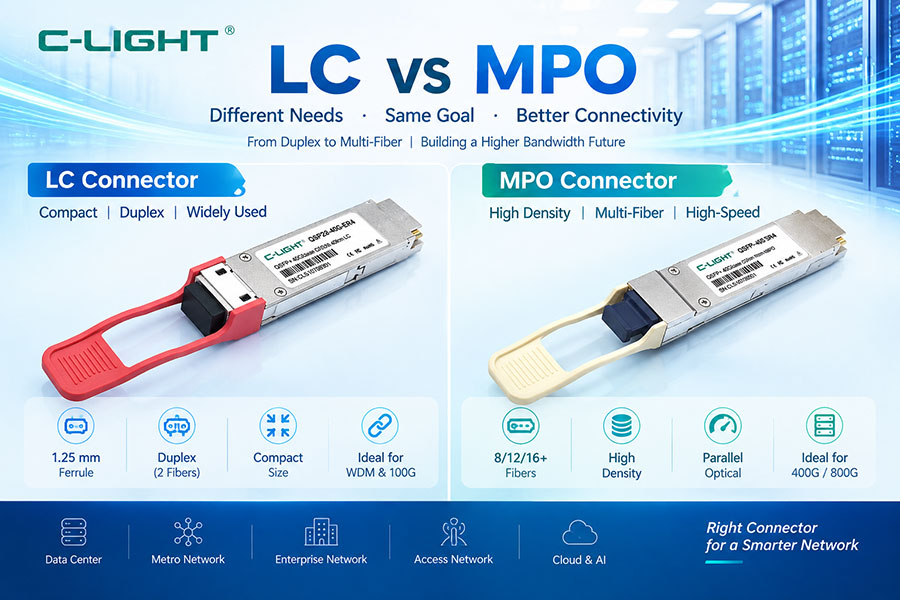
MPO/MTP connectors are commonly used for parallel-fiber solutions because they provide multiple optical channels through a single connector. Duplex LC can be used for wavelength-multiplexed solutions where multiple wavelengths are combined onto a pair of fibers.
Other high-density connectors can also be used for breakout and specialized applications depending on the module design.
16. DAC and AOC Applications
Both QSFP-DD and OSFP can be used for active and passive cable solutions as well as optical transceivers.
DACs are suitable for short-distance connections where a direct electrical cable can meet the link requirements. AOCs use optical transmission inside the cable assembly and can support longer distances than passive copper cables.
QSFP-DD DACs and AOCs are particularly useful when maintaining a compact front-panel interface is important. OSFP DACs and AOCs can provide similar connectivity while using the larger OSFP connector and module architecture.
17. Data Center Applications
QSFP-DD and OSFP are both widely suited to high-density data center networking. Typical applications include leaf-spine connections, switch uplinks, spine links, server connectivity, data center interconnects, and storage networks.
At 400G and 800G, the two form factors can provide high-bandwidth connectivity for modern switch platforms. At 1.6T, both platforms offer a path toward next-generation high-capacity Ethernet systems.
The decision is typically influenced by the switch vendor, port architecture, module ecosystem, cooling requirements, and optical standard supported by the system.
18. AI and High-Performance Computing
AI clusters and high-performance computing systems create significant east-west traffic between GPUs, accelerators, servers, storage, and network switches.
High-speed optical interfaces are therefore required to move large amounts of data between compute nodes. QSFP-DD and OSFP can both provide 400G and 800G connectivity for these environments, with 1.6T generations supporting future high-bandwidth architectures.
Thermal management becomes particularly important in AI switches because high-density ports can place substantial power demands on the chassis cooling system.
19. QSFP-DD vs OSFP for Port Density
QSFP-DD's compact mechanical structure makes it attractive for systems where maximum physical density is a major consideration. Its relationship with the QSFP ecosystem can also simplify platform evolution from older QSFP-based interfaces.
OSFP provides a larger module volume, which can offer more flexibility for thermal management and component integration.
Both standards can achieve high front-panel bandwidth density. The practical result depends on the number of ports, module generation, system spacing, heat sink design, airflow, and switch architecture.
20. QSFP-DD vs OSFP Power Considerations
Power consumption varies significantly between individual modules and cannot be determined from the form factor alone.
Optical reach, DSP architecture, laser technology, optical engine design, driver implementation, and thermal conditions all affect actual power consumption.
At higher speeds, however, the available system power budget becomes increasingly important. A high-density 800G or 1.6T switch must be designed to support the combined electrical and thermal load of many active modules operating simultaneously.
21. QSFP-DD vs OSFP Breakout
Both platforms support flexible lane mapping for breakout applications.
QSFP-DD electrical interfaces can support multiple lane configurations depending on the generation and host design. OSFP also defines single-port, dual-port, quad-port, and lane-level mapping options for different PMD configurations.
For example, an 800G interface may be mapped to one 800G optical connection or divided into multiple lower-speed optical ports. This flexibility can simplify connections between switches with different port speeds.
22. Management Interface
Both QSFP-DD and OSFP rely on the Common Management Interface Specification, or CMIS, for module management functions.
Management functions can include module identification, configuration, monitoring, alarms, and diagnostic information. The exact functions available depend on the module implementation and supported CMIS version.
Using a common management framework allows networking equipment to interact with complex high-speed modules using standardized management concepts.
23. QSFP-DD vs OSFP for Network Upgrades
For a network migrating from 100G to 400G, both QSFP-DD and OSFP can provide appropriate high-speed interfaces. The choice will often be determined by the new switch platform rather than by the optical module alone.
QSFP-DD can be attractive when backward compatibility with the QSFP ecosystem and compact mechanical dimensions are important. OSFP can be attractive when higher thermal capacity and additional module volume are priorities.
For an 800G or 1.6T upgrade, the host switch's electrical SerDes capability, cage type, module power budget, airflow, and supported optical standards should be confirmed before deciding on a module family.
24. QSFP-DD vs OSFP for 800G Networks
| Consideration | QSFP-DD800 | OSFP800 |
|---|---|---|
| Electrical Lanes | 8 | 8 |
| Electrical Lane Rate | Up to 112G-class | 112G-class |
| Signaling | PAM4 | PAM4 |
| Aggregate Bandwidth | 800G | 800G |
| Mechanical Design | Compact | Larger |
| Thermal Structure | Module/host thermal design | Integrated heat sink on standard OSFP |
| QSFP Compatibility | Strong QSFP-family relationship | Different mechanical platform |
From an electrical bandwidth perspective, the two 800G platforms are broadly similar. The major differences are physical architecture, thermal implementation, and ecosystem compatibility.
25. QSFP-DD vs OSFP for 1.6T
The 1.6T generation increases the electrical requirement to approximately 200G per lane across eight lanes.
QSFP-DD1600 and OSFP1600 both target this bandwidth level, but each uses its own mechanical implementation and host platform requirements.
At this performance level, network engineers need to consider channel loss, PCB materials, connector performance, thermal design, module power, and airflow together. The physical form factor becomes only one part of the system design.
26. Main Advantages of QSFP-DD
QSFP-DD provides a compact high-speed platform with strong continuity with the existing QSFP ecosystem. Its eight-lane architecture supports multiple bandwidth generations, while backward compatibility can simplify some migration scenarios.
The smaller mechanical design can also be useful where front-panel density is important.
For network equipment manufacturers that already have extensive QSFP-family infrastructure, the evolutionary nature of QSFP-DD can reduce the need for a completely new mechanical ecosystem.
27. Main Advantages of OSFP
OSFP was designed specifically for high-speed networking and provides a larger module package with strong thermal capability.
The integrated heat sink of the standard OSFP design provides a dedicated mechanism for removing heat from high-power modules. The OSFP-RHS architecture also provides an alternative for systems that prefer host-side thermal solutions.
This makes OSFP particularly suited to platforms where module power and cooling are major considerations.
28. Main Design Trade-Off
The fundamental trade-off between the two form factors can be summarized as mechanical density versus thermal and packaging flexibility.
QSFP-DD prioritizes a compact QSFP-derived structure and ecosystem continuity. OSFP uses more physical volume to provide additional thermal and component space.
Neither architecture is universally suitable for every system. The best fit depends on the switch platform, target bandwidth, module power, airflow, port density, optical architecture, and deployment requirements.
29. How to Choose Between QSFP-DD and OSFP
The first step is to identify the host switch or network platform. The cage, connector, supported electrical lane rate, firmware, and management interface determine which form factor can be used.
The second step is to identify the optical requirement, including transmission distance, fiber type, wavelength, connector, and link budget.
The third step is to evaluate thermal conditions. For dense 800G and 1.6T systems, module power and chassis airflow can be as important as optical specifications.
Finally, the planned network architecture should be considered. Backward compatibility, breakout requirements, DAC/AOC support, and future bandwidth upgrades may influence the choice between QSFP-DD and OSFP.
30. QSFP-DD vs OSFP: Key Differences
| Item | QSFP-DD | OSFP |
|---|---|---|
| Lane Architecture | Up to 8 high-speed lanes | 8 high-speed lanes |
| 400G | Supported | Supported |
| 800G | Supported | Supported |
| 1.6T | Supported | Supported |
| Electrical Signaling | Up to 112G / 224G PAM4 generations | 112G / 224G PAM4 generations |
| Module Size | More compact | Larger |
| Thermal Approach | Compact module and host solution | Integrated heat sink on standard OSFP |
| QSFP Ecosystem | Strong backward compatibility | Separate mechanical ecosystem |
| Typical Role | High-density scalable networking | High-speed networking with greater thermal volume |
31. Conclusion
QSFP-DD and OSFP are two major pluggable architectures for high-speed networking. Both use eight high-speed electrical lanes and have evolved from 400G to 800G and 1.6T applications.
The primary difference is not aggregate bandwidth but the way each form factor addresses mechanical space, thermal management, compatibility, and platform integration. QSFP-DD maintains a compact QSFP-derived design and strong compatibility with the QSFP ecosystem, while OSFP uses a larger package with an integrated thermal structure in its standard implementation.
For 800G and 1.6T networks, the selection between QSFP-DD and OSFP should be based on the host switch architecture, electrical lane rate, optical standard, transmission distance, module power, thermal environment, port density, and future upgrade requirements.
 >
>

 >
>
 >
>
 >
>
 >
>
 >
>
 >
>
 >
>