TEL:+86 132 6656 7067




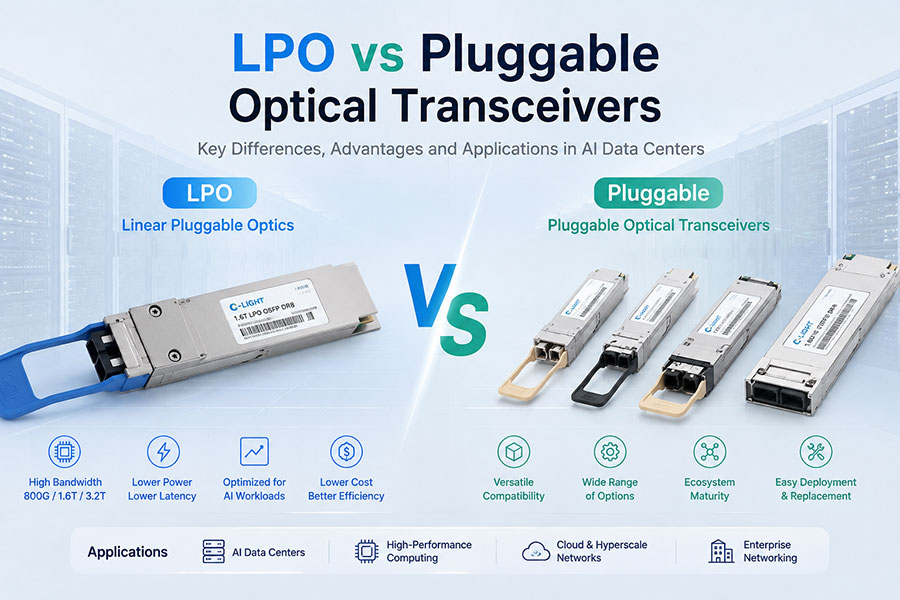
Linear Pluggable Optics (LPO) and conventional pluggable optical transceivers are both important approaches for high-speed data center connectivity. As network speeds move from 400G to 800G and toward 1.6T, the choice between LPO and traditional DSP-based pluggable optics increasingly depends on power consumption, link distance, signal integrity, system architecture, and deployment requirements.
Although both solutions use pluggable optical modules, their electrical architectures are significantly different. LPO reduces or eliminates the need for a traditional retimer or DSP inside the optical module, while conventional pluggable transceivers typically rely on DSP-based signal processing to compensate for electrical and optical impairments.
1. What Is LPO?
Linear Pluggable Optics, commonly known as LPO, is an optical transceiver architecture designed to minimize signal processing inside the optical module. Instead of relying on a conventional high-power DSP for equalization and signal recovery, LPO generally uses a more linear electrical path between the host system and the optical components.
The main objective of LPO is to reduce power consumption and latency while maintaining the bandwidth required by high-speed networks. This architecture is particularly relevant to AI clusters and data center networks where thousands of optical links may operate simultaneously.
In an LPO implementation, more of the electrical signal conditioning and equalization responsibility is shifted toward the host switch, NIC, accelerator, or other system-side components. This makes the design highly dependent on the quality of the complete electrical channel.
2. What Are Pluggable Optical Transceivers?
Pluggable optical transceivers are removable optical modules installed in switches, routers, NICs, servers, and other networking equipment. Common form factors include SFP, SFP28, QSFP28, QSFP-DD, QSFP112, and OSFP.
Traditional high-speed pluggable optical transceivers commonly incorporate a DSP or retimer to process high-speed electrical signals. The DSP can perform functions such as equalization, clock recovery, signal conditioning, and compensation for transmission impairments.
This processing capability provides greater flexibility for challenging electrical and optical links, but it also increases module power consumption, thermal requirements, and system complexity.
3. LPO vs Pluggable Optical Transceivers
The fundamental difference between LPO and conventional DSP-based pluggable optics is the location and amount of signal processing.
| Feature | LPO | Conventional Pluggable Optical Transceiver |
|---|---|---|
| Signal Processing | Minimal or no traditional DSP inside the module | Typically uses DSP or retimer-based processing |
| Module Power | Generally lower | Generally higher |
| Latency | Potentially lower | Higher due to additional signal processing |
| Electrical Channel Requirements | More demanding | More tolerant of channel impairments |
| Link Reach | More suitable for shorter and controlled links | Broader range of applications and distances |
| Thermal Requirements | Potentially easier to manage | Higher thermal load at higher speeds |
| System Dependence | Higher dependence on host-side equalization | More signal processing is handled within the module |
| Typical Application | Short-reach AI and data center interconnects | Data center, telecom, enterprise and longer-reach networks |
4. Why LPO Can Reduce Power Consumption
Power consumption is one of the major reasons LPO has attracted attention in high-speed networking. As electrical signaling rates increase, DSPs become increasingly sophisticated and can consume a meaningful portion of an optical module's total power.
By reducing the amount of signal processing performed inside the module, LPO can significantly simplify the optical module architecture. The resulting module can have fewer active electronic components and lower processing overhead.
This becomes particularly important in large AI clusters. A data center may deploy a very large number of optical connections between GPUs, switches, NICs, and other network devices. Even a small reduction in power per optical link can become significant when multiplied across thousands of ports.
However, lower module power does not automatically mean lower total system power. Some of the signal-processing workload may be transferred to the host-side ASIC, switch, NIC, or accelerator. Therefore, LPO should be evaluated at the system level rather than only by comparing optical module power consumption.
5. LPO and Latency
Latency is another potential advantage of the LPO architecture. Traditional DSP-based optical modules perform multiple stages of digital signal processing between the electrical interface and optical transmission path.
Removing or reducing these processing stages can shorten the signal path and potentially reduce latency. This characteristic is particularly attractive for AI workloads where large numbers of accelerators exchange data continuously.
Nevertheless, the actual end-to-end latency depends on the complete network architecture, including switch ASICs, NICs, optical components, transmission media, and protocol processing. LPO should therefore be viewed as one component of a low-latency network design rather than a standalone solution for eliminating network latency.
6. Signal Integrity Is a Major LPO Challenge
The primary trade-off of LPO is that less signal processing inside the module places greater demands on the electrical channel.
At 400G, 800G, and future 1.6T interfaces, electrical signals operate at extremely high data rates. Loss, reflections, crosstalk, insertion loss, return loss, connector performance, PCB routing, and package characteristics can all affect signal quality.
A conventional DSP can compensate for certain electrical impairments. LPO provides less opportunity for this type of compensation inside the module, which means the switch ASIC, PCB, connector, module and optical engine must be designed as a carefully optimized end-to-end channel.
This makes high-quality SI design and validation particularly important for LPO deployments.
7. LPO for 400G Networks
400G is an important generation for evaluating LPO architectures because the ecosystem already includes multiple optical module technologies and network architectures.
400G LPO can be considered for short-reach connections where the electrical channel can be tightly controlled and the system architecture is optimized for linear optical interfaces.
Traditional 400G pluggable optical transceivers remain important because DSP-based architectures provide greater flexibility and can support a wider range of electrical channel conditions and optical reach requirements.
For network operators, the decision between 400G LPO and conventional 400G pluggable optics should therefore consider port density, link distance, host platform design, power budget, thermal conditions, and interoperability requirements.
8. LPO in 800G AI Data Centers
800G is one of the key bandwidth levels for modern AI and high-performance data center networks. At this speed, power consumption and thermal management become increasingly important because large AI clusters can require very high optical port densities.
LPO is particularly relevant to short-reach 800G connections between network devices where the electrical channel can be tightly controlled. The architecture can reduce the amount of active signal processing inside the optical module and potentially improve the overall power efficiency of the optical interconnect.
However, 800G LPO also places greater requirements on host-side SerDes performance, PCB design, connectors, optical engines, and system-level signal integrity. Successful deployment therefore requires coordinated optimization between the switch ASIC and optical module.
9. LPO and the Transition Toward 1.6T
The move toward 1.6T networking further increases the importance of power and thermal efficiency. Higher aggregate bandwidth requires faster electrical interfaces and more advanced optical engines, increasing the design challenges associated with signal integrity and power consumption.
LPO is one architecture being considered for addressing these challenges, particularly in short-reach AI and data center interconnects. By minimizing module-level DSP processing, LPO can provide a path toward lower-power optical connectivity.
At the same time, 1.6T systems impose extremely demanding electrical requirements. The feasibility of an LPO implementation depends heavily on the host SerDes, electrical channel quality, optical engine design, connector ecosystem, and overall system architecture.
For this reason, LPO should not be considered a universal replacement for conventional pluggable optics. Different 1.6T applications may require different optical architectures depending on reach, interoperability, reliability, and system design requirements.
10. LPO vs Traditional Optics: Power and Performance Trade-Off
The most important distinction is not simply whether LPO is better than a conventional optical transceiver. Instead, each architecture makes a different engineering trade-off.
LPO prioritizes low module power, reduced processing complexity, and potentially lower latency. Conventional DSP-based pluggable optics prioritize signal conditioning flexibility, link robustness, and support for a broader range of electrical and optical conditions.
For a short and well-controlled AI fabric connection, the advantages of LPO can be particularly attractive. For longer links, more complex network environments, or applications requiring stronger signal compensation, conventional DSP-based optical transceivers can remain a practical choice.
11. Application Scenarios
LPO and conventional pluggable optical transceivers can coexist in the same data center rather than competing for exactly the same applications.
AI GPU Clusters: Short-reach, high-density optical connections where power efficiency is a major consideration.
Data Center Switching: High-speed switch-to-switch and switch-to-server connectivity.
High-Performance Computing: Low-latency and high-bandwidth interconnects between computing resources.
Enterprise Data Centers: Conventional pluggable optics remain useful where compatibility and deployment flexibility are priorities.
Longer-Reach Networks: DSP-based optical transceivers are generally more suitable when greater signal compensation or optical reach is required.
12. LPO vs Pluggable Optical Transceivers: Which One Should You Choose?
The appropriate technology depends on the requirements of the network rather than the data rate alone.
Choose LPO when: low module power, low processing overhead, short reach, high port density, and tightly controlled electrical channels are important.
Choose conventional pluggable optics when: wider compatibility, stronger signal conditioning, longer reach, or greater deployment flexibility is required.
For AI clusters: LPO can be attractive for selected short-reach links, while conventional optical transceivers remain important for links with more demanding reach or channel requirements.
For mixed networks: Different optical technologies can be deployed according to link distance, bandwidth, power budget, and network architecture.
13. The Role of C-LIGHT in High-Speed Optical Connectivity
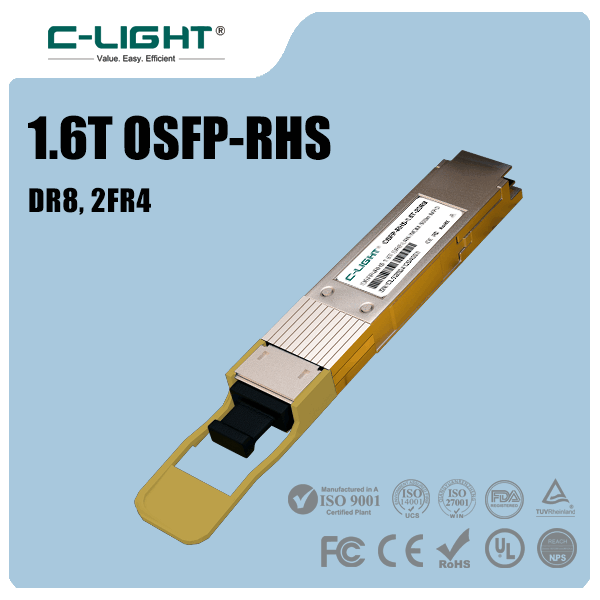
C-LIGHT develops high-speed optical connectivity products for data center and networking applications, including optical transceivers designed around 400G, 800G, and next-generation 1.6T network requirements.
As data center architectures evolve toward higher bandwidth and greater port density, optical modules must balance transmission performance, power consumption, thermal management, signal integrity, and system compatibility.
C-LIGHT's high-speed optical product portfolio can support different connectivity requirements across AI infrastructure and data center networks, allowing network designers to select suitable optical solutions according to bandwidth, reach, form factor, and application environment.
14. Future Development of LPO and Pluggable Optics
LPO is likely to remain one of several optical connectivity architectures considered for high-speed AI and data center networks. Its strongest value proposition is the potential combination of high bandwidth, lower module power, and simplified optical module processing.
However, conventional DSP-based pluggable optics will continue to have an important role because data center networks require different transmission distances, electrical environments, optical technologies, and interoperability characteristics.
The evolution from 400G to 800G and 1.6T is therefore more likely to produce a diversified optical ecosystem rather than a single architecture replacing all others. LPO, traditional DSP-based pluggables, AEC, DAC, AOC, CPO, and other optical technologies can each address different portions of the network.
15. Frequently Asked Questions
Q1: What is the main difference between LPO and conventional pluggable optical transceivers?
Answer: The main difference is the signal-processing architecture. LPO minimizes or removes traditional DSP processing inside the optical module, while conventional high-speed pluggable transceivers commonly use DSP or retimer-based processing.
Q2: Does LPO always consume less power?
Answer: LPO is designed to reduce optical module power by minimizing active signal processing. However, some signal-processing functions may move to the host system, so total system power should be evaluated rather than comparing module power alone.
Q3: Is LPO only used for 800G?
Answer: No. LPO architectures can be considered across different high-speed network generations, including 400G and 800G, with potential relevance to future 1.6T systems. The appropriate implementation depends on the electrical channel and system architecture.
Q4: Is LPO suitable for 1.6T optical connectivity?
Answer: LPO is being considered as one possible architecture for future 1.6T connectivity, particularly for short-reach applications. However, 1.6T introduces very demanding electrical and signal-integrity requirements, so implementation depends strongly on host SerDes, channel design, optical engine technology, and system-level integration.
Q5: What is the biggest challenge of LPO?
Answer: Signal integrity is one of the major challenges. Because LPO provides less signal processing inside the module, the electrical channel from the host ASIC to the optical engine must be carefully optimized for loss, reflections, crosstalk, and other high-speed impairments.
Q6: Is LPO better than DSP-based optical transceivers?
Answer: Neither architecture is universally better. LPO can provide advantages in power and processing overhead for suitable short-reach applications, while DSP-based optical transceivers provide greater signal-conditioning capability and broader application flexibility.
Q7: Why is LPO attractive for AI data centers?
Answer: AI clusters can require very large numbers of high-speed optical connections. Reducing optical module power and processing complexity can help address port-density and thermal-management challenges, particularly for short-reach connections.
Q8: Will LPO replace conventional pluggable optical transceivers?
Answer: LPO is unlikely to replace all conventional pluggable optics. Different network links have different requirements for reach, signal compensation, interoperability, power, and system architecture. LPO and DSP-based pluggable optics are expected to coexist across different applications.
16.Summary
LPO and conventional pluggable optical transceivers represent two different approaches to high-speed optical connectivity. LPO minimizes module-level signal processing to target lower power consumption, lower processing overhead, and efficient short-reach connectivity. Conventional DSP-based pluggable optics provide stronger signal-conditioning capabilities and broader deployment flexibility.
As AI data centers progress from 400G to 800G and toward 1.6T, the selection of optical technology will increasingly depend on system-level power, signal integrity, thermal management, link distance, and interoperability requirements. Rather than replacing conventional optics completely, LPO is best viewed as an additional architecture for specific high-bandwidth data center applications.
 >
>

 >
>
 >
>
 >
>
 >
>
 >
>
 >
>
 >
>