TEL:+86 132 6656 7067




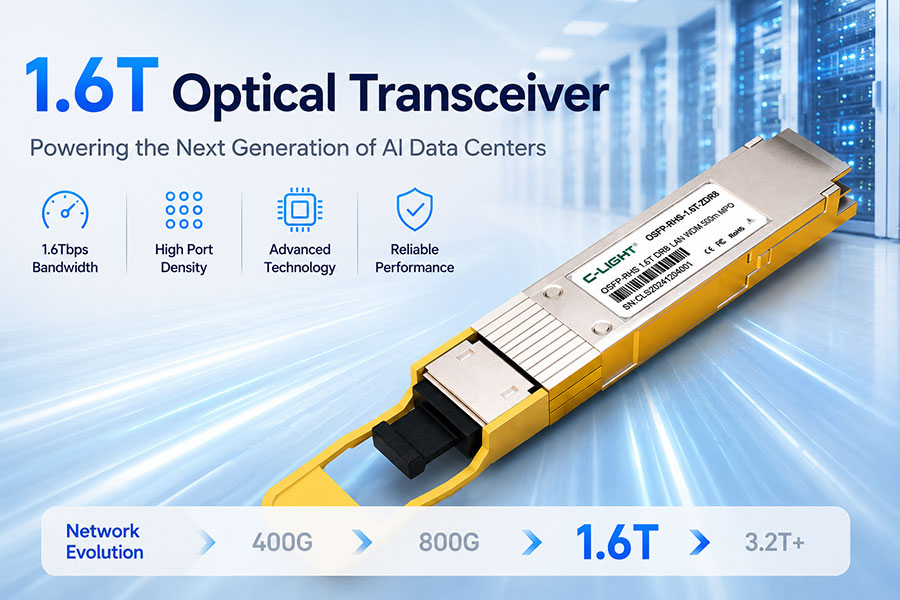
The 1.6T optical transceiver market is entering a new stage of growth as artificial intelligence, hyperscale data centers, and high-performance computing continue to increase network bandwidth requirements. After the rapid adoption of 400G and 800G optical connectivity, the industry is moving toward 1.6Tbps optical transceivers to support higher-density AI clusters and next-generation data center switching.
The transition to 1.6T is not simply a speed upgrade. It involves advances in electrical lane rates, optical engines, DSP technology, silicon photonics, thermal management, module packaging, and high-speed switch architectures.
For optical networking suppliers, data center operators, and system manufacturers, 1.6T is becoming an important market segment in the evolution from 400G to 800G, 1.6T and eventually 3.2T.
1. 1.6T Optical Transceiver Market Overview
1.6T optical transceivers provide an aggregate transmission capacity of approximately 1.6Tbps per optical module. This represents twice the bandwidth of 800G and four times the bandwidth of 400G.
400G → 800G → 1.6T → 3.2T
Each generation increases bandwidth density while requiring higher electrical and optical lane rates.
The market is primarily driven by the rapid expansion of AI data centers. Large GPU clusters require high-bandwidth communication between accelerator servers, switches, storage systems, and other parts of the network fabric.
As GPU performance and cluster scale increase, network bandwidth is becoming an increasingly important factor in overall AI infrastructure performance.
2. AI Data Centers Drive 1.6T Optical Transceiver Demand
Artificial intelligence is currently the most important growth driver for high-speed optical transceivers.
AI training and inference systems distribute workloads across large numbers of GPUs. These GPUs continuously exchange data through high-speed network fabrics, creating substantial east-west traffic inside the data center.
As AI clusters scale from hundreds to thousands or tens of thousands of accelerators, the bandwidth requirements between switches and compute nodes increase rapidly.
Larger GPU Clusters: More accelerators require more high-speed network connections.
Higher Network Traffic: Distributed AI workloads generate large volumes of east-west traffic.
Higher Switch Bandwidth: Next-generation switch ASICs require higher-speed optical interfaces.
Higher Port Density: Data center operators need more bandwidth without continuously increasing physical port counts.
Lower Network Bottlenecks: Higher-speed optical links can help maintain efficient GPU utilization.
Industry research indicates that 800G and above optical transceivers are becoming an increasingly important part of AI-focused data center infrastructure, while 1.6T is moving into commercial deployment. :contentReference[oaicite:1]{index=1}
3. 800G to 1.6T: The Next Optical Networking Upgrade
The transition from 800G to 1.6T is one of the most important trends in the optical transceiver market.
| Generation | Aggregate Bandwidth | Typical Network Role |
|---|---|---|
| 400G | 400Gbps | Established high-speed data center networking |
| 800G | 800Gbps | Large AI and hyperscale networks |
| 1.6T | 1.6Tbps | Next-generation AI and high-density networking |
| 3.2T | 3.2Tbps | Future ultra-high-bandwidth networking |
The 1.6T generation provides approximately twice the bandwidth of 800G without requiring a proportional increase in the number of physical optical connections.
This bandwidth-density advantage is particularly important for large AI data centers where rack space, switch port count, power consumption, and cooling capacity are all critical system-level considerations.
4. 2026: A Key Year for 1.6T Commercialization
The 1.6T optical transceiver market is moving from technology development and early qualification toward commercial deployment.
Industry research published in 2026 indicates that 1.6T shipments are expected to grow rapidly from a small 2025 base into the tens-of-millions-of-ports range, reflecting accelerating AI infrastructure investment. :contentReference[oaicite:2]{index=2}
The commercialization of 1.6T is also supported by the development of higher-speed optical DSPs and electrical interfaces. For example, 400G-per-lane PAM4 DSP technology is being developed specifically for 1.6T transceiver architectures and future higher-bandwidth networks. :contentReference[oaicite:3]{index=3}
Market Trend: 1.6T is shifting from an emerging technology category toward a commercial high-speed optical networking platform, with AI data centers serving as the primary demand driver.
5. 1.6T Optical Transceiver Technology Trends
The development of 1.6T optical transceivers requires improvements across multiple technologies.
5.1 Higher Electrical Lane Rates
Higher lane rates are essential for increasing aggregate module bandwidth without continuously increasing the number of lanes.
A simplified 1.6T architecture can be represented by:
8 × 200G = 1.6T
Next-generation architectures are also moving toward higher per-lane speeds, including 400G-per-lane technologies, creating a path toward future 3.2T networking.
5.2 PAM4 Technology
PAM4 remains an important signaling technology for high-speed optical networking.
Compared with traditional NRZ signaling, PAM4 transmits two bits per symbol through four signal levels, allowing higher data rates within practical electrical and optical lane configurations.
However, higher baud rates also increase requirements for signal integrity, equalization, DSP performance, optical components, PCB design, and connector quality.
5.3 Silicon Photonics
Silicon photonics is becoming increasingly important in the development of high-speed optical transceivers.
The technology can integrate multiple optical functions into a compact photonic platform and can support the scaling of optical bandwidth while addressing manufacturing and integration requirements.
Market research indicates that silicon photonics is expected to capture an increasing share of high-speed datacom optical applications as the industry moves toward 1.6T and beyond. :contentReference[oaicite:4]{index=4}
5.4 Advanced Optical Engines
The optical engine is becoming increasingly important as module speeds increase.
Higher-speed optical engines must provide high optical performance while maintaining acceptable power consumption, thermal characteristics, reliability, and manufacturing scalability.
6. 1.6T Optical Transceiver Form Factors
The form factor of a 1.6T optical transceiver depends on the switch platform and system architecture.
OSFP is an important form factor for high-speed 1.6T networking because its larger mechanical envelope provides additional space for thermal management and high-power optical module designs.
Other architectures can also be developed for different networking requirements, including future high-density pluggable solutions and near-package optical architectures.
| Form Factor / Architecture | Key Characteristic | Typical Direction |
|---|---|---|
| 1.6T OSFP | High bandwidth and thermal headroom | AI and hyperscale networking |
| High-Density Pluggable | Bandwidth density and serviceability | Next-generation data centers |
| LPO | Reduced DSP complexity and potential power advantages | Short-reach AI networking |
| CPO | Optics integrated close to switch silicon | Future high-density switching |
7. 1.6T Optical Transceiver Applications
The main application areas for 1.6T optical transceivers are closely connected to high-performance computing and AI infrastructure.
7.1 AI Data Centers
AI data centers are expected to become the largest application area for 1.6T optical connectivity.
Large GPU clusters require high-capacity links between servers and switches, as well as between different layers of the network fabric.
7.2 Hyperscale Data Centers
Hyperscale cloud providers are continuously increasing network bandwidth to support AI, cloud computing, storage, and other high-bandwidth workloads.
7.3 High-Performance Computing
HPC systems require low-latency and high-bandwidth communication between compute nodes. 1.6T optical connectivity can support higher network capacity in large-scale computing environments.
7.4 Data Center Interconnect
High-speed optical technologies are also used to connect data center facilities and distributed computing infrastructure.
The specific 1.6T solution depends on transmission distance, optical architecture, fiber infrastructure, and system requirements.
8. 1.6T Optical Transceiver Market Growth Drivers
Several structural factors are supporting the growth of the 1.6T optical transceiver market.
AI Infrastructure Expansion
Large-scale GPU deployments are increasing demand for high-bandwidth optical connectivity.
Switch Bandwidth Growth
Higher-capacity switch ASICs require optical interfaces capable of supporting higher aggregate bandwidth.
Network Bandwidth Density
Higher-speed modules can increase bandwidth per physical port.
Cloud Infrastructure
Hyperscale cloud networks continue to invest in high-speed data center infrastructure.
9. Power Consumption and Thermal Management
Power and thermal management are becoming major considerations in the 1.6T optical transceiver market.
Increasing optical bandwidth generally requires more advanced electrical and optical components. As a result, module designers must balance performance with power efficiency and heat dissipation.
Optical DSP Efficiency: Higher-speed processing must operate within practical power budgets.
Laser Efficiency: Optical transmitters must provide sufficient output while maintaining efficient power consumption.
Thermal Design: High-density modules require effective heat dissipation.
Switch Cooling: The thermal design of the host switch must accommodate high-speed optical modules.
Rack-Level Cooling: AI racks increasingly require advanced cooling strategies as compute and networking power increase.
These requirements are also encouraging the development of lower-power architectures such as LPO and longer-term alternatives such as CPO.
10. LPO and CPO Impact on the 1.6T Market
The growth of 1.6T does not mean that conventional pluggable optical transceivers will be the only optical architecture used in future AI networks.
Linear Pluggable Optics (LPO) is being evaluated for applications where reducing DSP complexity and power consumption can provide system-level benefits.
Co-Packaged Optics (CPO) takes a different approach by placing optical engines closer to the switching ASIC, reducing some of the electrical distance between the switch and optical interface.
| Technology | Main Advantage | Market Position |
|---|---|---|
| Pluggable Optics | Serviceability and flexible deployment | Major current architecture |
| LPO | Potential power and latency advantages | Growing AI networking interest |
| CPO | High bandwidth density and reduced electrical reach | Long-term development direction |
The emergence of LPO and CPO is therefore more likely to diversify the 1.6T optical market than immediately replace pluggable modules.
11. Supply Chain Trends in the 1.6T Optical Transceiver Market
The rapid increase in high-speed optical demand is also creating challenges across the supply chain.
A 1.6T optical transceiver requires multiple advanced components, including lasers, modulators, photodetectors, DSPs, optical engines, drivers, TIA components, connectors, and thermal solutions.
As demand increases, component availability and manufacturing capacity can become important factors affecting shipment volumes and deployment schedules.
Industry analysis in 2026 has highlighted supply constraints involving high-speed optical components, including laser and related photonic components, as a factor that could limit the pace of 1.6T deployment. :contentReference[oaicite:5]{index=5}
12. Regional Market Trends
The global 1.6T optical transceiver market is closely connected to the geographic distribution of AI and hyperscale data center investment.
North America
North America remains an important market because of the concentration of hyperscale cloud providers, AI infrastructure investment, and large-scale data center development.
Asia-Pacific
Asia-Pacific is an important manufacturing and technology region for optical components, optical transceivers, semiconductor devices, and data center infrastructure.
Europe
European demand is supported by cloud computing, enterprise data centers, high-performance computing, telecommunications infrastructure, and increasing investment in AI computing.
Regional market growth will continue to depend on AI infrastructure investment, data center construction, optical component supply, and the adoption rate of high-speed switching platforms.
13. Competitive Landscape
The 1.6T optical transceiver market includes optical component manufacturers, transceiver suppliers, semiconductor companies, photonic technology providers, and data center system manufacturers.
Competition is increasingly focused on several areas:
Optical performance
Power efficiency
Thermal performance
Manufacturing capacity
Product reliability
Switch interoperability
Silicon photonics integration
Supply chain stability
Total cost per transmitted bit
As 1.6T moves toward larger-scale deployment, interoperability and production scalability will become increasingly important alongside optical performance.
14. 1.6T Optical Transceiver Market Challenges
Despite strong growth potential, the 1.6T optical transceiver market faces several technical and commercial challenges.
Higher Power Consumption
Higher data rates can increase the power requirements of DSPs, optical components, and module electronics.
Thermal Management
High-power optical modules create additional thermal challenges for switches and data center systems.
Component Availability
High-speed lasers, DSPs, optical engines, and other components require significant manufacturing capacity.
Testing Complexity
1.6T modules require advanced testing for BER, eye diagrams, TDECQ, optical power, receiver sensitivity, jitter, insertion loss, crosstalk, and signal integrity.
Interoperability
The optical module must operate correctly with the target switch, fiber infrastructure, host electrical interface, and network architecture.
15. 1.6T Optical Transceiver Market Outlook
The market outlook for 1.6T optical transceivers is strongly connected to the continued expansion of AI infrastructure.
As 800G becomes increasingly established, 1.6T is expected to take a larger role in new high-density AI networks. Industry forecasts already point to rapid growth in 1.6T shipments through the second half of the decade. :contentReference[oaicite:6]{index=6}
The next stage of market development will depend on the ability of the optical industry to increase bandwidth while simultaneously improving power efficiency, thermal performance, manufacturing scalability, and reliability.
16. 1.6T Optical Transceiver Market and 3.2T Development
The development of 1.6T is closely connected to the next generation of 3.2T optical networking.
Higher per-lane technologies are being developed to support future bandwidth levels. 400G-per-lane optical DSP technology is already being positioned as a foundation for 1.6T modules and future 3.2T networks. :contentReference[oaicite:7]{index=7}
This creates a broader technology roadmap:
100G per lane → 200G per lane → 400G per lane
800G → 1.6T → 3.2T
The transition will require continued improvements in DSPs, lasers, modulators, photonic integration, packaging, connectors, PCB materials, and testing technologies.
17. C-LIGHT 1.6T Optical Transceiver Solutions
C-LIGHT is developing high-speed optical connectivity solutions for the rapidly evolving AI data center and hyperscale networking market.
The C-LIGHT 1.6T optical transceiver portfolio is designed around the increasing bandwidth requirements of next-generation data center networks.
1.6T High-Speed Optical Connectivity
Designed for AI data centers, hyperscale networks, high-performance computing, and next-generation data center switching applications.
Depending on the application, 1.6T optical solutions can be evaluated according to transmission distance, optical interface, fiber type, form factor, power consumption, thermal requirements, electrical lane architecture, and host switch compatibility.
C-LIGHT continues to expand its optical interconnect portfolio across the 400G, 800G, and 1.6T bandwidth generations to support the evolution of AI and high-performance data center networks.
18. FAQ: 1.6T Optical Transceiver Market
Q1: What is driving the 1.6T optical transceiver market?
Answer: The main drivers include AI data center expansion, larger GPU clusters, higher switch bandwidth, increasing east-west traffic, hyperscale infrastructure investment, and the transition from 800G to higher-bandwidth optical connectivity.
Q2: Is 1.6T optical transceiver technology commercially available?
Answer: Yes. 1.6T optical transceivers have entered commercial deployment and volume production is expanding as AI data center networks adopt higher-speed connectivity.
Q3: Why is 1.6T important for AI data centers?
Answer: 1.6T provides approximately twice the bandwidth of 800G, allowing AI networks to increase bandwidth density while supporting large-scale GPU clusters and high-capacity switching architectures.
Q4: What technologies are used in 1.6T optical transceivers?
Answer: Key technologies include PAM4 signaling, high-speed DSPs, higher electrical lane rates, advanced lasers, photonic integration, silicon photonics, high-performance optical engines, and advanced thermal management.
Q5: What form factor is commonly used for 1.6T optical transceivers?
Answer: OSFP is an important form factor for 1.6T optical modules because its larger mechanical envelope provides additional thermal and power-management headroom. Other high-density architectures are also being developed.
Q6: Will 1.6T replace 800G?
Answer: 1.6T is expected to expand rapidly, but 800G will continue to be deployed across many AI, cloud, and hyperscale networks. The two generations will coexist as data center architectures evolve.
Q7: What comes after 1.6T optical transceivers?
Answer: 3.2T is the next major bandwidth target. Higher per-lane technologies, including 400G-per-lane architectures, are being developed to support future high-speed optical networking.
19. Summary
The 1.6T optical transceiver market is becoming an important part of the next generation of AI data center networking.
The rapid growth of AI computing is increasing the demand for higher bandwidth between GPUs, servers, switches, and data center network fabrics. This is accelerating the transition from 800G to 1.6T optical connectivity.
Key market trends include the commercialization of 1.6T modules, higher electrical lane rates, PAM4 technology, silicon photonics, advanced optical engines, improved thermal management, LPO and CPO development, and increasing demand from hyperscale AI infrastructure.
At the same time, component availability, power consumption, testing complexity, thermal performance, and interoperability remain important challenges.
Looking forward, the optical networking roadmap is moving toward 400G → 800G → 1.6T → 3.2T. 1.6T is positioned as an important bridge between today's 800G AI networks and the future generation of ultra-high-bandwidth optical interconnects.
C-LIGHT provides high-speed optical transceiver and interconnect solutions for AI data centers, cloud computing, hyperscale networks, and next-generation optical networking applications.
 >
>

 >
>
 >
>
 >
>
 >
>
 >
>
 >
>
 >
>