TEL:+86 132 6656 7067




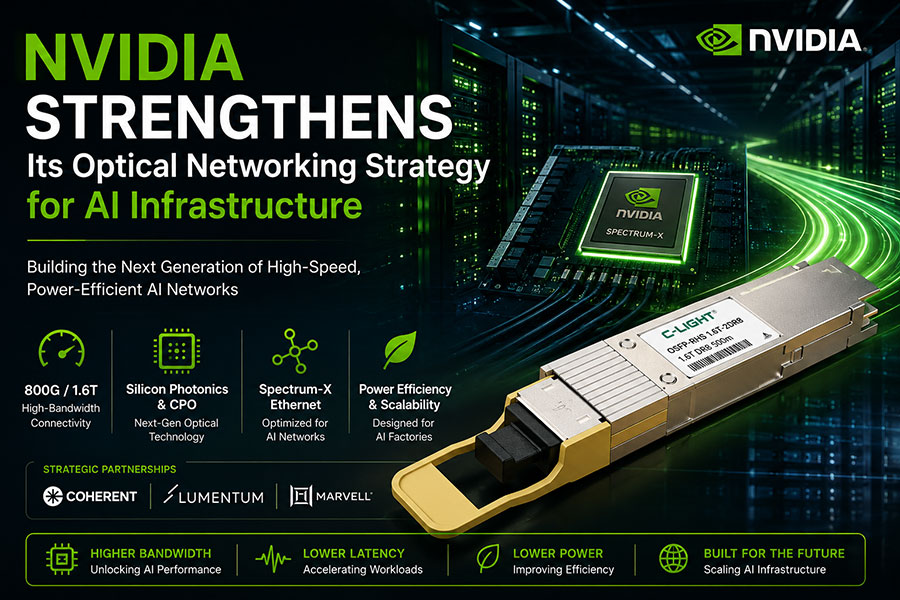
As artificial intelligence infrastructure moves toward larger GPU clusters and gigascale AI factories, networking is becoming one of the most important factors limiting overall system performance. NVIDIA is increasingly responding to this challenge by expanding its focus beyond GPUs, CPUs, and conventional networking hardware into advanced optical technologies.
Optical interconnects, silicon photonics, co-packaged optics (CPO), and high-speed Ethernet are becoming increasingly important components of NVIDIA's AI infrastructure strategy. The company's recent partnerships and investments across the optical ecosystem indicate that photonics is no longer viewed simply as a supporting technology, but as a critical part of future AI networking.
1. Why Optical Networking Is Becoming Critical for AI
Modern AI workloads are highly distributed. Training and inference increasingly involve thousands, tens of thousands, and eventually hundreds of thousands of GPUs working together.
These accelerators must continuously exchange model parameters, activations, gradients, and other data. As the number of GPUs increases, the amount of traffic moving between compute nodes also increases dramatically.
This creates a fundamental networking challenge: GPU performance can continue increasing rapidly, but the network must also provide sufficient bandwidth, low latency, predictable performance, and energy efficiency to keep those GPUs fully utilized.
NVIDIA describes its networking architecture as a multi-layer system that combines NVLink for scale-up communication, Quantum InfiniBand and Spectrum-X Ethernet for scale-out networking, and Spectrum-XGS for communication across data centers. The company is also adding next-generation silicon photonics to this architecture. :contentReference[oaicite:1]{index=1}
As AI clusters become larger, optical connectivity therefore becomes increasingly important for maintaining the performance of the entire computing system.
2. NVIDIA Is Moving Beyond Conventional Pluggable Optics
Traditional data center networks commonly use pluggable optical transceivers installed in switch front panels. This architecture remains important and will continue to support a large portion of AI networking deployments.
However, higher bandwidth creates new challenges for pluggable optics.
Higher electrical signaling rates increase signal integrity requirements.
Higher optical bandwidth increases module complexity.
Higher power consumption creates greater thermal pressure.
Increasing port density makes front-panel thermal management more difficult.
Large AI clusters require enormous numbers of optical connections.
These limitations are encouraging the industry to investigate architectures in which optical engines are placed closer to the switching ASIC.
This is where NVIDIA's silicon photonics and CPO strategy becomes particularly important.
3. NVIDIA's Silicon Photonics Strategy
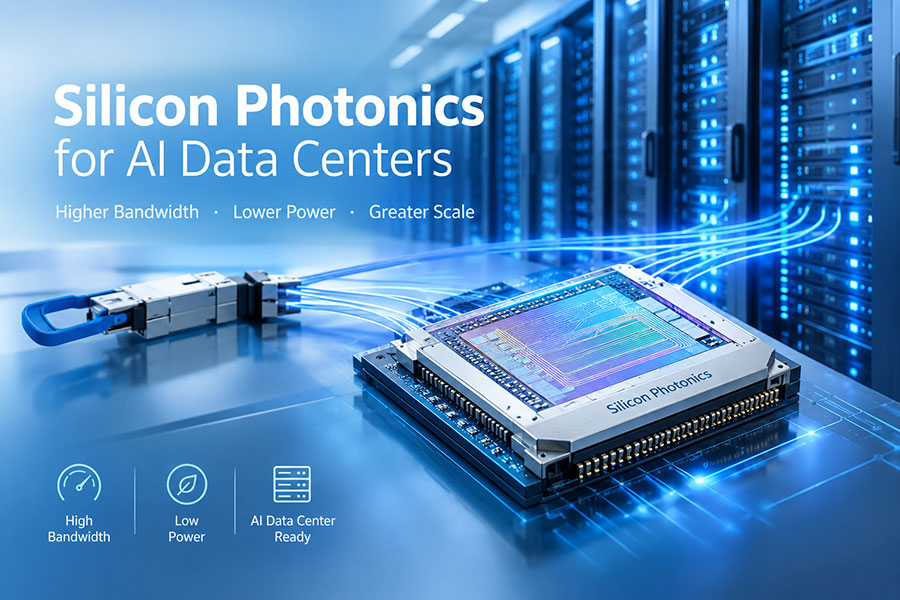
Silicon photonics integrates optical functions with semiconductor-based photonic technology, enabling high-speed optical communication while reducing some of the physical and electrical limitations associated with conventional architectures.
NVIDIA has incorporated silicon photonics into its next-generation networking strategy. Its Spectrum-X Ethernet platform now includes photonics-based networking approaches designed to improve power efficiency and scalability for AI factories.
NVIDIA states that Spectrum-X Ethernet Photonics places optical technology on the same package as the switch ASIC and is designed to reduce network power consumption and improve resiliency compared with traditional pluggable transceiver-based networks. :contentReference[oaicite:2]{index=2}
This represents an important architectural change.
Instead of treating the optical module as an independent component attached to a switch, the optical engine increasingly becomes part of the switch architecture itself.
4. CPO Becomes Part of the AI Networking Roadmap
Co-Packaged Optics is one of the most important technologies in NVIDIA's optical networking strategy.
In a traditional pluggable architecture, the electrical signal travels from the switch ASIC across the board and into a pluggable optical transceiver. As signaling speeds increase, this electrical path becomes increasingly difficult to manage.
CPO changes the architecture by positioning optical engines much closer to the switching ASIC.
This can reduce the length of high-speed electrical connections and potentially improve power efficiency, signal integrity, and system-level scalability.
NVIDIA's current networking strategy explicitly includes co-packaged optical switching. Its Spectrum-X platform identifies silicon photonics and optical integration as important technologies for scaling AI infrastructure.
5. NVIDIA's Investment in the Optical Supply Chain
One of the strongest signals of NVIDIA's optical strategy is its direct engagement with optical component suppliers.
In March 2026, NVIDIA announced a multiyear strategic partnership with Coherent to advance advanced optics technology, expand manufacturing capacity, and strengthen research and development for next-generation AI infrastructure. NVIDIA announced a $2 billion investment in Coherent as part of the agreement.
NVIDIA also announced a separate strategic agreement with Lumentum to accelerate advanced optics technologies and support next-generation AI infrastructure, accompanied by another $2 billion investment.
Together, these agreements demonstrate that NVIDIA is approaching optical connectivity not only from the system-design side, but also from the component and manufacturing supply-chain side.
This is significant because the optical ecosystem requires specialized lasers, photonic components, optical engines, packaging technologies, manufacturing capacity, and high-volume testing.
6. Why Coherent and Lumentum Matter
The importance of these partnerships extends beyond securing additional optical components.
Next-generation AI networking requires a broad optical ecosystem covering multiple technological layers:
Laser technologies
Optical transceivers
Silicon photonics
Optical engines
Photonic integrated circuits
Advanced optical packaging
High-speed optical testing
High-volume manufacturing
By strengthening relationships with major optical technology suppliers, NVIDIA can potentially accelerate the development and commercialization of these technologies while improving access to manufacturing capacity.
This becomes particularly important as AI infrastructure moves toward higher optical bandwidth and larger deployment volumes.
7. NVIDIA and Marvell Expand the Photonics Ecosystem
NVIDIA's optical strategy is not limited to traditional optical component manufacturers.
In March 2026, NVIDIA and Marvell announced a strategic partnership connected to the NVIDIA AI factory and NVLink Fusion ecosystem. The companies also stated that they would collaborate on silicon photonics technology, while NVIDIA invested $2 billion in Marvell.
The partnership highlights another important direction: optical technology is becoming integrated with broader compute and networking architectures rather than remaining an isolated transceiver technology.
This could create a more tightly integrated ecosystem spanning custom compute, networking, optical connectivity, and AI infrastructure.
8. Spectrum-X and the Optical Networking Layer
NVIDIA Spectrum-X is central to the company's Ethernet strategy for AI.
The platform combines Spectrum Ethernet switches and NVIDIA SuperNIC technologies to provide a networking architecture optimized for large-scale AI workloads. NVIDIA positions Spectrum-X as a full-stack Ethernet platform designed specifically for AI factories.
The evolution of Spectrum-X is particularly relevant to optical networking because the network increasingly needs to scale across:
GPU servers
AI racks
GPU clusters
Data center buildings
Multiple data center locations
As these distances and bandwidth requirements increase, optical connectivity becomes a fundamental layer of the networking architecture.
9. From 800G to 1.6T Optical Connectivity
The evolution of optical networking is also closely connected with the transition from 800G to 1.6T connectivity.
800G optical modules are becoming increasingly important for large AI clusters, while 1.6T connectivity represents the next major bandwidth step.
At the 1.6T level, the industry must address significantly higher electrical and optical signaling requirements, including:
200G-per-lane architectures
PAM4 signaling
Higher-bandwidth electrical interfaces
Advanced EML and silicon photonics technologies
Improved thermal management
Higher-density optical connectors
NVIDIA's networking roadmap is increasingly aligned with this bandwidth evolution. Its next-generation silicon-photonics networking platforms are designed around very high-bandwidth optical ports, including 1.6Tb/s-class connectivity. :contentReference[oaicite:8]{index=8}
10. Pluggable Optics Will Still Have an Important Role
The rise of CPO does not mean that conventional pluggable optical modules will disappear.
Pluggable optics offer important advantages in deployment flexibility, serviceability, interoperability, field replacement, and network upgrades.
For many data center architectures, pluggable transceivers will continue to provide a practical solution for scale-out connectivity.
The more likely development is a multi-layer optical ecosystem in which different architectures coexist:
400G: Established high-speed optical connectivity for a wide range of data center applications.
800G: Increasingly important for large AI clusters and high-performance Ethernet fabrics.
1.6T: Emerging as the next bandwidth generation for very large AI infrastructure.
CPO: Designed to address power, electrical reach, and bandwidth challenges at the switch level.
Silicon Photonics: Provides an important technology foundation for future optical integration.
11. Optical Networking Is Becoming a System-Level Issue
One of the most important changes in NVIDIA's strategy is that optical connectivity is no longer treated as a simple module specification.
In earlier generations, system designers could often select a transceiver according to data rate, reach, wavelength, and connector type.
At AI-factory scale, optical networking becomes a system-level engineering problem.
Network designers must consider:
GPU communication patterns
Network topology
Switch bandwidth
Optical port density
Power consumption
Thermal management
Fiber infrastructure
Optical module availability
Manufacturing scalability
Network reliability
This explains why NVIDIA is increasingly involved in both networking architecture and optical technology development.
12. The Role of Optical Interconnects in Gigascale AI Factories
NVIDIA's Vera Rubin platform provides a clear example of this architectural direction. NVIDIA announced that Spectrum-X Ethernet Photonics is in production as part of the Vera Rubin platform, combining co-packaged optics with Spectrum-X switching for large-scale AI factories.
NVIDIA has also introduced Spectrum-6, a 102.4Tb/s Ethernet switch system designed for gigascale AI infrastructure. The company positions the architecture as a foundation for connecting hundreds of thousands of GPUs.
These developments illustrate a broader trend: the scale of AI infrastructure is pushing networking from a supporting subsystem toward one of the primary determinants of overall system performance.
13. Why Power Efficiency Matters
Power consumption is becoming one of the most important challenges in AI data centers.
Large AI clusters already require substantial electrical power for GPUs, CPUs, memory, networking, and cooling. If network bandwidth increases while optical and electrical interconnect power also increases proportionally, the overall efficiency of the AI factory can deteriorate.
This creates a strong incentive to reduce the energy required to move each bit of data.
NVIDIA's photonics strategy directly addresses this issue. The company has highlighted power efficiency as a major advantage of its Spectrum-X Ethernet Photonics architecture compared with traditional pluggable approaches.
For future AI infrastructure, optical networking therefore needs to deliver not only higher bandwidth, but also better bandwidth-per-watt.
14. What NVIDIA's Optical Strategy Means for the Optical Industry
NVIDIA's increasing investment in photonics has implications for the broader optical communication industry.
The market is likely to see continued demand for several technology categories:
800G optical transceivers
1.6T optical transceivers
200G-per-lane optical technologies
Silicon photonics
Co-packaged optics
Optical engines
High-speed lasers
Advanced optical packaging
High-density fiber connectivity
At the same time, suppliers will face increasingly demanding requirements for power efficiency, optical performance, manufacturing scale, reliability, and supply-chain capacity.
15. C-LIGHT and the Evolution of High-Speed Optical Connectivity
The evolution toward AI-driven networking is creating demand for optical products across multiple bandwidth generations.
C-LIGHT's product portfolio covers a range of optical connectivity technologies relevant to this transition, including 400G, 800G, and 1.6T optical modules as well as DAC, AOC, and AEC interconnect solutions.
These technologies address different parts of the AI data center network:
400G optical modules: High-speed connectivity for existing and expanding data center networks.
800G optical modules: High-bandwidth connectivity for AI clusters and next-generation Ethernet fabrics.
1.6T optical modules: Higher-bandwidth connectivity for future AI infrastructure.
AEC: Active electrical connectivity for short-reach high-bandwidth applications.
AOC: Active optical connectivity for high-density data center links.
DAC: Cost-effective short-distance interconnect solutions for suitable AI and data center applications.
The future AI network will not depend on a single interconnect technology. Instead, different optical and electrical solutions will coexist according to bandwidth, reach, power, topology, and system requirements.
16. The Future: From Optical Modules to Optical Infrastructure
NVIDIA's current strategy suggests that the optical networking industry is moving toward a broader concept of optical infrastructure.
The key question is no longer simply how to build a faster optical transceiver. The larger question is how to build an AI network that can move enormous volumes of data with the lowest possible latency and energy consumption.
This transition will likely drive continued development across the entire optical technology stack, from lasers and photonic integrated circuits to optical engines, transceivers, switches, fiber infrastructure, and CPO systems.
17. Frequently Asked Questions
Q1:Why is NVIDIA increasing its focus on optical networking?
Answer: AI clusters are becoming increasingly large and communication-intensive. Optical networking provides the bandwidth, reach, and energy-efficiency characteristics required to connect large numbers of GPUs and networking devices.
Q2:What is NVIDIA's role in silicon photonics?
Answer: NVIDIA is incorporating silicon photonics into its next-generation networking platforms and working with technology partners to advance optical engines, manufacturing, and photonic technologies for AI infrastructure.
Q3:Why is CPO important for AI data centers?
Answer: CPO places optical engines closer to the switching ASIC, potentially reducing high-speed electrical reach and improving power efficiency and scalability as switch bandwidth increases.
Q4:Will pluggable optical modules be replaced by CPO?
Answer: Not necessarily. Pluggable modules provide flexibility and serviceability and will continue to play an important role. CPO and pluggable optics are expected to coexist for different applications and system architectures.
Q5:Why are 800G and 1.6T optical modules important for AI?
Answer: Larger AI clusters require increasingly high bandwidth between GPUs, servers, and switches. 800G and 1.6T optical modules increase bandwidth per network port and support the continued scaling of AI fabrics.
Q6:What companies are working with NVIDIA on optical technologies?
Answer: NVIDIA has announced strategic optical technology relationships with companies including Coherent, Lumentum, and Marvell. These collaborations cover areas such as advanced optics, silicon photonics, manufacturing, and AI networking infrastructure.
Q7:How does optical networking affect AI data center power consumption?
Answer: As network bandwidth increases, the energy required to move data becomes increasingly important. Advanced photonics and optical integration can reduce the power required for high-bandwidth connectivity and improve bandwidth-per-watt.
Q8:What is the future direction of NVIDIA optical networking?
Answer: NVIDIA is moving toward a combination of high-speed pluggable optics, silicon photonics, optical engines, and co-packaged optics integrated into larger AI networking platforms.
18. Conclusion
NVIDIA's expanding optical networking strategy reflects a fundamental change in AI infrastructure. As GPU clusters grow from thousands to hundreds of thousands of accelerators, networking capacity, power consumption, and optical scalability are becoming critical factors in overall AI system performance.
The company's investments in Coherent and Lumentum, collaboration with Marvell, and continued development of Spectrum-X Ethernet Photonics demonstrate a clear shift toward deeper integration of photonics into AI networking.
The transition from 400G to 800G and eventually 1.6T, together with the development of silicon photonics and CPO, will create a more tightly integrated optical networking ecosystem.
For the optical communication industry, the message is clear: AI is not only increasing demand for faster optical modules. It is changing the architecture of the network itself.
 >
>

 >
>
 >
>
 >
>
 >
>
 >
>
 >
>
 >
>