TEL:+86 132 6656 7067




1. Introduction
800G Direct Attach Copper (DAC) cables provide a short-reach, high-bandwidth interconnect option for data centers, AI clusters, HPC systems, and high-density Ethernet or InfiniBand networks. At 800G, two important pluggable form-factor families are OSFP and QSFP-DD. Although both can carry 800G-class traffic, their mechanical design, host cage requirements, thermal implementation, cable configurations, and deployment environments are different.
2. What Is an 800G DAC?
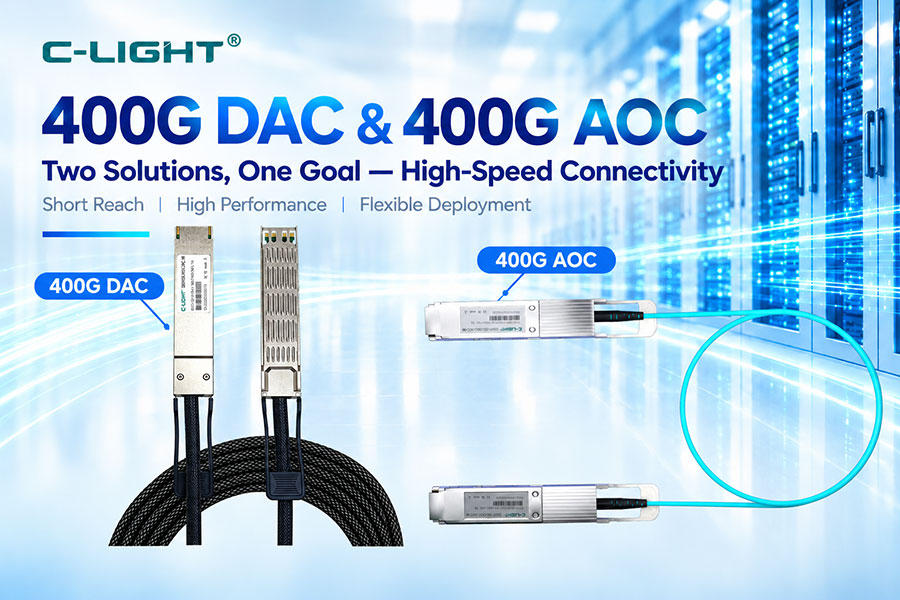
An 800G DAC is a high-speed copper cable with factory-attached pluggable ends. Unlike an optical transceiver connected with separate fiber, a DAC integrates the cable and connector modules into one assembly. Passive DACs do not contain optical lasers or receivers and are primarily intended for short-distance connections.
3. What Is an 800G OSFP DAC?
An 800G OSFP DAC uses OSFP-family connector modules on the ends of the copper cable. OSFP provides eight high-speed electrical lanes and has a larger mechanical envelope than QSFP-family modules. It is widely used for high-bandwidth networking platforms designed around the OSFP cage architecture.
4. What Is an 800G QSFP-DD DAC?
An 800G QSFP-DD DAC uses QSFP-DD connector modules at both ends or uses a breakout configuration. QSFP-DD extends the traditional QSFP architecture with additional electrical contacts to support eight high-speed lanes. Its smaller QSFP-based mechanical footprint makes it useful in switches, NICs, and other platforms designed around QSFP-DD cages.
5. Why Compare OSFP DAC and QSFP-DD DAC?
The two cable families can provide similar 800G bandwidth, but the cable cannot be selected independently of the host equipment. The cage, connector interface, electrical lane configuration, power class, thermal design, port mode, and supported cable types must all match the network platform.
6. 800G Electrical Architecture
800G interfaces commonly use eight electrical lanes in the 100G-class range. PAM4 signaling is widely used for this generation, allowing two bits per symbol. Exact lane rates, FEC implementation, electrical specifications, and host interfaces vary by platform and application.
7. Eight-Lane Connectivity
Both OSFP and QSFP-DD can provide eight electrical lanes for 800G implementations. This allows the two form factors to support similar aggregate bandwidth while using different mechanical designs and host interfaces.
8. Basic Comparison
| Feature | 800G OSFP DAC | 800G QSFP-DD DAC |
|---|---|---|
| Form Factor | OSFP family | QSFP-DD |
| Electrical Lanes | 8 high-speed lanes | 8 high-speed lanes |
| Transmission Medium | Copper | Copper |
| Typical Use | High-density AI/HPC platforms | Data center and Ethernet platforms |
| Host Cage | OSFP-compatible cage | QSFP-DD-compatible cage |
| Optical Components | No | No |
| Typical Reach | Short reach | Short reach |
9. Mechanical Form Factor
Mechanical design is one of the most important differences. OSFP has a larger module envelope, while QSFP-DD keeps the smaller QSFP-based footprint. The physical cage installed in the switch, NIC, or other equipment determines which cable end can be inserted.
10. Host Cage Compatibility
An OSFP DAC requires an OSFP-compatible host interface, while a QSFP-DD DAC requires a QSFP-DD interface. A cable should not be selected simply because both products are labeled 800G. The host platform documentation should be checked first.
11. Are OSFP and QSFP-DD DACs Interchangeable?
No. OSFP and QSFP-DD are different mechanical form factors. An OSFP connector is not a direct mechanical replacement for a QSFP-DD connector, and vice versa. The host cage and connector system must match the selected cable.
12. Backward Compatibility
QSFP-DD was developed as an extension of the QSFP family and can provide a migration path within platforms designed to support multiple QSFP generations. However, mechanical compatibility does not automatically mean electrical or software compatibility. Each host platform must be checked for supported modules and cable configurations.
13. OSFP Platform Considerations
OSFP platforms are commonly designed around the higher thermal and mechanical requirements of high-speed networking. The larger connector envelope can support different heat-sink and thermal-management implementations, depending on the equipment design.
14. QSFP-DD Platform Considerations
QSFP-DD platforms retain the compact QSFP-oriented architecture and are widely used in high-density switches and network equipment. The cage, heat sink, connector, and airflow system must be considered together when deploying 800G DACs.
15. Cable Length
800G DACs are intended for short-distance connections. Actual supported cable length depends on the cable gauge, passive or active architecture, connector design, host electrical channel, and manufacturer specifications. C-LIGHT 800G DAC configurations, for example, include short cable lengths such as 0.5m to 2m for specified form-factor combinations.
16. Why 800G DAC Reach Is Limited
At very high data rates, copper channels experience insertion loss, return loss, crosstalk, and other signal-integrity limitations. These effects increase with cable length and frequency, making passive copper most practical for short links where the electrical channel can remain within the host system's design limits.
17. Passive DAC
A passive DAC contains no active signal-conditioning electronics in the cable assembly. It provides a direct copper electrical path between the two endpoints and is generally used where the total electrical channel remains within the supported specification.
18. Active Electrical Cable
Active electrical cables can include electronics for signal conditioning or equalization. They can extend the usable electrical reach beyond some passive implementations, but they are not identical to passive DACs and may have different power, thermal, cost, and compatibility requirements.
19. OSFP DAC Cable Types
OSFP DAC assemblies can be configured as OSFP-to-OSFP straight-through cables or as breakout assemblies connecting one high-bandwidth port to multiple lower-rate ports. The exact configurations depend on the switch and NIC architecture.
20. QSFP-DD DAC Cable Types
QSFP-DD DACs can also be available as straight-through 800G connections or breakout configurations. Breakout cables are useful when one 800G interface needs to connect to multiple lower-speed interfaces supported by the host platform.
21. Breakout DAC
An 800G breakout DAC can distribute one 800G connection into two 400G or four 200G connections when the platform supports the corresponding breakout mode. This can simplify connections between different generations of switches, NICs, or accelerators.
22. OSFP to QSFP-DD DAC
Cross-form-factor DAC assemblies are also possible in some deployment scenarios. An OSFP-to-QSFP-DD cable can connect an OSFP host to a QSFP-DD host when the cable electrical configuration, lane mapping, breakout mode, and platform support are compatible. This is different from treating OSFP and QSFP-DD as mechanically interchangeable.
23. Straight-Through vs Breakout
| Configuration | Typical Structure | Application |
|---|---|---|
| Straight-through | 800G to 800G | Switch-to-switch or switch-to-NIC |
| 2-way breakout | 800G to 2 × 400G | Connecting different port rates |
| 4-way breakout | 800G to 4 × 200G | Mixed-speed network architectures |
| Cross-form-factor | OSFP to QSFP-DD | Platform interoperability |
24. Thermal Management
Although passive DACs do not contain optical engines or module DSPs, thermal management remains relevant at the host interface. High-speed electrical channels generate heat in the host ASIC, SerDes, connector, and surrounding circuitry. OSFP and QSFP-DD platforms use different mechanical and thermal solutions, so cable selection should consider the installed cage and airflow design.
25. OSFP Thermal Design
The larger OSFP form factor provides additional mechanical space for certain heat-sink configurations. Depending on the platform, OSFP implementations may use integrated or host-side thermal solutions. The actual thermal behavior depends on the host system rather than the connector name alone.
26. QSFP-DD Thermal Design
QSFP-DD uses a more compact form factor, so cage and heat-sink design are particularly important in dense 800G deployments. Adjacent-port loading, airflow direction, switch power limits, and the module or cable implementation should all be verified.
27. Signal Integrity
At 800G, signal integrity is critical for both OSFP and QSFP-DD DACs. The electrical path includes the host ASIC, PCB traces, connector, cable, and receiving interface. Loss and reflection across this complete channel influence eye opening and error performance.
28. PAM4 and 800G DAC
PAM4 uses four voltage levels to encode two bits per symbol, increasing the amount of data carried by each symbol compared with NRZ. The smaller eye openings of PAM4 make channel loss, crosstalk, equalization, and FEC performance important considerations for 800G electrical connections.
29. FEC Considerations
High-speed 800G systems commonly use forward error correction to improve link reliability. However, FEC support and configuration are controlled by the host platform and network architecture. A DAC that is electrically suitable for one platform should not be assumed to support another platform's FEC mode without validation.
30. InfiniBand Applications
800G DACs are widely relevant to high-performance computing and AI networks using high-speed interconnect architectures. OSFP and QSFP-DD variants can be used depending on the specific switch, accelerator, NIC, and cabling architecture.
31. Ethernet Applications
800G Ethernet networks can use DACs for short switch-to-switch, switch-to-NIC, and server connectivity. QSFP-DD and OSFP platforms are both used in 800G-class networking, but the exact supported cable configuration is platform dependent.
32. AI Data Center Applications
AI clusters generate high volumes of east-west traffic between GPUs, NICs, switches, and storage systems. Short high-bandwidth links can use DACs to reduce the complexity of separate optical modules and fiber patching, particularly inside a rack or between closely positioned devices.
33. GPU-to-Switch Connections
GPU servers and high-speed NICs may require very high-bandwidth short-reach connections to the network fabric. An 800G DAC can be suitable when the GPU server, NIC, switch port, and cable reach all support the required electrical interface.
34. Switch-to-Switch Connections
Short switch-to-switch links inside an AI or HPC environment can also use 800G DACs. For longer distances, optical solutions such as AOC or pluggable optical transceivers generally provide greater reach and routing flexibility.
35. Rack-Level Deployment
DACs are particularly useful when endpoints are physically close. Their integrated cable construction simplifies patching and eliminates the need for separate transceiver and fiber assemblies. Cable routing and bend management remain important in dense racks.
36. Port Density
Port density is affected by the host cage, connector envelope, thermal design, and surrounding system architecture. QSFP-DD maintains a compact QSFP-oriented footprint, while OSFP uses a larger form factor designed for high-speed applications. Neither characteristic should be evaluated independently from the actual switch design.
37. Power Consumption
Passive DACs generally have no active optical or electronic components in the cable itself, so they avoid the transceiver-level power consumption associated with lasers, receivers, and DSPs. However, the host SerDes and switching ASIC still consume power when driving an 800G electrical link.
38. Latency
Passive electrical cables provide a direct physical connection and do not add optical conversion or transceiver DSP processing. This makes them attractive for short-reach architectures where minimizing link complexity and latency is important.
39. Cable Gauge
High-speed DACs can use different conductor gauges to balance electrical performance, flexibility, weight, and thermal characteristics. Cable gauge should be selected according to the manufacturer's supported length and system requirements rather than based only on the 800G label.
40. Cable Management
800G DAC cables can be relatively thick and less flexible than smaller-speed copper cables. In high-density racks, cable routing, bend radius, connector access, and airflow should be considered during installation. A technically compatible cable can still create practical rack-management issues if too many thick cables are concentrated in one area.
41. DAC vs AOC
| Feature | 800G DAC | 800G AOC |
|---|---|---|
| Medium | Copper | Optical fiber |
| Typical Reach | Very short | Longer short-reach |
| Power | Very low for passive DAC | Requires active optical electronics |
| EMI Sensitivity | Electrical channel considerations | Fiber has low EMI sensitivity |
| Cabling | Integrated copper cable | Integrated optical cable |
| Best Fit | Short high-speed links | Longer short-reach links |
42. DAC vs Optical Transceiver
An 800G DAC integrates both endpoints and the cable into one assembly, making it convenient for short connections. Optical transceivers separate the transceiver from the fiber cable and provide more flexibility in distance, routing, and infrastructure. The choice depends heavily on the physical distance and network architecture.
43. OSFP DAC vs QSFP-DD DAC: Compatibility
Compatibility should be verified at several levels: mechanical form factor, host port support, electrical lane rate, breakout mode, FEC configuration, cable length, EEPROM identification, software release, and vendor qualification. A cable should not be considered compatible solely because its aggregate rate is 800G.
44. EEPROM and Cable Identification
High-speed cable assemblies can include identification information read by the host system. Vendor coding and identification data may affect whether a switch or NIC accepts the cable. Platform-specific restrictions should therefore be checked before large-scale deployment.
45. Interoperability Testing
Interoperability testing is especially important when connecting equipment from different vendors. Test the complete path rather than only the cable. The evaluation should include link establishment, lane health, FEC counters, error performance, temperature, cable length, breakout configuration, and sustained traffic.
46. How to Select an 800G OSFP DAC
Start with the host platform and confirm that the port uses an OSFP-compatible cage. Then verify supported 800G lane configuration, cable length, passive or active architecture, connector type, temperature range, FEC behavior, cable gauge, and vendor qualification.
47. How to Select an 800G QSFP-DD DAC
For QSFP-DD deployments, confirm that the host provides the required QSFP-DD electrical interface and supports the intended cable type. Check the supported 800G mode, breakout options, cable length, thermal environment, identification requirements, and platform software.
48. When to Use 800G OSFP DAC
OSFP DAC is suitable when the host platform is built around an OSFP interface and the required connection is short enough for a supported copper implementation. It can be useful in high-bandwidth AI, HPC, and data center systems where the platform already uses OSFP ports.
49. When to Use 800G QSFP-DD DAC
QSFP-DD DAC is suitable when the network equipment uses QSFP-DD cages and the required link remains within the supported copper reach. Its QSFP-based ecosystem can also be useful where the network architecture includes multiple QSFP generations or breakout connections.
50. When DAC Is Not the Right Choice
DAC is not ideal for every 800G connection. Longer transmission distances, cross-row connectivity, structured fiber infrastructure, or environments requiring greater cable flexibility may call for AOC or optical transceiver solutions instead.
51. 800G OSFP DAC vs QSFP-DD DAC Comparison
| Parameter | 800G OSFP DAC | 800G QSFP-DD DAC |
|---|---|---|
| Form Factor | OSFP | QSFP-DD |
| Bandwidth Class | 800G | 800G |
| Electrical Lanes | 8 | 8 |
| Transmission Medium | Copper | Copper |
| Passive Option | Yes | Yes |
| Typical Distance | Short reach | Short reach |
| Host Interface | OSFP cage | QSFP-DD cage |
| Breakout Options | Platform dependent | Platform dependent |
| Thermal Design | Platform and cage dependent | Platform and cage dependent |
| AI/HPC Use | Common in high-bandwidth platforms | Common in high-density platforms |
| Long-Distance Use | Not intended for long reach | Not intended for long reach |
52. Common Deployment Mistakes
Common mistakes include selecting a cable only by the 800G label, ignoring the host cage, using unsupported breakout configurations, exceeding the specified cable length, mixing incompatible FEC modes, overlooking cable gauge and airflow, and assuming that two different form factors can be mechanically substituted.
53. Troubleshooting an 800G DAC Link
When an 800G DAC fails to establish a link, first check the host port and physical form factor. Next verify cable identification, lane configuration, breakout mode, FEC settings, firmware, cable length, and remote-end compatibility. Check switch or NIC diagnostics for lane errors and FEC counters. Testing with a qualified known-good cable can help isolate the problem.
54. Future Transition to 1.6T
As network speeds move toward 1.6T, electrical channel loss, thermal density, signal integrity, and connector performance become increasingly important. The role of copper interconnects will continue to depend on reach requirements, lane speeds, host SerDes capability, and system architecture.
55. Frequently Asked Questions
Q1. What is the main difference between 800G OSFP DAC and QSFP-DD DAC?
Q2. Do both OSFP DAC and QSFP-DD DAC support 800G?
Q3. Can an OSFP DAC be plugged into a QSFP-DD port?
Q4. What is the typical reach of an 800G DAC?
Q5. Is an 800G DAC passive?
Q6. Can an 800G DAC be used for AI data centers?
Q7. Can 800G DACs support breakout connections?
Q8. Which has better thermal performance, OSFP DAC or QSFP-DD DAC?
Q9. Why choose DAC instead of an 800G optical transceiver?
Q10. When should an 800G AOC or optical module be used instead?
56. Summary
800G OSFP DAC and 800G QSFP-DD DAC both provide short-reach 800G-class electrical connectivity, but they are designed for different host form factors. OSFP uses a larger OSFP-based connector and cage architecture, while QSFP-DD retains the compact QSFP-based form factor with eight high-speed electrical lanes. The correct choice depends on the host platform, cage type, cable configuration, supported reach, thermal design, breakout requirements, and interoperability. For AI data centers, HPC networks, and high-density Ethernet or InfiniBand systems, the most important rule is to match the DAC to the complete host and link architecture rather than choosing only by the 800G data-rate label.
 >
>

 >
>
 >
>
 >
>
 >
>
 >
>
 >
>
 >
>