TEL:+86 132 6656 7067





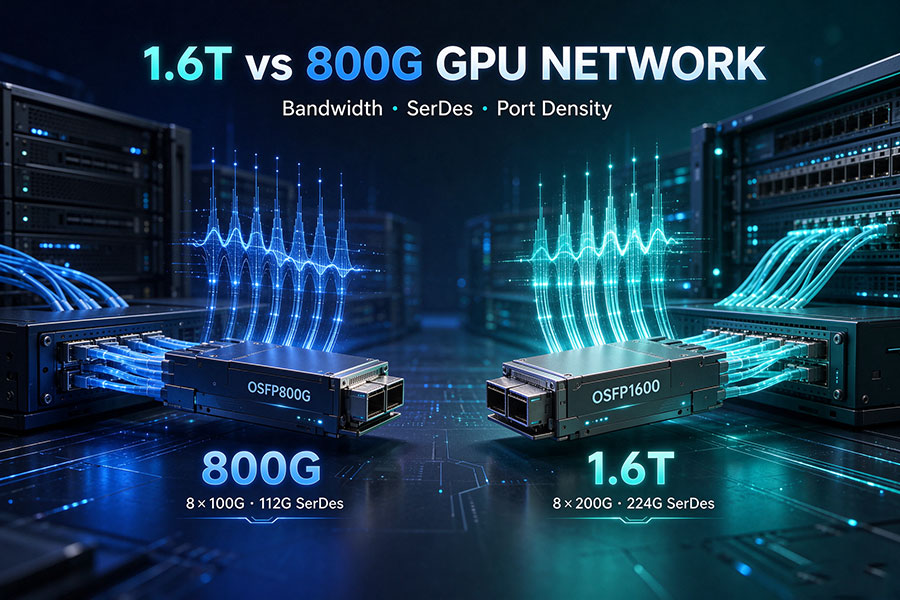
AI data center networks are moving toward higher-speed interfaces as GPU clusters grow in scale and distributed workloads generate increasingly intensive communication traffic. The transition from 800G to 1.6T represents an important step in this evolution, doubling the nominal bandwidth available through a single network port.
The difference extends beyond the optical transceiver. A 1.6T GPU network requires faster electrical signaling, compatible switch ASICs, higher-performance host interfaces and more demanding signal-integrity and thermal engineering. Meanwhile, 800G remains an important foundation for current AI cluster deployments, offering a mature connectivity ecosystem and substantial aggregate bandwidth.
For network architects, the decision involves more than choosing between two port speeds. GPU count, server architecture, switch capacity, oversubscription, optical reach, power consumption and deployment costs all influence the appropriate network generation.
1. What Is an 800G GPU Network?
An 800G GPU network is a high-speed networking infrastructure that provides up to 800Gbps of nominal bandwidth per port. It connects GPU servers, network adapters and switches to support distributed AI training, inference and high-performance computing.
A typical 800G OSFP implementation uses eight electrical lanes operating at approximately 100Gbps per lane. The host electrical interface uses 112G-class PAM4 signaling to accommodate the required data rate and protocol overhead.
800G GPU networks can use Ethernet or InfiniBand, depending on the cluster architecture and equipment ecosystem. Their physical connectivity may include optical transceivers, active optical cables, active electrical cables and direct-attach copper connections.
Common applications include:
GPU server-to-switch connections
AI leaf-spine network fabrics
Distributed model training
High-performance computing clusters
Large-scale AI inference infrastructure
2. What Is a 1.6T GPU Network?
A 1.6T GPU network uses network interfaces with a nominal aggregate bandwidth of 1.6Tbps per port. It doubles the port capacity of 800G and is designed to support higher-bandwidth AI fabrics and next-generation data center switching systems.
In an OSFP1600 implementation, the host interface uses eight electrical lanes operating at approximately 200Gbps per lane. These lanes use 224G-class PAM4 signaling.
The higher electrical lane rate allows the interface to deliver twice the aggregate bandwidth without doubling the number of host electrical lanes.
Potential applications include:
Next-generation GPU scale-out networks
High-capacity AI leaf-spine fabrics
High-bandwidth switch-to-switch connections
Large-scale distributed training clusters
Future AI infrastructure requiring higher port density
3. 1.6T GPU Network vs 800G GPU Network: Key Differences
| Parameter | 800G GPU Network | 1.6T GPU Network |
|---|---|---|
| Nominal port bandwidth | 800Gbps | 1.6Tbps |
| Typical OSFP electrical lanes | 8 lanes | 8 lanes |
| Approximate data rate per lane | 100Gbps | 200Gbps |
| Electrical signaling class | 112G-class PAM4 | 224G-class PAM4 |
| Host interface | 800GAUI-8 | 1.6TAUI-8 |
| Signal integrity requirements | 112G-class electrical channel | More demanding 224G-class electrical channel |
| Switch capacity per equal port count | Lower | Twice the nominal port bandwidth |
| Thermal design | High-speed module cooling required | More demanding module and system thermal planning |
| Deployment position | Established high-speed AI networking generation | Emerging next-generation AI networking generation |
4. 112G SerDes vs 224G SerDes
The most important technical change between 800G and 1.6T OSFP networking is the electrical lane rate.
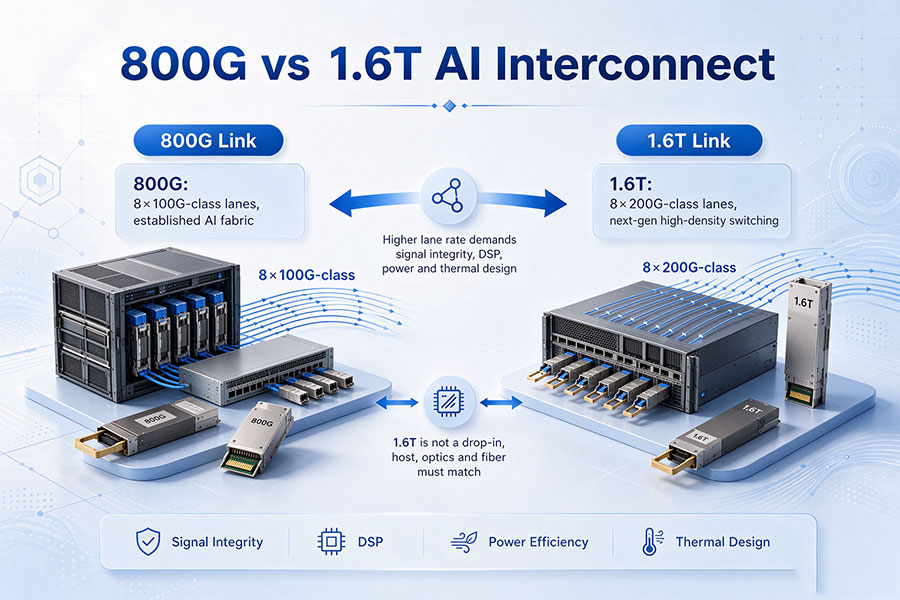
800G uses eight approximately 100Gbps data lanes supported by 112G-class PAM4 electrical signaling. The 1.6T generation moves to eight approximately 200Gbps data lanes using 224G-class PAM4 signaling.
8 × approximately 100Gbps per lane
112G-class PAM4 signaling
800Gbps aggregate interface
8 × approximately 200Gbps per lane
224G-class PAM4 signaling
1.6Tbps aggregate interface
PAM4 encodes two bits per symbol, increasing the amount of information transmitted per symbol compared with NRZ signaling. However, higher signaling rates also increase sensitivity to insertion loss, crosstalk, reflections and other channel impairments.
Consequently, 224G-class interfaces require careful electrical channel design, connector performance, PCB routing and signal conditioning. Host SerDes capability becomes a critical factor when moving from 800G to 1.6T.
5. Switch ASIC Bandwidth and Port Density
One of the main advantages of 1.6T networking is its ability to increase aggregate switch bandwidth without proportionally increasing the number of physical network ports.
For an illustrative switch configuration with 32 equivalent ports:
| Switch Configuration | Port Count | Nominal Aggregate Port Bandwidth |
|---|---|---|
| 800G switch | 32 × 800G | 25.6Tbps |
| 1.6T switch | 32 × 1.6T | 51.2Tbps |
| 800G switch | 64 × 800G | 51.2Tbps |
| 1.6T switch | 64 × 1.6T | 102.4Tbps |
These figures represent the arithmetic sum of nominal port rates, not a guarantee of a particular switch's internal switching capacity or non-blocking performance. Actual products depend on ASIC architecture, port configuration, chassis design and system implementation.
Higher port bandwidth can reduce the number of physical links required for a given aggregate capacity. However, actual front-panel density also depends on module dimensions, cooling, power delivery and host platform design.
6. Impact on GPU Cluster Architecture
GPU clusters rely on high-speed communication between compute nodes. During distributed training, GPUs exchange gradients, tensors and intermediate results through communication operations such as all-reduce.
Moving from 800G to 1.6T can increase the bandwidth available to each connected network interface. This can help reduce the number of physical links needed to deliver a given aggregate network capacity.
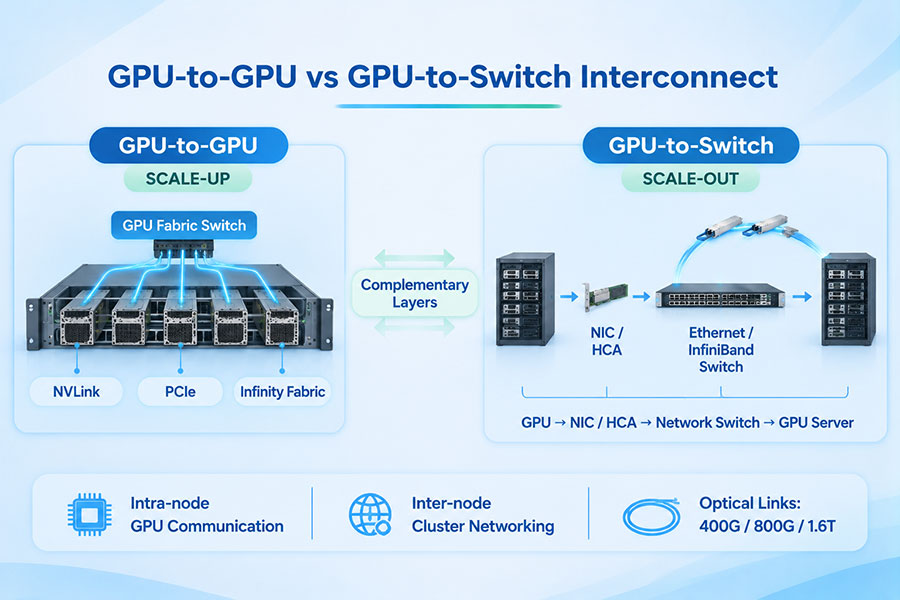
A simplified scale-out architecture is:
GPU server → NIC → optical connection → leaf switch → spine switch → leaf switch → optical connection → GPU server
At 800G, each compatible port provides up to 800Gbps of nominal bandwidth. At 1.6T, the corresponding port can provide up to 1.6Tbps.
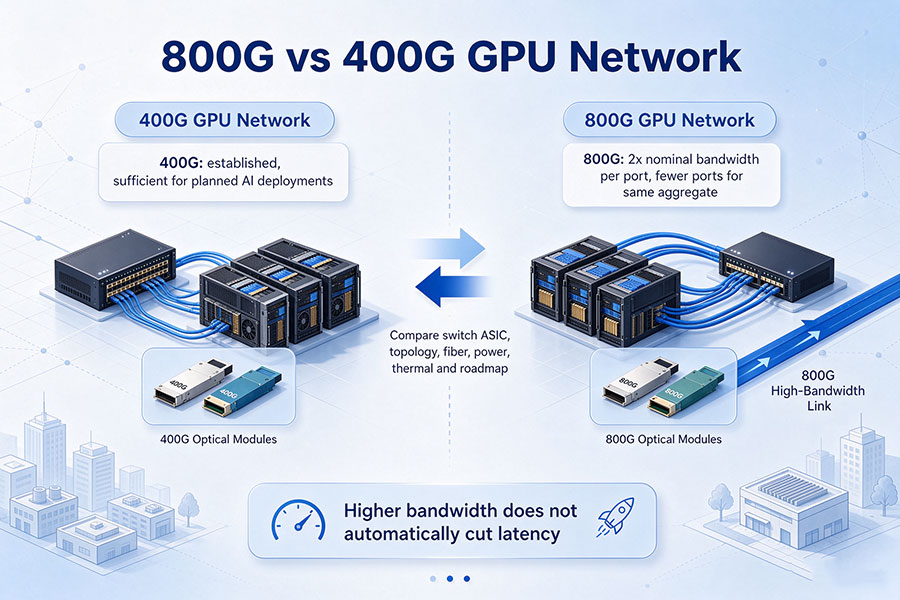
However, the real benefit depends on whether the GPU, NIC, switch ASIC and software stack can use the additional bandwidth. A faster optical port alone does not guarantee better distributed training performance.
7. 800G vs 1.6T in AI Leaf-Spine Networks
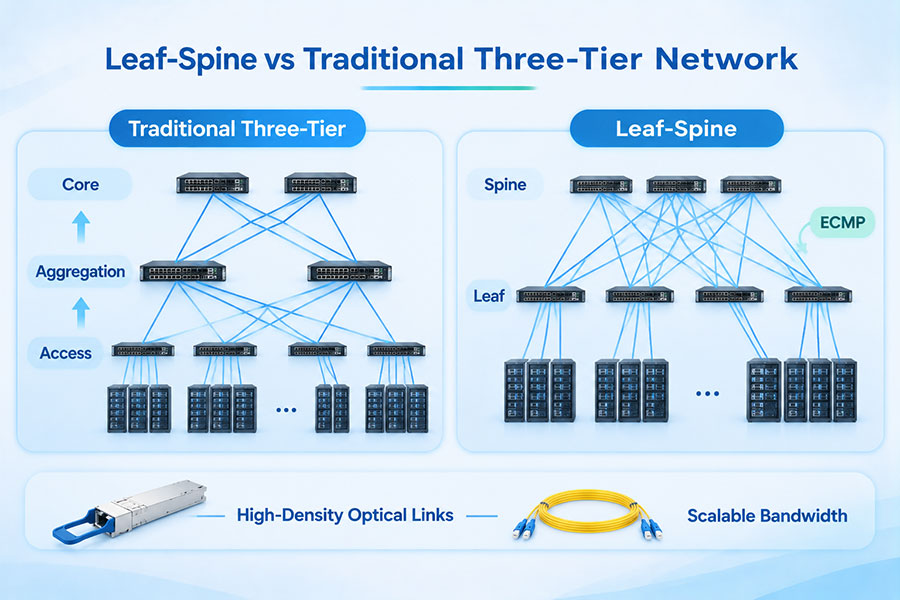
Leaf-spine architecture is widely used in scalable data center networks. Leaf switches connect GPU servers, while spine switches provide paths between leaf switches.
Both 800G and 1.6T interfaces can be used for server-facing or inter-switch connectivity, depending on the supported platform.
| Design Consideration | 800G Fabric | 1.6T Fabric |
|---|---|---|
| Bandwidth per compatible port | 800Gbps | 1.6Tbps |
| Required ports for a fixed aggregate bandwidth | More ports | Potentially fewer ports |
| Electrical interface | 112G-class lanes | 224G-class lanes |
| Platform requirements | Compatible 800G ASIC and host interfaces | Compatible 1.6T ASIC and host interfaces |
| Upgrade considerations | Established 800G ecosystem | May require broader platform upgrades |
Network designers must also evaluate oversubscription. Increasing individual port speed does not automatically eliminate congestion if the uplink capacity, switch fabric or host-facing bandwidth remains insufficient.
8. OSFP800 vs OSFP1600
OSFP is an important pluggable form factor for high-speed data center networking. Both 800G and 1.6T implementations use eight high-speed electrical lanes, but their lane rates and electrical requirements differ.
OSFP800 supports 100G-class electrical lanes, while OSFP1600 uses 200G-class electrical lanes. The mechanical and electrical details must be checked against the applicable OSFP MSA specification and host platform.
Important considerations include:
Host electrical interface generation
Module mechanical variant
Electrical connector and cage compatibility
Module power class
Thermal management design
CMIS management support
Host firmware and platform qualification
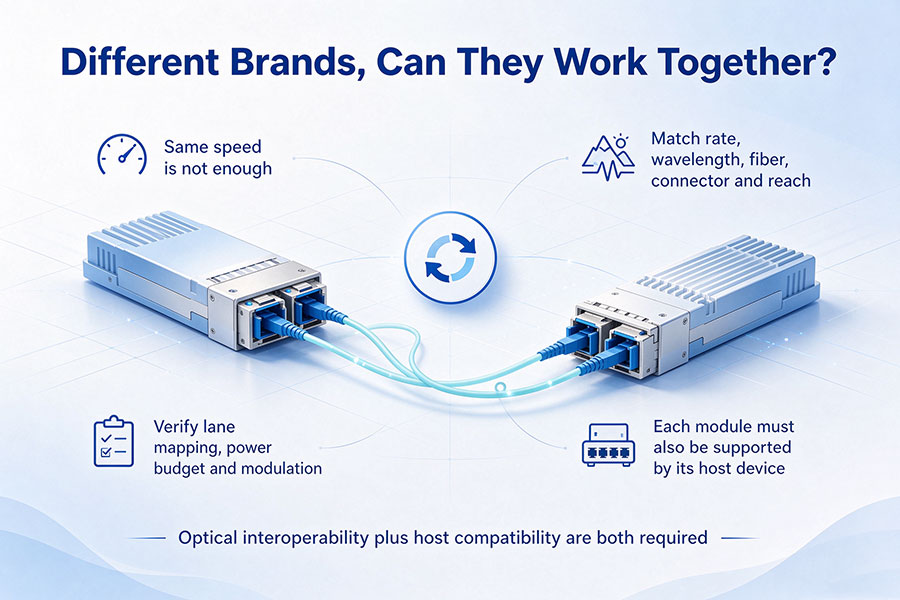
Physical similarity between two OSFP modules does not establish universal interoperability. OSFP800 and OSFP1600 modules must be matched to ports explicitly supporting their respective interfaces. OSFP and OSFP-RHS variants also have mechanical differences that must be checked.
9. Optical Transceiver Technologies for 800G and 1.6T
Higher electrical bandwidth must be converted into an optical signal that can travel through the selected fiber infrastructure. Both 800G and 1.6T networks can use different optical architectures depending on reach, fiber type and deployment requirements.
Examples of optical configurations include:
SR8 and parallel multimode fiber architectures
DR8 and parallel single-mode fiber architectures
2×DR4 implementations
FR4 and wavelength-division multiplexing architectures
Other application-specific optical implementations
For 1.6T, optical implementations can use eight 200G-class optical lanes or multiple optical groups, depending on the module architecture. The exact wavelength plan, connector, reach and fiber requirements must be confirmed in the individual product specification.
Higher aggregate bandwidth does not automatically mean longer transmission distance. Reach is determined by the optical interface design, transmitter and receiver performance, fiber characteristics, dispersion, link budget and error-performance requirements.
10. DAC, AEC and AOC Connectivity
Not every GPU network connection requires a pluggable optical transceiver at both ends. Short-distance connections inside a rack or between adjacent equipment can use copper or active cable technologies when supported by the host platform.
| Connectivity Type | 800G Applications | 1.6T Applications |
|---|---|---|
| DAC | Short-reach passive copper connections | Short-reach connections where the electrical channel and platform support the required rate |
| AEC | Active electrical connections with signal conditioning | Higher-speed active electrical connections using compatible 224G-class technology |
| AOC | Optical cable connections for suitable short-reach links | Active optical cable implementations designed for 1.6T operation |
| Pluggable optical transceiver | Server-to-switch and switch-to-switch fiber links | High-bandwidth fiber links using compatible 1.6T optical modules |
Passive DAC reach is particularly sensitive to electrical channel loss. At higher lane rates, the practical reach and cable construction become more demanding. AEC can extend suitable copper connections through active signal conditioning, while AOC uses optical transmission within the cable assembly.
C-LIGHT's DAC and AEC connectivity portfolio includes 800G and 1.6T OSFP product families for suitable high-speed data center applications. Exact cable compatibility should be confirmed against the target switch and NIC platforms.
11. Power Consumption and Thermal Management
Moving from 800G to 1.6T increases the performance demands placed on electrical and optical components. The higher lane rate, signal processing requirements and optical architecture can affect module power consumption and thermal design.
However, a 1.6T module should not be assumed to consume exactly twice the power of an 800G module. Actual consumption depends on the DSP, optical engine, laser technology, reach, process technology and cooling implementation.
AI data center designers should evaluate:
Maximum module power specified by the manufacturer
Switch port power budget
Airflow direction and cooling capacity
Operating temperature range
Rack-level thermal density
Power consumption per transmitted bit
Cooling requirements for high-density optical ports
Thermal design becomes especially important when a switch contains many high-power optical modules. The complete system must maintain acceptable operating conditions under realistic traffic and environmental loads.
12. Signal Integrity and FEC Requirements
At 224G-class electrical signaling rates, the available signal-integrity margin becomes more demanding. PCB traces, connectors, module contacts, cables and host SerDes must operate as a coordinated electrical channel.
Design considerations include:
Insertion loss
Return loss
Crosstalk
Signal-to-noise ratio
Clock and data recovery
Equalization and DSP performance
Forward error correction
FEC is an important part of high-speed link operation, but its exact implementation depends on the Ethernet or InfiniBand interface and the applicable physical-layer specification.
When upgrading a GPU network, engineers must verify that the host interface, optical module and switch port support compatible FEC behavior. A mismatch can prevent the link from operating correctly even when the nominal port speeds appear compatible.
13. Network Upgrade from 800G to 1.6T
Upgrading an existing 800G GPU network to 1.6T is not simply a matter of replacing 800G optical modules with 1.6T modules. The complete networking platform must support the higher electrical and optical interface.
A practical upgrade evaluation should cover:
Switch ASIC support for 1.6T ports
Host NIC or network adapter capability
224G-class SerDes support
OSFP1600 or other supported module form factors
Optical fiber infrastructure and connector compatibility
Switch power and thermal budgets
Firmware, management and diagnostic support
Network topology and oversubscription targets
In some environments, a phased deployment may be more practical than replacing the entire 800G infrastructure at once. New 1.6T switches can be introduced in selected network layers while existing 800G equipment continues to serve compatible links. Any interconnection between generations must use explicitly supported port modes and link configurations.
14. 800G or 1.6T: Which Is Better for GPU Networks?
Neither generation is universally the better choice. The appropriate interface depends on current platform support, GPU cluster scale, traffic requirements, deployment timing and total infrastructure cost.
The existing GPU servers and switches support 800G.
The required bandwidth can be delivered through available 800G ports.
The deployment needs an established high-speed connectivity ecosystem.
Power and thermal budgets favor the selected 800G platform.
A phased network expansion is preferred.
The switch and host platforms support 1.6T interfaces.
Higher bandwidth per port is a key design requirement.
224G-class electrical signaling is supported throughout the link.
The network requires greater aggregate capacity.
The deployment can accommodate the thermal and infrastructure requirements.
15. C-LIGHT 800G and 1.6T Connectivity Solutions
As AI networking moves toward higher port speeds, selecting compatible optical and electrical connectivity becomes an important part of system integration.
C-LIGHT offers high-speed connectivity product families for data center and AI networking applications, including:
800G OSFP DAC and AEC
1.6T OSFP DAC and AEC
400G QSFP-DD, OSFP and QSFP112 DAC and AEC
High-speed optical transceiver solutions
For fiber-based network connections, visit the C-LIGHT Optical Transceiver portfolio. For high-speed copper and active cable connectivity, visit C-LIGHT Products.
Product selection should be based on the target switch or NIC model, supported electrical interface, protocol, cable length, optical reach, power budget and operating environment. Nominal data rate alone is not sufficient to establish interoperability.
16. Conclusion
The transition from 800G to 1.6T represents a major increase in GPU network port bandwidth. By moving from eight 100G-class electrical lanes to eight 200G-class lanes, 1.6T OSFP interfaces can provide twice the nominal bandwidth through an eight-lane host interface.
For AI data centers, this can increase switch capacity, improve bandwidth density and reduce the number of physical ports needed for a given aggregate network capacity. At the same time, 224G-class SerDes, electrical channel design, optical implementation, power consumption and cooling introduce additional engineering requirements.
800G remains an important option for existing AI clusters and compatible platforms, while 1.6T provides a higher-bandwidth path for next-generation infrastructure. The best deployment depends on the complete network architecture rather than the optical module speed alone.
C-LIGHT provides high-speed optical transceiver solutions and DAC and AEC connectivity options for suitable data center and AI networking applications.
For 800G or 1.6T GPU network connectivity, product compatibility testing or customized high-speed interconnect requirements, Contact C-LIGHT.
 >

 >
 >
 >
 >
 >
 >
 >