TEL:+86 132 6656 7067




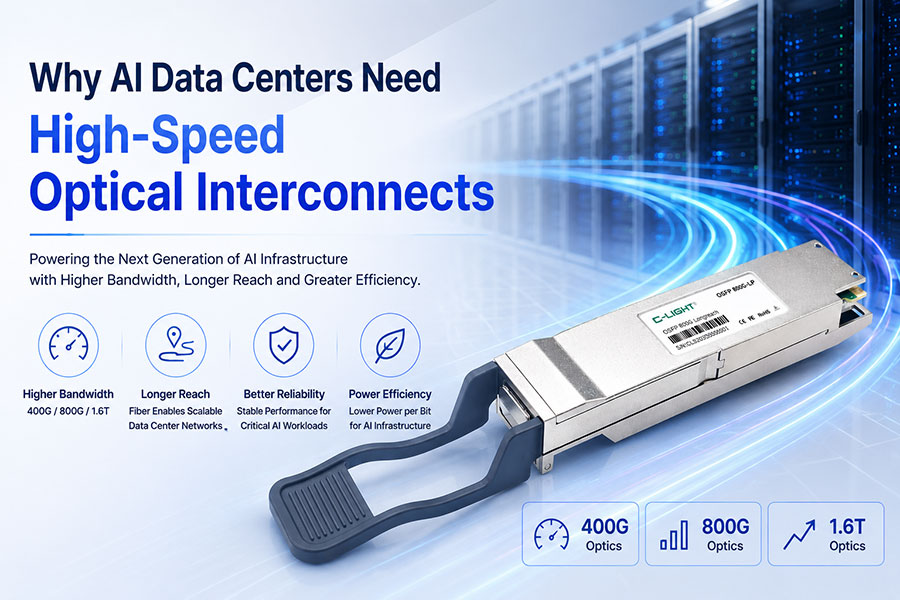
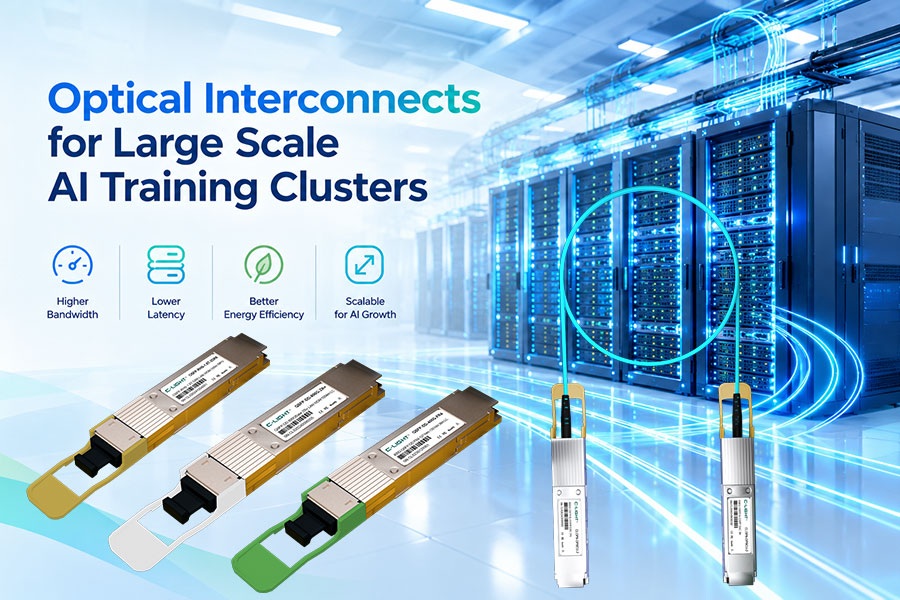
AI data centers are placing new demands on network infrastructure. Large clusters of GPUs and other accelerators continuously exchange model parameters, training data, intermediate results, and storage traffic. As the number of connected devices increases, the interconnect between computing and networking equipment becomes an increasingly important part of overall system performance.
High-speed optical interconnects provide a scalable approach to these requirements. By using optical transmission for high-bandwidth links, data centers can support longer reach and higher aggregate bandwidth while addressing some of the signal integrity and power challenges associated with very high-speed electrical connections.
1. AI Workloads Create Higher Network Bandwidth Requirements
AI workloads are fundamentally different from many conventional data center applications. Distributed AI training can involve large numbers of accelerators working together on the same model, requiring frequent communication between computing nodes.
This communication generates substantial east-west traffic inside the data center. Instead of moving data primarily between users and servers, AI networks must efficiently move large amounts of information between GPUs, switches, storage systems, and other compute resources.
As AI clusters scale from individual servers to large accelerator fabrics, network capacity must scale with them. Higher-speed links such as 400G and 800G are increasingly relevant, while 1.6T connectivity is emerging as a direction for future high-bandwidth architectures.
2. Optical Interconnects Support Higher Data Rates
One of the primary advantages of optical interconnects is their ability to support high data rates over practical data center distances.
Electrical signals experience increasing channel loss, attenuation, crosstalk, and signal integrity challenges as data rates increase. Maintaining reliable transmission therefore becomes more difficult as electrical links become faster and longer.
Optical transmission converts electrical data into optical signals for transport through fiber. Fiber provides high bandwidth and low attenuation over distances that can be difficult to support with passive copper connections at very high signaling rates.
This makes optical connectivity particularly useful for connections between servers, switches, racks, rows, and other parts of large-scale data center networks.
3. 400G and 800G Are Important Connectivity Generations
The transition toward higher-speed optical networking is taking place through several generations rather than a single technology change.
400G optical transceivers have become an important technology for high-performance data center networks, while 800G solutions are increasingly associated with large AI and high-performance computing deployments.
800G modules can provide twice the aggregate bandwidth of 400G modules when comparing equivalent port generations. Depending on the architecture, an 800G interface may use multiple optical lanes, with technologies such as 100G-per-lane or 200G-per-lane signaling.
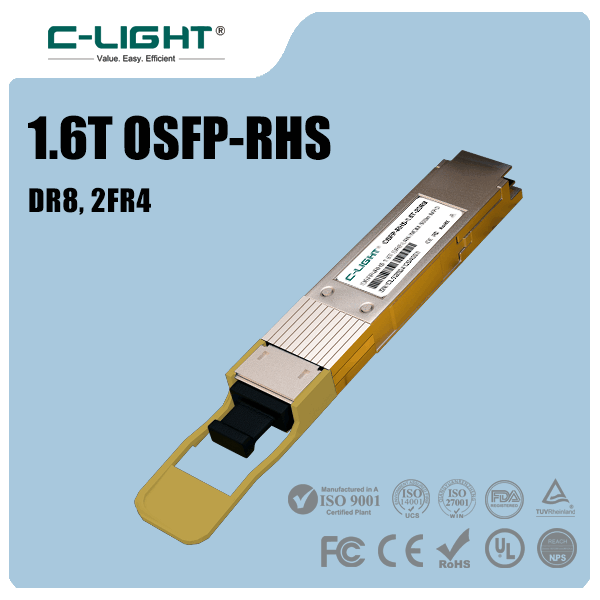
The next stage is 1.6T optical connectivity, which can use four 400G lanes in suitable architectures. Higher lane rates can increase port bandwidth while helping control the number of physical lanes and associated components.
4. High-Speed Optics Help Address Signal Integrity Challenges
Signal integrity becomes increasingly important as electrical data rates rise. Loss, reflections, crosstalk, insertion loss, return loss, and jitter can affect the ability of a receiver to correctly interpret a high-speed electrical signal.
Retimers, equalization, advanced SerDes, and active electrical cables can extend the practical range of electrical connections. However, optical transmission provides another option when reach and bandwidth requirements exceed the practical capabilities of passive electrical links.
Optical modules use components such as lasers, photodiodes, drivers, receivers, and digital signal processors to convert and process high-speed data. The combination of these technologies allows optical links to maintain high bandwidth over fiber-based connections.
5. Optical Connectivity Enables Greater Network Reach
AI data centers do not consist of a single rack. Large deployments can include many racks connected through a multi-tier network fabric.
Short connections inside a server or between nearby equipment can often use copper-based solutions. As the physical distance increases, optical fiber becomes increasingly attractive.
This creates a practical division between electrical and optical connectivity. Copper and AEC solutions can address certain short-reach applications, while optical transceivers and fiber links can provide connectivity across longer distances and between different parts of the data center.
The appropriate technology depends on bandwidth, distance, power, cost, thermal conditions, and system architecture rather than on bandwidth alone.
6. Power Efficiency Is a Major Consideration
Increasing network bandwidth also increases the importance of power consumption. AI data centers already contain large numbers of high-performance processors, switches, memory devices, and networking components.
Every additional network device contributes to the total power and thermal load of the system. As a result, network designers increasingly consider the energy required to transmit each bit of data.
Optical technology can help reduce the electrical transmission distance between high-speed components. Advanced optical DSPs, improved optical engines, higher-speed lanes, and integrated optical architectures are being developed with power efficiency in mind.
Power efficiency is particularly important when hundreds or thousands of high-speed connections operate simultaneously within a large AI cluster.
7. Optical Modules Are Evolving With AI Networks
The development of optical transceivers is closely connected to the evolution of AI networking.
Traditional data center generations included 10G, 25G, 40G, 100G, and 200G connectivity. The industry has subsequently moved toward 400G and 800G solutions, while 1.6T technologies are being developed for future high-bandwidth systems.
Higher-speed modules require improvements across multiple components, including optical engines, lasers, photodiodes, DSPs, electrical interfaces, packaging, and thermal management.
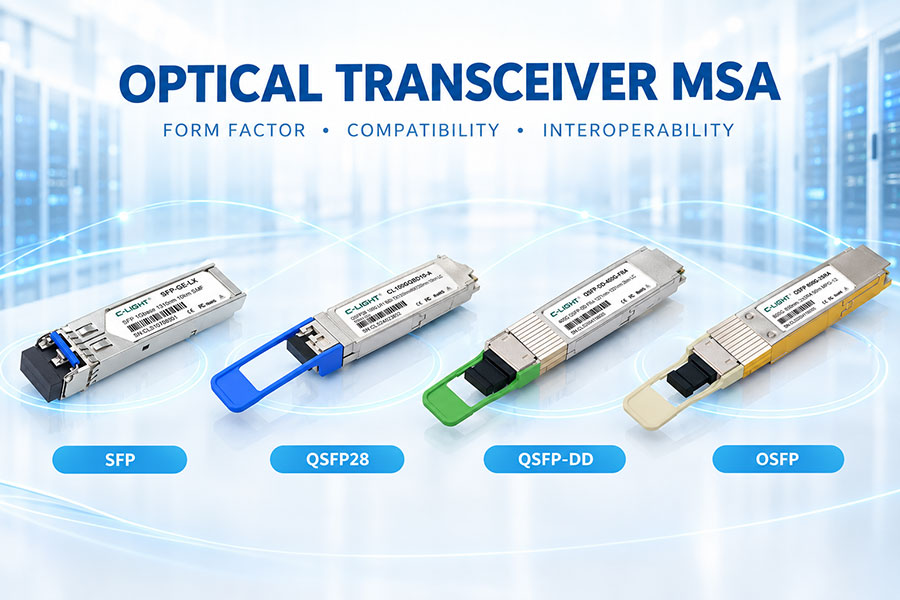
At the same time, different form factors such as QSFP-DD, QSFP112, OSFP, and future higher-density designs provide different approaches to achieving greater bandwidth and system density.
8. 200G-per-Lane and 400G-per-Lane Technologies
Increasing bandwidth per lane is one of the most important trends in optical connectivity.
For example, an 800G module can be implemented using four 200G optical lanes in an appropriate design. Moving toward 400G-per-lane technology creates a path toward 1.6T modules using four optical lanes.
This evolution can simplify the scaling of port bandwidth by increasing the amount of data carried by each lane rather than continuously increasing the total number of lanes.
However, higher lane rates also introduce greater requirements for optical components, DSP performance, electrical design, packaging, testing, and thermal management.
9. Pluggable Optics and CPO Can Coexist
High-speed optical connectivity is not limited to conventional pluggable transceivers. Co-Packaged Optics (CPO) is another architecture being developed for future high-bandwidth switching systems.
In a CPO architecture, optical engines are positioned much closer to the switch ASIC. This can reduce the length of high-speed electrical connections between the switch silicon and optical conversion point.
CPO may provide advantages in bandwidth density, signal integrity, and power efficiency for certain future systems. However, pluggable optics continue to provide important advantages in modularity, serviceability, and deployment flexibility.
For this reason, future AI networks are likely to include a combination of pluggable optics, AECs, CPO, and other interconnect technologies depending on the requirements of each network segment.
10. Optical Connectivity and AI Network Architecture
AI data center networks generally contain multiple layers of connectivity. Accelerator servers connect to switches, switches connect to other switches, and higher-level network layers provide connectivity across larger portions of the infrastructure.
Optical links can be deployed at different points within this architecture. Short-reach optical connections may link equipment within a rack or adjacent racks, while longer-reach solutions can connect different racks, rows, or data center areas.
The increasing use of optical connectivity therefore affects not only individual transceivers but also the overall design of the network fabric.
11. Optical Interconnects Improve Network Scalability
Scalability is an important requirement for AI infrastructure. A network designed for a relatively small accelerator cluster may not be suitable when the number of compute nodes increases significantly.
Higher-speed optical links allow individual network ports to carry more traffic, reducing the need to scale bandwidth solely by adding more physical connections.
This can help network architects build higher-capacity fabrics while managing cable density, rack space, power consumption, and thermal requirements.
However, scalability also depends on switch capacity, network protocols, routing architecture, congestion management, and the performance of the connected compute systems.
12. Optical Connectivity Is Not Only About Speed
It is tempting to evaluate optical modules primarily by their data rate, but AI networking requires a broader set of performance considerations.
Bandwidth and lane rate
Transmission distance
Power consumption
Optical link budget
Signal integrity
Thermal performance
Connector and fiber configuration
Network compatibility
Reliability and serviceability
Total system cost
A high-speed module must provide stable performance within the complete network architecture. Module selection therefore needs to consider the switch platform, fiber infrastructure, reach requirements, operating environment, and network topology.
13. The Role of Optical Transceiver Manufacturers
Optical transceiver manufacturers play an important role in translating high-speed semiconductor and optical technologies into deployable networking products.
Manufacturers must integrate optical components, DSPs, electrical interfaces, mechanical structures, firmware, thermal solutions, and monitoring functions into compact modules.
For 400G, 800G, and emerging 1.6T products, validation becomes increasingly important. Optical performance testing, electrical testing, interoperability testing, thermal evaluation, and long-duration reliability testing all contribute to product quality.
Compatibility with different network platforms is also an important consideration for data center operators and system integrators.
14. C-LIGHT Optical Connectivity Solutions
C-LIGHT provides optical transceiver and interconnect solutions for data center and high-speed networking applications. Its portfolio covers multiple data rates and form factors, supporting different requirements across data center network architectures.
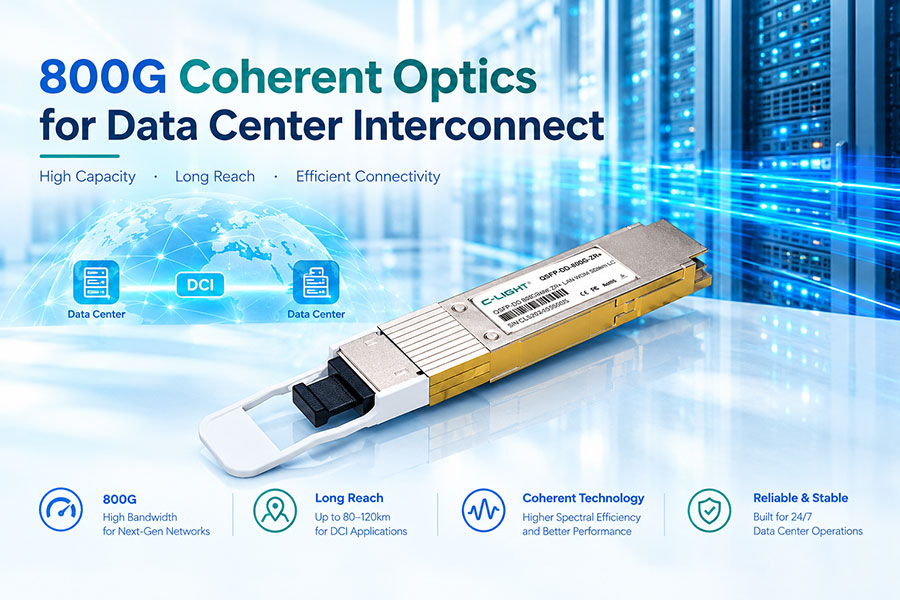
For AI and high-performance data center applications, high-speed products such as 400G and 800G optical transceivers can be considered for high-bandwidth network connections. Emerging 1.6T optical technologies provide a path toward future higher-capacity AI networking.
C-LIGHT also develops active electrical cable and other high-speed interconnect solutions for applications where short-reach electrical connectivity is appropriate.
15. Future Development of AI Optical Interconnects
The evolution of AI infrastructure is expected to continue increasing network bandwidth requirements. Future generations will likely combine higher lane rates, improved optical components, more efficient DSPs, advanced packaging, and new optical integration architectures.
800G is an important part of the current high-speed connectivity transition, while 1.6T represents a significant next step. Beyond 1.6T, technologies supporting even higher aggregate bandwidth are being explored for future AI and high-performance computing systems.
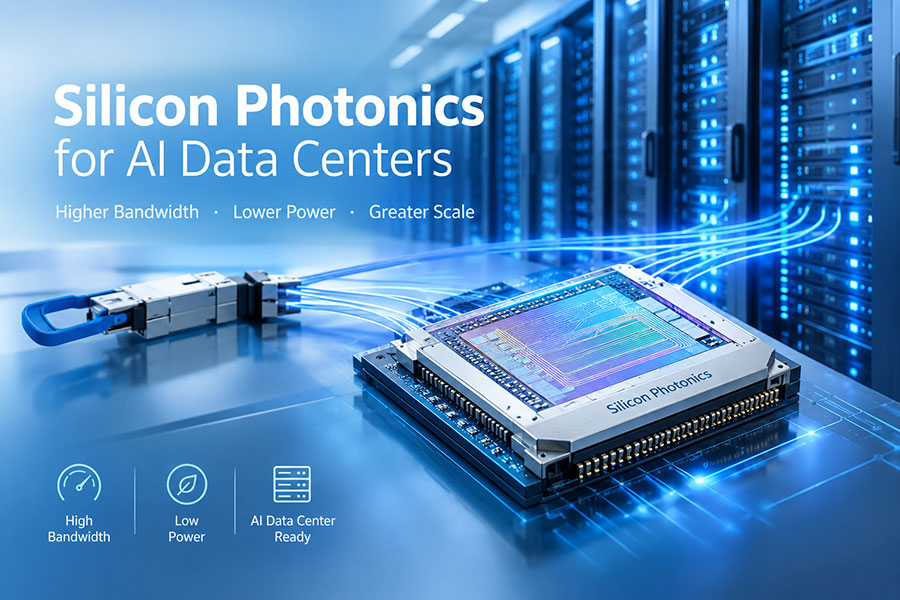
At the same time, the industry is unlikely to rely on a single interconnect technology. Copper, AEC, pluggable optics, CPO, silicon photonics, and other approaches can serve different portions of the network.
16.Conclusion
High-speed optical interconnects have become an important technology for scaling AI data center networks. The combination of increasing accelerator density, distributed computing, higher switch capacity, and growing east-west traffic is creating strong requirements for bandwidth, reach, power efficiency, and signal integrity.
400G and 800G optical connectivity provide important solutions for current high-performance networks, while 1.6T and higher-speed technologies are being developed for future AI infrastructure.
The long-term evolution of AI networking will depend on the combined development of optical transceivers, AECs, DSPs, SerDes, switches, CPO, fiber infrastructure, and network architectures. The most effective solution will ultimately depend on the specific bandwidth, distance, power, density, and deployment requirements of each AI data center.
17.Frequently Asked Questions
Q1: Why do AI data centers need high-speed optical interconnects?
Answer: AI clusters generate large amounts of traffic between accelerators, switches, storage, and other computing resources. High-speed optical interconnects provide high bandwidth and practical reach for these network connections.
Q2:What are the main advantages of optical interconnects?
Answer: Optical interconnects provide high bandwidth, low attenuation over fiber, and longer practical transmission distances compared with many high-speed electrical connections.
Q3:What role do 400G and 800G optical modules play in AI networks?
Answer: 400G and 800G optical modules provide high-capacity connections for data center and AI networking. They can support communication between servers, switches, racks, and other network components depending on the deployment architecture.
Q4:What is the relationship between 800G and 1.6T optical connectivity?
Answer: 1.6T represents the next increase in aggregate port bandwidth beyond 800G. A suitable 1.6T architecture can use four 400G optical lanes, although implementation details vary by platform and module design.
Q5:Can AECs still be used in AI data centers?
Answer: Yes. AECs are suitable for certain short-reach applications. Optical links become increasingly attractive as transmission distance, bandwidth, or electrical signal integrity requirements increase.
Q6:Will CPO replace pluggable optical modules?
Answer: CPO and pluggable optics address different system requirements. CPO can provide advantages for tightly integrated high-bandwidth switching architectures, while pluggable modules offer modularity, flexibility, and serviceability. Both technologies can coexist.
Q7:What factors should be considered when selecting an AI optical transceiver?
Answer: Important factors include data rate, transmission distance, optical link budget, power consumption, connector type, fiber type, thermal conditions, switch compatibility, and the requirements of the overall network architecture.
Q8:What is the future direction of optical interconnects for AI data centers?
Answer: Major development directions include higher lane rates, 800G and 1.6T connectivity, improved optical DSPs, advanced optical components, CPO, silicon photonics, and more power-efficient interconnect architectures.
 >
>

 >
>
 >
>
 >
>
 >
>
 >
>
 >
>
 >
>