TEL:+86 132 6656 7067




Data center interconnect is moving toward higher bandwidth, longer optical reach and simpler transport architectures as AI and cloud infrastructure expand across multiple facilities. 800G coherent optics address this requirement by allowing a single 800G optical channel to connect directly from a compatible router or switch port into an amplified DWDM network.
Unlike conventional 800G data center optics designed for relatively short direct-detect links, coherent 800G solutions use advanced modulation, coherent detection and digital signal processing to maintain performance over much longer fiber paths. This makes 800G coherent optics particularly relevant to metro DCI and other high-capacity inter-site connections.
1. What Are 800G Coherent Optics?
800G coherent optics are high-speed optical modules designed to transmit an aggregate 800Gb/s-class optical signal using coherent detection and digital signal processing.
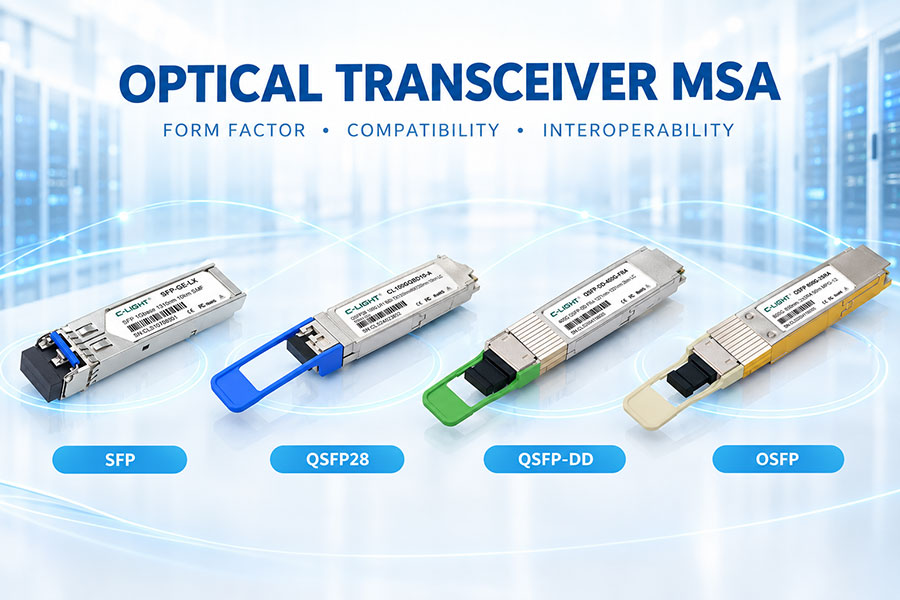
The modules can combine a coherent optical engine, high-speed electronics, DSP and optical interfaces within a pluggable form factor such as QSFP-DD or OSFP, depending on the product.
The Optical Internetworking Forum's 800ZR Implementation Agreement defines an 800ZR coherent interface for single-span amplified DWDM links intended specifically for data center interconnect applications.
2. Why 800G Coherent Optics Matter for DCI
Traditional data center optical modules are often designed for short internal connections, while DCI can extend across multiple buildings, campuses or metropolitan areas.
As DCI bandwidth moves toward 800G, using conventional short-reach optics would require a large number of optical channels to carry the same total traffic. Coherent 800G technology instead places a high-capacity wavelength onto a DWDM transport path.
This allows network operators to increase bandwidth per optical channel while keeping the physical interface directly on routers or switches.
3. 800G ZR vs 800G ZR+
| Feature | 800G ZR | 800G ZR+ |
|---|---|---|
| Primary Role | High-capacity DCI | Extended metro and regional optical transport |
| Optical Architecture | Coherent DWDM | Coherent DWDM |
| Typical Reach | Single-span DCI reach, depending on system conditions | Longer reach than standard 800ZR |
| Network Environment | Data center interconnect | Metro, regional DCI and service-provider networks |
| FEC / DSP | Advanced coherent DSP and FEC | Advanced coherent DSP and FEC |
| Deployment Model | Direct router or switch optical port to optical line system | Direct pluggable or transport-system integration |
Exact reach is product- and line-system-dependent. Current 800ZR implementations can support amplified links up to around 120km, while 800G ZR+ products can extend considerably farther depending on the optical architecture and operating mode.
4. Single-Wavelength 800G Transmission
One of the defining characteristics of 800G coherent DCI is the ability to carry 800G on a single optical wavelength or channel.
This differs from many short-reach 800G interfaces that distribute traffic across multiple optical lanes and wavelengths.
Single-wavelength coherent transmission is particularly valuable in DCI because the same concept can be integrated with a DWDM line system containing multiple independent channels.
5. Coherent Modulation and Detection
Coherent optical transmission carries information in the optical field rather than relying only on signal intensity.
The receiver mixes the incoming signal with a local oscillator and uses high-speed photodetection to recover the information. The resulting electrical signals are processed digitally to reconstruct the transmitted data.
This architecture enables advanced modulation formats and provides greater control over transmission impairments than conventional direct-detection reception.
6. DSP and FEC in 800G Coherent DCI
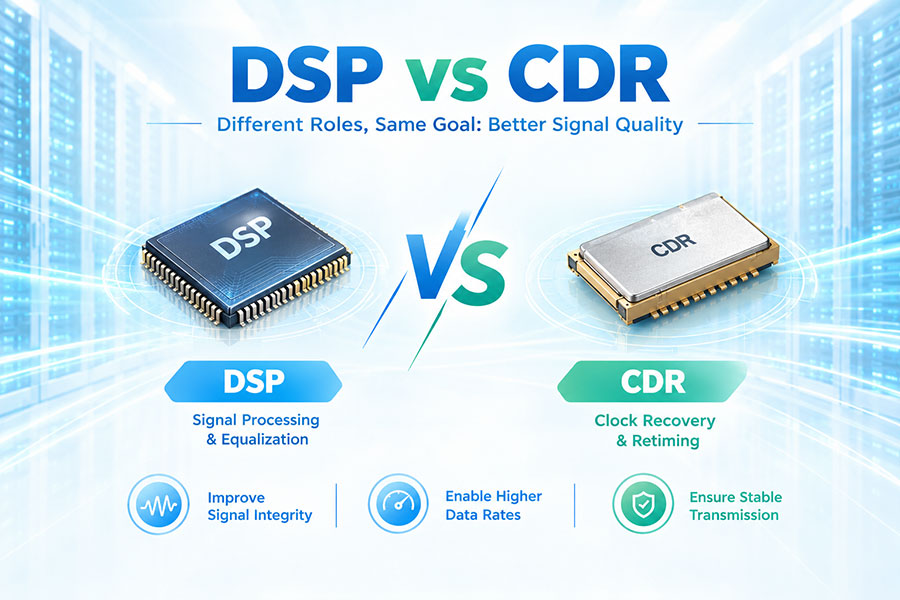
DSP is a central part of an 800G coherent module. It can perform functions such as equalization, carrier recovery, polarization processing, dispersion compensation and other signal-recovery operations.
FEC adds another layer of error tolerance by correcting a portion of transmission errors introduced by the optical channel.
The exact DSP and FEC implementation varies by vendor, coherent generation and operating mode, so the module datasheet should always be used for detailed parameters.
7. Why DWDM Is Important
800G coherent DCI is closely connected with DWDM because a single fiber pair can carry multiple independent high-speed optical channels at different wavelengths.
| Architecture | Optical Capacity Concept |
|---|---|
| Single 800G Coherent Channel | One 800G wavelength |
| Multiple 800G Channels | Several wavelengths share one fiber pair |
| 800G DWDM DCI | Combines high channel rate with wavelength multiplexing |
| Multi-Wavelength Line System | Uses amplifiers and optical components to transport multiple channels |
For large DCI networks, this allows fiber capacity to scale by increasing the number of wavelengths as well as the capacity of each individual wavelength.
8. Direct-Detect 800G vs Coherent 800G
| Feature | 800G Direct-Detect Optics | 800G Coherent Optics |
|---|---|---|
| Typical Use | Shorter data center links | Extended DCI and optical transport |
| Detection | Intensity detection | Coherent detection |
| Optical Channels | Typically multiple parallel or WDM channels | Can carry 800G on a single coherent wavelength |
| DSP | Depends on module | Core part of the architecture |
| Reach | Generally shorter | Much longer under suitable system conditions |
| DWDM Integration | Limited depending on design | Designed for DWDM transport |
| Optical Complexity | Lower for short-reach applications | Higher |
9. 800G Coherent Optics Reach
The achievable reach of an 800G coherent module depends on much more than the module label.
Fiber attenuation, span loss, amplifier configuration, wavelength band, modulation, FEC, baud rate, optical signal-to-noise ratio and the characteristics of the DWDM line system all affect the final distance.
Current commercial 800ZR modules demonstrate this range of operating conditions. Cisco specifies up to 75km for unamplified 800ZR links and up to 120km over amplified links, while 800G ZR+ is intended for substantially longer metro and regional applications.
10. 800G Coherent DCI and Optical Line Systems
An important architectural development is the combination of pluggable coherent optics with compact optical line systems.
Instead of installing separate transponders and large transport shelves, an 800G coherent module can be inserted directly into a router or switch while a compact line system provides functions such as amplification and wavelength management.
This approach moves more optical transport capability directly into the IP networking layer.
11. 800G Coherent Optics in Metro DCI
Metro DCI connects data center sites that are separated by significant distances but still operate within the same metropolitan or regional area.
800G coherent optics can provide high-capacity links between these sites while using the same router or switch platforms that generate the IP traffic.
For larger networks, multiple 800G wavelengths can be transported over a common fiber pair using DWDM, increasing total fiber utilization.
12. 800G Coherent Optics for AI Data Centers
AI infrastructure increases traffic between data centers as distributed computing, model training and data pipelines extend across multiple facilities.
At the same time, each AI cluster can generate large volumes of east-west and site-to-site traffic. 800G coherent optics provide a way to scale DCI capacity without using a separate low-speed optical channel for every traffic flow.
This makes coherent optics particularly relevant to AI scale-out and scale-across network architectures where high-capacity optical transport is required between geographically separated sites.
13. Fiber and Wavelength Requirements
800G coherent DCI normally operates over single-mode fiber and is closely associated with DWDM wavelength bands.
Many systems use the C-band, while some coherent platforms also support L-band operation. The actual wavelength range depends on the transceiver and optical line system.
Fiber quality, span loss and optical connector performance become increasingly important as the link approaches its design limit.
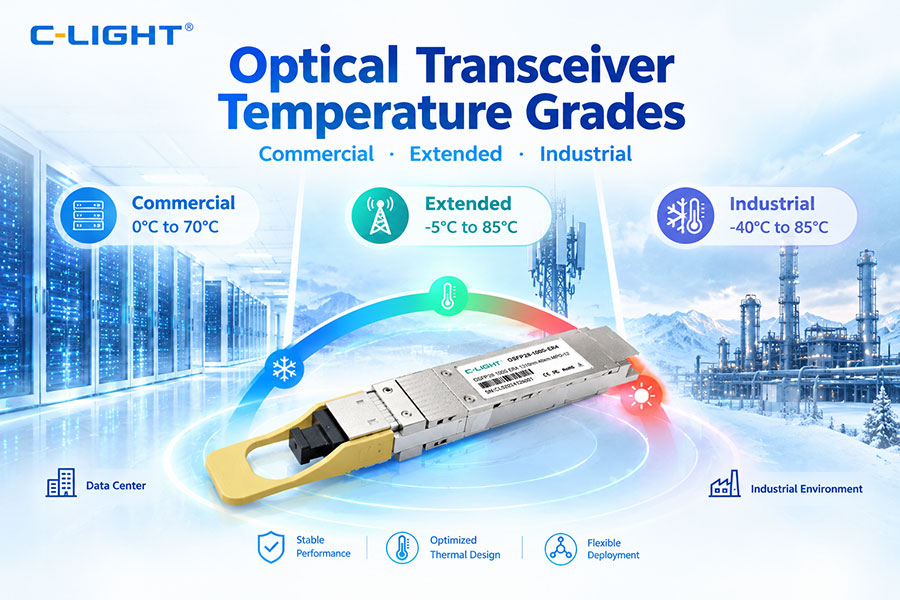
14. Power Consumption and Thermal Design
800G coherent modules contain more processing and optical functionality than conventional short-reach direct-detection modules.
The coherent engine, DSP, high-speed analog circuitry and optical components all contribute to the module power budget. As a result, thermal design is an important consideration for high-density routers and switches.
Current generation coherent pluggables are designed to improve integration and efficiency, but actual power consumption varies substantially by product and operating mode.
15. Deployment Advantages and Limitations
| Aspect | 800G Coherent DCI Consideration |
|---|---|
| Bandwidth | Provides 800G-class capacity per coherent channel |
| Reach | Supports substantially longer links than short-reach 800G optics |
| DWDM | Can integrate multiple high-capacity channels onto one fiber pair |
| Router Integration | Can connect directly to compatible router or switch ports |
| Transport Equipment | Can reduce dependence on traditional standalone transponders |
| Power | Higher than many short-reach optical modules |
| Cost | Higher module complexity and optical-system requirements |
| Engineering | Requires careful evaluation of span loss and optical performance |
16. 800G Coherent vs Traditional DCI Architecture
| Architecture | Traditional DCI | 800G Coherent Pluggable DCI |
|---|---|---|
| Router / Switch | Connects to transport equipment | Can connect directly to coherent optical module |
| Transponder | Often required | Can be eliminated in suitable IP-over-DWDM designs |
| DWDM Line System | Separate transport layer | Can be paired with compact pluggable line systems |
| Optical Capacity | Depends on transport platform | 800G per coherent channel |
| Operational Model | Separate IP and optical transport layers | Greater integration between IP routing and optical transport |
17. How to Plan an 800G Coherent DCI Link
Start with the actual fiber route and determine span length, attenuation, connector count, splice losses and available optical infrastructure.
Then select the appropriate 800G coherent operating mode and verify whether the target distance requires amplification, DWDM line-system support or a particular FEC configuration.
Finally, check router and switch compatibility, module form factor, power consumption, wavelength support, optical interoperability and the required network capacity.
18. 800G Coherent Optics for Data Center Interconnect: Summary
800G coherent optics provide a major step in DCI capacity by placing an 800G coherent channel directly on compatible router and switch interfaces. The technology combines coherent detection, advanced DSP, FEC and DWDM transmission to support optical links substantially longer than conventional short-reach 800G data center optics.
800ZR is particularly associated with single-span DCI, while 800G ZR+ extends the architecture toward longer metro and regional optical networks. The actual reach depends on fiber loss, amplification, optical signal quality, modulation, FEC and the complete DWDM system.
For AI and cloud infrastructure, the value of 800G coherent DCI goes beyond raw bandwidth. It enables higher capacity per optical wavelength, direct IP-to-optical connectivity and more compact transport architectures, while reducing the need for traditional transponder layers in suitable deployments.
Successful deployment requires careful coordination between coherent modules, routers or switches, fiber infrastructure and optical line systems. Optical budget, wavelength plan, power, thermal limits and interoperability should all be evaluated as part of the complete DCI design.
 >
>

 >
>
 >
>
 >
>
 >
>
 >
>
 >
>
 >
>