TEL:+86 132 6656 7067




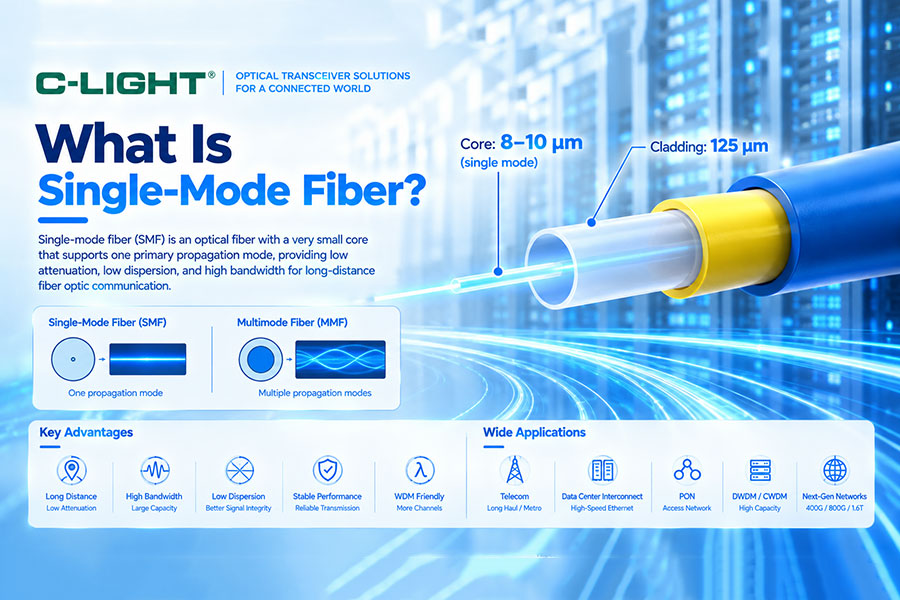
As optical networks move toward higher bandwidth and longer transmission distances, the characteristics of the fiber itself become increasingly important. Single-mode fiber (SMF) is the dominant fiber type used in long-distance telecom, data center interconnect, access networks, and many high-speed optical communication systems. Its small core and controlled mode propagation reduce modal dispersion and allow optical signals to travel significantly farther than they can over conventional multimode fiber. For applications ranging from 10G and 100G to 400G, 800G, and beyond, single-mode fiber provides the transmission medium required to maintain bandwidth, reach, and signal integrity.
1. What Is Single-Mode Fiber?
Single-mode fiber, commonly abbreviated as SMF, is an optical fiber designed to propagate one primary spatial mode of light. It normally has a small core, typically around 8–10 μm in diameter, surrounded by a larger glass cladding with a standard diameter of approximately 125 μm.
Because only one primary mode propagates through the core, single-mode fiber avoids the modal dispersion associated with multimode fiber and can support much longer transmission distances.
2. How Does Single-Mode Fiber Work?
An optical transmitter injects light into the fiber core, and the signal propagates through the glass by total internal reflection. The small core and appropriate refractive-index structure constrain the propagation to the fundamental mode over the intended operating conditions.
At the receiving end, an optical detector converts the optical signal back into an electrical signal for further processing.
3. What Is the Core Size of Single-Mode Fiber?
The core of standard single-mode communication fiber is much smaller than that of multimode fiber. A typical single-mode fiber has a nominal core diameter of approximately 8–10 μm, while the cladding is generally 125 μm.
The exact mode-field diameter, cutoff wavelength, and other optical characteristics depend on the specific fiber design and standard.
4. Why Does Single-Mode Fiber Have a Small Core?
The small core restricts the number of spatial propagation modes supported by the fiber. This reduces modal dispersion and allows optical pulses to maintain their shape over much longer distances.
This characteristic is one of the main reasons single-mode fiber is preferred for long-haul, metro, access, and high-capacity optical communication.
5. What Is Modal Dispersion?
Modal dispersion occurs when different propagation modes travel through a multimode fiber along different paths and arrive at the receiver at different times.
Single-mode fiber largely eliminates this form of dispersion because the intended transmission occurs through one primary mode. Chromatic dispersion and polarization-related effects can still exist and must be considered in high-speed or long-distance systems.
6. Single-Mode Fiber vs Multimode Fiber
| Parameter | Single-Mode Fiber | Multimode Fiber |
|---|---|---|
| Core Diameter | Approximately 8–10 μm | Typically 50 μm or 62.5 μm |
| Propagation Mode | One primary mode | Multiple modes |
| Modal Dispersion | Very low | Significant |
| Typical Wavelengths | 1310 nm / 1550 nm | 850 nm / other short-reach wavelengths |
| Typical Reach | Long distance | Short distance |
| Typical Applications | Telecom, DCI, access, long-reach Ethernet | Data center, LAN, short-reach links |
| Transceiver Technology | DFB, EML, coherent and other SMF technologies | Commonly VCSEL-based |
7. What Are the Main Advantages of Single-Mode Fiber?
The main advantages of single-mode fiber include long transmission reach, high bandwidth capability, low modal dispersion, low attenuation at commonly used communication wavelengths, and suitability for dense wavelength-division multiplexing and high-speed optical transmission.
Its performance makes SMF the standard medium for many telecom and high-capacity optical networks.
8. What Are the Limitations of Single-Mode Fiber?
Single-mode fiber has a smaller core, which makes optical coupling and alignment more demanding than with multimode fiber. Single-mode transceivers and related optical components can also be more complex for certain applications.
Despite these considerations, the long-reach and high-capacity advantages of SMF make it the preferred fiber type for many critical optical links.
9. What Wavelengths Are Used with Single-Mode Fiber?
Single-mode fiber is widely used around the 1310 nm and 1550 nm optical bands. The 1310 nm region is commonly used for Ethernet, access, metro, and data center applications, while the 1550 nm region is particularly important for long-distance transport and optical amplification.
Specific wavelength selection depends on the transceiver, fiber characteristics, transmission distance, WDM architecture, and network standard.
10. Why Is 1310 nm Common for Single-Mode Fiber?
The 1310 nm region offers relatively low chromatic dispersion in conventional communication fiber and is widely used for Ethernet and data center optical modules.
Many 10G, 25G, 100G, and other single-mode optical transceivers therefore use wavelengths around 1310 nm, especially for medium- to longer-reach applications.
11. Why Is 1550 nm Important for Single-Mode Fiber?
The 1550 nm region has very low fiber attenuation and is highly compatible with erbium-doped fiber amplifiers. This makes it particularly valuable in long-haul telecom and DWDM systems.
Long-distance systems can combine single-mode fiber with optical amplification and dense wavelength multiplexing to achieve high aggregate capacity over existing fiber infrastructure.
12. What Is OS2 Single-Mode Fiber?
OS2 is a commonly referenced single-mode fiber classification for outdoor and long-distance optical communication. It is designed for low-loss transmission and is widely used in telecom, data center interconnect, campus, metro, and backbone networks.
OS2 should be distinguished from the generic concept of SMF: SMF describes the propagation type, while OS2 refers to a specific fiber category with defined performance characteristics.
13. Single-Mode Fiber Attenuation
Fiber attenuation represents the reduction in optical power as the signal travels through the fiber. It is normally expressed in dB/km and varies with wavelength, fiber design, environmental conditions, bends, and installation quality.
Lower attenuation provides more available optical power for overcoming connector, splice, splitter, and other system losses.
14. Single-Mode Fiber and Chromatic Dispersion
Although single-mode fiber eliminates modal dispersion, chromatic dispersion remains an important consideration. Different spectral components of the optical signal can propagate at different velocities, causing pulse broadening.
The impact becomes more significant as transmission distance and data rate increase, which is why long-reach optical systems require careful consideration of wavelength, modulation format, and dispersion tolerance.
15. Single-Mode Fiber and Polarization Effects
Single-mode fiber supports a fundamental spatial mode, but the optical field can still experience polarization effects during propagation. Changes in fiber geometry, stress, bending, and environmental conditions can influence the polarization state.
For very high-speed or coherent systems, polarization-related impairments may need to be addressed through system design and digital signal processing.
16. Single-Mode Fiber and Bend Loss
Bending a fiber too tightly can cause part of the optical field to escape from the guided region, resulting in additional loss. This is known as bend loss.
Modern bend-insensitive single-mode fibers are designed to reduce this effect and are especially useful in access networks, compact fiber routing, and installations where space is limited.
17. What Is Bend-Insensitive Single-Mode Fiber?
Bend-insensitive single-mode fiber uses a fiber design optimized to maintain lower optical loss under tighter bending conditions. It is commonly used in FTTH, indoor access, distribution, and other applications where installation constraints can create small bend radii.
Different bend-insensitive fiber classifications are defined by applicable international standards and fiber construction.
18. Single-Mode Fiber and Optical Link Budget
Single-mode fiber characteristics directly affect optical link-budget calculations. Fiber attenuation, connector loss, splice loss, bend loss, and passive component loss must all be accounted for when determining whether a transceiver can support the required distance.
The basic concept is:
Link Margin = Transmitter Launch Power − Total Optical Loss − Receiver Sensitivity Requirement
Because single-mode links can extend over many kilometers, even relatively small loss differences can become important in the final link budget.
19. Single-Mode Fiber and Optical Transceivers
Single-mode optical transceivers are specifically designed to launch and receive optical signals through SMF. Depending on the required reach and data rate, these modules can use DFB lasers, EMLs, APDs, PIN receivers, DSPs, or coherent optical architectures.
Common single-mode interfaces include LC duplex, simplex LC, SC, and other optical connector configurations depending on the module and application.
20. Single-Mode Fiber in 10G Networks
10G single-mode optical links are widely used in enterprise, telecom, data center, and access networks. Depending on the transceiver design, modules can support distances ranging from several kilometers to tens of kilometers.
10GBASE-LR, ER, and ZR-class applications illustrate how different optical transmitter and receiver technologies can extend the operating range over SMF.
21. Single-Mode Fiber in 25G Networks
25G single-mode transceivers are commonly used for server connectivity, switch uplinks, telecom infrastructure, and data center applications requiring more bandwidth than 10G.
The small core of SMF and low modal dispersion make it suitable for maintaining high-speed signal integrity over medium and extended transmission distances.
22. Single-Mode Fiber in 100G Networks
100G optical transceivers frequently use single-mode fiber for longer-reach applications. Depending on the architecture, modules may use multiple optical wavelengths, such as CWDM or LAN-WDM, to transport the required aggregate data rate.
Examples include 100G LR4, ER4, and other single-mode optical interfaces designed for different transmission distances and optical budgets.
23. Single-Mode Fiber in 400G Networks
400G optical networking increasingly relies on single-mode fiber for medium- and long-reach connections. Depending on the application, 400G modules can use multiple wavelengths, parallel optical channels, PAM4, or coherent architectures.
Single-mode fiber provides the reach and bandwidth characteristics required by data center interconnect and telecom applications where multimode fiber is not practical.
24. Single-Mode Fiber in 800G Networks
800G optical systems can use both multimode and single-mode fiber depending on the required transmission distance and optical architecture. Single-mode variants are particularly important for longer-reach applications such as 800G DR, FR, and other single-mode configurations.
At these data rates, transmitter quality, receiver sensitivity, wavelength management, dispersion, FEC, and link margin all become critical parts of the system design.
25. Single-Mode Fiber in 1.6T Networks
1.6T optical networking increases the demand for higher lane rates and more efficient optical transmission. Single-mode fiber is expected to remain important for longer-reach 1.6T applications because it provides the optical path characteristics required for high-bandwidth transmission.
200G-per-lane technologies, advanced modulation, improved optical engines, and new transceiver architectures must all be evaluated together with the fiber infrastructure.
26. Single-Mode Fiber and WDM
Single-mode fiber is the primary transmission medium for CWDM and DWDM systems. Multiple wavelengths can share the same fiber, allowing network operators to increase aggregate capacity without installing additional fiber pairs.
DWDM systems in particular rely heavily on single-mode fiber because of their high channel density, long transmission distance, and compatibility with optical amplification.
27. Single-Mode Fiber and CWDM
CWDM optical systems use multiple relatively widely spaced wavelengths over single-mode fiber. CWDM is commonly used in metro, access, enterprise, and moderate-capacity optical networks.
The use of SMF allows CWDM links to achieve significantly greater reach than typical multimode fiber systems.
28. Single-Mode Fiber and DWDM
DWDM uses closely spaced wavelengths to transport a large number of optical channels over single-mode fiber. The technology is widely used in telecom backbone, data center interconnect, metro transport, and high-capacity optical networks.
The low attenuation and long-distance capability of SMF make it the standard physical medium for DWDM transmission.
29. Single-Mode Fiber in PON
PON access networks are predominantly based on single-mode fiber. The OLT, passive optical splitter, and ONU/ONT are connected through an SMF-based optical distribution network.
Single-mode fiber allows PON systems to support long feeder and distribution distances while maintaining the optical power budget required for passive splitting.
30. Single-Mode Fiber in Data Center Interconnect
Within a short data center, multimode fiber or copper-based interconnects may be appropriate for some applications. Between data centers, however, single-mode fiber is commonly preferred because of its longer reach and high bandwidth capability.
Single-mode connectivity is particularly important for metro and regional DCI deployments where links may extend several kilometers or more.
31. Single-Mode Fiber Connector Types
Single-mode fiber can use several connector types, including LC, SC, and duplex LC configurations. High-density optical transceivers commonly use LC connectors, while larger distribution systems may use other connector and patch-panel configurations.
Connector selection should consider insertion loss, return loss, density, polarity, maintenance requirements, and compatibility with the optical transceiver.
32. Single-Mode Fiber and Return Loss
Return loss describes the amount of optical power reflected back toward the transmitter from fiber interfaces and discontinuities. Poor connector quality, contamination, air gaps, damaged end faces, or mismatched interfaces can increase reflections.
For high-speed and sensitive optical systems, controlling return loss is important because excessive reflections can degrade transmitter and receiver performance.
33. How to Choose Single-Mode Fiber?
Fiber selection should consider transmission distance, wavelength, attenuation, dispersion, bend requirements, indoor or outdoor installation, connector type, environmental conditions, and compatibility with the optical transceiver.
For standard telecom and data center applications, OS2-class single-mode fiber is a common choice, while specific installations may require bend-insensitive or other specialized fiber designs.
34. Single-Mode Fiber Testing
SMF testing can include optical loss measurement, return-loss measurement, optical time-domain reflectometry, connector inspection, end-face inspection, and continuity testing.
OTDR testing can help locate events such as splices, connectors, bends, breaks, and excessive localized loss along the fiber path.
35. Single-Mode Fiber Cleaning and Maintenance
Contamination on fiber connector end faces can introduce insertion loss and reflections and can significantly affect high-speed optical links. Proper inspection and cleaning should therefore be performed before connecting optical interfaces.
Maintaining clean connector end faces is especially important for high-density data center and long-reach optical networks.
36. Single-Mode Fiber FAQ
Q1. What is single-mode fiber?
Q2. What is the core size of single-mode fiber?
Q3. What is the difference between single-mode and multimode fiber?
Q4. What wavelengths are commonly used with single-mode fiber?
Q5. Is OS2 the same as single-mode fiber?
Q6. Why is single-mode fiber used for long-distance transmission?
37. Summary
Single-mode fiber is the foundation of long-distance and high-capacity optical communication. Its small core, single-mode propagation, low modal dispersion, and strong bandwidth characteristics make it suitable for telecom, PON, CWDM, DWDM, data center interconnect, and high-speed Ethernet networks. As optical connectivity advances from 100G and 400G to 800G and 1.6T, single-mode fiber will continue to play a central role in applications where transmission distance, optical budget, wavelength efficiency, and signal integrity are critical.
 >
>

 >
>
 >
>
 >
>
 >
>
 >
>
 >
>
 >
>