TEL:+86 132 6656 7067





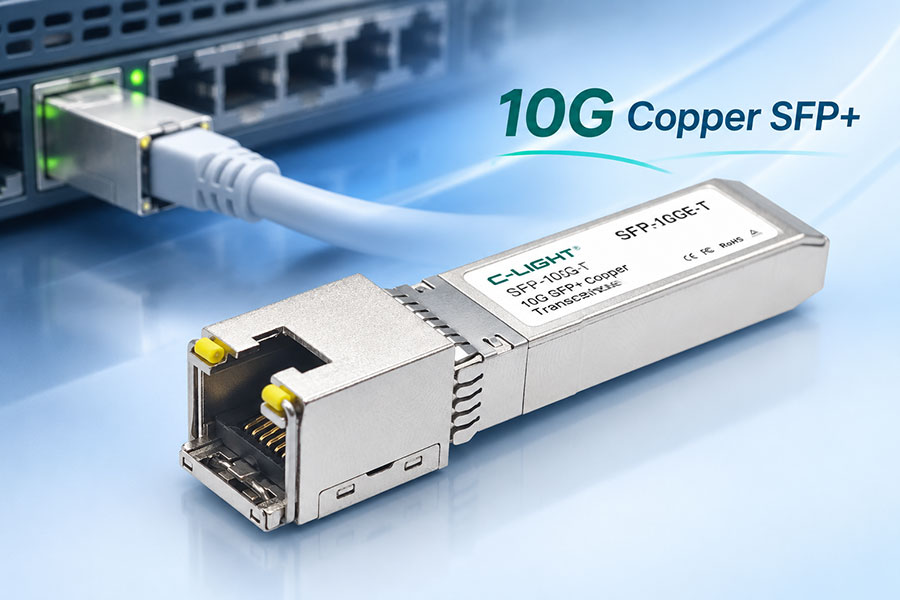
10GBASE-T SFP+ transceivers provide 10 Gigabit Ethernet connectivity over twisted-pair copper cabling through an RJ45 interface. Installed in a compatible SFP+ port, the module enables a switch or router to connect to equipment with a copper Ethernet port without requiring a separate optical transceiver and fiber patch cable.
In data center top-of-rack (ToR) networks, 10GBASE-T SFP+ modules can simplify copper connectivity for servers, storage systems, management interfaces, and devices equipped with 10GBASE-T network ports. They are particularly useful when an existing switch uses SFP+ cages but the connected equipment requires RJ45 connectivity.
The main design considerations are transmission distance, cable category, module power consumption, thermal limits, host compatibility, and link latency. These factors determine whether an RJ45 transceiver is more suitable than a direct-attach copper cable or an optical connection.
1. How Does a 10GBASE-T SFP+ Transceiver Work?
A conventional optical SFP+ converts electrical signals into optical signals and transmits them over fiber. A 10GBASE-T SFP+ module instead integrates a copper Ethernet physical-layer transceiver, commonly called a PHY, to support 10GBASE-T signaling over twisted-pair cabling.
On the switch side, the module interfaces with the compatible SFP+ electrical connection. On the cable side, its RJ45 connector links to a 10GBASE-T port on a server, storage device, or another network switch. The integrated PHY handles the signal processing required by the 10GBASE-T physical layer.
The transceiver is not a passive adapter. It performs active signal processing and requires electrical power from the host port. Its power and thermal requirements can therefore differ significantly from those of a passive DAC or a typical short-reach optical SFP+ module.
2. Technical Specifications and Transmission Distance
10GBASE-T SFP+ modules share a general form factor, but their supported rates, cable requirements, transmission distances, power consumption, and temperature ratings depend on the specific product.
| Parameter | Typical Consideration |
|---|---|
| Interface | SFP+ on the host side and RJ45 on the copper side |
| Ethernet speed | 10 Gbps; some modules also support 1 Gbps and 100 Mbps when permitted by the module and host |
| Cabling | Cat6A or better is commonly specified for 10G operation on short-reach SFP+ copper modules |
| Typical module reach | Up to 30 m for many 10GBASE-T SFP+ modules; verify the individual product specification |
| Host-side power | Higher than many conventional SFP+ optics; certain models consume up to approximately 2.5 W |
| Thermal design | Depends on module power, airflow, ambient temperature, and switch port restrictions |
| Compatibility | Requires support from the host platform, firmware, port, and transceiver specification |
Some manufacturer specifications rate a particular 10GBASE-T SFP+ module for up to 30 m using Cat6A or better at 10 Gbps, while lower speeds may support longer cable runs. This should not be confused with native 10GBASE-T switch ports that support up to 100 m on an appropriately designed and installed Cat6A channel.
For a ToR deployment, use the maximum reach specified for the actual SFP+ transceiver rather than assuming that the standard's native copper Ethernet reach applies to every pluggable module.
3. Why Use 10GBASE-T SFP+ in ToR Switches?
ToR switches sit close to servers in the rack, typically reducing the distance between server network interfaces and switch ports. The layout often favors short cable runs, high port density, and convenient maintenance. A 10GBASE-T SFP+ transceiver can bridge the gap between an SFP+-based switch and equipment that already uses RJ45 copper Ethernet.
Compatibility with Existing Copper Ports
Servers and network appliances may have built-in 10GBASE-T NICs. An RJ45 SFP+ module allows these devices to connect to compatible SFP+ switch ports without replacing their network adapters or introducing fiber connectivity solely for the access link.
Reuse of Structured Copper Cabling
Facilities with an established Cat6A copper infrastructure may prefer copper connectivity for suitable short runs. RJ45 cabling can also make it easier to connect to equipment with standard BASE-T ports without additional media conversion.
Deployment Flexibility
10GBASE-T SFP+ can be useful when a switch's port mix includes SFP+ cages but the required connection types vary across servers and network devices. Module-based port selection provides flexibility, provided that the switch supports the module's power and operating requirements.
4. 10GBASE-T SFP+ vs DAC vs Optical SFP+
All three approaches can be used for 10GbE, but they address different cabling and deployment requirements. The best choice depends on the distance, the interfaces available on each endpoint, power and cooling constraints, and future infrastructure plans.
| Feature | 10GBASE-T SFP+ | 10G SFP+ DAC | 10G Optical SFP+ |
|---|---|---|---|
| Transmission medium | Twisted-pair copper with RJ45 | Direct-attach twinax copper | Optical fiber |
| Common use | Connecting an SFP+ switch port to a BASE-T device | Short server-to-ToR or switch-to-switch connections | Links requiring optical connectivity or longer reach |
| Typical distance | Up to 30 m for many SFP+ modules | Usually a few meters; product-specific passive and active options differ | Depends on the optic, fiber type, and link budget |
| Remote interface | RJ45 10GBASE-T | Compatible SFP+ port or a supported direct-attach endpoint | Compatible optical transceiver and fiber interface |
| Power and heat | Can be relatively high due to the integrated copper PHY | Passive DAC has very low power requirements | Varies by optical module type and reach |
| Latency considerations | PHY processing adds latency; exact value is module-dependent | Typically the lowest added latency for short passive DAC links | Depends on optics and system design |
| Best fit | RJ45 interoperability and suitable short copper connections | Short, high-density connections between compatible SFP+ interfaces | Fiber infrastructure, longer runs, or optical port requirements |
For server-to-ToR links within the same rack, passive DAC is often an efficient option when both endpoints support it and the cable length is sufficient. A 10GBASE-T SFP+ module is more appropriate when the remote device exposes only an RJ45 Ethernet port or when an existing copper design must be retained.
Optical SFP+ solutions are preferable when the required link distance exceeds the module's supported copper reach, when the installed fiber plant is already available, or when electrical isolation and fiber routing are important design considerations.
5. Power Consumption and Thermal Constraints
Power consumption is one of the most important considerations when deploying 10GBASE-T SFP+ modules at scale. The integrated copper PHY requires active signal processing, which can result in greater power dissipation than a conventional 10G SR module or a passive DAC.
For example, Cisco specifies up to 2.5 W for its SFP-10G-T-X at 10 Gbps over up to 30 m. By comparison, many 10G SR modules are specified around 1 W, although exact values vary by model and operating conditions.
Before deployment, check:
Per-port power limits: Confirm that the SFP+ cage supports the transceiver's maximum power requirement.
Switch-wide power budget: Calculate the total load if several high-power copper modules are installed in the same switch.
Temperature and airflow: Dense ToR switches can have limited cooling margin, particularly when high-power modules occupy adjacent ports.
Environmental rating: Confirm the supported ambient and case-temperature range for the actual module.
Platform restrictions: Check the switch vendor's compatibility documentation for supported modules, port combinations, and any installation limits.
A module that fits physically may still exceed the host port's power or thermal specifications. Power availability and cooling therefore need to be confirmed before ordering transceivers for a full rack deployment.
6. Compatibility and Deployment Risks
Reliable deployment requires compatibility across the switch port, transceiver, cabling, and remote Ethernet interface. A working RJ45 connection at one end does not guarantee that the host can initialize or operate the module correctly.
| Potential Issue | What to Verify |
|---|---|
| Module not recognized | Supported transceiver list, module coding, switch firmware, and port compatibility |
| Port remains down | Port speed configuration, auto-negotiation settings, remote NIC support, and cable termination |
| Unstable 10G link | Cable category, cable quality, channel length, pair termination, and connector condition |
| Module overheats | Port power limit, adjacent-module density, airflow, ambient temperature, and thermal alarms |
| Unexpected lower speed | Supported rates on both ends, module operating limits, and host port configuration |
| Higher-than-expected latency | Module PHY characteristics, device interface settings, congestion, and end-to-end path behavior |
For a new deployment, test the intended transceiver with the actual switch model and software version, then validate link negotiation, sustained traffic, temperature, and error counters. This is especially important when deploying third-party modules across multiple switch platforms.
7. How to Select a 10GBASE-T SFP+ for ToR Deployments
Selection should begin with the endpoint interfaces and physical distance rather than the transceiver form factor alone.
Identify the remote interface: Confirm that the server or network device has an RJ45 10GBASE-T port. If both ends use SFP+, a DAC may be simpler.
Measure the actual cable route: Include the path through cable managers and patch panels, not just the straight-line distance between devices.
Choose the specified cable category: Use Cat6A or the cable type explicitly supported for 10G operation at the required distance.
Check power and thermal compatibility: Confirm the host port and switch can support the module, particularly when installing multiple copper transceivers.
Verify speed and interoperability: Check supported rates, module coding, firmware, and the compatibility requirements of both endpoints.
Evaluate future expansion: Consider whether a move to 25GbE or faster server connectivity is expected, since this may affect the choice of switch ports and cable assemblies.
For short server-to-ToR connections, passive DAC is often the first option to evaluate. Where RJ45 interoperability is required, 10GBASE-T SFP+ offers a flexible alternative within its supported reach and power limits. For longer routes or higher-density optical designs, optical transceivers and fiber may provide a more suitable solution.
8. Conclusion
10GBASE-T SFP+ transceivers enable RJ45 copper connectivity on compatible SFP+ ports, making them useful for ToR switches that need to connect to existing 10GBASE-T servers, storage systems, and network appliances. They provide flexibility without requiring every link to use optical fiber.
The main trade-offs are shorter reach than native 10GBASE-T structured cabling in many implementations, higher module power consumption, additional heat, and PHY-related latency. Evaluating cable length, host compatibility, power budget, and the alternative DAC or optical solutions helps determine whether 10GBASE-T SFP+ is appropriate for a particular rack design.
9. Q&A
Q1: What is a 10GBASE-T SFP+ transceiver?
Answer: It is an active SFP+ module with an RJ45 interface and integrated copper Ethernet PHY that enables 10GbE connectivity over supported twisted-pair copper cabling.
Q2: What is the maximum distance of a 10GBASE-T SFP+ module?
Answer: Many 10GBASE-T SFP+ modules support up to 30 m at 10 Gbps using Cat6A or better, but the exact reach depends on the product. Native 10GBASE-T ports with a compliant Cat6A channel may support longer distances, up to 100 m.
Q3: Is 10GBASE-T SFP+ suitable for ToR switches?
Answer: Yes, when the switch supports the module and the copper run fits within its rated reach. It is particularly useful for connecting SFP+-based switches to servers and devices with RJ45 10GBASE-T ports.
Q4: Why does a 10GBASE-T SFP+ consume more power than some optical modules?
Answer: The module contains an active copper PHY that processes high-speed electrical signals over twisted-pair cabling. Its processing and signal-conditioning requirements can produce greater power dissipation than some optical SFP+ modules.
Q5: Should I use 10GBASE-T SFP+ or DAC for server-to-ToR connectivity?
Answer: Use DAC when both endpoints support compatible SFP+ connections and the cable length is suitable. Choose 10GBASE-T SFP+ when the remote device requires RJ45 connectivity or an existing BASE-T cabling design needs to be preserved. Compare distance, power, latency, and switch compatibility before selecting either option.
 >

 >
 >
 >
 >
 >
 >
 >