TEL:+86 132 6656 7067




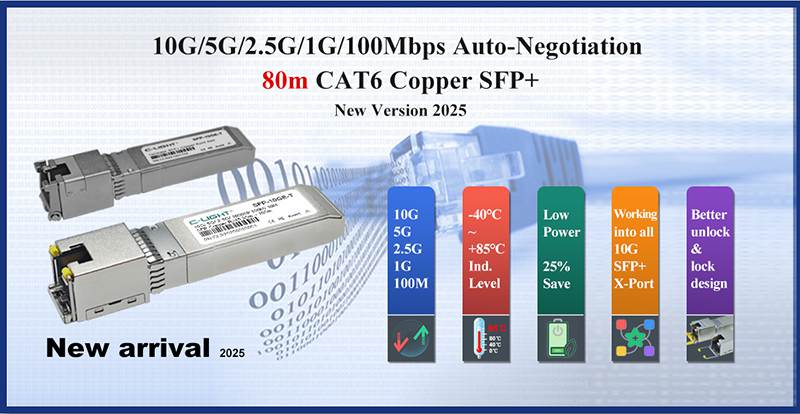
10G COPPER is a technology that enables 10Gbps data transmission rates over twisted-pair copper cabling. It allows enterprises and data centers to achieve high-speed network connectivity using existing copper cable infrastructure, serving as a critical component in network evolution. COPPER SFP/SFP+ 10G/5G/2.5G/1G Transceiver RJ45丨C-LIGHT
Technical Definition and Standard Basis
The core of 10G COPPER is the 10GBASE-T standard, defined by the IEEE 802.3an standard published in 2006. This technology allows for 10Gbps data transmission over common unshielded twisted-pair (UTP) or shielded twisted-pair (STP) cables, with a maximum reach of up to 100 meters.
Key Technical Challenges and Breakthroughs
Achieving 10G transmission over copper cabling faced two major challenges:
●Frequency and Signal Integrity: 10G transmission requires approximately 500 MHz of bandwidth, whereas traditional Cat5e only supports 100 MHz. High-frequency signals in copper cables suffer from significant return loss and alien crosstalk (ANEXT), analogous to echoes and interference when shouting in a narrow tunnel.
Innovative Technical Solutions:
●Advanced Coding Technique: Employs PAM-16 (16-level Pulse Amplitude Modulation) encoding, allowing 4 bits of data to be transmitted per signal change.
●Signal Processing Breakthrough: Utilizes DSQ128 encoding and Tomlinson-Harashima precoding to effectively cancel signal interference.
●Crosstalk Cancellation: Employs multi-channel processing technology based on MIMO principles to eliminate interference from adjacent pairs in real-time.
Cable Category Requirements
●Not all copper cables support 10G transmission; specific categories are required:
●Cat6a/Class EA (Recommended): 500 MHz bandwidth, fully supports 10G for up to 100 meters.
●Cat6/Class E: Supports 10G up to 55 meters, with 250 MHz bandwidth.
●Cat7/Class F: Shielded twisted-pair with 600 MHz bandwidth, offering superior performance.
Typical Application Scenarios
●Data Center Server Connections: Cost-effective connectivity solution for servers to top-of-rack switches.
●Enterprise Network Backbone: Backbone connections between building floors or departments.
●High-Performance Workstations: For workstations requiring large bandwidth, such as video editing and scientific computing.
●Storage Area Networks: An economical connectivity solution for mid-range storage systems.
Advantages and Limitations
Advantages:
●Backward Compatibility: Compatible with lower-speed standards like 1000BASE-T and 100BASE-TX.
●Cost-Effectiveness: More economical than fiber optic solutions, especially for short-distance applications.
●Simplified Management: Uses familiar RJ-45 interfaces and cabling techniques.
Limitations:
●Higher Power Consumption: Early 10GBASE-T network adapters consumed 10-15W, though newer generations have reduced this to 4-6W.
●Distance Limitation: Maximum 100 meters, far less than the kilometer-scale reach of single-mode fiber.
●Cooling Requirements: High-density deployments require better thermal design.
Deployment Considerations
●Cable Certification: Must use certified Cat6a or higher cabling.
●Connector Quality: All RJ-45 plugs and patch panels must meet the corresponding category standards.
●Thermal Planning: Ensure adequate ventilation between equipment for high-density deployments.
●Electromagnetic Compatibility: Consider the necessity of shielded cables in industrial environments.
Future Development Trends
With the emergence of NBASE-T (2.5G/5G Ethernet) and 25G/40G over Copper technologies, copper-based Ethernet is evolving towards multi-rate adaptive capabilities. Emerging single-pair Ethernet technologies (e.g., IEEE 802.3cg) further expand copper's application in specialized scenarios like industrial automation.
10G COPPER represents the pinnacle of copper-based Ethernet technology, balancing performance, cost, and compatibility for specific applications. While fiber optics hold advantages in long-distance and ultra-high-speed domains, copper cabling, with its ease of deployment, backward compatibility, and cost-effectiveness, will continue to play a vital role in specific layers of enterprise networks and data center connectivity.
10G Copper Solution FAQ
Q1: What is a 10G Copper transceiver?
Answer: A 10G Copper transceiver is a 10Gbps networking solution that uses copper cabling instead of optical fiber for data transmission. The main types include 10GBASE-T SFP+ copper transceivers using RJ45 interfaces and 10G SFP+ DAC cables using direct-attached twinax copper cables. They provide a cost-effective solution for short-distance 10Gb Ethernet connectivity.
Q2: What are the main types of 10G Copper solutions?
Answer: The two common types of 10G Copper solutions are:
1. 10GBASE-T SFP+ Copper Transceiver
Uses RJ45 interface
Supports Cat6a/Cat7 copper cabling
Provides compatibility with existing Ethernet cabling infrastructure
2. 10G SFP+ DAC Cable
Uses integrated SFP+ connectors with twinax copper cable
Designed for short-distance server and switch connections
Provides low-cost and low-power connectivity
Q3: What are the advantages of 10G Copper solutions?
Answer: The main advantages of 10G Copper solutions include:
Lower deployment cost compared with fiber solutions
Simple plug-and-play installation
Reuse of existing copper cabling infrastructure
Low latency for short-distance connections
Suitable for high-density server and switch environments
These advantages make 10G Copper a practical choice for cost-sensitive network upgrades.
Q4: What is the difference between 10G Copper and 10G Fiber solutions?
Answer: The main difference is the transmission medium. 10G Copper uses electrical signals transmitted through copper cables, while 10G Fiber uses optical signals transmitted through fiber.
10G Copper is typically preferred for short-distance, cost-efficient connections, while 10G Fiber is more suitable for longer distances, higher scalability, and environments requiring stronger electromagnetic interference resistance.
Q5: What is the difference between 10GBASE-T SFP+ and 10G SFP+ DAC?
Answer: The main difference is the cable interface and application scenario.
10GBASE-T SFP+ Copper Module:
Uses RJ45 connector
Works with Cat6a/Cat7 cables
Suitable for integrating existing Ethernet cabling
10G SFP+ DAC:
Uses fixed twinax copper cable
Optimized for short-distance connections
Offers lower power consumption and lower latency
10G DAC is commonly used for server-to-switch connections inside racks, while 10GBASE-T is useful for copper infrastructure upgrades.
Q6: What are the typical applications of 10G Copper solutions?
Answer: 10G Copper solutions are widely used in:
Data center server-to-switch connections
Storage network connections
Enterprise LAN upgrades
Short-distance Ethernet connections
High-density rack deployments
They are especially suitable for environments where existing copper cabling needs to be upgraded to 10Gbps performance.
Q7: How far can 10G Copper solutions transmit?
Answer: The transmission distance depends on the type of copper solution.
10G SFP+ DAC: Typically designed for short-distance connections, commonly from 1m to several meters, with some active DAC solutions extending further.
10GBASE-T SFP+ Copper Transceiver: Can support longer distances using Cat6a/Cat7 cabling, depending on cable quality and network conditions.
For longer-distance applications, optical transceivers are usually preferred.
Q8: How do I choose between 10G Copper and optical transceivers?
Answer: The choice depends on network distance, cost, infrastructure, and future expansion requirements.
Choose 10G Copper when:
The connection distance is short
Existing copper cabling is available
Cost optimization is important
Low-latency direct connections are required
Choose 10G Optical Transceivers when:
Longer transmission distance is needed
Higher scalability is required
The network environment requires fiber connectivity
Selecting the right solution helps optimize network performance and total deployment cost.
 >
>

 >
>
 >
>
 >
>
 >
>
 >
>
 >
>
 >
>