TEL:+86 132 6656 7067




AI data centers support large-scale computing for artificial intelligence training, inference, cloud services, and high-performance workloads. As AI infrastructure expands, these facilities can increase electricity demand, water consumption, material use, electronic waste, and carbon emissions. At the same time, improvements in computing efficiency, renewable energy, cooling systems, and high-speed optical networking can help reduce the environmental impact per unit of computing.
1. Why AI Data Centers Affect the Environment
An AI data center is an energy-intensive computing facility containing servers, GPUs, networking equipment, storage systems, power infrastructure, and cooling systems. Unlike conventional data centers, AI facilities can deploy very high concentrations of GPUs and accelerators, creating significant power and thermal requirements.
The environmental impact therefore extends beyond electricity consumption. It includes the energy used to manufacture equipment, construction materials, water used for cooling, power generation emissions, transportation, and the eventual disposal or recycling of hardware.
2. Electricity Consumption
Electricity is one of the most important environmental factors associated with AI data centers. AI training and inference workloads can run large numbers of accelerators continuously, while supporting equipment also consumes power.
Total facility electricity consumption includes IT equipment as well as cooling, power conversion, lighting, networking, storage, and other infrastructure. The environmental effect of this electricity depends heavily on how the electricity is generated.
3. Why AI Workloads Require More Power
AI models can contain billions or even trillions of parameters and may require large distributed computing clusters for training. GPUs and other accelerators perform massive numbers of mathematical operations, creating high computational and electrical loads.
Large AI clusters can also contain thousands of accelerators connected through high-speed networks. Maintaining communication between these systems requires additional networking, switching, optical interconnects, storage and power infrastructure.
4. Power Density in AI Data Centers
AI infrastructure is characterized by high rack-level power density. A conventional server rack and an AI accelerator rack can have significantly different power and cooling requirements.
Higher power density can improve computing capacity within a limited physical footprint, but it also increases the requirements for power delivery, thermal management, cooling capacity and facility design.
5. Carbon Emissions
AI data center emissions are influenced by both electricity consumption and the carbon intensity of the electricity supply. A facility powered primarily by fossil-fuel-based electricity can have a substantially different carbon footprint from a facility supplied by lower-carbon energy.
Carbon emissions can also occur throughout the equipment lifecycle, including semiconductor manufacturing, server production, transportation, construction and equipment replacement.
6. Renewable Energy and AI Data Centers
Renewable electricity can reduce the operational carbon emissions associated with data center power consumption. Solar, wind, hydroelectric and other low-carbon electricity sources can form part of a data center's energy strategy.
However, renewable energy availability varies by region and time. AI data centers therefore need to consider electricity sourcing, grid conditions, storage, power purchase arrangements and the timing of energy consumption.
7. Water Consumption
Water can be used in data center cooling systems to remove heat generated by computing equipment. The amount of water required depends on the cooling technology, climate, facility design and operating conditions.
In regions where water resources are limited, water consumption can become an important environmental consideration when planning new AI data centers.
8. Why AI Cooling Is Becoming More Important
As accelerator power density increases, removing heat efficiently becomes increasingly difficult. Air cooling can become less practical at very high thermal densities, leading operators to evaluate liquid cooling and other advanced thermal management technologies.
Cooling efficiency can influence both electricity consumption and the amount of computing capacity that can be deployed within a given facility.
9. Liquid Cooling
Liquid cooling transfers heat through a liquid medium rather than relying entirely on air. Depending on the design, cooling systems can use cold plates, direct-to-chip cooling, immersion cooling or other liquid-based architectures.
Liquid cooling can support high-density AI infrastructure by improving heat transfer and reducing dependence on large volumes of air movement. Its environmental impact still depends on system efficiency, water requirements, refrigerants, pumping power and the complete facility design.
10. Air Cooling vs Liquid Cooling
| Factor | Air Cooling | Liquid Cooling |
|---|---|---|
| Heat Transfer | Uses air as the primary cooling medium | Uses liquid for more direct heat transfer |
| High-Density AI | Can become more challenging at high rack densities | Designed for high thermal densities |
| Infrastructure | Fans, air handlers and cooling systems | Pumps, cold plates, heat exchangers or immersion systems |
| Water Considerations | Depends on facility cooling architecture | Depends on liquid and heat-rejection design |
| Energy Efficiency | Depends on airflow and cooling system efficiency | Depends on pumping, heat exchange and cooling architecture |
11. AI Data Center Water Stress
The environmental impact of water use depends on local conditions. A cooling system operating in a water-stressed region can create different environmental concerns from an equivalent system located in an area with abundant water resources.
Data center planning therefore increasingly considers water availability, cooling technology, water recycling and local environmental conditions.
12. Electronic Waste
AI hardware can have relatively short technology cycles as newer accelerators, servers and networking platforms become available. Hardware replacement can generate electronic waste if equipment is not reused, refurbished or properly recycled.
Electronic waste may contain valuable materials as well as substances requiring controlled handling. Extending hardware life and improving recycling processes can reduce the environmental burden associated with equipment replacement.
13. Semiconductor Manufacturing
The environmental footprint of AI computing begins before equipment reaches the data center. Semiconductor manufacturing requires energy, water, chemicals, specialized materials and complex production facilities.
Advanced processors, memory devices and optical components used in AI infrastructure therefore contribute to the overall lifecycle impact of the computing system.
14. Manufacturing AI Servers and Networking Equipment
AI infrastructure requires more than GPUs. Servers also include CPUs, memory, storage, power supplies, motherboards, cooling components and networking hardware.
Large AI clusters can require high-speed switches, optical transceivers, DAC cables, AOCs and fiber infrastructure. Manufacturing and transporting these components contributes to the overall environmental footprint.
15. Optical Networking and Environmental Impact
High-speed optical interconnects are increasingly important in AI clusters because GPUs and switches must exchange large amounts of data. Optical links can provide high bandwidth over longer distances while avoiding some limitations of high-speed electrical interconnects.
Optical networking does not eliminate environmental impact, but efficient optical components can contribute to lower energy consumption per transmitted bit when compared with less efficient alternatives under appropriate deployment conditions.
16. 400G, 800G and 1.6T Optical Interconnects
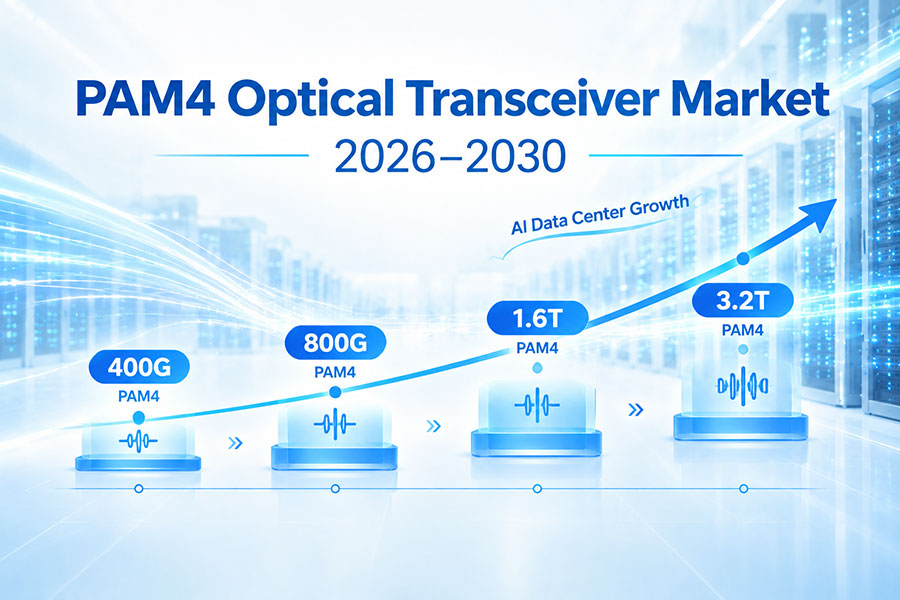
AI networks are moving toward 400G, 800G and 1.6T optical connectivity to support increasing bandwidth requirements. Higher-speed interfaces can increase network capacity without requiring a proportional increase in the number of physical links.
However, higher-speed optical modules can also introduce higher power consumption depending on their architecture. Evaluating energy efficiency therefore requires looking at power per bit rather than module power alone.
17. Power per Bit
Power per bit is a useful metric for evaluating networking efficiency. A higher-speed optical module may consume more total power while still delivering more bandwidth per watt.
For example, comparing 800G and 1.6T infrastructure should consider both module power and delivered bandwidth. This provides a more meaningful view of network energy efficiency than looking at absolute power alone.
18. LPO and Network Energy Efficiency
Linear-drive pluggable optics, commonly referred to as LPO, remove or bypass certain retiming and DSP functions from the optical module architecture. This can reduce module power consumption in suitable implementations.
LPO can therefore contribute to lower optical module power and thermal requirements. However, it places greater signal-integrity requirements on the host electrical channel and requires careful system-level interoperability.
19. Data Center Efficiency and PUE
Power Usage Effectiveness, or PUE, is commonly used to evaluate data center energy efficiency. It compares total facility energy consumption with the energy consumed by IT equipment.
A lower PUE indicates that a smaller proportion of total facility power is being consumed by overhead systems such as cooling and power infrastructure. PUE does not, by itself, measure the full environmental impact of a data center.
20. Location Matters
The environmental impact of an AI data center varies significantly depending on where it is built. Electricity generation, climate, water availability, grid capacity, land use and local infrastructure all influence the overall impact.
A facility located in a region with low-carbon electricity and suitable cooling conditions can have a different environmental profile from an equivalent facility operating in a carbon-intensive or water-stressed region.
21. Grid Infrastructure
Large AI data centers can require substantial electrical capacity. Connecting new facilities to the grid may require substations, transmission upgrades and other electrical infrastructure.
These infrastructure requirements can create additional material and construction impacts beyond the data center building itself.
22. Land and Construction Impact
Building a large data center requires land, concrete, steel, electrical equipment, cooling systems and other construction materials. Site preparation and construction can affect local land use and ecosystems.
Environmental planning can consider site selection, energy availability, water resources, transportation, local infrastructure and the potential impact on surrounding communities.
23. Heat Rejection
Almost all electrical energy consumed by computing equipment eventually becomes heat. AI data centers therefore need systems capable of continuously rejecting large amounts of thermal energy.
Efficient heat rejection can reduce cooling power requirements. Some facilities may also evaluate opportunities to reuse waste heat for district heating or other applications where local conditions make this practical.
24. Hardware Lifecycle
The environmental impact of AI infrastructure should be considered across the entire hardware lifecycle:
Raw material extraction
Semiconductor manufacturing
Component production
Equipment transportation
Data center operation
Maintenance and upgrades
Reuse and refurbishment
Recycling and disposal
25. Extending Hardware Lifespan
Keeping servers, networking equipment and optical components in service for longer can reduce the frequency of manufacturing and replacement. Hardware reuse and refurbishment can also preserve the value of embedded materials and energy.
However, extending hardware lifespan must be balanced against efficiency improvements from newer equipment. Replacing an inefficient system with substantially more efficient hardware can sometimes reduce operational energy consumption.
26. AI Efficiency Improvements
Environmental impact is not determined only by the size of an AI model. Improvements in algorithms, model architectures, accelerator efficiency, quantization, workload scheduling and software optimization can reduce the computing resources required for a given task.
Higher utilization of existing infrastructure can also improve resource efficiency by producing more useful computation from the same physical equipment.
27. Network Efficiency in AI Clusters
AI training involves frequent communication between accelerators. Inefficient networking can increase communication time and leave computing resources underutilized.
High-bandwidth, low-latency optical networks can help reduce communication bottlenecks and improve cluster utilization. The environmental benefit depends on the complete system, including switch power, optical module power, topology, traffic patterns and workload efficiency.
28. Data Center Power Management
Power management can reduce unnecessary energy consumption by matching computing resources to workload demand. Techniques include dynamic workload scheduling, accelerator utilization optimization, power-aware computing and infrastructure monitoring.
For large AI facilities, even small efficiency improvements can become significant when applied across thousands of servers and networking devices.
29. Carbon-Aware Computing
Some computing workloads can potentially be scheduled according to electricity availability and carbon intensity. Workloads with flexible timing may be shifted toward periods or locations where lower-carbon electricity is available.
This approach requires coordination between software workloads, data center operations and electricity systems and is more applicable to workloads that can tolerate scheduling flexibility.
30. Renewable Energy and Energy Storage
Renewable generation can be combined with energy storage and grid power to support data center operations. Batteries and other storage technologies can help manage fluctuations in renewable generation and electricity demand.
The environmental impact of storage must also be considered across its manufacturing, operation and eventual recycling lifecycle.
31. Can AI Data Centers Become More Sustainable?
Reducing environmental impact requires improvements across multiple layers rather than relying on a single technology. More efficient processors, optical networking, advanced cooling, renewable electricity, better workload utilization and responsible hardware lifecycle management can all contribute.
The most meaningful measure is often the environmental impact associated with delivering a specific amount of useful computing or AI workload, rather than facility size alone.
32. Key Environmental Metrics
| Metric | What It Measures |
|---|---|
| Electricity Consumption | Total energy required to operate the facility |
| PUE | Facility energy efficiency |
| Carbon Emissions | Emissions associated with energy and other lifecycle activities |
| Water Consumption | Water required by cooling and related operations |
| Power per Bit | Networking energy efficiency relative to transmitted data |
| Hardware Utilization | How effectively computing equipment is used |
| Electronic Waste | Hardware discarded or recycled at end of life |
33. Environmental Considerations for AI Network Design
Network architecture can influence both energy consumption and hardware requirements. Engineers can evaluate link speeds, switch port density, optical module power, cable types, network topology and physical reach when designing AI clusters.
Short-reach connections may use DAC or AOC solutions, while longer links can require optical transceivers and fiber infrastructure. Selecting the appropriate interconnect for each link can help avoid unnecessary power and material consumption.
34. The Role of Higher-Speed Optical Interconnects
As AI clusters scale, 800G and 1.6T optical connectivity can support greater traffic volumes between switches and computing systems. Higher bandwidth can reduce the number of parallel connections required for a given aggregate capacity.
At the same time, higher-speed optics require careful attention to module power, thermal management and manufacturing efficiency. Future generations will need to improve both bandwidth density and energy efficiency.
35. Environmental Trade-Offs of AI Infrastructure
AI data center sustainability involves multiple trade-offs. A more powerful accelerator may consume more electricity per device but deliver substantially more computing performance. Liquid cooling may require additional infrastructure but can support higher rack density and improve thermal efficiency.
Similarly, a higher-speed optical transceiver may consume more power than an earlier-generation module while carrying substantially more traffic. These systems should therefore be evaluated using workload efficiency and system-level metrics.
36. What Operators Can Do
Increase computing and hardware utilization
Improve cooling efficiency
Evaluate lower-carbon electricity sources
Monitor water consumption
Optimize network power consumption
Use efficient optical interconnects
Extend hardware reuse where practical
Improve equipment recycling
Optimize AI workloads and scheduling
Measure environmental impact across the hardware lifecycle
37. What Equipment Manufacturers Can Improve
Equipment manufacturers can improve environmental performance through more efficient processors, power supplies, optical modules, switches and cooling components.
For optical networking, improvements can include lower-power DSP architectures, efficient laser and driver designs, higher bandwidth per module, improved thermal management and architectures such as LPO where appropriate.
38. The Future of Sustainable AI Data Centers
Future AI data centers are likely to focus simultaneously on computing density, energy efficiency, cooling, renewable electricity, networking efficiency and hardware lifecycle management.
As AI workloads continue to scale, the environmental challenge will not simply be how to build larger facilities, but how to deliver more useful computing with less energy, water, material and carbon impact.
39. Conclusion
AI data centers can affect the environment through electricity consumption, carbon emissions, water use, construction, equipment manufacturing, electronic waste and network infrastructure. The scale of these impacts depends heavily on workload efficiency, energy sources, cooling technology, facility location and hardware lifecycle management.
Reducing the environmental impact of AI requires a system-level approach. Efficient accelerators, high-utilization computing, advanced cooling, renewable electricity and energy-efficient optical networking can all contribute to more sustainable AI infrastructure. The key is to evaluate the complete lifecycle and the amount of useful computing delivered for the resources consumed.
40. Frequently Asked Questions
Q1. How does an AI data center affect the environment?
Q2. Why do AI data centers consume so much electricity?
Q3. Do AI data centers use a lot of water?
Q4. Does liquid cooling reduce the environmental impact of AI data centers?
Q5. How do optical transceivers affect AI data center energy consumption?
Q6. Can 800G and 1.6T optics improve network efficiency?
Q7. What is PUE in an AI data center?
Q8. Does renewable energy make AI data centers environmentally friendly?
Q9. How can AI data centers reduce their environmental impact?
Q10. What is the biggest environmental concern for AI data centers?
41. Summary
AI data centers provide the computing infrastructure required for modern AI applications, but their rapid expansion creates environmental challenges involving energy, carbon, water, cooling, materials and electronic waste. Improving efficiency across computing, networking, power and cooling systems is essential for reducing resource consumption while supporting continued AI growth.
 >
>

 >
>
 >
>
 >
>
 >
>
 >
>
 >
>
 >
>