TEL:+86 132 6656 7067





Data center interconnect (DCI) solutions provide the optical and networking infrastructure needed to connect geographically separated data centers, cloud facilities, colocation sites, and distributed computing environments. A complete solution may combine high-speed optical transceivers, single-mode fiber, DWDM multiplexing, coherent transmission, transport equipment, and network resilience mechanisms.
The right design depends on the distance between sites, required bandwidth, existing fiber resources, latency targets, host compatibility, and total operating cost. For some links, direct Ethernet optics are sufficient. Longer or capacity-constrained routes may benefit from coherent pluggables and DWDM-based transport.
1. What Are Data Center Interconnect Solutions?
Data center interconnect solutions connect network infrastructure across separate facilities, enabling data to move between locations without requiring every workload or storage system to reside in the same building. They support cloud expansion, data replication, disaster recovery, enterprise connectivity, and distributed AI infrastructure.
DCI is an architecture rather than a single optical product. The implementation may range from a pair of Ethernet switches connected by optical fiber to a multi-wavelength transport network spanning metropolitan or regional distances.
Typical DCI applications include:
Cloud and colocation connectivity: Connecting private infrastructure with cloud services or third-party facilities.
Storage replication: Transferring data between primary and secondary storage environments.
Disaster recovery: Maintaining access to critical services and data when a site becomes unavailable.
Multi-site enterprise networks: Extending network services across offices, campuses, and data centers.
AI and high-performance computing: Moving datasets, checkpoints, and other workloads between computing locations.
Capacity expansion: Increasing inter-site bandwidth while making efficient use of available fiber infrastructure.
2. Core Components of a DCI Solution
A reliable DCI deployment requires the optical interface, fiber route, transport architecture, and network configuration to operate as a coordinated system. Selecting an optical module based only on its nominal data rate is insufficient.
| Component | Primary Function | Key Selection Criteria |
|---|---|---|
| Optical transceivers | Convert electrical data into optical signals and recover data at the receiving end | Data rate, form factor, reach, wavelength, optical budget, and host compatibility |
| Single-mode fiber | Carries optical signals between sites | Fiber attenuation, route length, connector loss, installation conditions, and available fiber pairs |
| DWDM equipment | Combines multiple wavelengths on a shared fiber path | Channel spacing, supported wavelengths, insertion loss, and capacity |
| Coherent optical technology | Supports high-capacity transmission over engineered optical links | Reach, modulation, OSNR, FEC, optical power, and line-system compatibility |
| Optical transport equipment | Provides multiplexing, amplification, monitoring, or transponder functions as required | Distance, optical architecture, scalability, and operational requirements |
| Network equipment | Switches, routes, and manages traffic between connected sites | Port availability, supported optics, routing, MTU, redundancy, and traffic requirements |
3. Selecting a DCI Solution by Distance
The physical distance between sites is one of the first factors used to narrow down the available technologies. These categories are planning guidelines, not universal reach guarantees. The achievable distance must be validated against the actual transceiver specification and the complete optical path.
| Deployment Type | Indicative Distance | Potential Solution | Main Consideration |
|---|---|---|---|
| Campus DCI | Hundreds of metres to a few kilometres | Compatible Ethernet optics over installed fiber | Cost, connector type, and host support |
| Metro DCI | Several to tens of kilometres | Single-mode Ethernet optics or coherent pluggables, depending on the link | Optical budget, capacity, and fiber availability |
| Regional DCI | Tens to hundreds of kilometres | Coherent optics with suitable fiber and transport infrastructure | OSNR, amplification, and optical line compatibility |
| Long-haul interconnection | Several hundred kilometres or more | Engineered coherent DWDM transport | End-to-end transmission performance, resilience, and cost |
For shorter connections, direct optical links can reduce system complexity. As reach increases, attenuation, noise accumulation, and other optical impairments may require a more carefully engineered transport design. Some coherent pluggables support amplified line systems, but compatibility must be checked for the exact module and network architecture.
4. 100G, 400G and 800G Optical Connectivity
DCI bandwidth requirements vary according to the number of connected applications, storage traffic, replication schedules, and growth expectations. Higher-speed ports can increase capacity per interface and reduce the number of connections required, but they also introduce specific host, power, thermal, and optical requirements.
100G DCI
100G connectivity remains useful for existing enterprise networks, incremental capacity upgrades, and some metropolitan connections. The required optical interface may use parallel optical lanes, multiple wavelengths, or coherent transmission, depending on the intended distance and system design.
400G DCI
400G offers a higher-capacity option for metro interconnection and selected longer-distance deployments. Shorter links may use appropriate client-side optics, while longer links may use 400G coherent pluggables or a dedicated optical transport system.
800G DCI
800G supports higher aggregate capacity for large cloud environments and growing inter-site traffic. For DCI applications, the selected 800G interface must specifically support the intended transmission mode, reach, host platform, and optical line system. An 800G short-reach transceiver is not interchangeable with an 800G coherent DCI transceiver merely because both have the same aggregate data rate.
5. DWDM-Based DCI Solutions
Dense wavelength-division multiplexing allows multiple optical channels to share the same fiber pair. Each channel operates at a designated wavelength, and multiplexers combine the channels for transmission while demultiplexers separate them at the destination.
DWDM is particularly useful when fiber capacity is limited, new fiber construction is expensive, or traffic demand is growing faster than the available physical infrastructure.
A DWDM-based DCI system may include:
Optical transceivers or transponders that generate supported wavelengths.
Multiplexers and demultiplexers for combining and separating channels.
Optical amplifiers when required by the link budget and system design.
Monitoring and control functions for channel power and transmission performance.
Additional wavelengths or higher-rate interfaces as capacity requirements increase.
Before deploying DWDM, verify the wavelength plan, channel spacing, multiplexer insertion loss, optical power range, and compatibility of the transceivers with the line system. The use of a shared fiber pair does not eliminate the need to engineer each channel's optical performance.
6. Coherent Optics and IP-over-DWDM
Coherent optical technology combines advanced modulation, coherent detection, and digital signal processing to support high-capacity transmission over optical links. It is widely used for DCI applications where distance, spectral efficiency, and optical impairments make conventional short-reach optics unsuitable.
In a traditional transport architecture, client traffic may pass through a separate transponder or muxponder before entering the optical line system. With a compatible coherent pluggable, the optical interface can be installed directly in a supported router or switch, enabling an IP-over-DWDM architecture.
Potential advantages
Fewer standalone transport devices in suitable deployments.
Higher capacity per wavelength than many conventional client-optics approaches.
More direct integration between routing and optical transport.
Potential reductions in equipment footprint, power, and operational complexity.
Engineering requirements
Supported coherent interface and host platform.
Transmitter power and receiver operating range.
Optical signal-to-noise ratio (OSNR) and the characteristics of the fiber route.
FEC capability and supported modulation modes.
Wavelength compatibility with the optical line system.
Software, monitoring, and interoperability requirements.
Coherent pluggables can simplify some DCI architectures, but they do not remove all transport-engineering requirements. Amplification, filtering, optical power management, or additional transport equipment may still be necessary for particular routes.
7. Direct Detection vs. Coherent DCI
Direct-detection and coherent optical technologies serve different operating ranges and system requirements. The appropriate choice depends on the specified optical interface, not simply on whether a connection is classified as DCI.
| Factor | Direct-Detection Optics | Coherent Optics |
|---|---|---|
| Typical role | Shorter-reach and selected metropolitan links | Metro, regional, and longer-reach high-capacity links |
| Signal recovery | Detects optical intensity | Uses coherent detection and digital signal processing |
| Transport architecture | May connect directly over a suitable fiber link | May connect directly to a compatible host or operate with a transport line system |
| Optical engineering | Must meet the specified power budget and interface requirements | Must meet the applicable OSNR, power, modulation, and line-system requirements |
| Selection priority | Cost, reach, simplicity, and supported capacity | Reach, spectral efficiency, host integration, and transport compatibility |
Neither approach is universally better. For a short link with sufficient fiber capacity, a direct-detection interface may be the more straightforward choice. For longer routes or dense wavelength deployments, coherent optics may provide a more appropriate solution.
8. Fiber Infrastructure and Optical Power Budget
Single-mode fiber is commonly used for metropolitan and longer-distance DCI because it supports a broad range of high-speed optical interfaces. The installed fiber route, connectors, splices, patch panels, and passive optical components all contribute to the total link loss.
A simplified optical budget calculation is:
Total link loss = Fiber attenuation + Connector loss + Splice loss + Passive component loss
Available power margin = Transmitter output power − Total link loss − Receiver sensitivity
This calculation provides an initial estimate, not a complete system qualification. Engineers should also verify maximum receiver input power, specified operating conditions, applicable penalties, and the margin needed for stable operation.
Common causes of optical problems include dirty connectors, damaged patch cords, unexpectedly high insertion loss, incorrect fiber type, incompatible wavelengths, and poor channel-power balance. Optical diagnostics should be reviewed alongside interface error counters and host logs.
For physical connectivity, see the fiber optic cabling product range. Cable and connector selection should match the installed route, fiber type, interface, and environmental requirements.
9. Latency, Redundancy and Availability
DCI performance is influenced by propagation delay, routing, congestion, packet loss, endpoint processing, and the application's traffic pattern. Higher bandwidth can increase transfer capacity, but it does not remove the propagation delay associated with a longer fiber route.
Storage replication and synchronous applications may have strict latency limits. Distributed AI workloads also require careful consideration of communication patterns: moving datasets between sites is different from running tightly synchronized GPU collectives across a long-distance link.
Reliable DCI deployments should consider:
Physical route diversity: Separate fiber routes to reduce the risk of a common cable cut or infrastructure failure.
Equipment redundancy: Backup interfaces, line cards, and transport devices where the service requires them.
Network resilience: Alternate paths, suitable routing policies, and tested recovery procedures.
Optical monitoring: Tracking received power, FEC statistics, errors, and available diagnostic indicators.
Operational validation: Testing failover, restoration time, and application recovery under realistic conditions.
Two logical connections are not necessarily physically diverse. If both traverse the same conduit, building entrance, or intermediate facility, one physical incident may interrupt both links.
10. DCI for AI and Distributed Cloud Infrastructure
AI and cloud growth are increasing the need to connect facilities with different power, space, and compute capacities. DCI allows organizations to exchange large datasets, replicate checkpoints, connect distributed storage, and link services across sites.
| Workload | Network Requirement | Design Focus |
|---|---|---|
| Dataset movement | High sustained throughput | Aggregate capacity, scheduling, and storage performance |
| Checkpoint replication | Reliable transfer of large files and data blocks | Recovery objectives, transfer windows, and available bandwidth |
| Distributed inference | Predictable connectivity between services | Latency, routing, and service availability |
| Multi-site AI infrastructure | Inter-site network capacity and resilience | Workload placement, communication patterns, and failure handling |
DCI should not automatically be treated as a substitute for a low-latency scale-up fabric. Applications that require tightly synchronized communication between accelerators may be sensitive to inter-site delay. The architecture should match the workload's communication behavior and performance requirements.
11. Power Consumption and Operational Cost
The total cost of a DCI solution includes more than the purchase price of the optical modules. It may include fiber leasing, transport equipment, line amplification, site power, cooling, maintenance, monitoring, and the cost of service interruption.
When evaluating alternatives, consider:
Capacity per fiber pair: Whether DWDM can increase utilization of the available fiber infrastructure.
Power per transported bit: The combined power of client interfaces, transport equipment, and optical line systems.
Equipment footprint: Whether compatible coherent pluggables can reduce the need for separate transponders.
Upgrade flexibility: The ability to add wavelengths or increase channel rates without rebuilding the entire network.
Maintenance requirements: The complexity of monitoring, troubleshooting, and replacing components.
Availability targets: The financial and operational impact of outages and the cost of required redundancy.
Integrated coherent optics may reduce footprint and power in suitable architectures, but the actual savings depend on the host platform, optical line system, route, and deployment design. Evaluate the complete system rather than assuming a particular module type guarantees lower total cost.
12. How to Choose the Right DCI Solution
A practical selection process begins with the network requirements and works toward the specific optical components. The following checklist helps establish the basic design before product selection.
| Planning Step | Information to Confirm |
|---|---|
| Define the connection | Site locations, fiber route, approximate distance, and required availability |
| Calculate bandwidth | Current traffic, peak utilization, growth forecast, and required port speed |
| Assess the fiber | Fiber type, measured loss, connector path, available fiber pairs, and route diversity |
| Select the architecture | Direct optical link, DWDM, coherent pluggables, or a dedicated transport system |
| Verify compatibility | Host model, software requirements, form factor, interface standard, and remote-end support |
| Validate the optical link | Power budget, wavelength plan, receiver limits, and any required OSNR analysis |
| Plan operations | Monitoring, fault isolation, failover, spare components, and upgrade strategy |
For a short, uncomplicated connection, a pair of compatible Ethernet optics may be sufficient. For a fiber-constrained metropolitan network, DWDM can increase the number of channels carried on existing fiber. For higher-capacity or longer-reach applications, coherent optics may be appropriate when the host and optical line system support the required operating mode.
Explore the optical transceiver portfolio and review the datasheet for the exact model before finalizing a DCI design. Form factor, nominal speed, and connector type alone do not establish full compatibility.
13. Common DCI Deployment Challenges
Insufficient optical power margin
Excessive link loss may result from fiber attenuation, connector contamination, splices, or passive components. Measure the optical path and verify transmitter and receiver limits before changing modules.
High error rates
Review FEC counters, interface statistics, optical diagnostics, host logs, and fiber conditions. A link can remain operational while accumulating errors or experiencing performance degradation.
DWDM wavelength mismatch
Confirm the channel assignment, supported wavelength range, mux/demux connections, and compatibility between the transceiver and line system. Coherent links may also require OSNR and optical power validation.
Throughput below expectations
Check congestion, packet loss, MTU settings, routing, traffic shaping, and endpoint performance. A high-speed optical interface does not guarantee that the complete application path can sustain the same throughput.
Unexpected link or service interruptions
Correlate optical alarms with interface events, routing changes, and equipment logs. Validate that backup paths are independent and that recovery mechanisms operate as expected.
14. Future Trends in Data Center Interconnect Solutions
DCI is evolving toward higher-capacity optical interfaces, more integrated coherent transmission, improved fiber utilization, and more automated operations. These developments are intended to increase network capacity while controlling equipment footprint, power consumption, and deployment complexity.
400G and 800G coherent connectivity: Higher-rate coherent interfaces support growing metropolitan and regional traffic requirements where the optical system permits.
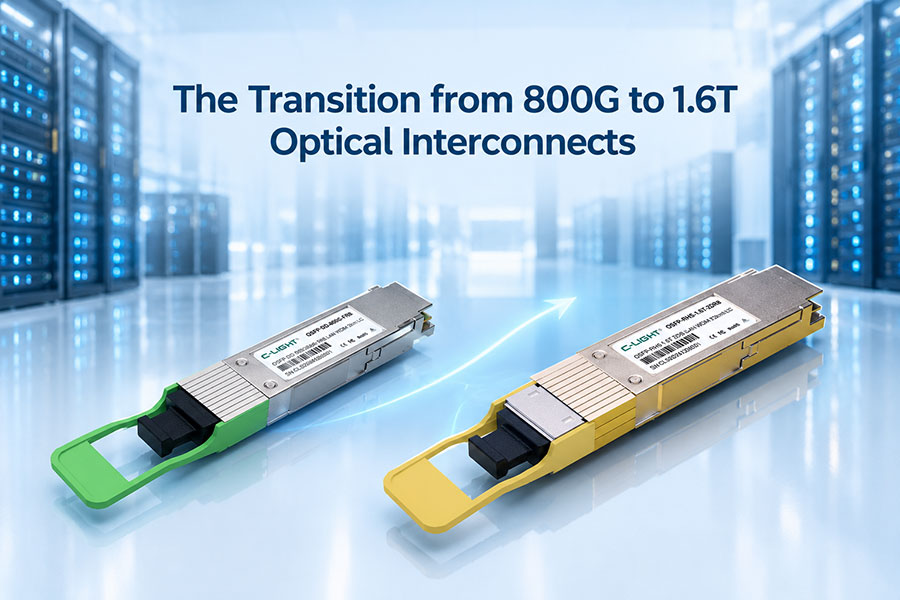
Emerging 1.6T interfaces: Higher aggregate client rates are developing for suitable network platforms, but actual DCI reach and coherent capabilities depend on the specific implementation.
IP-over-DWDM: Direct integration of compatible coherent pluggables into routers and switches can simplify selected network architectures.
Higher fiber utilization: DWDM and related line-system technologies help operators scale capacity on existing fiber routes.
Automated optical operations: Telemetry and monitoring can improve visibility into channel performance and accelerate fault isolation.
Distributed AI connectivity: Multi-site computing increases the importance of balancing bandwidth, latency, reliability, and physical route diversity.
Higher interface rates alone do not guarantee a better network. Successful upgrades require compatible host equipment, a suitable optical path, adequate cooling and power, and a validated operating configuration.
15. Frequently Asked Questions
A traditional data center network primarily connects devices and systems within a facility or local cluster. DCI connects separate facilities and must account for inter-site distance, fiber infrastructure, transport technology, and route resilience.
No. A direct optical link may be sufficient when distance, bandwidth, and fiber resources permit. DWDM is useful when multiple wavelengths need to share a fiber path or when additional channel capacity is required.
Coherent optics are worth evaluating for suitable metropolitan, regional, and longer-reach links, particularly when high capacity or efficient spectrum use is important. The final choice depends on the exact optical path and system compatibility.
Yes, if the selected transceiver is designed for the intended DCI application and is compatible with the host, remote interface, fiber route, and optical line system.
Key inputs include the host equipment model, required data rate, distance, fiber type, connector, optical budget, wavelength plan, and whether the link uses direct detection or coherent transmission.
16. Conclusion
Data center interconnect solutions combine optical transceivers, fiber infrastructure, transport technologies, and network engineering to provide high-capacity connectivity between separate facilities. Direct Ethernet optics, DWDM, and coherent pluggables each serve different requirements, and the most suitable design depends on distance, capacity, optical conditions, host compatibility, and operational targets.
For a reliable deployment, evaluate the complete optical path rather than selecting components by data rate alone. A properly engineered DCI solution can scale inter-site bandwidth, improve fiber utilization, and support cloud, enterprise, storage, and distributed AI workloads.
Planning a data center interconnect deployment?
Confirm the required bandwidth, distance, fiber type, optical architecture, and host compatibility to identify suitable optical connectivity components.
Contact C-LIGHT >

 >
 >
 >
 >
 >
 >
 >