TEL:+86 132 6656 7067





VCSEL-based optical interconnects are widely used for short-reach, high-bandwidth connections inside data centers and high-performance computing environments. By combining vertical-cavity surface-emitting lasers with multimode fiber, these links provide a practical way to connect servers, switches, storage systems, and accelerator infrastructure over distances typically measured in tens or hundreds of meters.
As network speeds advance from 100G and 400G toward 800G and beyond, VCSEL technology remains important in multimode optical transmission. Its advantages include compact laser structures, efficient optical coupling, suitability for parallel-lane transceivers, and compatibility with established OM3 and OM4 fiber installations. However, increasing lane rates also introduces tighter requirements for modulation bandwidth, modal dispersion, signal integrity, thermal control, and receiver performance.
1. What Is a VCSEL-Based Optical Interconnect?
A VCSEL is a semiconductor laser that emits light vertically from the surface of its chip rather than from the edge. Its optical cavity is formed by distributed Bragg reflector (DBR) mirrors above and below the active region. This vertical structure supports compact device dimensions and enables multiple VCSELs to be fabricated and integrated into arrays.
In short-reach optical communication, VCSELs commonly operate around 850 nm and transmit data through multimode fiber (MMF). The optical signal is generated by modulating the laser with an electrical data stream. At the receiving end, a photodetector converts the incoming optical signal back into an electrical signal for further processing.
VCSEL-based links are particularly suitable for short-reach connections because the technology can deliver high data rates over multimode fiber without requiring the same optical architecture used for longer-distance single-mode transmission.
2. Why VCSEL Technology Is Used for Short-Reach Links
VCSELs offer several characteristics that make them attractive for high-density optical connectivity. Their surface-emitting structure supports wafer-level testing and array integration, while their optical output can be efficiently coupled into multimode fiber.
| VCSEL Characteristic | Technical Benefit | Network Relevance |
|---|---|---|
| Vertical emission | Compact device structure and suitability for array fabrication | Supports high-density optical transmitter designs |
| 850 nm operation | Compatible with established short-wavelength multimode fiber systems | Supports common SR optical interconnect applications |
| Efficient fiber coupling | Suitable for coupling into relatively large-core multimode fiber | Facilitates parallel optical connections |
| Low-threshold operation | Can support efficient laser operation under suitable device conditions | Helps manage transceiver power consumption |
| Array integration | Multiple optical channels can be integrated into a compact assembly | Supports 400G and 800G parallel-lane architectures |
| Wafer-level testing | Enables testing before individual device packaging | Can support manufacturing efficiency and production screening |
These benefits are especially relevant in data centers, where thousands of short optical links may connect equipment across racks, rows, and adjacent network zones. The combination of VCSEL arrays, multimode fiber, and parallel optical interfaces offers a practical solution for high-density connectivity.
3. VCSEL and Multimode Fiber: How They Work Together
VCSEL-based optical interconnects are commonly designed around 50/125 µm multimode fiber. Unlike single-mode fiber, which supports one fundamental propagation mode under normal operating conditions, multimode fiber supports multiple optical modes within its core.
The different modes can travel along different optical paths and arrive at the receiver at different times. This effect, known as modal dispersion, can spread transmitted optical pulses and cause adjacent symbols to overlap. The resulting signal distortion limits the achievable data rate and transmission distance.
OM3, OM4 and OM5 Fiber
| Fiber Type | Minimum Effective Modal Bandwidth at 850 nm | Typical Application Consideration |
|---|---|---|
| OM3 | 2,000 MHz·km | Supports shorter-reach 850 nm VCSEL links |
| OM4 | 4,700 MHz·km | Provides higher modal bandwidth for longer multimode transmission |
| OM5 | 4,700 MHz·km at 850 nm, with additional characterization at longer wavelengths | Supports broadband multimode applications, including specified shortwave WDM systems |
OM4 generally provides more modal bandwidth than OM3 at 850 nm, making it suitable for longer distances at a given signaling rate. OM5 maintains the same minimum 850 nm effective modal bandwidth as OM4 but adds broadband wavelength characterization for applications that use multiple wavelengths.
For conventional 850 nm parallel VCSEL links, OM5 does not automatically provide a longer reach than OM4. The supported distance must be checked against the specific Ethernet application and fiber channel requirements.
4. VCSEL-Based Transceivers in 400G and 800G Networks
Higher network speeds are achieved by increasing the number of optical lanes, raising the signaling rate per lane, or combining both approaches. VCSEL-based multimode transceivers commonly use parallel optical lanes, allowing multiple independent signals to travel through separate fiber paths.
400GBASE-SR4
400GBASE-SR4 uses four optical lanes, each operating at 100 Gb/s, for an aggregate data rate of 400 Gb/s. It uses PAM4 signaling at 850 nm over eight multimode fibers: four transmit fibers and four receive fibers.
With compliant cabling, the specified reach is up to 100 m over OM4 or OM5 fiber and up to 60 m over OM3. This architecture is suitable for short-reach connections between high-speed switches and other data center equipment.
400GBASE-SR8
400GBASE-SR8 uses eight optical lanes at 50 Gb/s per lane, providing an aggregate rate of 400 Gb/s. It requires 16 multimode fibers for parallel transmission and reception. The additional lanes distribute the aggregate bandwidth across more optical channels.
800GBASE-SR8
800GBASE-SR8 extends parallel multimode transmission to eight 100 Gb/s optical lanes. It uses PAM4 signaling at approximately 106.25 GBd per lane and requires 16 fibers for full-duplex operation.
| Ethernet Application | Aggregate Rate | Optical Lanes | Fiber Count | Typical Maximum Reach on OM4 |
|---|---|---|---|---|
| 400GBASE-SR4 | 400G | 4 × 100G | 8 | 100 m |
| 400GBASE-SR8 | 400G | 8 × 50G | 16 | 100 m |
| 800GBASE-SR8 | 800G | 8 × 100G | 16 | 100 m |
These application examples demonstrate how VCSEL-based parallel optics support higher aggregate bandwidth. The actual transceiver implementation must comply with the relevant Ethernet physical-layer specification, including lane signaling, optical power, receiver sensitivity, channel loss, and fiber requirements.
5. PAM4 Signaling and VCSEL Modulation Performance
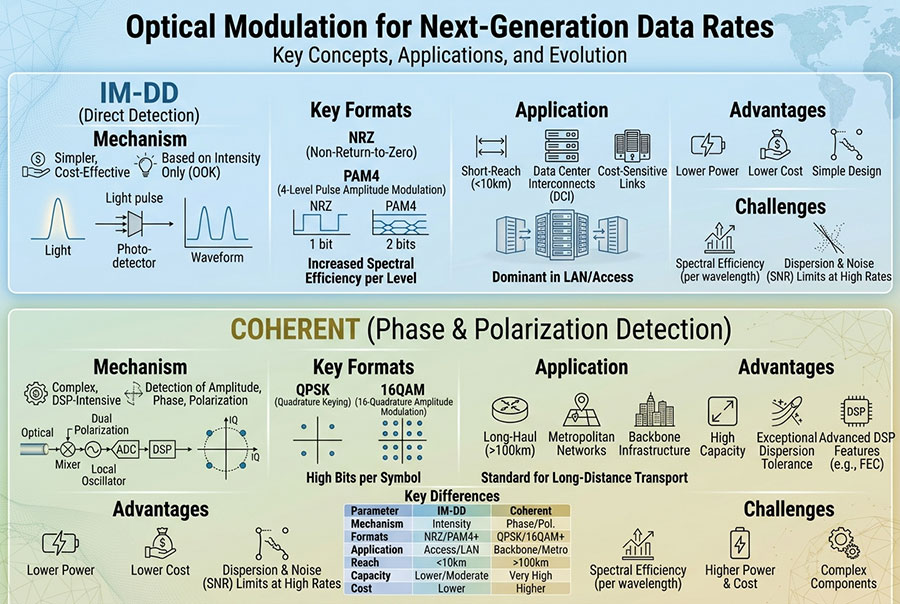
PAM4 is widely used in high-speed optical interconnects because it carries two bits per symbol through four distinct signal levels. Compared with NRZ, which uses two signal levels and carries one bit per symbol, PAM4 increases the number of bits transmitted at a given symbol rate.
For example, a 100 Gb/s optical lane can use approximately 53.125 GBd PAM4 signaling. This is one of the key techniques that enables 100G-per-lane short-reach applications without requiring a symbol rate of 100 GBd.
However, PAM4 introduces tighter signal-quality requirements. The spacing between adjacent amplitude levels is smaller than the full voltage separation used by NRZ, making the signal more sensitive to noise, distortion, and optical power variations.
VCSEL transmitters and their associated driver circuits must therefore maintain adequate modulation bandwidth, linearity, and signal quality. At the receiver, photodiodes, transimpedance amplifiers, equalization, clock recovery, and error correction contribute to reliable data recovery.
6. Key Performance Challenges of VCSEL Optical Links
Modulation Bandwidth
The modulation bandwidth of a VCSEL determines how rapidly its optical output can respond to changes in the electrical drive signal. At higher lane rates, insufficient bandwidth can cause signal attenuation and waveform distortion. Device design, aperture structure, parasitic capacitance, and electrical packaging all influence high-frequency performance.
Modal Dispersion
Multimode fiber supports multiple propagation modes, each with a different group delay. As transmission distance increases, modal dispersion can reduce the available signal margin. Fiber bandwidth, launch conditions, connector quality, and VCSEL emission characteristics all affect the usable transmission distance.
Thermal Management
VCSEL performance is temperature-dependent. Changes in temperature can affect threshold current, output power, wavelength, modulation response, and reliability. Higher drive currents may increase internal heating, so thermal design becomes increasingly important as optical lane rates and channel density rise.
Optical and Electrical Signal Integrity
High-speed VCSEL links depend on coordinated transmitter and receiver performance. Driver impedance, package parasitics, PCB routing, photodiode response, receiver noise, and equalization all influence the final link margin. A strong optical output alone does not guarantee a reliable high-speed connection.
Manufacturing Consistency
Parallel optical systems require multiple channels to operate within specified performance limits. Variations in VCSEL output power, wavelength, modulation response, and coupling efficiency can create channel-to-channel differences. Production testing must verify each optical lane and the complete transceiver assembly.
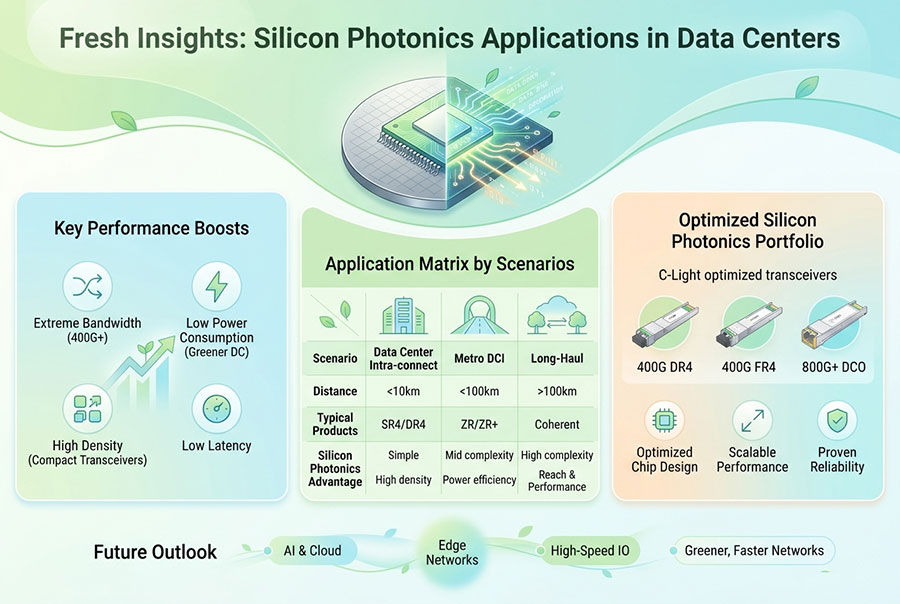
7. VCSEL vs EML and Silicon Photonics
VCSELs, externally modulated lasers (EMLs), and silicon photonics serve different optical interconnect requirements. Their suitability depends on transmission distance, data rate, wavelength, fiber type, power budget, cost, and transceiver architecture.
| Technology | Typical Optical Approach | Common Application Area | Key Design Consideration |
|---|---|---|---|
| VCSEL | Directly modulated laser, commonly around 850 nm | Short-reach multimode links | Modal bandwidth, lane rate, and transmission distance |
| EML | Laser integrated with an electro-absorption modulator, commonly at 1310 nm or other specified wavelengths | High-speed single-mode links over longer distances | Optical power, extinction ratio, dispersion, and link budget |
| Silicon Photonics | Integrated waveguides, modulators, and optical coupling, typically with an external or integrated light source | High-density data center and other optical interconnect architectures | Laser integration, coupling, packaging, and thermal management |
VCSEL technology is particularly competitive where short transmission distances and multimode fiber are already established. EML-based and silicon photonics solutions are often considered for single-mode applications that require different reach, wavelength, or integration characteristics.
These technologies are not direct replacements in every application. A transceiver should be selected according to the required Ethernet standard, optical interface, fiber plant, reach, and equipment compatibility.
8. Where VCSEL-Based Optical Interconnects Are Used
VCSEL-based links are most relevant where high bandwidth is needed over relatively short distances and multimode fiber infrastructure is practical.
Data center server connectivity: Short optical links connect servers and network interface equipment to nearby switches.
Switch-to-switch connections: Parallel multimode transceivers support high-capacity connections between switches in the same rack or adjacent network areas.
AI and high-performance computing clusters: Short-reach optical links can connect network equipment and compute infrastructure where high port density is required.
Storage networks: Optical connectivity supports high-speed data movement between storage systems and network equipment.
Enterprise network infrastructure: Multimode optical links provide high-bandwidth connections within buildings and equipment rooms.
In AI clusters, the choice between multimode VCSEL links and single-mode optical solutions depends on physical topology, cable distance, port density, power targets, and the scale of the network. VCSEL technology remains relevant for short connections, while longer links generally require other optical architectures.
9. Selecting a VCSEL-Based Optical Transceiver
Choosing a VCSEL-based transceiver requires more than matching the aggregate data rate. The optical module, fiber channel, connector system, and host equipment must be compatible as a complete link.
| Selection Parameter | What to Verify |
|---|---|
| Data rate and Ethernet standard | Confirm the required 100G, 400G, or 800G application and its physical-layer specification. |
| Optical wavelength | Verify the specified operating wavelength, commonly 850 nm for conventional VCSEL-based SR links. |
| Fiber type | Check OM3, OM4, or OM5 support and the application-specific reach. |
| Lane configuration | Confirm optical lane count, lane rate, transmit and receive fiber allocation, and host electrical interface. |
| Connector | Check whether the module requires MPO/MTP or another specified optical connector. |
| Optical power budget | Verify transmitter output, receiver sensitivity, maximum input power, and channel insertion loss. |
| Host compatibility | Confirm form factor, electrical interface, firmware support, and equipment compatibility. |
| Thermal and power requirements | Check module power consumption, operating temperature range, and host cooling capability. |
For high-speed applications, testing should include optical power measurements, lane-level performance, error-rate verification, and operation under the specified temperature range. Connector inspection and fiber cleanliness are also important because multimode links can be affected by contamination and connection loss.
10. Future Development of VCSEL-Based Interconnects
VCSEL development continues to focus on higher modulation bandwidth, improved thermal performance, reduced parasitic effects, and more consistent optical characteristics across device arrays. These improvements are important as data center networks move toward higher per-lane signaling rates and greater optical port density.
Advanced VCSEL structures, improved driver integration, receiver equalization, and better multimode fiber designs can extend the performance of short-reach links. Research into reduced-mode and single-mode-emission VCSELs also explores ways to mitigate modal-dispersion constraints in multimode fiber systems.
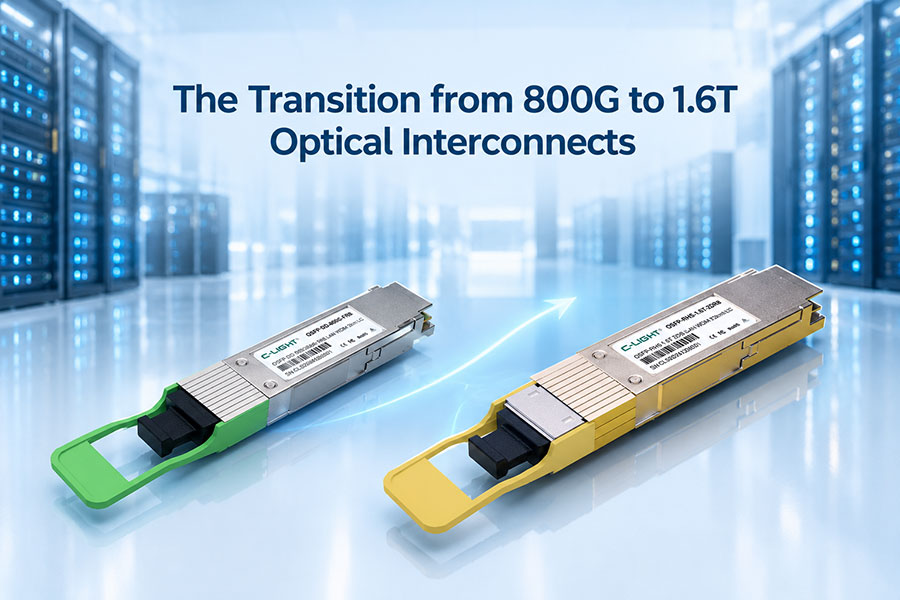
At the same time, the growth of 800G and future 1.6T network architectures is increasing the need to evaluate the limits of parallel multimode transmission. VCSELs are likely to remain relevant in suitable short-reach applications, while single-mode optics, co-packaged optics, and other integrated optical technologies address different reach, density, and power requirements.
11. Conclusion
VCSEL-based optical interconnects provide an established solution for short-reach, high-speed communication in data centers and high-performance computing networks. Their compact surface-emitting structure, array integration capability, and compatibility with 850 nm multimode fiber make them suitable for parallel optical architectures such as 400GBASE-SR4, 400GBASE-SR8, and 800GBASE-SR8.
As lane rates increase, modulation bandwidth, modal dispersion, thermal management, and signal integrity become more demanding. Selecting the right VCSEL-based transceiver therefore requires coordinated consideration of the Ethernet standard, fiber category, optical channel, connector system, and host equipment. These factors determine whether a short-reach optical link can deliver reliable high-speed performance in a real network environment.
12. Q&A
Q1: What is a VCSEL-based optical interconnect?
Answer: It is an optical communication link that uses a vertical-cavity surface-emitting laser to transmit data through optical fiber. Most conventional short-reach data center implementations operate around 850 nm and use multimode fiber.
Q2: Why are VCSELs commonly used with multimode fiber?
Answer: VCSELs can be efficiently coupled into multimode fiber and integrated into compact optical arrays. This combination supports high-density, short-reach connections in data centers and enterprise networks.
Q3: What wavelength do conventional VCSEL optical transceivers use?
Answer: Conventional short-reach VCSEL transceivers commonly use an operating wavelength around 850 nm, matched with suitable multimode fiber.
Q4: Can VCSEL-based transceivers support 400G and 800G?
Answer: Yes. Standards-based multimode applications such as 400GBASE-SR4, 400GBASE-SR8, and 800GBASE-SR8 use parallel optical lanes at 850 nm. Their supported reach depends on the fiber category and complete optical channel.
Q5: What is the difference between OM3 and OM4 fiber for VCSEL links?
Answer: OM4 provides a higher minimum effective modal bandwidth at 850 nm than OM3, allowing longer reach in many standardized short-reach applications. The exact distance depends on the Ethernet physical-layer specification.
Q6: What limits the transmission distance of VCSEL-based optical links?
Answer: Important limitations include modal dispersion, VCSEL modulation bandwidth, optical power budget, receiver sensitivity, connector loss, and signal quality. Fiber type and lane signaling rate also influence the supported reach.
Q7: Are VCSELs suitable for long-distance optical communication?
Answer: Conventional 850 nm VCSEL and multimode fiber systems are primarily designed for short-reach applications. Longer-distance links generally use single-mode fiber and optical transmitter technologies designed for the required reach and wavelength.
Q8: Will VCSEL technology remain relevant in future AI data centers?
Answer: VCSELs are expected to remain useful for suitable short-reach connections where multimode fiber, parallel optics, and high port density offer practical advantages. Their role will depend on future lane rates, link distances, power targets, and the development of competing optical architectures.
 >

 >
 >
 >
 >
 >
 >
 >