TEL:+86 132 6656 7067





Silicon photonics technology integrates optical functions with semiconductor-based manufacturing processes to support compact, high-bandwidth communication systems. By combining waveguides, modulators, photodetectors, and other optical structures on photonic integrated circuits, silicon photonics can reduce component count and support scalable optical engine designs. Its role is increasingly important in high-density data center networks, AI infrastructure, and emerging 400G, 800G, and 1.6T optical interconnect platforms.
1. What Is Silicon Photonics Technology?
Silicon photonics is a technology platform that uses silicon-based photonic integrated circuits (PICs) to guide, modulate, split, combine, and detect optical signals. Instead of assembling every optical function from a separate discrete component, designers can integrate multiple photonic structures on a common chip or closely related semiconductor platform.
Silicon is attractive because it supports mature semiconductor manufacturing processes and enables dense optical routing at small dimensions. Silicon photonics commonly uses silicon-on-insulator (SOI) wafers, where a thin silicon device layer is separated from the silicon substrate by a buried oxide layer. This structure provides strong optical confinement for appropriately designed waveguides.
Silicon itself is not an efficient light emitter under conventional conditions, so silicon photonics systems generally require a suitable external laser, an integrated III-V light source, or another compatible optical-source arrangement. The final implementation depends on cost, reliability, packaging, wavelength, and power requirements.
2. Core Components of a Silicon Photonics Circuit
Optical waveguides
Waveguides confine and route light through the photonic circuit. Their geometry, refractive-index contrast, bends, and coupling structures influence propagation loss, optical mode behavior, and integration density.
Optical modulators
Modulators encode electrical data onto an optical carrier by changing a property of the light, typically its phase or intensity. Silicon photonics implementations may use carrier-depletion or carrier-injection structures, while hybrid platforms can incorporate other modulation materials where needed.
Photodetectors
Photodetectors convert received optical signals into electrical current. Germanium is widely used in silicon photonics receivers because it can detect important telecommunications wavelengths and can be integrated with silicon-based structures using compatible process flows.
Couplers, splitters, and multiplexers
These structures connect light between fibers, waveguides, and multiple optical paths. Grating couplers and edge couplers are common fiber-interface approaches, while wavelength multiplexers and demultiplexers enable multiple optical channels to share a single fiber.
Laser sources
Many silicon photonics transceivers use an external continuous-wave laser coupled into the photonic integrated circuit. Other architectures use hybrid or heterogeneous integration to bring light sources closer to the silicon photonics platform. Laser placement affects coupling loss, thermal design, reliability, and serviceability.
| Component | Primary Function | Key Design Consideration |
|---|---|---|
| Waveguide | Routes optical signals on the chip | Propagation loss, geometry, and optical confinement |
| Modulator | Encodes electrical data onto light | Bandwidth, drive voltage, insertion loss, and linearity |
| Photodetector | Converts optical signals to electrical signals | Responsivity, bandwidth, noise, and wavelength range |
| Optical coupler | Transfers light between fibers and the PIC | Coupling loss, alignment tolerance, and packaging |
| Laser source | Supplies the optical carrier | Output power, wavelength stability, reliability, and thermal behavior |
3. How Silicon Photonics Works in an Optical Transceiver
A silicon photonics transceiver converts electrical data into optical signals for transmission and converts received light back into electrical data. The photonic integrated circuit performs key optical functions, while driver electronics, receiver electronics, control circuitry, and packaging complete the transceiver.
Transmit path
The host ASIC sends high-speed electrical data to the module. The driver provides the electrical signal required by the modulator, which encodes the data onto light from a laser source. The resulting optical signal passes through the coupling interface and into the fiber.
Receive path
Incoming light enters the photonic circuit and reaches the photodetector. The detector converts optical power variations into an electrical signal, which receiver electronics amplify and condition before the data is delivered to the host.
The exact signal path varies with modulation format, lane rate, optical reach, and whether the module uses a DSP, retimer, linear-drive architecture, or coherent processing. Silicon photonics describes the photonic integration platform; it does not by itself specify the complete transceiver architecture.
4. Why Silicon Photonics Matters for 400G, 800G, and 1.6T
Higher network bandwidth requires more data to pass through each optical module without exceeding practical limits on size, power, thermal load, and manufacturing complexity. Silicon photonics can integrate multiple optical functions into a compact photonic circuit, making it useful for high-speed optical engines and dense transceiver designs.
400G: Silicon photonics can support compact optical implementations using parallel optical lanes or wavelength-multiplexed architectures, depending on the module design.
800G: Higher aggregate throughput increases the importance of integration density, electrical-to-optical interface design, thermal management, and manufacturing consistency.
1.6T: Continued scaling places greater demands on optical lane rates, packaging, electrical interfaces, and photonic integration. The specific implementation depends on the product architecture and host platform.
Silicon photonics is not the only way to build high-speed optical modules. Indium phosphide (InP) and other photonic technologies remain important for lasers, modulators, coherent systems, and specialized applications. The most appropriate platform depends on the required optical performance, integration strategy, production volume, and cost structure.
5. Silicon Photonics vs. Traditional Discrete Optical Components
Traditional optical designs can use individual lasers, modulators, detectors, and optical routing components assembled through precision packaging. Silicon photonics moves many optical functions onto a shared integrated circuit, although the complete module still contains multiple electrical, optical, mechanical, and thermal components.
| Factor | Silicon Photonics | Discrete or Other Photonic Platforms |
|---|---|---|
| Integration | Multiple optical functions can be integrated on a PIC. | Functions may rely on separate optical components or different integration methods. |
| Manufacturing approach | Can leverage semiconductor fabrication and wafer-scale processing. | Depends on the materials, device processes, and packaging method. |
| Design flexibility | Strong for compact, repeatable optical routing and integrated functions. | Separate components can offer flexibility for certain specialized performance requirements. |
| Laser integration | Often requires external, hybrid, or heterogeneous light-source integration. | Some material platforms, such as InP, can provide efficient laser functionality directly. |
| Packaging | Requires accurate fiber coupling, electrical connections, and thermal control. | May require alignment and assembly of multiple separate optical devices. |
| Cost at scale | Potential for manufacturing and assembly efficiencies at suitable production volumes. | Economics depend on device complexity, production scale, yield, and assembly requirements. |
6. Silicon Photonics vs. Indium Phosphide Technology
Silicon photonics and indium phosphide photonics serve overlapping but distinct roles. Silicon photonics is especially attractive for integrating waveguides, modulators, and detectors in dense circuits. InP is an important direct-bandgap semiconductor platform for efficient laser sources and other active photonic devices.
The technologies are not mutually exclusive. A silicon photonics module can use an InP laser coupled to a silicon photonic circuit. Hybrid and heterogeneous integration approaches combine the properties of different materials to achieve an overall system design that would be difficult to implement with a single material platform.
| Characteristic | Silicon Photonics | Indium Phosphide Photonics |
|---|---|---|
| Waveguide integration | Well suited to dense silicon-based optical routing. | Supports integrated optical routing and active devices. |
| Laser generation | Usually requires an external or integrated compatible light source. | Supports efficient laser generation in suitable device structures. |
| Modulation and detection | Can integrate modulators and compatible photodetectors. | Can integrate active optical functions on an InP platform. |
| System design | Often emphasizes integration density and scalable photonic routing. | Often emphasizes active-device performance and optical-source integration. |
7. Silicon Photonics and Optical Engine Packaging
The performance of a silicon photonics circuit depends on more than the PIC itself. Optical coupling, electrical parasitics, heat transfer, mechanical alignment, and assembly yield can determine whether the complete transceiver meets its specifications.
An optical engine typically combines a photonic integrated circuit with associated electrical and optical interfaces. Depending on the design, the assembly may include a laser source, modulator drivers, receiver amplifiers, control electronics, and fiber-array connections.
Packaging becomes increasingly challenging as data rates rise. Electrical connections must preserve signal integrity, while optical interfaces must maintain low coupling loss and stable alignment. Thermal design must also account for the laser, drivers, DSP where present, and nearby host components.
For pluggable modules, the optical engine is integrated into a removable module that connects to a switch or NIC through a standardized host interface. Co-packaged optics places optical engines closer to the host ASIC, potentially shortening high-speed electrical paths but changing serviceability, packaging, and system-level maintenance considerations.
8. Silicon Photonics, LPO, and Co-Packaged Optics
Silicon photonics, Linear Pluggable Optics (LPO), and Co-Packaged Optics (CPO) describe different aspects of optical system design. Silicon photonics is a photonic integration technology. LPO is a transceiver signal-processing architecture that reduces dependence on conventional module-level DSP retiming. CPO is a packaging approach that places optical engines close to a host ASIC.
| Technology | What It Describes | Potential Benefit | Main Engineering Concern |
|---|---|---|---|
| Silicon Photonics | Integration of optical functions on silicon-based PICs | Compact optical integration and scalable manufacturing | Coupling, laser integration, loss, yield, and packaging |
| LPO | Linear electrical-to-optical signal path with reduced module DSP retiming | Potentially lower module power and latency | Host SerDes capability and electrical-channel quality |
| CPO | Optical engines packaged close to the host ASIC | Shorter electrical paths and potential improvements in bandwidth density | Serviceability, fiber management, thermal integration, and repair strategy |
These approaches can coexist. A silicon photonics circuit may be used in a conventional retimed pluggable module, an LPO module, or a co-packaged optical engine. Silicon photonics alone does not determine whether a product uses a DSP or where its optical engine is packaged.
9. Key Engineering Challenges
Optical insertion loss
Waveguides, bends, couplers, multiplexers, and interfaces contribute loss. The total loss budget must leave sufficient margin for the transmitter, fiber path, connectors, and receiver sensitivity.
Laser coupling and wavelength stability
Laser output must be coupled efficiently into the photonic circuit. Wavelength stability and optical power can be affected by temperature, packaging stress, and device characteristics. The required controls depend on the optical interface and modulation method.
Thermal management
Temperature can affect laser behavior, modulator performance, and component reliability. High-density optical modules therefore require thermal designs that account for the optical engine, electronics, module enclosure, and host airflow or liquid-cooling arrangement.
Manufacturing yield and test
Wafer-level fabrication can enable repeatable photonic structures, but final module performance also depends on coupling alignment, laser attachment, electrical assembly, and packaging. Testing at the PIC, optical-engine, and completed-module levels helps identify losses and defects at different stages.
Electrical and optical co-design
The host electrical interface, driver, modulator, receiver, and photonic circuit must be designed together. Increasing lane rates can reduce the available margin for insertion loss, bandwidth, reflections, and crosstalk, making channel modeling and system-level validation essential.
10. Applications in AI Data Centers and Telecom Networks
AI data centers
AI training and inference infrastructure uses high-bandwidth connections between accelerators, switches, storage, and other network equipment. Silicon photonics can support compact optical engines and high-density transceivers used in short-reach and intermediate-reach interconnects. The appropriate module depends on the network topology, optical reach, port rate, and host interface.
High-speed Ethernet
Silicon photonics can be used in optical transceivers for 400GbE, 800GbE, and emerging 1.6TbE systems. Implementations vary in lane count, modulation, wavelength arrangement, optical reach, and signal-processing architecture.
Data center interconnect
Interconnecting data centers may require wavelength multiplexing, coherent modulation, advanced digital signal processing, and optical amplification depending on distance and line-system design. Silicon photonics can contribute to integrated optical components, but not every coherent transceiver uses a silicon photonics platform.
Telecommunications infrastructure
Optical access, metro networks, and other telecom systems require different combinations of reach, wavelength management, power, and environmental specifications. Silicon photonics can support selected optical functions in these applications, while device choice remains dependent on the system's optical and protocol requirements.
11. How to Evaluate Silicon Photonics Optical Modules
Selecting a silicon photonics transceiver requires evaluating the complete optical link rather than the photonic integration technology alone. The following factors help determine whether a module meets the application requirements.
Data rate and host interface: Confirm the supported Ethernet or other protocol, electrical lane configuration, and switch or NIC compatibility.
Optical reach: Match the module's supported distance, wavelength, fiber type, and connector arrangement to the link design.
Optical budget: Verify transmitter output, receiver sensitivity, insertion losses, and engineering margin.
Power and thermal limits: Check module power, cooling requirements, operating temperature, and host platform limits.
Signal-processing architecture: Confirm whether the transceiver uses a DSP, retimer, linear-drive approach, or coherent processing as applicable.
Reliability and manufacturing quality: Review environmental ratings, monitoring capabilities, test coverage, and operating requirements.
Interoperability: Validate the exact module part number against the intended host platform and network configuration.
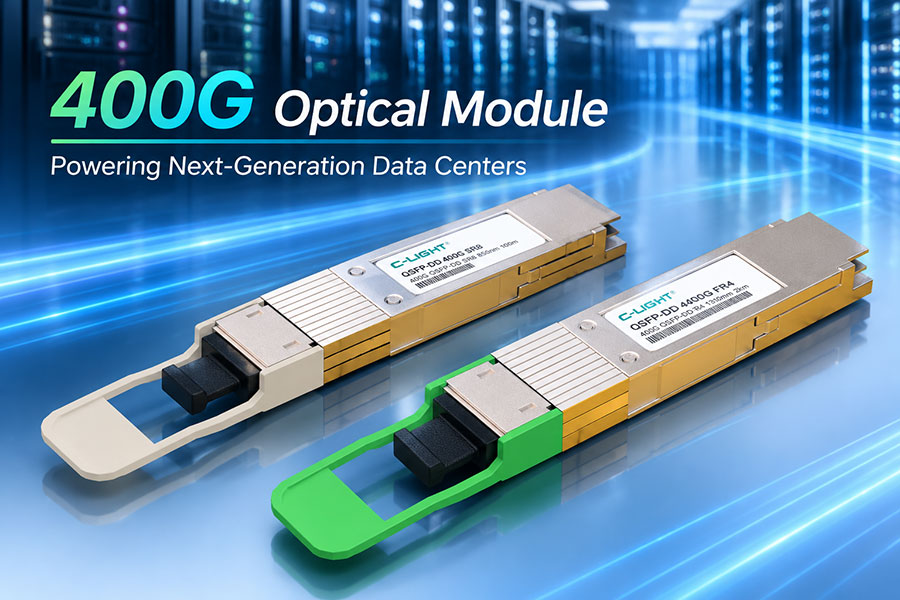
C-LIGHT provides optical transceiver options across multiple data rates and form factors. Review the C-LIGHT Optical Transceiver Product Range, including the 400G QSFP-DD and 800G QSFP-DD product families. The specific photonic platform and internal architecture should be confirmed for each selected part number.
12. Conclusion
Silicon photonics technology integrates multiple optical functions on semiconductor-based photonic circuits, helping optical transceivers scale in bandwidth and integration density. Its capabilities are relevant to 400G, 800G, and emerging 1.6T interconnects, where optical loss, power consumption, thermal limits, and packaging complexity become increasingly important.
Successful deployment depends on the complete system: laser integration, modulation, detection, fiber coupling, electrical interfaces, thermal management, and manufacturing quality. Silicon photonics should therefore be evaluated as part of an end-to-end optical architecture rather than as a guarantee of a particular data rate, power level, or transmission distance.
13. Frequently Asked Questions
Does silicon photonics generate its own laser light?
Not necessarily. Silicon is generally not an efficient light emitter in conventional silicon photonics implementations. Many systems use an external laser or integrate a compatible light source through hybrid or heterogeneous approaches.
Is silicon photonics always lower power than traditional optics?
No. Integration can reduce component count and support efficient designs, but total power depends on the laser, drivers, receiver electronics, DSP, data rate, and packaging. The complete module or system must be evaluated.
Can silicon photonics support 800G and 1.6T optical modules?
Yes. Silicon photonics is applicable to high-speed optical engines and transceivers at these aggregate rates. The exact module implementation depends on lane architecture, modulation, optical reach, host interface, and product design.
Is silicon photonics the same as LPO?
No. Silicon photonics describes a photonic integration platform, while LPO describes a signal-processing architecture that reduces reliance on conventional module-level DSP retiming. An LPO module may use silicon photonics, but the terms are not interchangeable.
Is silicon photonics suitable for long-distance coherent transmission?
Silicon photonics can be used in some coherent optical architectures, but suitability depends on the specific modulator, receiver, laser, DSP, optical performance, and line-system requirements. Not every silicon photonics transceiver is designed for coherent or long-haul transmission.
What determines the performance of a silicon photonics transceiver?
Performance depends on the photonic circuit, laser source, modulators, photodetectors, electrical signal processing, fiber coupling, packaging, thermal conditions, and the complete link budget. The supported host platform and interoperability requirements are also important.
Looking for optical transceivers for high-speed data center or telecom applications?
Specify your data rate, transmission distance, fiber type, host platform, and operating conditions to identify a suitable solution.
Contact C-LIGHT >

 >
 >
 >
 >
 >
 >
 >