TEL:+86 132 6656 7067




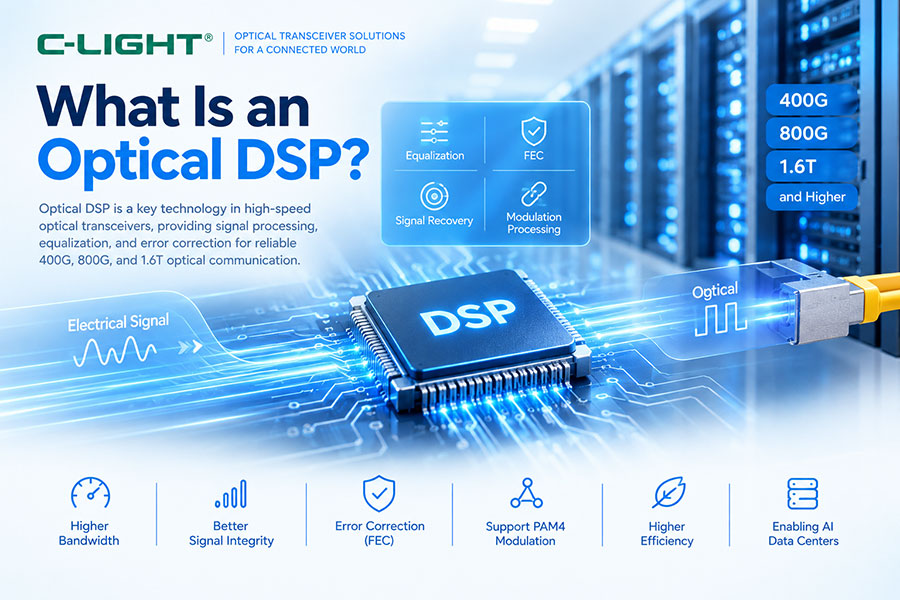
Optical DSP, or Optical Digital Signal Processing, is a key technology used in high-speed optical transceivers to process and optimize electrical and optical signals. It helps compensate for signal impairments, support high-speed modulation such as PAM4, and maintain reliable transmission at 400G, 800G, 1.6T, and higher data rates.
1. What Is an Optical DSP?
An optical DSP is a digital signal processing chip used inside or alongside an optical transceiver to manage high-speed data signals. It converts, processes, and reconstructs electrical signals while applying algorithms to compensate for transmission impairments.
2. Why Is Optical DSP Important?
As optical networks move from 100G and 200G to 400G, 800G, and 1.6T, signal integrity becomes increasingly difficult to maintain. Optical DSP technology helps improve signal quality and enables higher data rates over practical transmission distances.
3. How Does an Optical DSP Work?
The DSP receives high-speed electrical data from the host system and processes the signal before it reaches the optical transmitter. On the receiving side, it processes the electrical signal generated by the optical receiver and reconstructs the original data.
4. Optical DSP in a Transceiver
A typical high-speed optical transceiver may include a host electrical interface, DSP, optical transmitter, optical receiver, and management circuitry. The DSP acts as an important processing layer between the electrical and optical domains.
5. Optical DSP and PAM4
PAM4 uses four signal levels to transmit two bits per symbol, increasing the data rate without simply doubling the electrical signaling frequency. DSP technology is commonly used to process PAM4 signals and compensate for the additional signal impairments associated with higher-order modulation.
6. Optical DSP and 400G Transceivers
400G optical transceivers commonly use multiple high-speed lanes to achieve the required aggregate bandwidth. DSP technology can provide signal conditioning, equalization, clock recovery, and other processing functions required for reliable 400G operation.
7. Optical DSP and 800G Transceivers
800G transceivers place greater demands on electrical and optical signal processing. Depending on the architecture, 800G solutions can use 8×100G lanes or 4×200G lanes, with DSP technology helping manage PAM4 signaling and compensate for channel impairments.
8. Optical DSP and 1.6T Transceivers
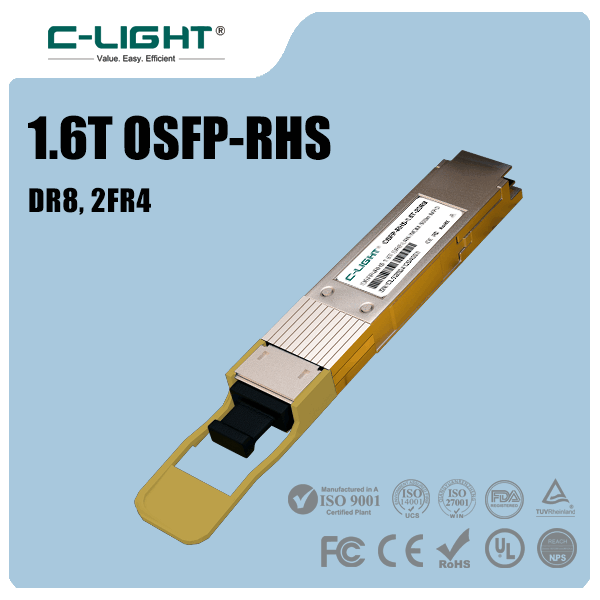
1.6T optical transceivers represent another major increase in bandwidth density. Many 1.6T architectures use 8×200G lanes, requiring advanced DSP capabilities to support higher-speed electrical interfaces and maintain signal quality.
9. Main Functions of an Optical DSP
Common DSP functions include equalization, clock and data recovery, signal conditioning, forward error correction, modulation processing, and compensation for electrical channel losses. The exact functions depend on the transceiver architecture and application.
10. DSP and Equalization
High-speed electrical signals experience insertion loss, reflections, crosstalk, and other impairments when traveling through PCB traces, connectors, and cables. DSP-based equalization helps compensate for these effects and improves the quality of the received signal.
11. DSP and FEC
Forward Error Correction, or FEC, adds redundant information to transmitted data so that certain errors can be detected and corrected. In high-speed optical systems, FEC can significantly improve link performance and help extend the usable transmission range.
12. DSP vs. LPO
Traditional pluggable optical transceivers often use DSPs for signal processing and compensation. Linear Pluggable Optics, or LPO, reduces or removes some of the DSP processing from the optical module and relies more heavily on the host system for signal conditioning. As a result, LPO can reduce power consumption and latency, but it places greater requirements on the host electrical channel.
13. DSP vs. LRO
Linear Receive Optics, or LRO, is another architecture designed to reduce processing inside the optical module, particularly on the receive path. Compared with conventional DSP-based modules, LRO can provide a different balance between power consumption, latency, signal processing, and link performance.
14. Optical DSP Power Consumption
DSPs can represent a significant portion of the power consumption of high-speed optical modules. As data rates increase, improving DSP efficiency becomes increasingly important for AI data centers and high-density networking environments.
15. Optical DSP in AI Data Centers
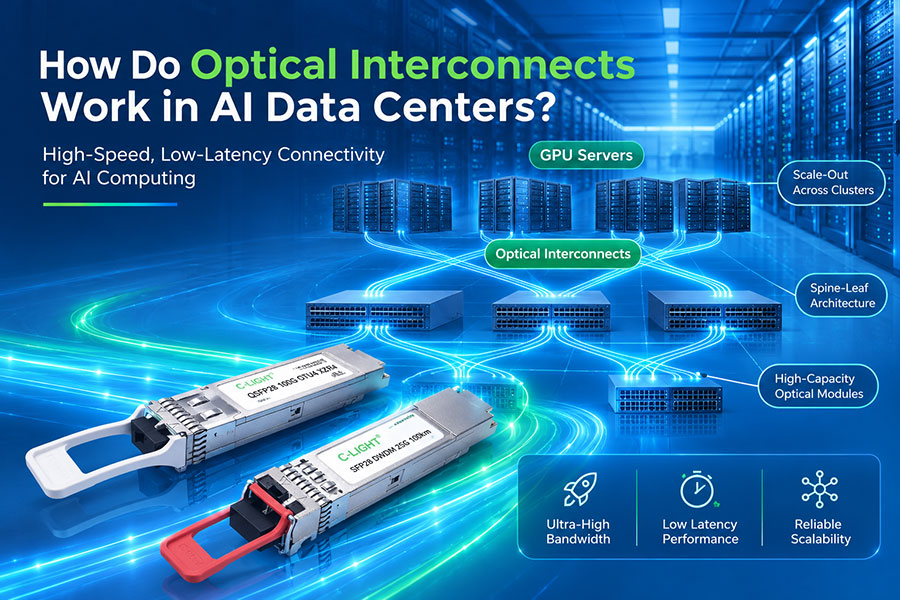
AI clusters generate extremely high volumes of east-west traffic between GPUs, switches, and other computing resources. 800G and 1.6T optical connections use advanced signal processing technologies to support the bandwidth, density, and reliability requirements of these networks.
16. Advantages of Optical DSP
Optical DSP technology provides several important advantages, including improved signal integrity, compensation for channel impairments, support for high-speed PAM4 signaling, FEC processing, and greater flexibility for high-speed optical network designs.
17. Limitations of Optical DSP
The main limitations include power consumption, heat generation, processing latency, and increased module complexity. These factors become more important as optical networks move toward 1.6T and future higher-speed architectures.
18. Why DSP Technology Is Evolving
The transition from 100G to 400G, 800G, and 1.6T requires higher baud rates and greater bandwidth per electrical lane. DSP architectures are therefore evolving to provide higher processing performance while reducing power consumption and maintaining signal quality.
19. Optical DSP in Future Optical Networks
Optical DSP will continue to play an important role in high-speed optical networking, particularly where longer reach, complex signal compensation, and high link reliability are required. At the same time, DSP alternatives such as LPO and LRO are being developed for applications where lower power and latency are priorities.
20. Conclusion
Optical DSP is a core technology for modern high-speed optical transceivers. By processing signals, compensating for transmission impairments, and supporting technologies such as PAM4 and FEC, DSP enables reliable 400G, 800G, and 1.6T optical connectivity for data centers, AI infrastructure, and high-performance networks.
 >
>

 >
>
 >
>
 >
>
 >
>
 >
>
 >
>
 >
>