TEL:+86 132 6656 7067




1. What Is TOSA?
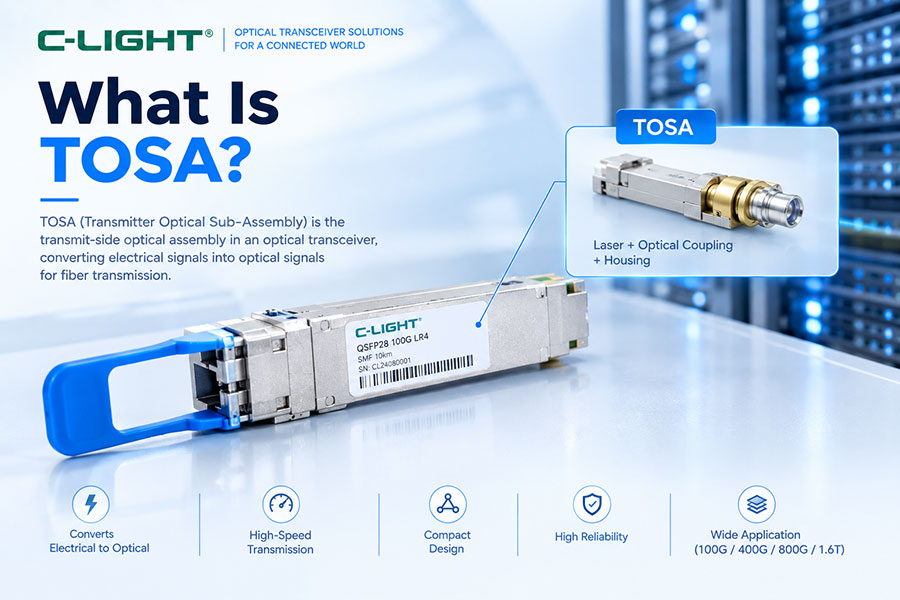
TOSA stands for Transmitter Optical Sub-Assembly. It is the optical transmitting component inside an optical transceiver, responsible for converting electrical signals into optical signals and sending them into the optical fiber.
2. What Is the Function of TOSA?
The main function of TOSA is to generate and modulate optical signals according to the electrical data received from the transceiver circuit. The optical output is then coupled into the fiber through the optical interface.
3. How Does TOSA Work?
In a typical transmission path, the host electrical signal is processed by the transceiver's driver or related circuitry. The driver controls the optical source inside the TOSA, producing a modulated optical signal. Optical coupling components then direct the signal into the fiber.
4. What Are the Main Components of TOSA?
A TOSA can contain an optical source such as a laser diode, together with optical coupling, monitoring, and packaging components. Depending on the design, it may include a laser, lens, isolator, monitor photodiode, optical connector, and related electrical connections.
5. What Type of Lasers Are Used in TOSA?
The laser source depends on the application and transmission distance. VCSELs are commonly used for short-reach multimode fiber applications, while DFB and EML lasers are widely used for longer-reach single-mode fiber optical transceivers.
6. TOSA and Optical Wavelength
The wavelength of a TOSA is determined mainly by the laser source and the target optical application. Common wavelengths include 850nm for short-reach multimode transmission and 1310nm or 1550nm for single-mode fiber applications.
7. What Is the Difference Between TOSA and ROSA?
TOSA is the transmitting side of an optical transceiver, while ROSA stands for Receiver Optical Sub-Assembly and is responsible for receiving optical signals and converting them into electrical signals.
8. TOSA vs. ROSA in an Optical Transceiver
A complete optical transceiver generally contains both transmitting and receiving functions. The TOSA handles electrical-to-optical conversion, while the ROSA handles optical-to-electrical conversion.
9. What Is the Difference Between TOSA and a Complete Optical Transceiver?
TOSA is only a sub-assembly within an optical transceiver. A complete transceiver also includes receiver components, electrical circuits, management functions, connectors, housing, and other components required for system operation.
10. What Is the Role of the Laser Driver?
The laser driver provides the electrical drive signal required by the laser. In some transceiver architectures, the driver is closely integrated with the TOSA, while in other designs it is implemented separately on the transceiver's electrical circuit.
11. What Is the Role of the Monitor Photodiode?
A monitor photodiode can be used to monitor the optical output of the laser. Feedback from the monitor photodiode helps maintain stable transmitter performance and supports optical power control.
12. TOSA in Single-Mode Optical Transceivers
Single-mode optical transceivers commonly use TOSA designs based on DFB or EML laser technology. These assemblies are used for applications such as 10G, 25G, 100G, 400G, and higher-speed optical communication.
13. TOSA in Multimode Optical Transceivers
Short-reach multimode optical transceivers commonly use VCSEL-based TOSA designs. The 850nm wavelength is widely associated with short-distance data center links using OM3 or OM4 multimode fiber.
14. TOSA in 100G Optical Transceivers
100G optical transceivers can use different TOSA architectures depending on the application. For example, short-reach modules may use VCSELs, while long-reach modules can use DFB or EML-based transmitters with multiple optical channels.
15. TOSA in 400G and 800G Optical Transceivers
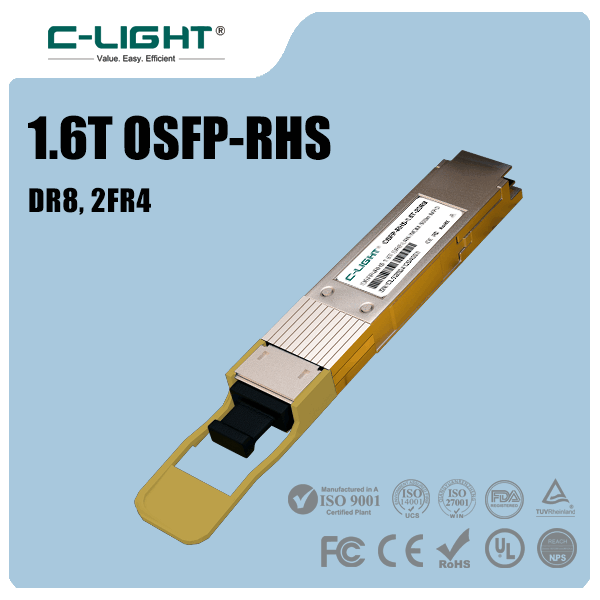
At 400G and 800G, transmitter architectures typically use multiple optical lanes and advanced modulation technologies such as PAM4. The TOSA or optical transmitter assembly must support higher symbol rates, accurate optical power control, and tight optical performance requirements.
16. TOSA and PAM4
PAM4 is widely used in modern high-speed optical transceivers. In a PAM4 transmitter, the electrical driver controls the optical source or modulator to generate multiple signal levels, increasing the amount of data transmitted per symbol.
17. TOSA and EML
EML, or Electro-Absorption Modulated Laser, combines a laser source with an electro-absorption modulator. EML-based transmitter assemblies are commonly used where high-speed performance and longer transmission distance are required.
18. TOSA and VCSEL
VCSEL, or Vertical-Cavity Surface-Emitting Laser, is commonly used in short-reach optical communication. VCSEL-based TOSA designs are particularly suitable for multimode fiber applications because of their cost, efficiency, and suitability for high-volume data center deployments.
19. Key TOSA Performance Parameters
Important TOSA parameters include optical output power, center wavelength, spectral characteristics, extinction ratio, modulation performance, power consumption, operating temperature, coupling efficiency, and transmitter dispersion performance.
20. TOSA Manufacturing and Testing
TOSA manufacturing requires precise laser alignment, optical coupling, electrical connection, and packaging. Testing typically evaluates optical output power, wavelength, extinction ratio, eye quality, modulation performance, temperature characteristics, and long-term reliability.
21. Why Is TOSA Important?
TOSA directly affects the transmitting performance of an optical transceiver. Laser characteristics, optical coupling efficiency, thermal stability, and high-speed modulation performance all influence the quality and reliability of the final optical link.
22. TOSA FAQ
Q1. What does TOSA stand for?
Q2. What is the main function of TOSA?
Q3. What is the difference between TOSA and ROSA?
Q4. Which lasers are commonly used in TOSA?
Q5. Is TOSA a complete optical transceiver?
Q6. Is TOSA used in 400G and 800G optical modules?
23. Summary
TOSA, or Transmitter Optical Sub-Assembly, is a core transmitting component of an optical transceiver. It integrates the optical source and related optical components to convert electrical data into optical signals. From short-reach VCSEL applications to long-reach DFB and EML designs, TOSA technology plays an important role in modern 100G, 400G, 800G, and next-generation optical communication systems.
 >
>

 >
>
 >
>
 >
>
 >
>
 >
>
 >
>
 >
>