TEL:+86 132 6656 7067




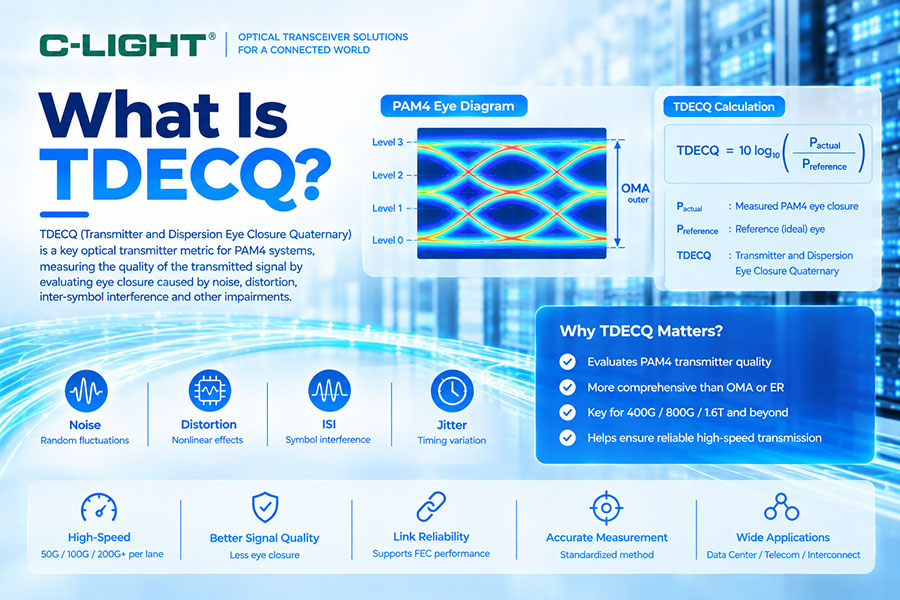
As optical communication moves from NRZ toward PAM4, evaluating transmitter quality requires more than measuring average optical power and modulation amplitude. PAM4 uses four optical signal levels, making the transmitter more sensitive to noise, inter-symbol interference, nonlinear distortion, jitter, level imbalance, and other impairments. TDECQ (Transmitter and Dispersion Eye Closure Quaternary) is a standardized transmitter performance metric developed to quantify how much these impairments degrade the effective eye opening of a PAM4 optical signal. It has become an important parameter in the validation of modern 50G-per-lane, 100G-per-lane, 400G, 800G, and higher-speed optical interfaces.
1. What Is TDECQ?
TDECQ stands for Transmitter and Dispersion Eye Closure Quaternary. It is a performance metric used to evaluate the quality of a PAM4 optical transmitter after considering the effects of transmitter distortion, noise, and simulated or defined channel dispersion conditions.
Unlike a simple optical power measurement, TDECQ evaluates the quality of the transmitted waveform and expresses the amount of eye closure relative to an ideal reference condition.
TDECQ is normally expressed in dB, and a lower TDECQ value indicates better transmitter performance.
2. Why Was TDECQ Developed?
Traditional NRZ transmitter metrics such as extinction ratio and OMA are not sufficient to fully characterize PAM4 transmitter performance. PAM4 contains four optical amplitude levels and three eye openings, so waveform linearity and noise become much more significant.
TDECQ provides a standardized way to evaluate PAM4 transmitter quality while taking into account the combined effects of signal distortion and channel-related impairment.
3. Why Is TDECQ Important for PAM4?
PAM4 doubles the number of bits carried per symbol compared with binary NRZ, but the receiver must distinguish four amplitude levels instead of two. The voltage or optical separation between adjacent levels is therefore smaller.
Noise, distortion, jitter, and inter-symbol interference can close the three PAM4 eyes and increase detection errors. TDECQ provides a quantitative method for evaluating this transmitter degradation.
4. What Does TDECQ Measure?
TDECQ measures the effective degradation of a PAM4 transmitter relative to an ideal reference transmitter under the defined measurement methodology.
The measurement reflects the combined influence of multiple transmitter characteristics, including noise, level distortion, inter-symbol interference, and waveform imperfections. It is therefore more comprehensive than evaluating one optical parameter independently.
5. What Does a Lower TDECQ Mean?
A lower TDECQ generally means that the transmitter produces a cleaner PAM4 optical waveform with less eye closure. This indicates better signal quality and provides a stronger basis for reliable receiver detection.
A higher TDECQ indicates greater transmitter degradation and potentially less available system margin.
6. Is TDECQ an Optical Power Measurement?
No. TDECQ is not simply a measurement of optical output power. A transmitter may have adequate average optical power and OMA while still producing a distorted or noisy PAM4 waveform.
TDECQ evaluates waveform quality rather than only the amount of optical power launched into the fiber.
7. TDECQ vs OMA
OMA measures the optical modulation amplitude of a transmitter, while TDECQ evaluates the quality of the PAM4 waveform after considering signal impairments.
| Parameter | OMA | TDECQ |
|---|---|---|
| Primary Purpose | Measure modulation amplitude | Evaluate PAM4 transmitter quality |
| Typical Unit | dBm | dB |
| Signal Information | Optical level separation | Eye closure and waveform degradation |
| Common Use | Transmitter power characterization | PAM4 transmitter validation |
| Lower Value | Not necessarily better | Generally better |
OMA and TDECQ should be evaluated together rather than treating either parameter as a complete description of transmitter performance.
8. TDECQ vs Extinction Ratio
Extinction ratio describes the ratio between optical signal levels, particularly the high and low levels in a binary optical signal. TDECQ is designed for PAM4 transmitter quality evaluation and includes the effects of waveform degradation that extinction ratio cannot fully represent.
For modern PAM4 systems, TDECQ provides a more comprehensive indication of transmitter signal quality.
9. TDECQ vs OMAouter
OMAouter represents the optical amplitude span between the highest and lowest PAM4 levels. TDECQ evaluates how effectively the complete PAM4 waveform maintains its usable eye openings.
A transmitter can have adequate OMAouter while still producing poor TDECQ because of noise, nonlinear distortion, level imbalance, or inter-symbol interference.
10. TDECQ and the PAM4 Eye Diagram
The PAM4 eye diagram contains three eye openings corresponding to the four signal levels. An ideal PAM4 waveform would have well-separated levels and clearly defined eyes.
Real transmitters introduce noise, distortion, and timing variations that reduce eye height and eye width. TDECQ converts these effects into a quantitative performance metric.
11. What Causes Poor TDECQ?
Poor TDECQ can be caused by several transmitter impairments, including electrical noise, optical noise, insufficient driver linearity, level mismatch, inter-symbol interference, bandwidth limitations, ringing, overshoot, undershoot, jitter, laser nonlinearity, and other waveform distortions.
Thermal variation and device operating conditions can also affect PAM4 transmitter performance.
12. TDECQ and Inter-Symbol Interference
Inter-symbol interference occurs when one symbol affects the detection of neighboring symbols. In high-speed PAM4 systems, limited bandwidth and frequency-dependent channel loss can spread transitions and reduce eye opening.
Because TDECQ captures the resulting eye degradation under the defined measurement methodology, it can reveal transmitter limitations that are not visible from average power measurements alone.
13. TDECQ and Noise
Noise introduces random variations into the PAM4 signal levels. When noise becomes large relative to the separation between adjacent levels, the receiver has a higher probability of making incorrect decisions.
TDECQ accounts for the impact of noise on the effective eye opening and therefore serves as an important transmitter-quality metric.
14. TDECQ and PAM4 Level Linearity
Ideally, the four PAM4 levels should maintain an appropriate and predictable relationship. Nonlinear level spacing can reduce one or more eye openings and create unequal detection margins.
This type of distortion may not be adequately represented by average optical power or OMA alone, but it can contribute significantly to TDECQ degradation.
15. TDECQ and Jitter
Jitter is timing variation relative to the ideal signal transition position. Excessive jitter reduces horizontal eye opening and can increase the probability that the receiver samples the signal at an incorrect time.
TDECQ is primarily associated with PAM4 transmitter eye closure, so jitter and other timing effects must be controlled as part of the overall transmitter design and validation process.
16. TDECQ and Transmitter Bandwidth
A PAM4 transmitter requires sufficient electrical and optical bandwidth to reproduce the intended high-speed waveform. Insufficient bandwidth can attenuate high-frequency components and produce inter-symbol interference.
This can reduce eye opening and worsen TDECQ, particularly as lane rates move from 50G to 100G and 200G per lane.
17. TDECQ and Laser Performance
The optical source has a direct impact on transmitter waveform quality. Laser response, modulation efficiency, bandwidth, chirp, nonlinear behavior, temperature dependence, and bias conditions can all influence PAM4 signal quality.
Depending on the architecture, VCSEL, EML, and silicon-photonics-based transmitters can have different design considerations when optimizing TDECQ performance.
18. TDECQ and EML
EML transmitters integrate a laser with an electro-absorption modulator. Their high-speed performance makes them suitable for many data center and telecom optical applications.
Driver linearity, modulator response, extinction behavior, optical bandwidth, and temperature stability all influence the resulting PAM4 waveform and therefore the measured TDECQ.
19. TDECQ and VCSEL
VCSELs are widely used for short-reach optical communication. As lane rates increase, VCSEL bandwidth, modulation efficiency, device linearity, and thermal characteristics become increasingly important.
A high-quality VCSEL transmitter must maintain sufficient eye opening while controlling power consumption and waveform distortion.
20. TDECQ and Silicon Photonics
Silicon photonics can integrate optical modulators and other photonic functions into a compact photonic integrated circuit. At high data rates, modulator bandwidth, driver interaction, optical loss, and nonlinear effects can all influence PAM4 waveform quality.
TDECQ provides a useful transmitter-level metric for evaluating whether the resulting optical signal maintains acceptable performance.
21. How Is TDECQ Measured?
TDECQ measurement requires a defined PAM4 test signal, a suitable optical measurement system, and a standardized analysis procedure. The transmitted waveform is captured and analyzed against the required reference conditions.
The measurement process typically involves waveform acquisition, signal normalization or calibration, reference filtering or receiver modeling, and mathematical optimization according to the applicable standard.
22. What Equipment Is Used for TDECQ Testing?
A typical TDECQ test setup can include a high-speed pattern generator or BERT, optical transmitter under test, optical measurement receiver or optical oscilloscope, calibrated reference equipment, and software capable of performing the required TDECQ calculation.
The exact instruments and measurement bandwidth depend on the lane rate and applicable Ethernet or optical-interface standard.
23. TDECQ Test Signal
PAM4 transmitter testing uses defined test patterns rather than arbitrary network traffic. The pattern is selected to exercise the transmitter and provide repeatable measurement conditions.
The test sequence, pattern length, symbol rate, and analysis conditions should follow the relevant standard or product specification to ensure that TDECQ results are comparable.
24. TDECQ Measurement Workflow
A simplified TDECQ validation workflow begins with generating the required PAM4 pattern, driving the optical transmitter, capturing the optical waveform, applying the specified measurement and reference conditions, evaluating the resulting PAM4 eye quality, and calculating the TDECQ value.
Calibration is essential because inaccurate measurement bandwidth, amplitude scaling, or reference conditions can produce misleading results.
25. TDECQ and Reference Receiver
TDECQ analysis uses a defined reference or receiver model as part of the measurement methodology. This provides a consistent basis for comparing the transmitter under test with a reference condition.
The reference processing is important because the measured result is not simply the raw eye height observed on an oscilloscope. It is the result of a standardized analysis process.
26. TDECQ and Transmitter Dispersion
The term "dispersion" in TDECQ reflects the effect of a defined dispersive channel or reference condition on the transmitter waveform. The objective is to evaluate the transmitter under a controlled condition that represents the degradation mechanisms relevant to the interface.
This makes TDECQ more meaningful for system transmission than a transmitter measurement performed only under an ideal back-to-back configuration.
27. TDECQ and 50G PAM4
50G-per-lane PAM4 technology became an important step in the evolution of high-speed Ethernet interfaces. At this data rate, PAM4 transmitter quality must be controlled carefully to maintain sufficient eye opening and receiver margin.
TDECQ is therefore an important parameter in validating 50G-per-lane optical transmitters.
28. TDECQ and 100G-per-Lane PAM4
100G-per-lane PAM4 significantly increases the symbol rate and reduces available electrical and optical margins. Transmitter bandwidth, linearity, noise, and package characteristics become increasingly important.
TDECQ provides a quantitative way to assess whether the optical transmitter maintains acceptable PAM4 quality at these higher lane rates.
29. TDECQ and 200G-per-Lane PAM4
200G-per-lane PAM4 is associated with next-generation optical interfaces such as 1.6T-class connectivity. The significantly higher baud rate creates tighter requirements for electrical bandwidth, driver performance, optical modulation, packaging, and signal integrity.
At these speeds, TDECQ becomes an increasingly important part of transmitter qualification alongside other electrical and optical measurements.
30. TDECQ in 400G Optical Transceivers
Many 400G optical transceivers use four PAM4 optical lanes. Each lane must maintain sufficient waveform quality to achieve the required aggregate transmission performance.
TDECQ testing can be performed on individual lanes to verify transmitter quality and identify lane-to-lane performance variation.
31. TDECQ in 800G Optical Transceivers
800G optical transceivers commonly use eight 100G-class electrical or optical lanes or other architectures depending on the implementation. The higher aggregate bandwidth places greater demands on transmitter uniformity and high-speed signal integrity.
Testing TDECQ across all relevant optical lanes helps identify marginal transmitters and ensure consistent module performance.
32. TDECQ in 1.6T Optical Transceivers
1.6T optical systems introduce 200G-per-lane technologies and significantly tighter signal-integrity requirements. Electrical channel loss, driver performance, modulator bandwidth, noise, packaging, and thermal behavior become critical factors.
TDECQ provides an important optical transmitter metric for evaluating the quality of these next-generation PAM4 lanes.
33. TDECQ and BER
TDECQ and BER evaluate different aspects of system performance. TDECQ is primarily a transmitter-quality metric, while BER measures the actual rate of incorrect bit decisions at the receiver.
A poor TDECQ value can contribute to higher BER, but BER also depends on receiver performance, optical loss, dispersion, noise, jitter, electrical channel quality, and other system-level factors.
34. TDECQ and FEC
Modern high-speed optical systems frequently use Forward Error Correction to improve overall link reliability. TDECQ evaluates transmitter waveform quality before considering the error-correction capability provided by the complete link.
A transmitter may meet the required FEC operating range while still showing different TDECQ values, making TDECQ useful for evaluating transmitter quality independently of higher-level error correction.
35. TDECQ vs Eye Height
Eye height provides a direct measurement of vertical signal separation in an eye diagram. TDECQ incorporates eye closure effects through a standardized calculation rather than reporting only one geometric eye dimension.
Eye height is therefore a useful waveform diagnostic, while TDECQ provides a standardized transmitter-performance metric.
36. TDECQ vs Eye Width
Eye width represents the horizontal opening of the eye and is strongly influenced by timing uncertainty, bandwidth limitations, and inter-symbol interference.
TDECQ primarily evaluates transmitter quality through effective eye closure and therefore should be considered together with eye-width and jitter measurements when diagnosing high-speed PAM4 signals.
37. TDECQ and Optical Modulation Amplitude
Maintaining sufficient OMA is necessary for reliable PAM4 signal detection, but a high OMA value does not automatically guarantee good TDECQ.
The transmitter must provide both adequate modulation amplitude and good waveform integrity. This is why OMA and TDECQ are complementary transmitter parameters.
38. Typical TDECQ Acceptance Criteria
TDECQ acceptance limits depend on the specific optical interface, lane rate, Ethernet standard, test condition, and transmitter architecture. There is no single TDECQ value that can be applied universally to every PAM4 optical module.
When evaluating a transceiver, the limit specified by the applicable standard or product specification should always be used rather than relying on a generic target.
39. How to Improve TDECQ?
Improving TDECQ generally requires optimizing the complete transmitter signal path. Important areas include driver linearity, laser bias, modulation amplitude, electrical bandwidth, optical bandwidth, impedance matching, package design, thermal management, and signal integrity.
For PAM4 transmitters, level linearity and equalization must also be carefully controlled to prevent excessive closure of any of the three eyes.
40. TDECQ Troubleshooting
When a transmitter fails TDECQ testing, engineers should first confirm the test setup, calibration, measurement bandwidth, pattern configuration, and reference conditions. The next step is to determine whether the degradation originates in the electrical driver, optical source, modulator, package, or thermal environment.
Eye diagrams, OMA, optical power, jitter, TDECQ, and BER measurements can then be compared to isolate the dominant impairment.
41. TDECQ FAQ
Q1. What does TDECQ stand for?
Q2. What does TDECQ measure?
Q3. Is a lower TDECQ better?
Q4. What is the difference between TDECQ and OMA?
Q5. Is TDECQ important for 400G and 800G?
Q6. Does good TDECQ guarantee low BER?
42. Summary
TDECQ is a critical transmitter-quality metric for modern PAM4 optical communication. It provides a standardized way to quantify effective eye closure caused by noise, distortion, inter-symbol interference, and other transmitter impairments. Unlike OMA or average optical power, TDECQ evaluates the quality of the complete PAM4 waveform. As optical technologies advance from 400G and 800G toward 1.6T and 200G-per-lane connectivity, TDECQ measurement becomes increasingly important for transmitter qualification, interoperability testing, production validation, and high-speed optical system design.
 >
>

 >
>
 >
>
 >
>
 >
>
 >
>
 >
>
 >
>