TEL:+86 132 6656 7067




1. What Is Silicon Photonics?
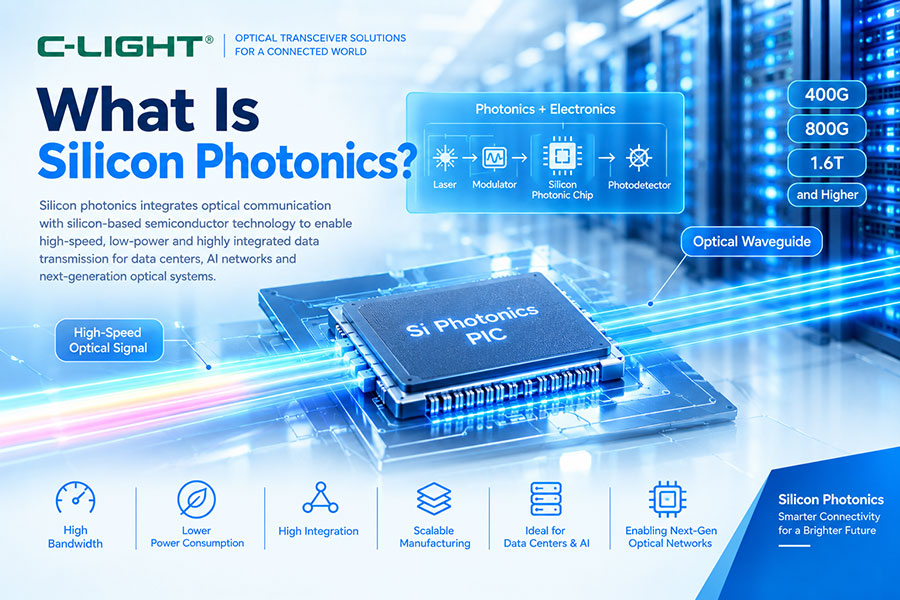
Silicon photonics is an optical technology that uses silicon-based semiconductor manufacturing processes to generate, modulate, transmit, and receive optical signals. It combines photonic components with electronic circuits on or around a silicon platform to provide high-speed data transmission with improved integration and scalability.
2. How Does Silicon Photonics Work?
Silicon photonics uses optical waveguides to guide light through a silicon photonic chip. Electrical data is converted into optical signals by a laser and modulator, transmitted through the optical path, and converted back into electrical signals by a photodetector at the receiving side.
3. Why Is Silicon Used in Photonics?
Silicon is widely used because it supports mature semiconductor manufacturing processes, high-density integration, and scalable production. Silicon photonics can integrate multiple optical functions into a compact chip while working with conventional electronic components.
4. What Are the Main Components of Silicon Photonics?
A typical silicon photonics system can include optical waveguides, modulators, photodetectors, couplers, multiplexers, demultiplexers, and laser sources. Electronic drivers, transimpedance amplifiers, DSPs, and control circuits may also be integrated into the overall optical module.
5. What Is a Silicon Photonics Optical Transceiver?
A silicon photonics optical transceiver uses a silicon photonic integrated circuit to perform part of the optical transmission and reception functions. It can support multiple optical channels in a compact architecture and is increasingly used in high-speed data center optical modules.
6. Silicon Photonics vs. Traditional Optical Technology
Traditional optical modules often use individually packaged optical components. Silicon photonics enables greater integration of optical functions on a photonic integrated circuit. This can reduce component count, improve packaging density, and support higher-volume manufacturing.
7. What Is the Role of Optical Waveguides?
Optical waveguides provide controlled paths for light inside the silicon photonic chip. They connect components such as modulators, splitters, multiplexers, and photodetectors while maintaining the required optical routing between different channels.
8. How Does Silicon Photonics Handle Multiple Wavelengths?
Silicon photonics can use wavelength-division multiplexing to transmit multiple optical channels through a single fiber. Multiplexers combine different wavelengths on the transmit side, while demultiplexers separate them at the receiver.
9. What Is the Role of the Laser?
Silicon itself is not an efficient light source, so silicon photonics systems typically use an external or integrated laser source. The laser provides the optical carrier, while the silicon photonic circuit controls and routes the optical signal.
10. What Is the Role of the Optical Modulator?
The optical modulator converts electrical information into changes in the optical signal. In high-speed systems, silicon photonics modulators can support advanced modulation formats such as PAM4 and enable high data rates across multiple optical lanes.
11. Silicon Photonics and PAM4
PAM4 is widely used in modern high-speed optical communication because it carries two bits per symbol. Silicon photonics can integrate high-speed modulators and optical channels suitable for PAM4-based 400G, 800G, and next-generation optical interfaces.
12. Silicon Photonics for 400G and 800G
As optical data rates increase, silicon photonics provides a scalable platform for multi-lane optical architectures. It can support high-density optical engines and transceiver designs for 400G and 800G data center networks.
13. Silicon Photonics and 1.6T Optical Networking
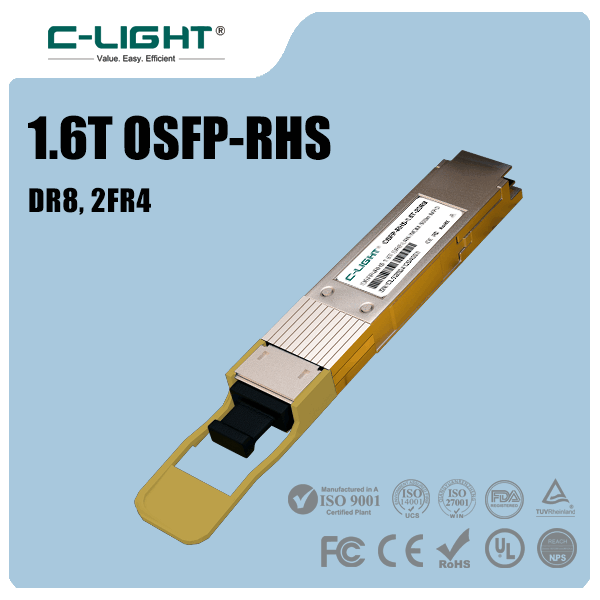
The transition toward 1.6T networking increases the demand for higher optical bandwidth and greater integration. Silicon photonics can support 200G-per-lane architectures and high-density optical engines used in next-generation AI and data center networks.
14. Why Is Silicon Photonics Important for AI Data Centers?
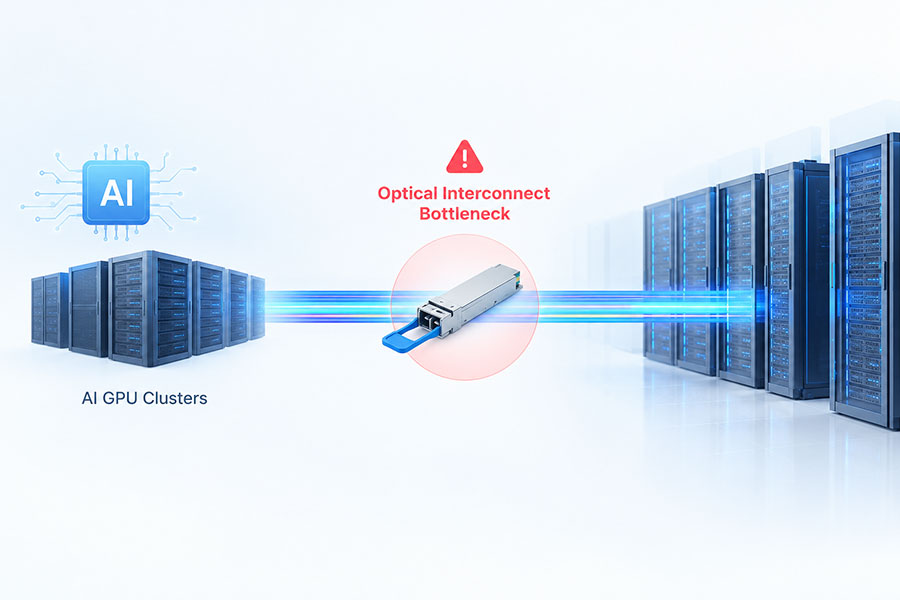
AI clusters generate large volumes of traffic between GPUs, switches, and storage systems. Silicon photonics can provide compact, high-bandwidth optical connectivity while supporting the increasing port density and power-efficiency requirements of AI data centers.
15. Silicon Photonics and Co-Packaged Optics
Silicon photonics is an important technology for co-packaged optics. CPO places optical engines closer to the switching ASIC, reducing the electrical distance between the chip and optical interface. This architecture can help address bandwidth density and electrical signal integrity challenges at higher data rates.
16. Silicon Photonics and LPO
Silicon photonics and Linear Pluggable Optics are different technologies but can be used together. Silicon photonics defines the optical integration platform, while LPO defines an optical module architecture that reduces or eliminates DSP-based signal processing inside the module.
17. Advantages of Silicon Photonics
Key advantages include high optical integration, compact size, scalable semiconductor manufacturing, support for multi-channel architectures, and potential improvements in power efficiency and manufacturing consistency. These characteristics make silicon photonics suitable for high-density optical applications.
18. Challenges of Silicon Photonics
Silicon photonics still faces challenges in laser integration, optical coupling, packaging, thermal management, manufacturing yield, and system-level interoperability. High-speed applications also require careful electrical and optical design to maintain sufficient link margin.
19. Applications of Silicon Photonics
Silicon photonics is used in data center optical transceivers, AI networks, high-performance computing, optical interconnects, telecommunications, data center interconnects, and emerging CPO and optical-engineering platforms.
20. What Is the Future of Silicon Photonics?
Silicon photonics is expected to become increasingly important as optical networks move from 800G toward 1.6T and higher data rates. Further improvements in photonic integration, laser technology, packaging, and optical engines will support higher bandwidth density and more efficient AI and data center connectivity.
21. Silicon Photonics FAQ
Q1. What is silicon photonics?
Q2. Is silicon photonics the same as an optical transceiver?
Q3. Why is silicon photonics important for data centers?
Q4. Can silicon photonics support 800G?
Q5. Can silicon photonics support 1.6T?
Q6. What is the difference between silicon photonics and LPO?
22. Summary
Silicon photonics combines optical communication with silicon semiconductor technology to achieve highly integrated optical connectivity. Its ability to support multi-channel transmission, high-speed modulation, and compact optical engines makes it an important technology for 400G, 800G, 1.6T, AI data centers, and future optical networking architectures.
 >
>

 >
>
 >
>
 >
>
 >
>
 >
>
 >
>
 >
>