TEL:+86 132 6656 7067




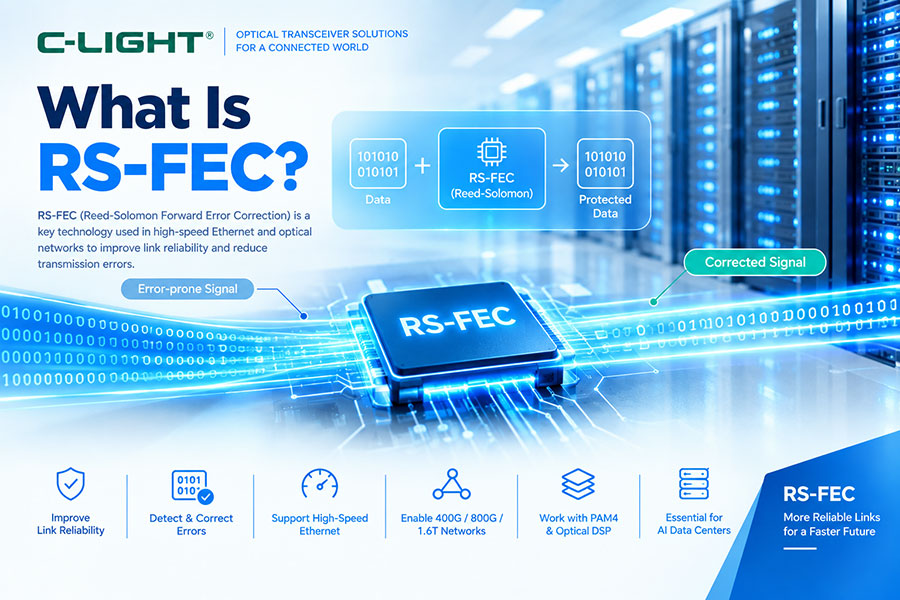
RS-FEC, or Reed-Solomon Forward Error Correction, is an error correction technology widely used in high-speed Ethernet and optical communication systems. It improves link reliability by detecting and correcting transmission errors, making it an important technology for 100G, 200G, 400G, 800G, and higher-speed networks.
1. What Is RS-FEC?
RS-FEC is a Forward Error Correction technology based on Reed-Solomon coding. It adds redundant information to transmitted data, allowing the receiver to detect and correct certain errors without retransmitting the original data.
2. Why Is RS-FEC Needed?
As Ethernet speeds increase, electrical and optical links become more sensitive to signal loss, noise, crosstalk, reflections, and other impairments. RS-FEC improves the effective error performance of the link and helps high-speed interfaces achieve reliable operation.
3. How Does RS-FEC Work?
The transmitter divides data into blocks and generates additional parity information using Reed-Solomon coding. The receiver uses the original data and parity information to detect errors and correct them within the capability of the FEC code.
4. What Is Reed-Solomon Coding?
Reed-Solomon coding is a block error correction method that operates on symbols rather than individual bits. It is particularly effective for correcting burst errors and is widely used in communication systems, storage, and networking.
5. What Is RS(544,514) FEC?
RS(544,514) is a commonly used Reed-Solomon FEC code in high-speed Ethernet. It processes 514 data symbols together with 30 additional parity symbols to form a 544-symbol codeword. The added redundancy enables error detection and correction at the receiver.
6. RS-FEC in 100G Ethernet
RS-FEC is used in several 100G Ethernet implementations to improve link performance. It is particularly important for interfaces using high-speed electrical lanes and PAM4-related technologies where signal margins are more limited.
7. RS-FEC in 200G Ethernet
200G Ethernet increases the signaling requirements compared with 100G. RS-FEC provides an additional error correction layer that helps maintain reliable data transmission across high-speed electrical and optical links.
8. RS-FEC in 400G Ethernet
400G Ethernet commonly relies on advanced FEC to support high-speed PAM4 signaling. RS-FEC helps compensate for residual bit errors after the physical transmission path and improves the overall link error performance.
9. RS-FEC in 800G Networks
800G optical networking uses even higher aggregate bandwidth and increasingly high-speed lanes. RS-FEC can provide the error correction capability required by the electrical and optical interfaces used in data center and AI networking environments.
10. RS-FEC and PAM4
PAM4 transmits two bits per symbol using four signal levels, increasing bandwidth efficiency but reducing the noise margin compared with traditional NRZ signaling. FEC becomes more important as PAM4 data rates increase because it helps correct errors that remain after physical-layer signal processing.
11. RS-FEC Coding Gain
One of the major benefits of FEC is coding gain. It improves the effective error performance of a communication link by allowing the receiver to correct errors that would otherwise cause data corruption. The actual coding gain depends on the FEC implementation and operating conditions.
12. RS-FEC and BER
Bit Error Rate, or BER, measures the number of incorrectly received bits relative to the total number of transmitted bits. RS-FEC allows a system to tolerate a higher pre-FEC BER while achieving a much lower post-FEC BER, provided the error level remains within the correction capability of the code.
13. Pre-FEC BER vs. Post-FEC BER
Pre-FEC BER represents the error rate before FEC correction, while post-FEC BER represents the remaining error rate after the FEC process. A properly designed FEC system can significantly reduce the effective error rate of a high-speed optical link.
14. RS-FEC and Optical Transceivers
In high-speed optical networking, FEC may be implemented in the host system, optical module, DSP, or another part of the communication architecture. The exact implementation depends on the Ethernet standard, transceiver design, and network equipment.
15. RS-FEC and Optical DSP
Modern optical DSPs can integrate FEC with other signal processing functions such as equalization, clock recovery, and PAM4 processing. Combining these functions allows high-speed optical transceivers to manage increasingly complex electrical and optical signals.
16. Advantages of RS-FEC
RS-FEC provides strong error correction, improved link reliability, better tolerance to transmission impairments, and support for high-speed Ethernet interfaces. It is especially valuable as network speeds and signaling rates continue to increase.
17. Limitations of RS-FEC
FEC introduces additional processing requirements, redundancy, and some latency. It also cannot correct unlimited errors. When the error rate exceeds the correction capability of the selected code, the link may still experience uncorrectable errors.
18. RS-FEC vs. Other FEC Technologies
Different communication systems may use Reed-Solomon, BCH, LDPC, or other FEC technologies. RS-FEC is widely adopted in Ethernet because it provides a practical balance between correction capability, implementation complexity, latency, and high-speed operation.
19. RS-FEC in AI Data Centers
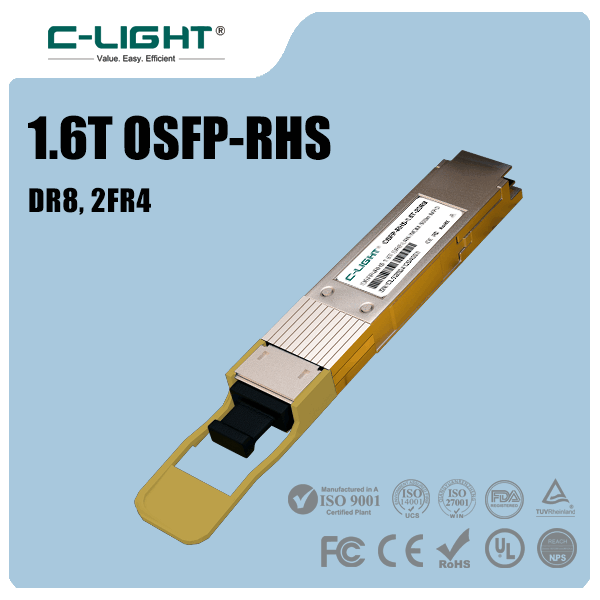
AI data centers rely on high-bandwidth connections between GPUs, switches, servers, and storage systems. As 400G, 800G, and 1.6T optical links become increasingly important, FEC technology plays a key role in maintaining reliable high-speed communication.
20. Conclusion
RS-FEC is an important error correction technology for modern high-speed Ethernet and optical networks. By adding controlled redundancy and correcting transmission errors at the receiver, RS-FEC helps support reliable 100G, 200G, 400G, 800G, and next-generation optical connectivity.
 >
>

 >
>
 >
>
 >
>
 >
>
 >
>
 >
>
 >
>