TEL:+86 132 6656 7067




1. What Is PON?
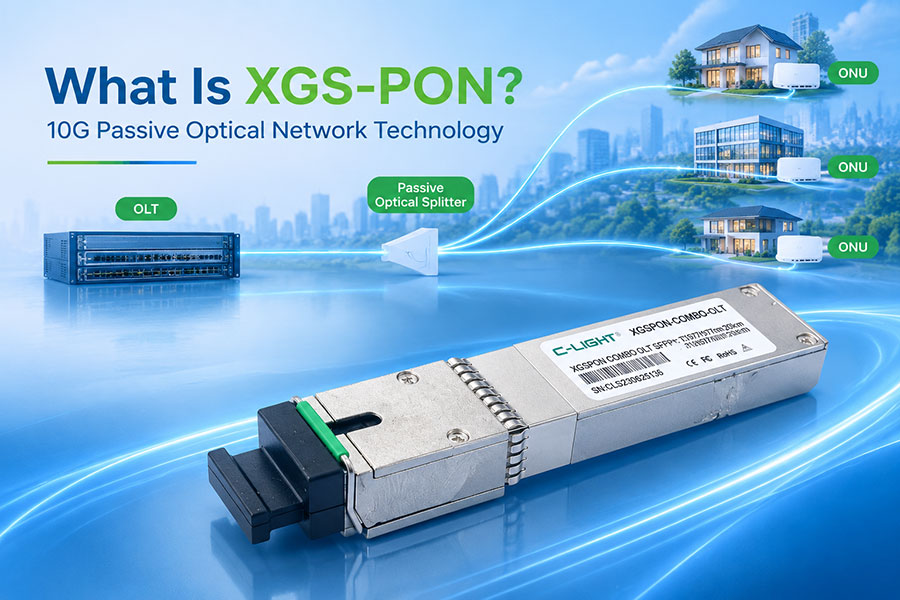
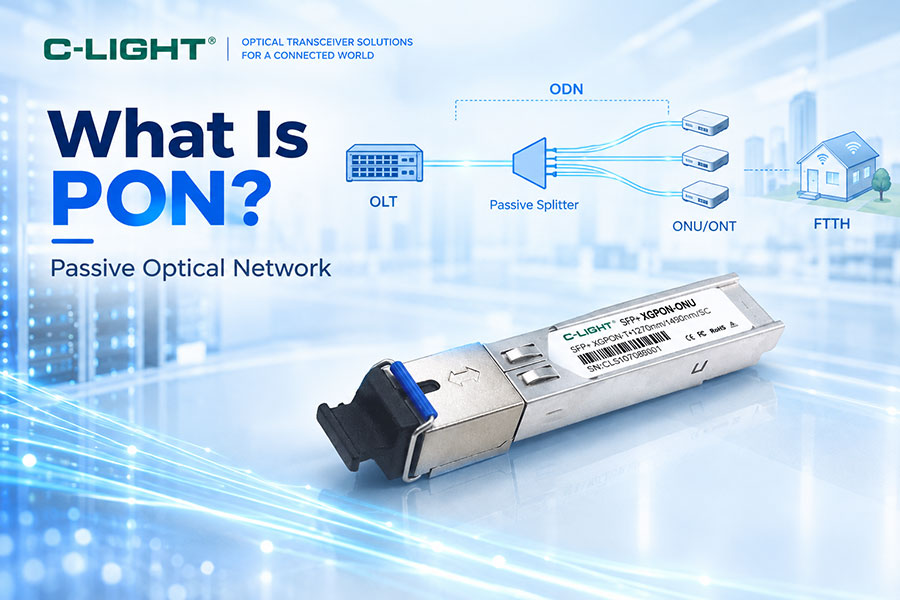
PON stands for Passive Optical Network. It is a point-to-multipoint fiber access architecture that uses passive optical components between the central office and multiple subscribers. A typical PON system consists of an OLT (Optical Line Terminal), an ODN (Optical Distribution Network), and multiple ONUs or ONTs at the subscriber side.
2. How Does a PON Network Work?
In a PON system, the OLT is connected to a passive optical splitter through a feeder fiber. The splitter divides the optical signal into multiple branches that connect to ONUs or ONTs. In the downstream direction, the OLT broadcasts optical data toward multiple users, while upstream traffic from users is controlled and scheduled by the OLT to share the common fiber.
3. What Are the Main Components of a PON System?
A PON network mainly includes the OLT, optical splitter, fiber distribution infrastructure, and ONU or ONT. The OLT provides the network-side interface, the passive splitter distributes optical signals, and the ONU or ONT provides the subscriber-side optical and service interface.
4. What Is an OLT?
OLT stands for Optical Line Terminal. It is the active optical and network-side device located at the service provider or aggregation side of a PON network. The OLT controls downstream transmission, coordinates upstream access, manages connected ONUs, and interfaces with the core or aggregation network.
5. What Is an ONU?
ONU stands for Optical Network Unit. It is the subscriber-side device that receives optical signals from the PON network and converts them into the electrical or service interfaces required by end equipment.
6. What Is an ONT?
ONT stands for Optical Network Terminal. In many deployment scenarios, ONT refers specifically to a subscriber-side PON device used in fiber-to-the-home applications. The terms ONU and ONT are often used interchangeably, although their usage can depend on the network architecture and application.
7. What Is an ODN?
ODN stands for Optical Distribution Network. It is the passive optical infrastructure between the OLT and ONUs or ONTs, including feeder fibers, distribution fibers, patching components, connectors, and passive optical splitters.
8. What Is a Passive Optical Splitter?
A passive optical splitter divides one optical signal into multiple output paths without requiring electrical power at the splitter itself. PLC and FBT splitters are common technologies used in optical access networks, with PLC splitters providing a compact and scalable approach for high-density deployments.
9. How Does PON Handle Downstream and Upstream Traffic?
PON uses different mechanisms for downstream and upstream transmission over the shared optical distribution network. Downstream data can be distributed from the OLT to multiple ONUs, while upstream transmission requires coordinated access so that different ONUs do not transmit simultaneously on the same shared medium.
10. What Is the Difference Between PON and Point-to-Point Fiber?
A point-to-point fiber network normally provides a dedicated optical path between two endpoints. PON uses a point-to-multipoint architecture in which one OLT port can serve multiple subscribers through passive optical splitting. This shared architecture reduces the amount of fiber and active equipment required in the access network.
11. What Are the Main Types of PON?
Common PON technologies include APON, BPON, GPON, EPON, XG-PON, XGS-PON, 10G-EPON, and emerging 25G or 50G-class PON technologies. GPON and EPON have been widely deployed, while XG-PON and XGS-PON provide higher bandwidth for next-generation access networks.
12. What Is GPON?
GPON stands for Gigabit Passive Optical Network. It is a widely deployed PON technology designed for broadband access services. GPON supports downstream and upstream data transmission over a shared passive optical infrastructure and is commonly used in FTTH and other FTTx applications.
13. What Is EPON?
EPON stands for Ethernet Passive Optical Network. It uses Ethernet-based framing and a passive optical distribution architecture to provide fiber access. EPON is widely used in broadband access networks where Ethernet integration and cost efficiency are important.
14. What Is XG-PON?
XG-PON is a 10G-class passive optical network technology designed to provide higher bandwidth than traditional GPON. It is suitable for higher-capacity broadband access, enterprise access, and other FTTx applications where existing PON capacity needs to be increased.
15. What Is XGS-PON?
XGS-PON is a symmetric 10G PON technology that supports high-speed downstream and upstream transmission. Compared with GPON, XGS-PON provides a significant increase in access capacity and is suitable for high-bandwidth FTTH, business access, mobile transport, and converged access networks.
16. What Is 10G-EPON?
10G-EPON is an enhanced EPON technology that provides 10G-class Ethernet passive optical access. It is designed for higher-bandwidth access applications and can support residential, enterprise, and other FTTx deployments.
17. What Is 50G PON?
50G PON is a next-generation PON technology targeting much higher access capacity than 10G-class systems. It is intended for future broadband evolution, enterprise services, mobile xHaul, and other applications that require significantly higher bandwidth per PON port.
18. PON Optical Wavelengths
PON systems use defined optical wavelength bands for downstream and upstream transmission. The exact wavelengths depend on the PON standard and implementation. Wavelength separation allows bidirectional communication over the same optical fiber while maintaining the required channel isolation.
19. What Is a PON Optical Transceiver?
A PON optical transceiver is the optical interface used to convert electrical signals into optical signals and optical signals back into electrical signals within PON equipment. Depending on the application, PON optical modules can be designed for OLT or ONU/ONT equipment and support different PON standards and transmission distances.
20. What Is a PON SFP Module?
A PON SFP module integrates the optical transmitter and receiver into a pluggable form factor. SFP-based PON modules are widely used in access equipment because they simplify maintenance and allow optical interfaces to be replaced or upgraded without replacing the entire network device.
21. What Is the Difference Between OLT and ONU Optical Modules?
OLT and ONU optical modules operate at different positions within the PON architecture and are designed for different optical budgets, transmission behavior, and network functions. OLT modules operate on the network side, while ONU modules operate at the subscriber side.
22. PON Transmission Distance
PON transmission distance depends on the PON standard, optical power class, splitter ratio, fiber attenuation, connector loss, and overall optical budget. C-LIGHT's current PON portfolio includes XGS-PON OLT/ONU solutions covering 20 km and 30 km, XG-PON solutions covering 20 km and 30 km, GPON solutions supporting up to 20 km, and 10G EPON solutions covering 20 km, 30 km, and 40 km configurations.
23. What Is the PON Optical Budget?
Optical budget is the allowable loss between the transmitting device and receiving device while maintaining the required receiver performance. In a PON network, the budget must account for fiber attenuation, splitter insertion loss, connector loss, splice loss, and other passive component losses.
24. PON Split Ratio
The split ratio defines how one PON optical signal is divided among multiple branches. Higher split ratios allow more users to share one PON port, but they also increase splitter loss and therefore place greater requirements on the available optical budget.
25. PON vs. Active Optical Network
PON uses passive optical components in the distribution section and centralizes active transmission functions at the OLT and subscriber equipment. An active optical network uses powered switching or transmission equipment within the access path. PON can reduce field power requirements and simplify the physical distribution architecture.
26. Why Is PON Important for FTTH?
PON is one of the core technologies for fiber-to-the-home deployment because a single feeder fiber can be passively split to serve multiple users. This point-to-multipoint architecture can reduce fiber consumption and simplify the access plant compared with deploying a dedicated fiber pair for every subscriber.
27. PON Applications
PON is widely used in FTTH, FTTB, FTTO, enterprise broadband access, mobile backhaul and fronthaul-related transport, campus networking, and other fiber access scenarios. Higher-speed PON technologies are also being considered for bandwidth-intensive enterprise and converged access services.
28. C-LIGHT PON Optical Solutions
C-LIGHT provides PON optical products covering PON lasers, XGS-PON OLT/ONU, XG-PON OLT/ONU, GPON OLT/ONU, 10G EPON OLT/ONU, and EPON OLT/ONU. The product portfolio is designed to support different access architectures, transmission distances, and deployment requirements.
29. PON FAQ
Q1. What does PON stand for?
Q2. What are the main components of a PON network?
Q3. What is the difference between OLT and ONU?
Q4. What is the difference between GPON and XGS-PON?
Q5. What is the difference between XG-PON and XGS-PON?
Q6. How far can a PON network transmit?
30. Summary
PON is a scalable fiber access architecture that combines an OLT, passive optical distribution network, and multiple ONUs or ONTs over a shared fiber infrastructure. Technologies such as GPON, EPON, XG-PON, XGS-PON, and 10G-EPON provide different bandwidth and deployment options, while higher-speed PON technologies continue to expand the capacity of FTTH, enterprise, and next-generation access networks.
 >
>

 >
>
 >
>
 >
>
 >
>
 >
>
 >
>
 >
>