TEL:+86 132 6656 7067




As optical communication moves toward higher data rates and longer transmission distances, the performance of the transmitter becomes increasingly important. Electro-Absorption Modulated Laser (EML) technology combines a semiconductor laser with an electro-absorption modulator in a compact optical structure, allowing the optical carrier to be generated and modulated within the same device. Compared with directly modulated laser architectures, EML can provide better control of high-speed optical signals, lower chirp, and stronger transmission performance for applications such as 100G, 200G, 400G, 800G, and other high-speed optical networks.
1. What Is EML?
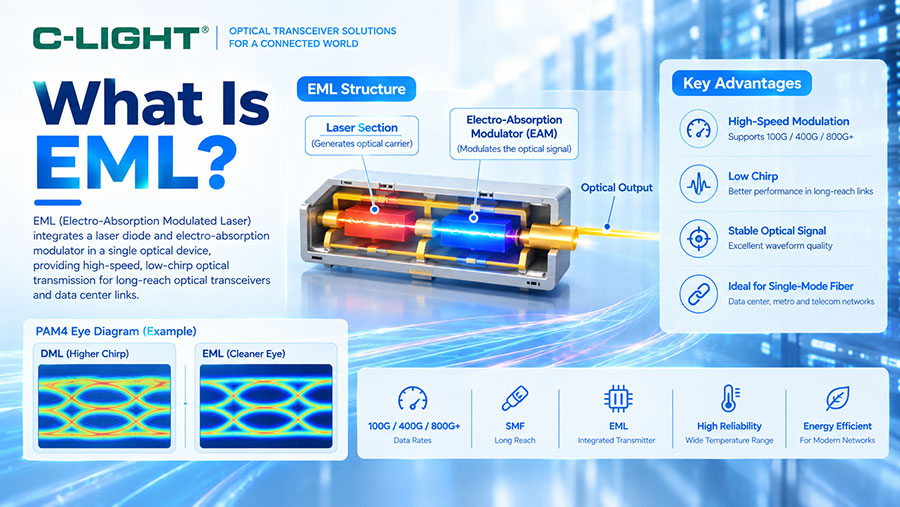
EML stands for Electro-Absorption Modulated Laser. It is an integrated optical transmitter device that combines a continuous-wave semiconductor laser with an electro-absorption modulator.
The laser section generates the optical carrier, while the electro-absorption modulator changes the optical transmission characteristics according to the electrical data signal. This architecture allows high-speed electrical information to be imposed onto the optical carrier without directly modulating the laser cavity in the same way as a DML.
2. How Does an EML Work?
An EML generally contains two functional sections: the laser section and the electro-absorption modulator section. The laser generates continuous optical power, and the modulator controls how much of that optical signal passes through according to the input electrical signal.
The simplified transmission path is:
Electrical Data → EML Driver → Electro-Absorption Modulator → Optical Carrier → Fiber
The separation of optical generation and optical modulation allows the transmitter to achieve high-speed operation with improved chirp and bandwidth characteristics.
3. What Are the Main Components of an EML?
The two primary elements of an EML are the semiconductor laser and the electro-absorption modulator. Additional package elements can include optical coupling structures, electrodes, monitoring components, thermal-control elements, and electrical connections.
The laser and modulator are fabricated and packaged as an integrated optical transmitter, which helps reduce the overall footprint of the transmitter assembly.
4. What Is the Laser Section in an EML?
The laser section is responsible for generating the optical carrier. Depending on the application, EML devices can use semiconductor laser structures optimized for specific wavelengths, output power, modulation rates, and transmission distances.
For many single-mode optical communication applications, EML transmitters operate in wavelength regions around 1310 nm or 1550 nm.
5. What Is the Electro-Absorption Modulator?
An electro-absorption modulator changes the absorption characteristics of a semiconductor material when an electrical field is applied. By controlling the absorption of the optical carrier, the modulator generates the desired optical intensity changes corresponding to the input data.
Unlike a directly modulated laser, the laser itself can remain relatively stable while the separate modulator performs the high-speed data modulation.
6. Why Is EML Used in Optical Communication?
EML is used because it can provide high modulation bandwidth, relatively low chirp, good extinction characteristics, and strong performance over longer optical transmission distances.
These properties make EML particularly suitable for optical modules where the transmitter must maintain signal quality while operating at high data rates and over single-mode fiber.
7. What Is Chirp in an Optical Transmitter?
Chirp refers to a variation in the optical frequency or instantaneous wavelength as the optical signal is modulated. Excessive chirp can interact with chromatic dispersion in the fiber and degrade the transmitted waveform.
EML architectures can provide lower chirp than many directly modulated laser designs, making them attractive for higher-speed and longer-distance transmission.
8. Why Is Low Chirp Important?
In a dispersive optical fiber, different optical frequency components propagate at different velocities. When transmitter chirp interacts with chromatic dispersion, the optical pulse can become distorted.
Reducing chirp helps control this interaction and can improve the transmission performance of high-speed optical links.
9. EML vs DML
DML stands for Directly Modulated Laser. In a DML architecture, the laser current itself is varied according to the data signal. In an EML, the laser generates the optical carrier while a separate electro-absorption modulator performs the high-speed modulation.
| Parameter | EML | DML |
|---|---|---|
| Modulation Method | Electro-absorption modulation | Direct laser modulation |
| Chirp | Generally lower | Generally higher |
| Bandwidth | High | High, application dependent |
| Long-Reach Suitability | Strong | More limited in many applications |
| Architecture | Laser + EAM | Laser only for optical generation/modulation |
| Typical Cost | Higher | Lower |
10. EML vs DML: Why Does EML Support Longer Reach?
The main reason is better control of the optical waveform and generally lower chirp. When transmission distance increases, chromatic dispersion has a greater impact on signal integrity.
By reducing the interaction between laser modulation chirp and fiber dispersion, EML can provide better performance for applications where the optical link extends beyond short-reach data center connections.
11. EML vs DFB Laser
DFB describes a type of semiconductor laser structure, while EML describes an integrated transmitter architecture that combines a laser with an electro-absorption modulator.
An EML can therefore use a DFB-type laser section as part of its overall device architecture. The two terms should not be treated as mutually exclusive technologies.
12. EML and DFB Relationship
A common EML architecture integrates a distributed-feedback laser section with an electro-absorption modulator. The DFB section generates the optical carrier, while the EAM section controls the optical intensity.
This integrated design combines stable laser generation with high-speed external optical modulation.
13. EML and NRZ
EML technology has been widely used in NRZ optical transmitters for higher-speed and longer-reach applications. In an NRZ transmitter, the modulator produces two main optical signal states corresponding to binary data.
EML can provide high-quality optical modulation while maintaining controlled chirp and extinction characteristics.
14. EML and PAM4
PAM4 uses four amplitude levels and carries two bits per symbol. As the lane rate increases, the transmitter must maintain accurate amplitude levels, sufficient bandwidth, and low distortion.
EML technology can be used in PAM4 optical transmitters, particularly where high-speed optical modulation and controlled transmission performance are required.
15. EML and 100G Optical Transceivers
EML has been widely used in 100G single-mode optical transceivers, especially for longer-reach applications. Depending on the module architecture, EML transmitters may operate with multiple wavelengths or lanes to achieve the required aggregate data rate.
Applications can include 100G LR, ER, and other single-mode optical interfaces where transmitter quality and transmission distance are important.
16. EML and 400G Optical Transceivers
400G optical transceivers may use multiple EML-based optical lanes, particularly in single-mode configurations. Depending on the optical architecture, the module can combine several wavelengths to achieve the required aggregate bandwidth.
At 400G, the EML transmitter must maintain tight control of optical power, wavelength, extinction ratio, OMA, eye quality, and other high-speed parameters.
17. EML and 800G Optical Transceivers
800G optical architectures can use multiple 100G-class optical lanes or other configurations depending on the product design. EML-based transmitters can be used where higher optical performance and single-mode transmission are required.
At these speeds, transmitter linearity, bandwidth, thermal stability, optical power, and PAM4 waveform quality become increasingly important.
18. EML and 1.6T Optical Transceivers
1.6T optical systems introduce substantially higher lane rates and tighter transmitter requirements. EML technology can remain relevant for architectures that require high-speed external modulation and controlled optical characteristics.
However, the suitability of EML for a specific 1.6T implementation depends on the lane rate, optical engine architecture, modulation technology, packaging, and system requirements.
19. EML Wavelengths
EML transmitters are commonly designed for wavelength regions used in single-mode fiber communication. 1310 nm is widely associated with data center and metro optical applications, while 1550 nm is important for longer-distance optical transmission and compatibility with optical amplification technologies.
The exact wavelength depends on the specific optical transceiver, application, and network standard.
20. EML Optical Power
Optical output power is an important EML parameter because it directly affects the available optical link budget. However, high output power alone does not guarantee long-distance performance.
The optical design must balance launch power, extinction ratio, OMA, receiver sensitivity, fiber attenuation, dispersion, and other link parameters.
21. EML Extinction Ratio
Extinction ratio describes the relationship between the high and low optical signal levels. In an EML transmitter, the electro-absorption modulator controls the optical transmission state and therefore has a direct influence on extinction performance.
Extinction ratio is normally evaluated together with optical power and OMA when characterizing transmitter performance.
22. EML and OMA
OMA, or Optical Modulation Amplitude, represents the difference between defined optical signal levels. It is an important transmitter parameter for high-speed optical modules.
For PAM4 EML transmitters, the outer modulation amplitude and level separation must be controlled carefully to maintain adequate eye openings.
23. EML and TDECQ
TDECQ is an important PAM4 transmitter-quality metric that evaluates effective eye closure caused by noise, distortion, inter-symbol interference, and other impairments.
For PAM4 EML transmitters, TDECQ provides information about waveform quality that cannot be obtained from optical power or OMA measurements alone.
24. EML and Eye Diagram
The eye diagram provides a visual representation of the optical signal waveform. EML transmitter testing can use eye diagrams to evaluate eye height, eye width, signal level separation, overshoot, undershoot, and other waveform characteristics.
For PAM4, three eye openings must be considered rather than a single NRZ eye.
25. EML and Optical Link Budget
The EML transmitter contributes directly to the optical link budget through its guaranteed launch power and transmitter performance. A higher launch power can increase the available power margin, but it must remain within the optical and receiver operating range.
Long-reach EML links should also consider chromatic dispersion and other optical penalties in addition to basic insertion loss.
26. EML Thermal Performance
Laser wavelength, optical output power, extinction performance, and modulator behavior can vary with temperature. Thermal management is therefore important for maintaining consistent EML transmitter performance over the specified operating temperature range.
High-speed optical modules may use thermal design, control circuits, and calibrated operating conditions to stabilize transmitter characteristics.
27. Advantages of EML
Key advantages of EML include high-speed modulation capability, relatively low chirp, good optical waveform control, compact integration of laser and modulator, and strong suitability for single-mode fiber transmission.
These characteristics make EML particularly valuable in applications where higher bandwidth and longer reach are required.
28. Limitations of EML
EML devices generally involve more complex fabrication and packaging than basic directly modulated laser solutions. This can increase cost and design complexity.
EML performance also depends on accurate electrical drive, optical alignment, thermal management, and control of the laser and modulator operating points.
29. EML Applications
EML is widely used in high-speed optical communication, data center interconnect, telecom transport, metro networks, access networks, enterprise networking, and other single-mode fiber applications.
It is particularly valuable where transmission distance, optical signal quality, and high-speed modulation performance are important.
30. EML vs DML vs VCSEL
| Technology | Modulation | Typical Application | Reach | Main Characteristic |
|---|---|---|---|---|
| EML | External electro-absorption modulation | High-speed SMF | Medium to long | Low chirp and high-speed performance |
| DML | Direct laser modulation | Data center and access | Short to medium | Simpler architecture and lower cost |
| VCSEL | Direct laser modulation | Short-reach MMF | Short | Low-cost, high-volume short-reach transmission |
31. How Is EML Tested?
EML transmitter testing can include optical output power, wavelength, extinction ratio, OMA, spectral characteristics, eye diagram, jitter, TDECQ for PAM4 applications, and BER-related system testing.
Tests should be performed at defined operating temperatures and data rates to verify that the transmitter remains within the required optical and electrical specifications.
32. EML Quality and Manufacturing
EML production requires accurate control of semiconductor fabrication, laser-to-modulator integration, optical coupling, electrical connection, and package assembly.
Because the laser and modulator interact closely, manufacturing variation must be controlled to ensure stable wavelength, optical power, extinction characteristics, bandwidth, and long-term reliability.
33. Why Is EML Important for High-Speed Optical Networks?
As optical links move toward higher lane rates, maintaining signal integrity becomes increasingly difficult. EML provides a transmitter architecture that separates optical generation from high-speed optical modulation while maintaining compact integration.
This combination makes EML an important technology for applications where DML performance is insufficient but highly integrated coherent transmitter architectures are not necessary.
34. EML FAQ
Q1. What does EML stand for?
Q2. What is the main advantage of EML?
Q3. What is the difference between EML and DML?
Q4. Is EML used in 100G and 400G optical transceivers?
Q5. Can EML be used with PAM4?
Q6. Why is EML suitable for long-distance optical transmission?
35. Summary
EML (Electro-Absorption Modulated Laser) combines a semiconductor laser and electro-absorption modulator to provide high-speed optical transmission with controlled chirp and waveform performance. Its architecture offers important advantages over direct laser modulation for many single-mode, high-speed, and longer-reach applications. EML remains an important transmitter technology for 100G, 400G, 800G, and emerging higher-speed optical networks, particularly where optical signal quality, bandwidth, and transmission distance must be balanced.
 >
>

 >
>
 >
>
 >
>
 >
>
 >
>
 >
>
 >
>