TEL:+86 132 6656 7067





SFP, SFP+, SFP28, and SFP56 are compact pluggable interface families used for network connectivity at different data rates. In common Ethernet applications, SFP is widely associated with 1G links, SFP+ with 10G, SFP28 with 25G, and SFP56 with 50G. Although these modules share a similar physical design, they differ in electrical signaling requirements, supported speeds, and host compatibility.
Choosing the right SFP transceiver requires more than matching the connector or module size. Network engineers must also consider port capabilities, optical specifications, transmission distance, fiber type, and vendor support.
1. What Are SFP, SFP+, SFP28, and SFP56?
These names describe generations of the Small Form-factor Pluggable interface family. They use compact, hot-pluggable modules or cable assemblies to connect switches, routers, servers, network interface cards, and other equipment.
The number in each designation reflects the generation's approximate signaling-rate class rather than a guaranteed application data rate for every product. The supported speed depends on the specific module, protocol, and host interface.
SFP
Commonly used for Gigabit Ethernet, access links, and other lower-speed networking applications.
SFP+
Designed for higher-speed single-lane connections, including 10 Gigabit Ethernet and certain Fibre Channel applications.
SFP28
Supports 25G Ethernet and other compatible applications, often for server connectivity and switch uplinks.
SFP56
Supports single-lane 50G applications, commonly using PAM4 signaling for higher bandwidth per lane.
2. SFP vs. SFP+ vs. SFP28 vs. SFP56: Key Differences
| Feature | SFP | SFP+ | SFP28 | SFP56 |
|---|---|---|---|---|
| Common Ethernet rate | 1G | 10G | 25G | 50G |
| Typical lane configuration | 1 lane | 1 lane | 1 lane | 1 lane |
| Typical signaling | Depends on application; commonly NRZ | NRZ | NRZ | PAM4 |
| Physical family | SFP | SFP-family | SFP-family | SFP-family, with higher-speed electrical requirements |
| Common applications | Gigabit access and legacy links | 10G aggregation and server links | 25G server and data center links | 50G server, switch, and data center links |
| Backward compatibility | Host-dependent | May support SFP modules on compatible ports | May support SFP+ modules on compatible ports | May support SFP28 and SFP+ modules on compatible ports |
| Main selection factor | Supported port speed and application | 10G host interface | 25G host interface | 50G host interface and PAM4 support |
The rates shown above are common Ethernet use cases, not a complete list of every protocol or speed supported by each interface family. Always check the module data sheet and the host device's compatibility documentation.
3. What Is an SFP Transceiver?
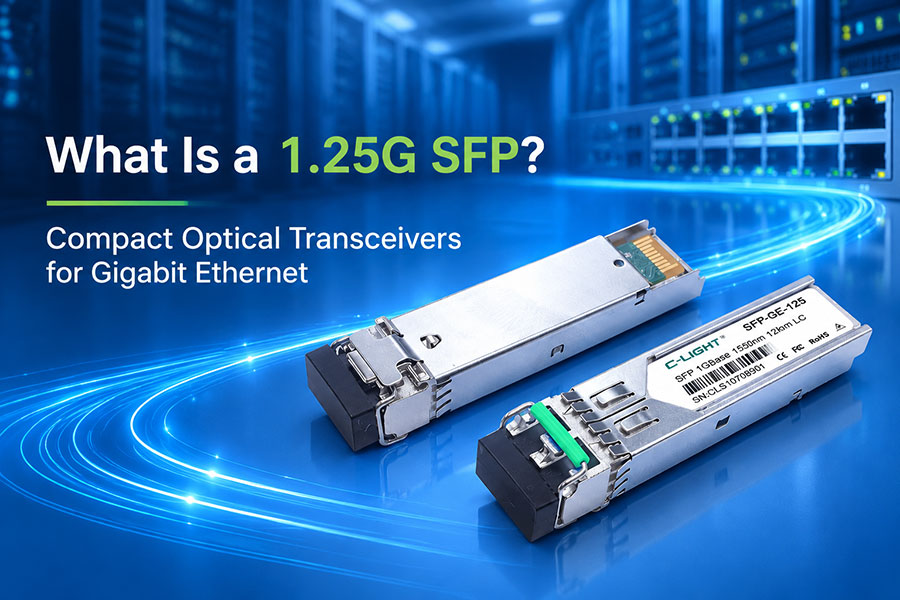
An SFP transceiver is a compact module that provides an interface between network equipment and a communication link. Optical SFP modules convert electrical data into optical signals for fiber transmission and convert received optical signals back into electrical data.
Common SFP applications include Gigabit Ethernet uplinks, enterprise access networks, and fiber connections between network devices. Depending on the product, SFP modules can support single-mode fiber, multimode fiber, or copper connections.
3.1 Common SFP Applications
Gigabit Ethernet access and aggregation links.
Fiber connections between switches and routers.
Legacy network upgrades where 1G connectivity remains sufficient.
Selected telecom and Fibre Channel applications supported by the module specification.
SFP is a broad product family rather than a guarantee of one particular data rate, wavelength, or transmission distance. Check the full product designation before selecting a module.
4. What Is an SFP+ Transceiver?
SFP+ is an enhanced SFP-family interface commonly used for 10 Gigabit Ethernet. It retains a compact pluggable design while supporting higher-speed electrical signaling than traditional 1G SFP interfaces.
SFP+ transceivers are widely deployed in data center switches, enterprise aggregation networks, storage networks, and server connectivity. Available optical options include short-reach multimode modules and single-mode modules designed for longer links.
4.1 SFP+ vs. SFP
The main distinction is the supported data rate and associated host interface. A typical SFP module supports 1G Ethernet, while an SFP+ module commonly supports 10G Ethernet.
Although their physical dimensions are similar, a 1G SFP module does not automatically operate in every SFP+ port, and an SFP+ module cannot make a 1G-only host operate at 10G. The host must support the inserted module and the intended link speed.
5. What Is an SFP28 Transceiver?
SFP28 is a compact pluggable interface commonly used for 25 Gigabit Ethernet. It builds on the SFP+ design family but supports higher-speed electrical signaling to enable 25G connections over a single lane.
SFP28 optical transceivers are common in modern data centers, where they connect servers to top-of-rack switches and support 25G aggregation links. SFP28 direct-attach copper (DAC) cables and active optical cables (AOCs) are also used for compatible short-reach connections.
5.1 SFP28 vs. SFP+
| Comparison | SFP+ | SFP28 |
|---|---|---|
| Common Ethernet speed | 10G | 25G |
| Electrical interface | Designed for 10G-class signaling | Designed for 25G-class signaling |
| Common data center use | 10G server and switch links | 25G server and switch links |
| Compatibility | Depends on host port support | Some SFP28 ports can accept SFP+ modules at 10G |
Using a 10G SFP+ module in a compatible SFP28 port generally limits the link to the supported 10G rate. It does not turn the SFP+ module into a 25G transceiver.
6. What Is an SFP56 Transceiver?
SFP56 is a higher-speed member of the SFP-family interface designed for 50G-class single-lane applications. In common 50G Ethernet implementations, it uses PAM4 signaling to carry more information per symbol than NRZ signaling.
SFP56 modules can support 50G optical links, while SFP56 DAC and AOC products provide alternative connection methods for supported short-reach applications. The actual fiber type, reach, connector, and power requirements depend on the product.
6.1 SFP56 vs. SFP28
The most important difference is the supported lane rate. SFP28 commonly supports 25G per lane, while SFP56 commonly supports 50G per lane. This allows SFP56-based equipment to increase port bandwidth without moving to a wider multi-lane module family.
PAM4 uses four signal levels to represent two bits per symbol, whereas NRZ uses two levels to represent one bit per symbol. PAM4 can increase bit rate at a given symbol rate, but it also introduces stricter signal-quality and receiver-processing requirements.
7. Are SFP, SFP+, SFP28, and SFP56 Compatible with Each Other?
Physical similarity makes these modules look interchangeable, but compatibility depends on the electrical interface, supported speed, module identification, firmware, and host implementation.
| Combination | What to Know |
|---|---|
| SFP module in an SFP+ port | May work at 1G if the host explicitly supports the module and speed. |
| SFP+ module in an SFP28 port | Often supported at 10G by compatible SFP28 ports, but this must be confirmed for the device. |
| SFP28 module in an SFP+ port | Do not assume support. An SFP+ port generally cannot provide a 25G host interface. |
| SFP56 module in an SFP28 port | Do not assume that it will work. The host must support the SFP56 module and 50G signaling. |
| SFP+ or SFP28 module in an SFP56 port | Some SFP56 ports support lower-speed modules, but support depends on the host and vendor specifications. |
Backward compatibility is a property of the complete host-port implementation, not simply the shape of the module. Before ordering, review the switch or NIC compatibility list and the module data sheet.
8. How Do You Choose the Right SFP Transceiver?
The best option depends on the required bandwidth, network equipment, fiber infrastructure, and link distance. Use the following checklist to narrow down the selection.
8.1 Match the Required Data Rate
1G: Consider an SFP module when the network equipment and application require Gigabit Ethernet.
10G: Consider SFP+ for supported 10G Ethernet links.
25G: Consider SFP28 for compatible 25G server and switch connections.
50G: Consider SFP56 when the host and application support 50G single-lane connectivity.
8.2 Check Fiber Type and Transmission Distance
For optical transceivers, match the module to the installed fiber type and required reach. Multimode modules are commonly used for short-reach data center links, while single-mode modules cover a wider range of distances depending on their specifications.
Check the supported wavelength, connector type, transmit power, receiver sensitivity, and optical power budget. A higher data rate does not automatically mean a longer transmission distance.
8.3 Verify Host Compatibility
Confirm that the switch, router, server NIC, or other host device supports the selected form factor, data rate, and module type. Some vendors require qualified modules or specific firmware versions. Copper DAC, AOC, and optical transceivers may also have different host support requirements.
8.4 Consider the Network Upgrade Path
If the current network uses 10G connections but requires greater server bandwidth, SFP28 may provide a path to 25G where supported by the host. For equipment designed for 50G single-lane connectivity, SFP56 can increase bandwidth while retaining a compact interface.
However, upgrading the module alone is not sufficient if the switch port, network adapter, cabling, or link configuration does not support the target speed.
9. Frequently Asked Questions
Q1: What is the main difference between SFP, SFP+, SFP28, and SFP56?
They represent different generations of the SFP-family interface. Common Ethernet rates are 1G for SFP, 10G for SFP+, 25G for SFP28, and 50G for SFP56.
Q2: Is SFP28 faster than SFP+?
Yes. SFP28 commonly supports 25G Ethernet, compared with 10G Ethernet for SFP+.
Q3: Is SFP56 twice as fast as SFP28?
In common Ethernet applications, SFP56 supports 50G per lane, compared with 25G per lane for SFP28. Actual performance depends on the module and host specifications.
Q4: Can I use an SFP+ module in an SFP28 port?
Some SFP28 ports support SFP+ modules at 10G. Check the equipment manufacturer's compatibility documentation before installation.
Q5: Can I use an SFP28 module in an SFP+ port?
Do not assume compatibility. An SFP+ port is generally designed for 10G-class signaling and may not support an SFP28 module's 25G operation.
Q6: Does SFP56 use PAM4?
Common 50G Ethernet SFP56 implementations use PAM4 signaling. Always confirm the signaling and electrical requirements of the specific product.
Q7: Are all four modules the same physical size?
They belong to the same compact SFP-family design, but similar dimensions do not guarantee identical electrical specifications or universal compatibility.
Q8: Does a 50G SFP56 transceiver support a longer distance than a 25G SFP28 transceiver?
Not necessarily. Transmission distance depends on the optical design, wavelength, fiber type, link loss, and product specification rather than data rate alone.
Q9: What is the difference between an SFP transceiver and an SFP DAC cable?
An optical SFP transceiver connects to fiber and converts electrical and optical signals. A DAC is a copper cable assembly with integrated electrical interfaces, typically used for compatible short-reach connections.
Q10: What should I check before buying an SFP module?
Check the host model, supported data rate, module type, fiber or cable requirements, connector, wavelength, transmission distance, power requirements, and vendor compatibility list.
10. Conclusion
SFP, SFP+, SFP28, and SFP56 serve different bandwidth requirements within the compact pluggable interface family. SFP is commonly used for 1G connectivity, SFP+ for 10G, SFP28 for 25G, and SFP56 for 50G applications.
The right choice depends on more than the nominal data rate. Host compatibility, electrical signaling, fiber type, optical reach, and module qualification all affect whether a link will operate correctly. Verifying these factors before purchasing helps avoid compatibility problems and supports a more reliable network upgrade.
C-LIGHT provides optical connectivity solutions for data center, enterprise, and telecommunications applications. Confirm your required data rate, fiber type, transmission distance, and host compatibility when selecting a suitable module.
 >

 >
 >
 >
 >
 >
 >
 >