TEL:+86 132 6656 7067




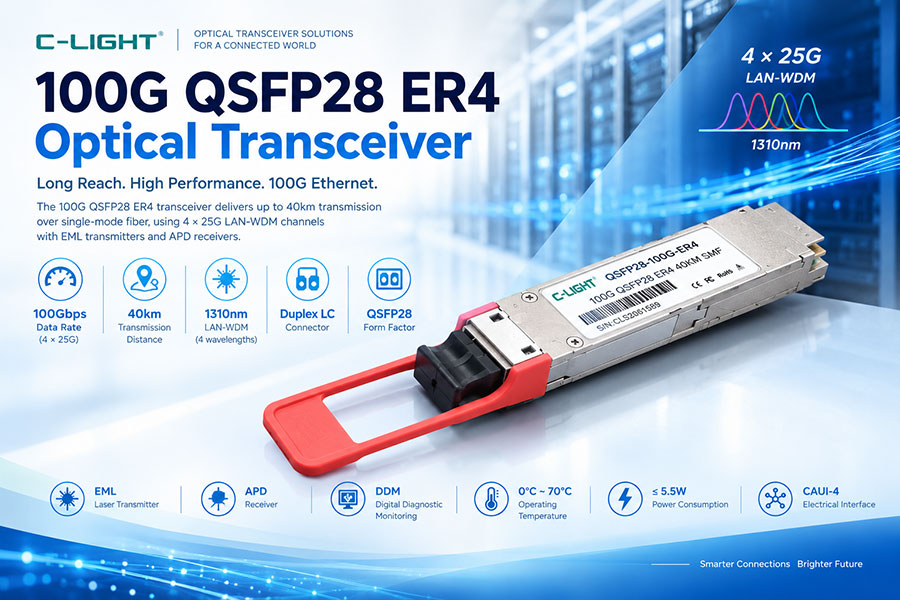
100G QSFP28 ER4 is a 100Gbps optical transceiver designed for long-distance Ethernet connectivity over single-mode fiber. It uses four LAN-WDM optical channels, EML laser transmitters, APD receivers, and a compact QSFP28 form factor with a duplex LC optical interface.
1. What Is 100G QSFP28 ER4?
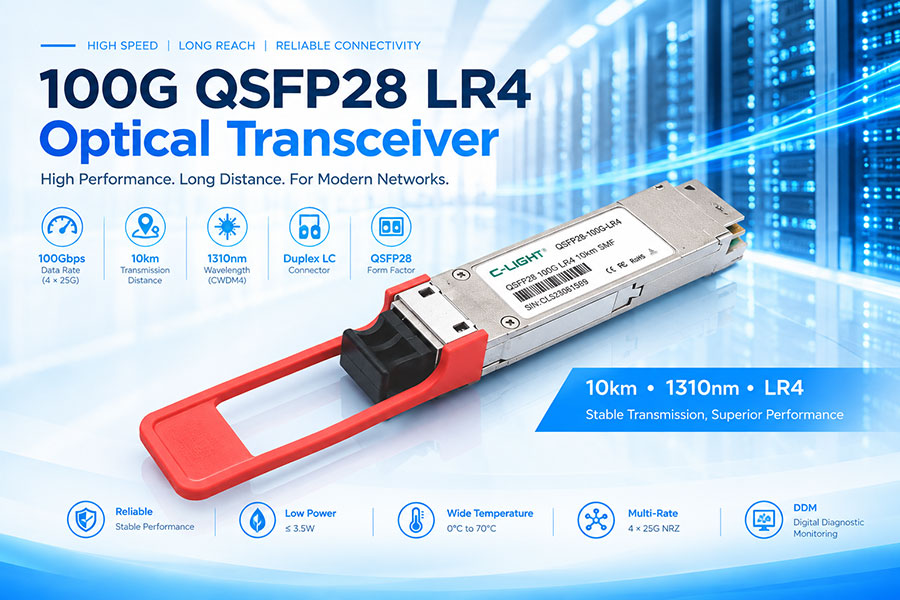
100G QSFP28 ER4 is a pluggable optical transceiver designed for 100 Gigabit Ethernet applications. The ER4 architecture uses four optical channels, with each channel carrying approximately 25Gbps data using NRZ modulation.
The four optical channels operate on different LAN-WDM wavelengths and are multiplexed into a single-mode fiber link. At the receiving side, the optical signal is demultiplexed back into four channels and converted into electrical data.
2. What Does ER4 Mean?
ER4 refers to an extended-reach 100G optical architecture using four optical wavelengths. The number "4" represents the four optical channels used by the transceiver.
Unlike single-wavelength 100G designs, ER4 uses four LAN-WDM wavelengths around the 1310nm window to carry the 100G signal over a single pair of single-mode fibers.
3. Key Features of 100G QSFP28 ER4
100Gbps Ethernet data transmission
4 × 25Gbps optical channels
LAN-WDM wavelength technology
Four wavelengths around 1310nm
EML laser transmitter
APD receiver
QSFP28 MSA form factor
Duplex LC optical connector
CAUI-4 electrical interface
Digital Diagnostic Monitoring (DDM)
Single 3.3V power supply
Maximum power consumption of 5.5W at 70°C
4. How Does 100G QSFP28 ER4 Work?
The electrical 100G signal is divided into four high-speed channels inside the transceiver. Each channel drives an individual LAN-WDM optical transmitter.
The four optical signals are then combined through an internal multiplexer and transmitted through a single-mode fiber pair. On the receiving side, the optical signals are separated by a demultiplexer and converted back into four electrical data channels.
5. 4 × 25G Optical Architecture
100G QSFP28 ER4 uses four optical lanes instead of a single 100G optical lane. Each lane operates at approximately 25Gbps, providing an aggregate 100Gbps data rate.
This 4 × 25G architecture was widely adopted for 100G Ethernet and allows the transceiver to use established 25G-class optical and electrical technologies.
6. LAN-WDM Wavelengths
The C-LIGHT 100G QSFP28 ER4 uses four LAN-WDM wavelengths centered at approximately 1295.56nm, 1300.05nm, 1304.58nm, and 1309.14nm.
These wavelengths are combined into one optical transmission path, allowing four data channels to share the same fiber pair.
7. EML Transmitter and APD Receiver
The transmitter section uses LAN-WDM EML lasers to generate the four optical channels. EML technology provides the wavelength control and optical performance required for 100G long-reach transmission.
The receiver uses APD detectors to provide high optical sensitivity. The combination of EML transmitters and APD receivers is commonly used in extended-reach 100G optical transceivers.
8. QSFP28 Form Factor
100G QSFP28 ER4 uses the QSFP28 form factor, providing a compact and hot-pluggable interface for 100G network equipment.
The compact package allows high-density optical ports to be deployed in switches, routers, and other network devices while maintaining the optical and electrical interfaces required for 100G Ethernet.
9. Duplex LC Optical Interface
The transceiver uses a duplex LC optical connector. One fiber is used for transmission and the other for reception.
LC connectivity is widely used with single-mode fiber infrastructure, making the QSFP28 ER4 suitable for integration with existing fiber cabling systems.
10. 100G QSFP28 ER4 Transmission Distance
The C-LIGHT CL100GQSFPER4 is specified as a 40km ER4 transceiver for single-mode fiber applications. The actual achievable link distance depends on the optical link budget, fiber attenuation, connector loss, dispersion, and the requirements of the connected equipment.
For long-distance deployments, the complete optical link should be evaluated rather than selecting the transceiver based only on the nominal transmission distance.
11. Electrical Interface and Power Consumption
The module uses a CAUI-4 high-speed electrical interface and operates from a single 3.3V power supply. Maximum power consumption is specified at 5.5W at a 70°C case operating temperature.
Power consumption is an important consideration when multiple 100G optical modules are installed in high-density switches and routers.
12. Digital Diagnostic Monitoring
100G QSFP28 ER4 supports Digital Diagnostic Monitoring through a two-wire serial interface. DDM allows compatible host equipment to monitor operating parameters and module status.
Diagnostic information can help network operators monitor optical module performance and identify potential link or module-related issues.
13. 100G QSFP28 ER4 Standards
The C-LIGHT CL100GQSFPER4 complies with QSFP28-related standards including SFF-8661 and SFF-8636. Its CAUI-4 electrical interface is specified as compliant with IEEE 802.3bm-2015, and the module is designed for the 100GBASE-ER4 Lite application.
The module is also RoHS compliant and uses a Class 1 laser.
14. 100G QSFP28 ER4 Applications
100G QSFP28 ER4 is suitable for high-bandwidth network connections that require extended optical reach.
Data Center Interconnect (DCI)
Metropolitan Area Network (MAN) backbone
5G transport networks
Enterprise core networks
Carrier-class networks
Long-distance 100G Ethernet connections
15. 100G QSFP28 ER4 vs 100G QSFP28 LR4
Both ER4 and LR4 use the QSFP28 form factor and four wavelength channels around the 1310nm region. The main difference is their intended transmission reach and network application.
LR4 is generally used for shorter 100G connections, while ER4 is designed for extended-reach applications. The appropriate module should be selected according to the required distance, optical budget, fiber infrastructure, and network equipment.
16. Why Use 100G QSFP28 ER4?
100G QSFP28 ER4 provides a compact solution for extending 100G Ethernet connectivity over single-mode fiber. Its four-channel LAN-WDM architecture combines high bandwidth with extended reach while maintaining the widely adopted QSFP28 package.
The module is particularly suitable for DCI, metro networks, enterprise core networks, and other applications where standard short-reach 100G modules are insufficient.
17. C-LIGHT 100G QSFP28 ER4
C-LIGHT CL100GQSFPER4 is a 100G QSFP28 ER4 transceiver designed for 100GBASE-ER4 applications. It integrates four LAN-WDM EML transmitters, APD receivers, a QSFP28 MSA package, duplex LC connectivity, and Digital Diagnostic Monitoring.
The module supports single-mode fiber applications and provides a practical 100G solution for long-distance Ethernet and network interconnection.
18. Conclusion
100G QSFP28 ER4 is a 100Gbps optical transceiver based on four LAN-WDM optical channels. With EML transmitters, APD receivers, duplex LC connectivity, QSFP28 packaging, and DDM support, it provides an extended-reach solution for single-mode fiber networks.
Its combination of 4 × 25G optical architecture, 1310nm-class LAN-WDM wavelengths, compact packaging, and long-distance capability makes it suitable for DCI, metro, telecom, enterprise, and carrier network applications.
 >
>

 >
>
 >
>
 >
>
 >
>
 >
>
 >
>
 >
>