TEL:+86 132 6656 7067




VCSEL and EML are two important laser technologies used in optical transceivers. Both convert electrical signals into optical signals, but they use different device structures and are optimized for different transmission requirements.
VCSELs are widely used in short-reach multimode fiber applications, especially high-density data center links. EMLs combine a laser with an electro-absorption modulator and are commonly used for higher-speed, single-mode and wavelength-division multiplexed optical transmission.
Understanding the differences between VCSEL and EML helps network designers select suitable optical transceivers for data centers, Ethernet networks, storage systems and other high-speed optical communication applications.
1. What Is VCSEL?
VCSEL stands for Vertical-Cavity Surface-Emitting Laser. It is a semiconductor laser that emits light vertically from the surface of the wafer rather than through the edge of the semiconductor device.
The vertical cavity structure allows VCSELs to be fabricated and tested at wafer level, which supports high-volume manufacturing and low-cost array integration.
VCSEL technology is particularly common in short-distance optical communication using multimode fiber.
2. What Is EML?
EML stands for Electro-Absorption Modulated Laser. An EML integrates a laser section and an electro-absorption modulator in the same semiconductor device.
The laser generates continuous optical power, while the electro-absorption modulator controls the optical signal according to the electrical input.
Compared with directly modulated lasers, EML technology provides better control of modulation characteristics and optical chirp, making it suitable for high-speed and longer-reach transmission.
3. Basic Difference Between VCSEL and EML
| Feature | VCSEL | EML |
|---|---|---|
| Full Name | Vertical-Cavity Surface-Emitting Laser | Electro-Absorption Modulated Laser |
| Device Structure | Vertical-cavity laser | Laser + electro-absorption modulator |
| Typical Wavelength | 850nm | 1310nm and other WDM wavelengths |
| Typical Fiber | Multimode fiber | Single-mode fiber |
| Typical Reach | Short reach | Short, medium and longer reach |
| Modulation | Direct modulation | External electro-absorption modulation |
| Chirp | Higher compared with EML in many implementations | Lower chirp |
| Manufacturing | Well suited to high-volume array manufacturing | More complex semiconductor integration |
| Cost | Generally lower for short-reach applications | Generally higher |
| Common Applications | Data center SR links, short optical interconnects | High-speed single-mode links, WDM, longer-reach transmission |
4. VCSEL vs EML: Device Structure
The physical structures of VCSEL and EML are fundamentally different.
A VCSEL forms an optical cavity vertically through semiconductor layers. Its light exits from the surface of the device, which is different from conventional edge-emitting laser structures.
An EML combines a laser section with an electro-absorption modulator. The two sections perform different functions: the laser generates continuous light, while the modulator changes the intensity of the optical signal.
5. How Does a VCSEL Work?
A VCSEL uses semiconductor layers to create a vertical optical cavity. Electrical current is injected into the active region, causing the device to generate laser light.
The optical signal can be directly modulated by changing the drive current of the laser.
This relatively simple transmitter architecture makes VCSELs attractive for high-volume short-reach optical transceivers.
6. How Does an EML Work?
An EML separates optical generation and optical modulation within the same integrated device.
The laser section continuously generates optical power. The electro-absorption modulator then changes the optical intensity by controlling absorption in response to the electrical signal.
This architecture provides better control over high-speed modulation and helps reduce chirp compared with many directly modulated laser implementations.
7. VCSEL and EML Wavelength Differences
VCSELs used for data communication are commonly associated with the 850nm wavelength region.
EMLs are commonly used in the 1310nm region and other wavelength bands suitable for single-mode and wavelength-division multiplexed transmission.
The wavelength difference is closely related to the fiber type and transmission distance for which each technology is normally selected.
8. VCSEL vs EML and Fiber Type
VCSEL-based optical modules are widely paired with multimode fiber because multimode fiber is well suited to short-distance data center links.
EML-based modules are commonly paired with single-mode fiber. Single-mode fiber supports longer transmission distances and is suitable for WDM architectures.
| Technology | Common Fiber | Typical Architecture |
|---|---|---|
| VCSEL | Multimode Fiber | 850nm short-reach transmission |
| EML | Single-Mode Fiber | 1310nm or WDM transmission |
9. VCSEL vs EML Modulation Method
A VCSEL is normally directly modulated. The electrical drive signal changes the laser output directly.
An EML uses an electro-absorption modulator after the laser section. This allows the optical carrier to be modulated independently from the laser's light generation function.
Direct modulation reduces transmitter complexity, while electro-absorption modulation provides greater control over high-speed optical transmission characteristics.
10. VCSEL vs EML Chirp
Laser chirp refers to changes in the instantaneous optical frequency during modulation.
Higher chirp can interact with fiber chromatic dispersion and degrade signal quality as transmission distance increases.
EML technology is designed to provide lower chirp characteristics than many directly modulated laser solutions, which is one reason EMLs are widely used for higher-speed and longer-reach single-mode transmission.
11. Why Does Chirp Matter?
Chirp becomes increasingly important as transmission speed and distance increase.
In short multimode links, the impact of transmitter chirp can be relatively limited. In single-mode links operating at high speeds, chromatic dispersion and laser chirp can become more significant factors in system performance.
For this reason, EML technology is commonly selected where tighter control of the optical waveform is required.
12. VCSEL vs EML Bandwidth
Both VCSEL and EML technologies can support high-speed optical transmission, but their practical performance depends on device design, modulation format, driver architecture and the complete optical link.
VCSELs have evolved significantly and can support high-speed parallel optical applications.
EMLs are widely used where high bandwidth, controlled chirp and single-mode transmission are important.
13. VCSEL in Short-Reach Optical Modules
VCSELs are strongly associated with short-reach optical modules such as SR products.
Typical applications include switch-to-server connections, switch-to-switch links and other high-density data center interconnects where the transmission distance is relatively short.
The combination of VCSEL arrays and multimode fiber can provide a cost-effective solution for high-volume short-distance links.
14. EML in High-Speed Optical Modules
EMLs are commonly used in high-speed single-mode optical modules where optical performance and transmission distance are more demanding.
They can be found in optical transceivers using multiple wavelengths, including designs for 100G, 200G, 400G and other high-speed optical interfaces.
15. VCSEL vs EML for 100G Optical Transceivers
For 100G applications, VCSELs are commonly used in SR4-type multimode solutions, while EMLs can be used in single-mode and WDM optical modules designed for longer transmission distances.
| Application | Typical Laser Technology | Fiber |
|---|---|---|
| 100G SR4 | VCSEL | Multimode Fiber |
| 100G LR4 | EML or other suitable single-mode transmitter technology | Single-Mode Fiber |
| 100G ER4 | EML or other suitable transmitter architecture | Single-Mode Fiber |
16. VCSEL vs EML for 400G Optical Transceivers
400G optical transceivers can use different optical architectures depending on reach and application.
VCSEL technology is suitable for short-reach multimode implementations such as parallel-optics SR applications.
EML technology is commonly considered for single-mode WDM solutions where higher optical performance and longer reach are required.
17. VCSEL in 400G SR Applications
400G SR solutions are designed for short-distance data center interconnection.
Parallel VCSEL arrays can provide multiple optical lanes, typically operating around the 850nm wavelength region over multimode fiber.
The architecture is attractive for high-density server and switch connections where the required reach is limited.
18. EML in 400G WDM Applications
Many 400G single-mode optical transceiver architectures use multiple wavelengths to increase aggregate data rate while using a duplex fiber interface.
EML technology is well suited to these applications because it combines high-speed modulation capability with low-chirp characteristics and supports the wavelength-specific optical transmitters required by WDM designs.
19. VCSEL vs EML for 800G Optical Transceivers
800G optical transceivers can use both parallel multimode and single-mode optical architectures.
VCSEL arrays remain relevant to short-reach multimode applications, while EML-based architectures can be used in high-speed single-mode and WDM solutions.
The appropriate laser technology depends on the optical lane rate, reach, wavelength plan, fiber type, modulation format and system architecture.
20. VCSEL vs EML for 1.6T Optical Transmission
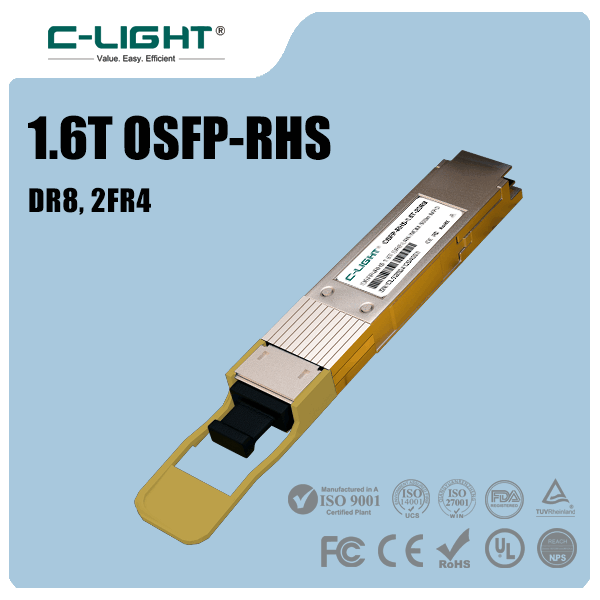
As optical interconnect speeds increase toward 1.6T, transmitter design becomes increasingly dependent on bandwidth, signal integrity, thermal performance and system-level electrical and optical constraints.
VCSEL arrays may continue to serve selected short-reach parallel-optics applications, while EML and other advanced transmitter technologies can support single-mode and WDM architectures.
The laser type alone does not define whether a 1.6T optical module is suitable for a specific system.
21. VCSEL vs EML Power Consumption
VCSEL transmitters can benefit from relatively simple direct-modulation architectures and compact array integration.
EML transmitters typically require a more complex device and driver architecture, which can result in higher transmitter complexity and power requirements.
However, total module power is determined by much more than the laser itself. DSP, driver, TIA, cooling, optical coupling and thermal design all contribute to overall power consumption.
22. VCSEL vs EML Cost
VCSELs are widely used in high-volume applications and can be manufactured in arrays using wafer-level processing and testing techniques.
These characteristics support cost-effective short-reach optical modules.
EMLs require more complex semiconductor integration and high-speed modulation structures. As a result, EML-based transmitters are generally associated with higher component and module costs.
23. VCSEL vs EML Manufacturing
VCSEL fabrication is well suited to wafer-level processing. Multiple VCSEL devices can be manufactured and tested simultaneously, which is particularly useful for array-based optical engines.
EML manufacturing requires integration of laser and electro-absorption modulation sections with tight control of optical and electrical characteristics.
The manufacturing processes and testing requirements are therefore different.
24. VCSEL Array vs EML Array
VCSEL technology is especially attractive for array applications because multiple laser emitters can be arranged in compact configurations.
This makes VCSEL arrays suitable for parallel optical transmission using multiple fibers.
EMLs can also be integrated into multi-channel optical transmitters, particularly in WDM systems where several optical wavelengths are generated and modulated independently.
25. VCSEL vs EML Optical Coupling
VCSELs emit vertically from the semiconductor surface, which simplifies certain array coupling and packaging approaches.
EMLs generally use an edge-emitting optical structure. Coupling the optical output into single-mode fibers requires precise optical alignment.
The coupling architecture therefore differs significantly between the two technologies.
26. VCSEL vs EML Beam Characteristics
The emitted optical beam from a VCSEL can support efficient coupling into multimode fiber, especially in array-based implementations.
EMLs produce a directional edge-emitting optical beam that is typically coupled into single-mode optical paths.
Packaging optics must therefore be designed differently for VCSEL and EML transmitters.
27. VCSEL vs EML and Transmission Distance
| Technology | Common Reach Category | Typical Environment |
|---|---|---|
| VCSEL | Short reach | Server and data center interconnects |
| EML | Short to longer reach | Data center, campus, metro and high-speed single-mode links |
The actual reach is determined by the transceiver standard, optical budget, fiber, receiver sensitivity, modulation format and other system parameters.
28. VCSEL vs EML and WDM
VCSELs are commonly used for parallel-optics architectures where multiple fibers carry independent optical lanes.
EMLs are particularly useful in WDM architectures because individual EML transmitters can operate at different optical wavelengths and combine multiple channels onto one fiber pair.
This makes EML technology especially valuable for compact high-speed single-mode modules.
29. VCSEL vs EML for Parallel Optics
Parallel optics sends multiple optical lanes through multiple fiber channels.
VCSEL arrays are highly suitable for this architecture because several emitters can be placed together and connected to multi-fiber connectors.
Applications such as SR4 and SR8 commonly use this approach.
30. VCSEL vs EML for Duplex LC Optical Modules
Duplex LC modules commonly use single-mode fiber and may use wavelength multiplexing to carry multiple optical channels over a single fiber pair.
EML technology is therefore frequently associated with modules that provide high aggregate data rates through multiple WDM wavelengths.
VCSEL-based solutions are more commonly paired with multi-fiber parallel interfaces rather than duplex LC WDM architectures.
31. VCSEL vs EML and PAM4
Modern high-speed optical transceivers increasingly use PAM4 modulation to increase the amount of data carried by each optical lane.
Both VCSEL and EML technologies can be part of PAM4 optical transmitters when the device bandwidth, linearity, driver and overall link design support the required signaling conditions.
Therefore, PAM4 alone does not determine whether a module should use VCSEL or EML.
32. VCSEL vs EML and NRZ
NRZ uses two signal levels, while PAM4 uses four signal levels.
Many traditional VCSEL applications used NRZ signaling, but modern VCSEL designs have evolved to support much higher data rates and advanced modulation schemes.
EML transmitters are also widely used in PAM4-based high-speed optical systems.
33. VCSEL vs EML and Signal Integrity
Signal integrity depends on the entire transmitter and receiver chain rather than the laser alone.
Important factors include laser bandwidth, driver linearity, package parasitics, optical coupling, receiver sensitivity, equalization and FEC.
EML technology can provide favorable characteristics for demanding high-speed single-mode links, while VCSEL technology remains highly effective for short-reach parallel optical transmission.
34. VCSEL vs EML Thermal Performance
Thermal performance is an important consideration in high-density optical modules.
VCSEL arrays can provide compact optical integration, but multiple active channels still generate heat that must be removed efficiently.
EML transmitters also require thermal management, especially when multiple high-speed WDM channels are integrated into one optical module.
For 800G and 1.6T products, thermal design must be evaluated at the complete module and system level.
35. VCSEL vs EML Reliability
Both VCSEL and EML technologies can achieve high reliability when properly designed and operated within their specified conditions.
Reliability depends on semiconductor design, packaging, operating temperature, drive conditions, optical power, manufacturing quality and qualification processes.
Laser technology alone should not be used as the only reliability criterion.
36. VCSEL vs EML Packaging
VCSEL arrays are well suited to compact parallel optical engines and multi-fiber coupling structures.
EMLs require accurate alignment for coupling into single-mode optical paths and may be integrated with wavelength-specific optical components.
As data rates increase, both technologies require sophisticated packaging to maintain optical and electrical performance.
37. VCSEL vs EML in Data Centers
Data centers use both technologies for different network segments.
VCSELs are frequently associated with short-distance connections where multimode fiber and parallel optics provide a practical solution.
EMLs are more commonly used when single-mode fiber, WDM and longer transmission distances are required.
38. VCSEL vs EML for Server-to-Switch Links
Server-to-switch connections are generally short, making VCSEL-based multimode solutions attractive for many deployments.
For longer connections between racks, rows or data center areas, single-mode solutions using technologies such as EML may become more relevant.
39. VCSEL vs EML for Switch-to-Switch Links
Switch-to-switch links can range from very short connections inside a rack to much longer connections between data halls.
Short links may use VCSEL-based SR modules, while longer links may use single-mode WDM modules using EML or other suitable transmitter technologies.
40. VCSEL vs EML for AI Data Centers
AI clusters require large numbers of high-bandwidth optical connections between accelerators, switches and network fabrics.
VCSEL technology can serve short-reach high-density interconnects, particularly where parallel multimode optics are practical.
EML technology can support high-speed single-mode links where higher reach and WDM density are required.
The increasing bandwidth of AI clusters means that both technologies can remain relevant within different parts of the network architecture.
41. VCSEL vs EML for 400G SR8
400G SR8 is a short-reach parallel optical architecture that can use multiple VCSEL channels operating around the 850nm wavelength region.
The optical lanes are transmitted over multimode fiber using a multi-fiber connector.
This architecture is fundamentally different from 400G single-mode WDM modules that use multiple wavelength channels.
42. VCSEL vs EML for 400G FR4
400G FR4 uses multiple optical wavelengths over single-mode fiber and typically provides a duplex LC interface.
This type of WDM architecture is commonly associated with EML-based transmitters because each optical channel requires a high-speed wavelength-specific transmitter.
43. VCSEL vs EML for 400G DR4
400G DR4 is a short-reach single-mode parallel architecture rather than an 850nm multimode architecture.
Its optical implementation can use high-speed single-mode laser technologies, including solutions based on directly modulated or externally modulated transmitters depending on the module design.
This demonstrates why optical module reach and fiber type should be considered together with the laser technology.
44. VCSEL vs EML Efficiency
VCSELs can offer strong efficiency and compact integration for short-reach optical transmission.
EMLs may require more complex drive and modulation structures, but their optical performance can reduce transmission penalties in applications where single-mode fiber and WDM are required.
System efficiency should therefore be evaluated using the complete link rather than comparing only laser power.
45. VCSEL vs EML: Main Advantages of VCSEL
VCSEL technology provides several important advantages:
Compact vertical device structure, efficient array integration, high-volume manufacturability and suitability for multimode short-reach links.
VCSELs are particularly useful when low-cost, high-density and short-distance optical connectivity are the main requirements.
46. VCSEL vs EML: Main Advantages of EML
EML technology provides controlled electro-absorption modulation, low-chirp characteristics and strong performance for high-speed single-mode transmission.
These characteristics make EMLs suitable for WDM optical modules and applications requiring higher optical performance over longer distances.
47. When Should You Choose VCSEL?
VCSEL is generally suitable when the application requires short transmission distance, multimode fiber, parallel optical lanes, compact array integration and cost-efficient high-volume deployment.
Typical examples include SR optical modules, data center short-reach links and high-density parallel optical interconnects.
48. When Should You Choose EML?
EML is generally considered when the application requires single-mode fiber, WDM transmission, controlled chirp, high-speed modulation or longer transmission distance.
Typical applications include high-speed LR and FR optical modules, WDM transceivers and high-bandwidth single-mode network connections.
49. VCSEL vs EML Selection Factors
| Selection Factor | VCSEL | EML |
|---|---|---|
| Reach | Short reach | Short to longer reach |
| Fiber | Usually multimode | Usually single-mode |
| Wavelength | Commonly 850nm | Commonly 1310nm and WDM wavelengths |
| Optical Architecture | Parallel optics | Single-mode and WDM |
| Chirp | Higher in many direct-modulation designs | Lower chirp |
| Cost | Generally lower for short-reach applications | Generally higher |
| Array Integration | Excellent | Possible but more complex |
| Typical Use | SR and short data center links | FR, LR and WDM applications |
50. VCSEL vs EML: Are They Interchangeable?
VCSEL and EML are not directly interchangeable in a finished optical module.
Changing from one laser technology to another can require changes to the driver, optical coupling, fiber type, wavelength configuration, modulation design, thermal system and receiver architecture.
The complete transceiver must be designed around the selected transmitter technology.
51. VCSEL vs EML and Optical Module Design
The laser source is only one part of an optical transceiver.
A complete module may include a laser or laser array, driver, TOSA, optical multiplexer, optical demultiplexer, TIA, photodetector, DSP or retimer, controller and thermal management system.
Therefore, the performance of a VCSEL or EML should always be evaluated as part of the complete module architecture.
52. VCSEL vs EML: Future Development
Higher Ethernet speeds and AI data center bandwidth requirements continue to push optical transmitter technologies toward higher bandwidth, better energy efficiency, tighter integration and improved manufacturability.
VCSEL technology is expected to remain important for high-density short-reach optical interconnects and parallel optics.
EML technology continues to play an important role in high-speed single-mode and WDM optical transmission.
At the same time, other technologies such as silicon photonics, DML, LPO and integrated optical engines are expanding the range of available transmitter architectures.
53. VCSEL vs EML: Final Comparison
| Category | VCSEL | EML |
|---|---|---|
| Technology Type | Surface-emitting semiconductor laser | Laser integrated with electro-absorption modulator |
| Common Wavelength | 850nm | 1310nm and WDM wavelengths |
| Fiber | Multimode | Single-mode |
| Reach | Short | Short to long depending on design |
| Modulation | Direct modulation | Electro-absorption modulation |
| Chirp | Higher in many implementations | Lower |
| Array Capability | Excellent | Suitable for multi-channel designs |
| Cost | Generally lower | Generally higher |
| Best-Fit Applications | Short-reach data center optics | High-speed single-mode and WDM optics |
VCSEL and EML serve different but complementary roles in optical communication. VCSELs are strongly suited to short-reach, high-density multimode and parallel optical applications, while EMLs are widely used for high-speed single-mode and WDM transmission where bandwidth, chirp and reach are important.
The right choice depends on the complete optical architecture, including transmission distance, fiber type, wavelength, modulation format, lane rate, optical budget, power consumption and system requirements.
 >
>

 >
>
 >
>
 >
>
 >
>
 >
>
 >
>
 >
>