TEL:+86 132 6656 7067




Trunk cables and breakout cables are widely used in fiber optic networks, particularly in high-density data centers. Although both support multiple fiber connections, they serve different purposes. A trunk cable consolidates multiple fibers into a single cable assembly for connections between network locations, while a breakout cable separates a multi-fiber connection into individual fiber links or connector branches.
Understanding the differences between trunk cable and breakout cable helps network designers select the appropriate cabling configuration for backbone connectivity, equipment connections, and high-speed optical links. Fiber count, connector configuration, polarity, and transceiver compatibility are important factors in determining the correct cable assembly.
1. What Is a Trunk Cable?
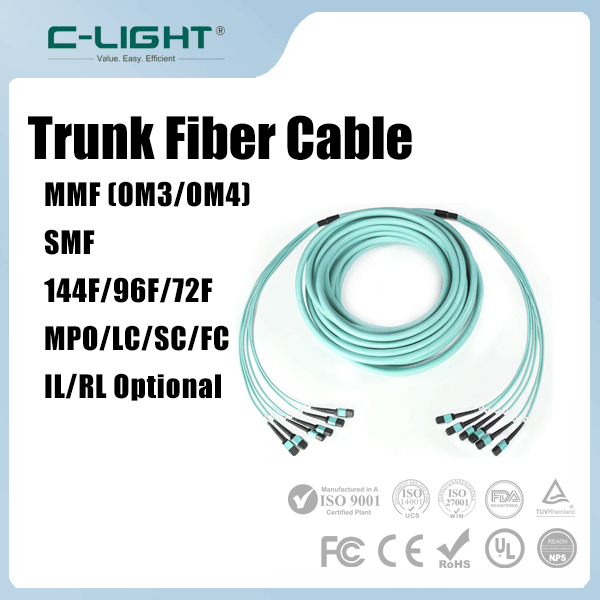
A trunk cable is a multi-fiber cable assembly designed to connect two points in a structured fiber optic network. It typically contains multiple optical fibers within a common cable jacket and uses high-density connectors, such as MPO connectors, at the ends.
By combining multiple fibers into a single assembly, trunk cables simplify cable routing and support high-density installations. They are commonly deployed between patch panels, distribution areas, equipment cabinets, and other network locations.
1.1 Trunk Cable Structure
A typical MPO trunk cable has multi-fiber connectors at both ends. Depending on the network design, it may contain 8, 12, 16, 24, or more fibers. The required fiber count depends on the connected equipment and the intended optical architecture.
Trunk cables can be manufactured with different connector configurations, fiber types, lengths, and polarity options. For MPO applications, Type A, Type B, and other specified configurations may be used depending on the complete link design.
1.2 Common Applications of Trunk Cables
Data center backbone cabling: Connecting patch panels, network cabinets, and distribution areas.
High-density fiber infrastructure: Consolidating multiple optical fibers into a single cable assembly.
MPO connectivity: Connecting compatible multi-fiber ports and structured cabling components.
Network expansion: Providing organized fiber pathways for additional switches, servers, and optical equipment.
2. What Is a Breakout Cable?
A breakout cable is a fiber optic cable assembly designed to separate individual fibers or fiber groups from a common cable into separate branches. In high-density cabling systems, a common configuration uses an MPO connector at one end and multiple LC or other individual connectors at the other end.
Breakout cables provide a practical way to connect multi-fiber interfaces to individual optical ports. They are frequently used when the network architecture requires parallel-optics connectivity on one side and multiple duplex fiber connections on the other.
2.1 Breakout Cable Structure
A typical MPO-to-LC breakout cable has one MPO connector at the common end and multiple LC connectors on separate branch legs. Each branch carries the designated fibers for its corresponding optical connection.
For example, an MPO-to-4×LC duplex breakout cable provides four LC duplex connections from a compatible MPO interface. The actual fiber mapping and supported application depend on the connector arrangement, transceiver standard, and equipment configuration.
2.2 Common Applications of Breakout Cables
Optical breakout connections: Connecting a multi-fiber interface to multiple individual optical ports.
Switch and server connectivity: Connecting compatible MPO interfaces to LC-based equipment links.
High-speed Ethernet: Supporting specified parallel-optics breakout architectures.
Equipment-level cabling: Providing direct connections between high-density fiber interfaces and individual optical ports.
3. Trunk Cable vs Breakout Cable: Key Differences
The primary difference between trunk cables and breakout cables is their structure and connectivity function. Trunk cables carry multiple fibers together between network locations, while breakout cables distribute fibers from a common cable or connector into individual branches.
| Feature | Trunk Cable | Breakout Cable |
|---|---|---|
| Primary function | Provides consolidated multi-fiber connectivity | Separates fibers into individual branches or connections |
| Typical structure | Multi-fiber cable with connectors at both ends | Common cable or connector with multiple breakout branches |
| Common connector configuration | MPO-to-MPO | MPO-to-LC or other multi-fiber-to-individual connector configurations |
| Fiber arrangement | Fibers remain grouped within the trunk assembly | Fibers are distributed into separate branches |
| Typical network role | Backbone and inter-panel connectivity | Equipment-level and breakout connectivity |
| Cable routing | Generally follows a consolidated cable route | Branch legs route to individual equipment ports |
| Selection priorities | Fiber count, length, connector type, and polarity | Branch count, fiber mapping, connector type, and polarity |
| Common deployment | Data center backbone and structured cabling | Parallel-optics breakout and individual equipment connections |
4. Connector Configurations and Fiber Mapping
Connector configuration and fiber mapping are important when selecting trunk and breakout cables. Even if two cable assemblies use compatible connector types, their fiber mapping or polarity may differ. These details must match the intended optical link.
4.1 MPO-to-MPO Trunk Cables
MPO-to-MPO trunk cables are commonly used to connect multi-fiber ports, patch panels, and structured cabling components. Connector gender, key orientation, fiber count, and polarity must match the connected equipment and cabling design.
For example, MPO Type A and Type B configurations use different fiber-position mappings. The appropriate configuration depends on the end-to-end optical path, including transceivers, adapters, patch panels, and any additional cable assemblies.
4.2 MPO-to-LC Breakout Cables
MPO-to-LC breakout cables distribute fibers from a multi-fiber interface to multiple LC connections. They are often used when compatible parallel-optics interfaces must connect to several duplex optical links.
The number of branches, LC connector arrangement, and fiber mapping must match the required breakout architecture. The cable should be specified for the intended transceiver standard rather than selected solely by connector type.
4.3 Polarity and Transmit/Receive Mapping
Correct polarity ensures that transmit and receive paths align across the optical link. This is particularly important for parallel-optics applications, where individual fiber positions correspond to specific optical lanes.
Before deployment, verify the polarity and fiber mapping of both ends of the cable assembly. The trunk cable, breakout cable, and connected transceivers must work together as part of a compatible end-to-end optical path.
5. Trunk Cable vs Breakout Cable in Data Center Networks
5.1 Backbone Connectivity with Trunk Cables
Trunk cables provide consolidated fiber pathways between cabinets, patch panels, and distribution areas. Their multi-fiber design helps reduce the number of individual cable runs and supports organized cable management in high-density data centers.
They are particularly useful when multiple optical fibers must be routed together over a defined path. Fiber count, cable length, connector type, and polarity should be selected according to the network architecture.
5.2 Equipment Connectivity with Breakout Cables
Breakout cables are useful when a multi-fiber interface must connect to multiple individual optical ports. They can simplify equipment-level cabling in network architectures that support parallel-optics breakout.
For high-speed Ethernet, the supported breakout configuration depends on the transceiver standard, lane arrangement, optical interface, and switch capabilities. A breakout cable alone does not determine the data rate or guarantee interoperability.
6. How to Select the Right Cable
The choice between a trunk cable and a breakout cable depends on the connection required between network components. Consider the physical layout and the intended optical architecture before specifying a cable assembly.
6.1 When to Choose a Trunk Cable
You need a multi-fiber connection between patch panels, cabinets, or distribution locations.
The network design requires MPO-to-MPO connectivity.
You want to consolidate multiple fiber paths into a single cable assembly.
You need a backbone assembly with a specified fiber count, length, and polarity.
6.2 When to Choose a Breakout Cable
You need to distribute fibers from a common cable or multi-fiber interface into individual branches.
Your application requires MPO-to-LC or another compatible breakout configuration.
You are implementing a supported parallel-optics breakout architecture.
You need predefined branch lengths and connector mapping for equipment connections.
6.3 Specifications to Verify Before Ordering
Fiber type: Confirm whether OS2 single-mode or OM3, OM4, or OM5 multimode fiber is required.
Fiber count: Select the required number of fibers for the optical link.
Connector type: Verify MPO, LC, SC, or other required interfaces.
Polarity: Confirm fiber mapping and transmit/receive alignment.
Connector gender and polish: Check pin configuration and APC/UPC requirements where applicable.
Cable length: Account for the installation route and the required branch lengths.
Equipment compatibility: Verify the transceiver standard, port configuration, and supported breakout mode.
7. Can Trunk Cables and Breakout Cables Be Used Together?
Yes. Trunk cables and breakout cables can be used together in the same structured fiber optic network when their connector interfaces and optical configurations are compatible.
For example, an MPO trunk cable can carry multiple fibers between a patch panel and a distribution point. A compatible MPO breakout cable can then distribute those fibers to individual LC duplex connections near the equipment.
This arrangement combines consolidated backbone routing with flexible equipment-level connectivity. Depending on the network design, patch panels, adapters, or cassette modules may also be required.
The complete optical path must be checked for connector compatibility, fiber type, polarity, and fiber mapping. Verifying these details helps prevent connection errors and supports reliable optical link operation.
8. Frequently Asked Questions
Q1: What is the main difference between a trunk cable and a breakout cable?
Q2: Is a breakout cable the same as a fan-out cable?
Q3: Are trunk cables usually MPO-to-MPO?
Q4: Can a breakout cable connect MPO and LC interfaces?
Q5: Which cable is suitable for data center backbone cabling?
Q6: Which cable is suitable for optical breakout applications?
Q7: Are trunk and breakout cables available in single-mode and multimode fiber?
Q8: Does an MPO breakout cable automatically support 400G breakout?
Q9: Is polarity important for trunk and breakout cables?
Q10: Can trunk cables and breakout cables be used in the same installation?
9. Conclusion
Trunk cables and breakout cables perform complementary functions in high-density fiber optic networks. Trunk cables provide consolidated multi-fiber connectivity between network locations, while breakout cables distribute fibers into individual branches or equipment connections.
Selecting the appropriate cable assembly requires verification of fiber count, fiber type, connector configuration, polarity, cable length, and transceiver compatibility. A properly designed combination of trunk and breakout cables supports organized cabling, efficient installation, and reliable optical connectivity in modern data centers.
 >
>

 >
>
 >
>
 >
>
 >
>
 >
>
 >
>
 >
>