TEL:+86 132 6656 7067




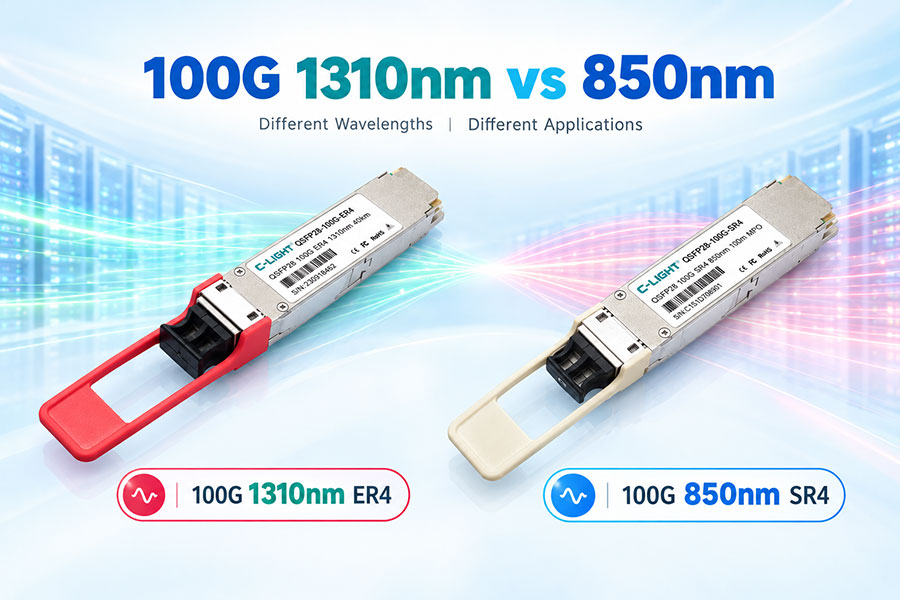
850nm and 1310nm are two important wavelength regions widely used in optical communication systems. Although both can be used to transmit digital information through optical fiber, they are typically associated with different fiber types, laser technologies, transmission distances, optical budgets, and application environments.
850nm is strongly associated with multimode fiber and VCSEL-based short-reach optical transceivers, making it common in data center and enterprise connections. 1310nm is widely associated with single-mode fiber and is used for longer-reach data center, telecom, and high-speed optical links.
The difference between the two wavelengths is therefore not simply a matter of wavelength. Fiber type, modal behavior, attenuation, dispersion, optical components, module architecture, and required transmission distance all influence which wavelength is appropriate.
1. What Is 850nm Optical Communication?
850nm optical communication uses light centered around the 850nm wavelength region to transmit data through optical fiber.
It is widely associated with multimode fiber because multimode fiber has a relatively large core and supports multiple propagation modes. In short-reach data center applications, 850nm VCSEL technology provides an efficient way to generate high-speed optical signals.
850nm optics are particularly useful where the transmission distance is relatively short and the installation benefits from lower-cost optical components and high-density parallel connectivity.
2. What Is 1310nm Optical Communication?
1310nm optical communication uses light in the O-band around the 1310nm region. It is strongly associated with single-mode fiber and is widely used for data center, telecommunications, metro, and access applications.
Single-mode fiber provides a much smaller propagation mode than multimode fiber and is suitable for significantly longer transmission distances.
1310nm is also important because conventional single-mode fiber has a low-dispersion region around this wavelength, making it useful for high-speed direct-detection systems.
3. 850nm vs 1310nm at a Glance
| Factor | 850nm | 1310nm |
|---|---|---|
| Typical Fiber | Multimode fiber | Single-mode fiber |
| Typical Laser | VCSEL | DML, EML, and other laser architectures |
| Typical Reach | Short reach | Short, medium, and longer reach |
| Common Application | Data center and enterprise links | Data center, telecom, access, metro, and interconnect |
| Core Diameter | Typically 50µm multimode fiber | Typically about 9µm single-mode fiber |
| Modal Dispersion | Important in multimode transmission | Much lower in single-mode transmission |
| Component Cost | Often lower for short-reach applications | Generally higher depending on reach and architecture |
| Common Connector | LC or MPO/MTP® | LC or MPO/MTP® |
| Typical High-Speed Role | SR and VR-class links | DR, FR, LR, and other single-mode links |
4. Why 850nm Is Commonly Used with Multimode Fiber
Multimode fiber has a much larger core than single-mode fiber and supports multiple modes of light propagation.
850nm VCSELs are well suited to this environment because they can efficiently couple optical power into multimode fiber and are comparatively compact and economical for short-distance applications.
The combination of 850nm VCSELs and multimode fiber has therefore become an important solution for short-reach data center connectivity.
5. Why 1310nm Is Commonly Used with Single-Mode Fiber
1310nm is widely used with single-mode fiber because the fiber provides a low-loss, low-dispersion transmission environment suitable for longer distances.
Single-mode fiber eliminates the significant modal dispersion associated with multimode transmission because only the fundamental propagation mode is used.
This makes 1310nm single-mode optical systems well suited to higher-speed links where longer transmission distances or stricter signal margins are required.
6. 850nm VCSEL vs 1310nm Laser Technology
| Feature | 850nm VCSEL | 1310nm DML/EML |
|---|---|---|
| Typical Wavelength | 850nm region | 1310nm region |
| Fiber | Multimode | Single-mode |
| Laser Structure | Vertical-cavity surface-emitting laser | Distributed-feedback or electro-absorption-modulated laser architectures |
| Typical Reach | Short | Short to long depending on design |
| Manufacturing | Well suited to high-volume short-reach optics | More complex depending on the specific laser architecture |
| Typical Application | SR and VR data center optics | DR, FR, LR and telecom optics |
VCSEL technology is particularly attractive for high-volume short-reach applications, while 1310nm systems can use several different laser technologies depending on required reach, modulation format, and optical budget.
7. Attenuation at 850nm and 1310nm
Fiber attenuation is one of the fundamental factors that separates the two wavelength regions.
For multimode fiber, attenuation is generally higher around 850nm than around the 1300nm region. However, short data center links are often limited more by modal bandwidth, connector loss, and system design than by fiber attenuation alone.
Single-mode fiber has substantially lower attenuation than multimode fiber and is designed for long-distance optical transmission.
| Fiber Type | 850nm Region | 1310nm Region |
|---|---|---|
| Multimode Fiber | Widely optimized for high-speed short reach | Lower attenuation region but not the dominant high-speed data center window |
| Single-Mode Fiber | Not the primary operating window | Widely used |
The actual system loss must always be calculated using the specifications of the particular fiber and optical module rather than wavelength alone.
8. Modal Dispersion: A Major 850nm Difference
Multimode fiber allows multiple propagation modes, and these modes can travel different optical paths through the fiber.
The resulting modal dispersion causes optical pulses to spread as they travel. As data rates increase, this spreading can limit the usable distance of an 850nm multimode link.
This is why multimode fiber specifications include parameters such as effective modal bandwidth, which is particularly important for high-speed 850nm transmission.
Single-mode fiber largely avoids this form of modal dispersion, making 1310nm single-mode systems more suitable for longer and higher-bandwidth transmission.
9. Chromatic Dispersion at 850nm and 1310nm
Chromatic dispersion occurs because different spectral components of an optical signal can propagate at slightly different velocities through the fiber.
Conventional single-mode fiber has a relatively low chromatic-dispersion region around 1310nm. This makes the wavelength attractive for high-speed short- and medium-reach direct-detection systems.
At 850nm, multimode systems are generally dominated by modal bandwidth considerations rather than the chromatic-dispersion behavior that dominates many longer single-mode links.
10. 850nm vs 1310nm Transmission Distance
Transmission distance is one of the easiest ways to understand the practical difference between the two wavelength regions.
| Application Class | 850nm | 1310nm |
|---|---|---|
| Very Short Reach | Excellent fit | Possible |
| Short Data Center Links | Common | Common |
| 500m-Class Links | Limited and architecture dependent | Common in suitable designs |
| 2km-Class Links | Generally unsuitable for conventional multimode SR designs | Common in suitable single-mode designs |
| 10km-Class Links | Generally unsuitable | Common with appropriate optical architecture |
| Metro and Telecom | Limited | Widely applicable |
The distance shown for any particular transceiver must still be determined from the actual standard and module specification. Wavelength alone does not define link reach.
11. 850nm in 400G and 800G Optical Transceivers
850nm remains highly relevant to high-speed short-reach data center optics.
For example, 400G VR4 and 400G SR-class modules can use 850nm optical transmission over multimode fiber. High-speed 800G VR8 architectures also use 850nm multimode optics for short-reach applications.
These architectures typically use multiple parallel optical lanes to achieve the aggregate bandwidth.
| Optical Technology | Typical Wavelength | Fiber | Application |
|---|---|---|---|
| 400G SR/VR | 850nm region | MMF | Short data center connections |
| 800G VR8 | 850nm region | MMF | Very short high-bandwidth data center links |
12. 1310nm in 400G and 800G Optical Transceivers
1310nm is widely used in high-speed single-mode optical modules.
400G DR4 and FR4 architectures use the 1310nm region for applications ranging from several hundred meters to several kilometers, depending on the specific module.
800G DR8 architectures also use 1310nm single-mode transmission, providing an important route toward higher-capacity switch-to-switch and AI data center connectivity.
This makes 1310nm especially relevant as data centers move toward longer optical reach and higher bandwidth.
13. 850nm vs 1310nm in 400G Applications
| 400G Module Type | Wavelength | Fiber | Representative Reach |
|---|---|---|---|
| 400G VR4 | 850nm | MMF | Short reach |
| 400G SR4 | 850nm | MMF | Short reach |
| 400G DR4 | 1310nm | SMF | 500m-class |
| 400G FR4 | 1310nm | SMF | 2km-class |
This comparison demonstrates how wavelength and fiber type are closely connected to the intended transmission distance.
14. 850nm vs 1310nm in 800G Applications
| 800G Architecture | Wavelength | Fiber | Representative Application |
|---|---|---|---|
| 800G VR8 | 850nm | MMF | Very short data center links |
| 800G DR8 | 1310nm | SMF | 500m-class single-mode links |
| 2 × 400G FR4 | 1270/1290/1310/1330nm | SMF | 2km-class connectivity |
The evolution from 850nm multimode optics toward 1310nm single-mode optics becomes increasingly visible as link distance and bandwidth requirements rise.
15. Cost Differences Between 850nm and 1310nm
850nm short-reach optical modules can be cost-effective because VCSELs and multimode fiber are well established for high-volume data center applications.
1310nm modules can have higher component and system costs depending on their laser technology, optical architecture, reach, and optical budget.
However, comparing wavelength cost alone can be misleading. The total solution cost also includes transceivers, fiber, connectors, patch panels, switches, installation, power consumption, and future upgrade requirements.
16. Power Consumption and Efficiency
Power efficiency depends on the entire optical module architecture rather than wavelength alone.
850nm VCSEL modules can provide efficient short-reach transmission and are widely used in dense data center environments.
1310nm modules can also be highly power efficient, particularly as modern DML, EML, silicon photonics, and DSP technologies continue to improve.
For high-speed 400G, 800G, and 1.6T networks, the relevant design metric is increasingly power per transmitted bit rather than simply comparing the nominal wavelength.
17. Connector and Fiber Infrastructure
The connector itself does not determine whether a system uses 850nm or 1310nm.
850nm short-reach parallel optics frequently use MPO/MTP® connectors because multiple multimode fibers are required for parallel transmission.
1310nm single-mode systems can use MPO/MTP® for parallel optical architectures such as DR4/DR8, while duplex LC is common in wavelength-multiplexed designs such as FR4.
| Architecture | Typical Fiber | Common Connector Example |
|---|---|---|
| 850nm SR/VR | MMF | MPO/MTP® |
| 1310nm DR4/DR8 | SMF | MPO/MTP® |
| 1310nm FR4-class | SMF | Duplex LC |
18. How to Choose 850nm or 1310nm
The appropriate wavelength should be selected according to the complete optical link rather than simply choosing the lowest-cost module.
| Requirement | Recommended Direction |
|---|---|
| Very short data center link | 850nm multimode is often suitable |
| High-density short-reach AI network | 850nm MMF or 1310nm SMF depending on distance and architecture |
| 500m-class single-mode connection | 1310nm is commonly used |
| 2km-class connection | 1310nm single-mode is generally appropriate |
| 10km or longer | 1310nm or other telecom wavelength architectures |
| Existing MMF infrastructure | 850nm short-reach optics may be advantageous |
| Future long-distance scaling | Single-mode infrastructure provides greater flexibility |
The actual selection should also verify fiber category, insertion loss, optical budget, connector loss, module compatibility, power, and operating temperature.
19. 850nm vs 1310nm: Key Differences
| Category | 850nm | 1310nm |
|---|---|---|
| Optical Window | 850nm region | 1310nm O-band region |
| Typical Fiber | Multimode | Single-mode |
| Typical Laser | VCSEL | DML, EML, silicon photonics and related technologies |
| Modal Dispersion | Important | Very low in single-mode fiber |
| Attenuation | Higher in typical multimode fiber | Lower in typical single-mode fiber |
| Reach | Short | Short to long depending on module design |
| Typical Data Center Role | SR/VR | DR/FR/LR and other SMF links |
| Cost | Often economical for short reach | Higher in many longer-reach implementations |
| Fiber Scalability | Best for short-reach infrastructure | Strong scalability toward longer reach |
| Telecom Use | Limited | Extensive |
20. 850nm vs 1310nm: Which Wavelength Fits the Network?
850nm and 1310nm serve different but complementary roles in modern optical networks.
850nm: commonly paired with multimode fiber and VCSEL technology for short-reach, high-density data center and enterprise connections. It is particularly attractive when the link distance is short and an economical parallel-optics solution is required.
1310nm: commonly paired with single-mode fiber and is used across a much broader reach range. It is particularly important for 400G and 800G DR/FR-class data center optics, telecom networks, access networks, and longer-distance optical interconnects.
The key principle is that wavelength should be considered together with fiber type, optical components, transmission distance, bandwidth, optical budget, and network architecture.
For modern high-speed networks, 850nm remains important for short-reach multimode connectivity, while 1310nm provides a strong platform for single-mode systems as data rates and transmission distances increase.
C-LIGHT optical connectivity solutions can be evaluated across both wavelength regions according to application requirements, including high-speed multimode and single-mode optical transceivers, AOC/DAC connectivity, MPO/MTP® fiber systems, and 400G/800G data center interconnect solutions.
21.850nm vs 1310nm Q&A
Q1. What is the main difference between 850nm and 1310nm?
Q2. Why is 850nm commonly used with multimode fiber?
Q3. Why is 1310nm commonly used with single-mode fiber?
Q4. Is 850nm or 1310nm better for data centers?
Q5. Can 850nm be used for 400G?
Q6. Can 1310nm be used for 400G?
Q7. Can 850nm be used for 800G?
Q8. Can 1310nm be used for 800G?
Q9. Which wavelength has lower optical loss?
Q10. Should I choose 850nm or 1310nm for a new optical network?
```
 >
>

 >
>
 >
>
 >
>
 >
>
 >
>
 >
>
 >
>