TEL:+86 132 6656 7067




With the rapid advancement of 5G/6G networks, AI computing, and data center infrastructure, optical communication technology is evolving at an unprecedented pace. From 1G to 800G, and from SFP to OSFP, optical transceivers now come in a wide array of data rates and form factors. However, this diversity in networking equipment also introduces a significant challenge—different brands and models of switches and routers often have varying compatibility requirements for optical modules. A transceiver that works seamlessly in one vendor's device may not be plug-and-play compatible with another. It is against this backdrop that the Transceiver Coding Box has emerged as an essential auxiliary tool.
https://c-light.com/products/Network_Tools/Coding_Box.html
C-LIGHT founded in 2011, is a fiber optic network product manufacturer with over 15 years of industry experience. The company's product portfolio includes high-speed optical transceivers at rates such as 800G, 2×400G, 400G, 4×100G, 200G, and 100G, as well as AOC, ACC, and DAC products. Leveraging its independent R&D capabilities and deep understanding of industry needs, C-LIGHT has developed a series of Transceiver Coding Box products that provide an efficient, reliable, and all-in-one solution for flexible configuration and batch programming of optical modules.
Product Overview
C-LIGHT Transceiver Coding Tool is a comprehensive hardware and software system designed specifically for programming the MSA customer EEPROM area of various optical transceivers. The tool communicates with the transceiver's internal EEPROM chip via the I²C bus protocol, enabling reading, editing, and writing of coding information such as vendor name, product number, serial number, date code, and wavelength settings. This process effectively grants the optical module compatibility with networking equipment from different vendors.
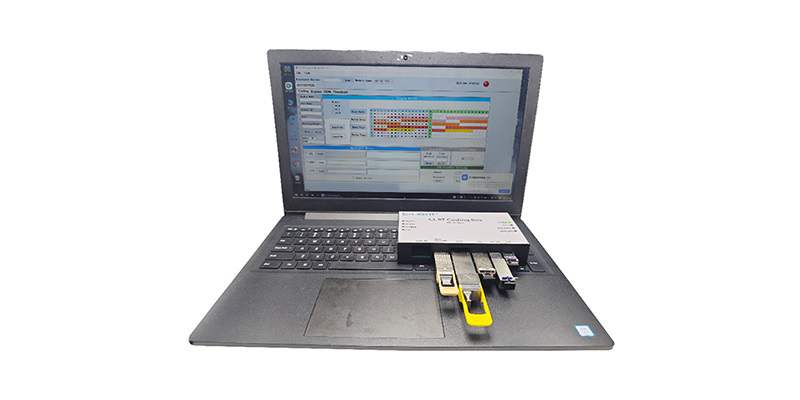
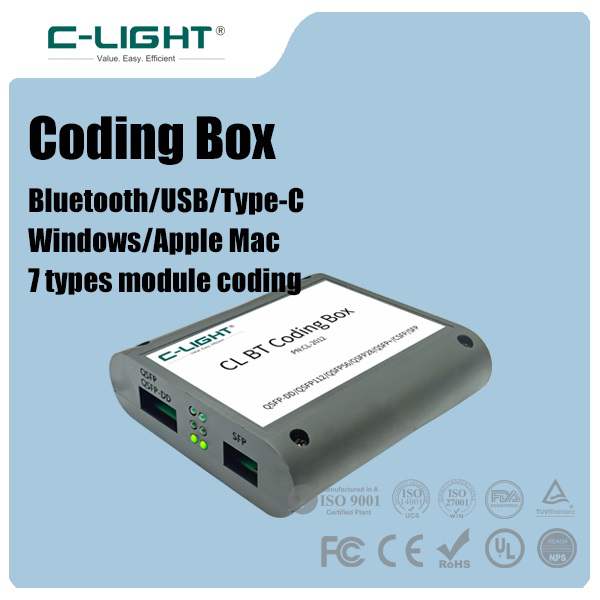
C-LIGHT currently offers three main coding box models: CL-2010, CL-2011, and CL-2012, each tailored with distinct configurations for different application scenarios and interface requirements.
Core Technical Features
Extensive Optical Transceiver Compatibility
The C-LIGHT Coding Box supports nearly all mainstream optical transceiver form factors, including SFP, SFP+, SFP28, SFP56, SFP112, CSFP, XFP, SFP-DD, QSFP+, QSFP28, QSFP56, QSFP112, QSFP-DD, OSFP, and OSFP-XD. Additionally, the tool is compatible with various AOC (Active Optical Cable), ACC (Active Copper Cable), DAC (Direct Attach Cable), and AEC (Active Electrical Cable) products.
At the protocol level, the C-LIGHT Coding Box strictly adheres to industry standards. Its EEPROM compatibility encompasses mainstream transceiver specifications such as SFF-8472, SFF-8636, and OIF-CMIS 5.2, ensuring that coding operations comply with MSA (Multi-Source Agreement) requirements and that programmed modules operate stably in mainstream vendor equipment.
Rich Software Functionality
The companion coding software for the C-LIGHT Coding Box is feature-rich and intuitively designed:
Multi-page Auto-Write / Single-Page Write / Single-Byte Editing: Users can select coding granularity based on their needs, from precise modification of a single byte to automatic batch writing of multiple pages, offering flexibility for various use cases.
Tunable SFP Wavelength Setting: Supports wavelength parameter configuration for tunable optical transceivers, meeting the requirements of DWDM and other wavelength division multiplexing network environments.
Password Editing and Entry: Enables unlocking and operation of modules protected by coding passwords.
Threshold Detection Function: Allows detection and verification of key module parameters to ensure programmed modules meet performance standards.
Easy Edit Mode: Provides quick access for editing common information such as vendor name, product number, serial number, and production date, significantly improving operational efficiency.
Convenient Data Connectivity
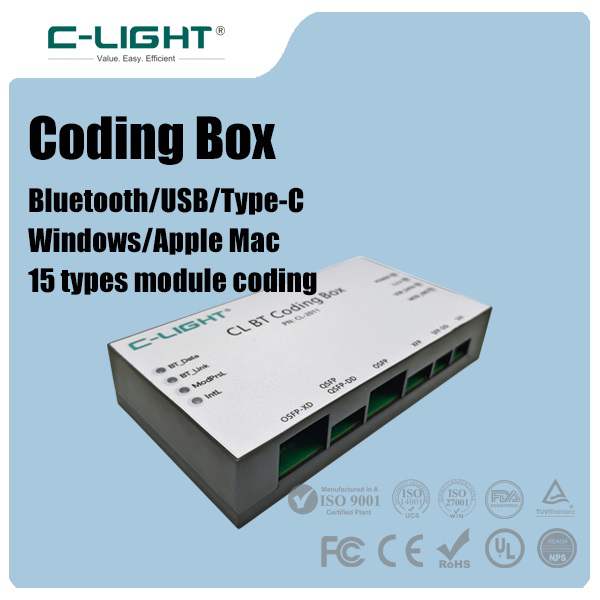
The C-LIGHT Coding Box supports multiple data connection methods. The CL-2011 model features Bluetooth, USB, and Type-C connectivity, offering flexibility for various field scenarios. The CL-2012 supports Bluetooth and USB connections, meeting essential data transfer needs. The inclusion of a Type-C interface on the CL-2011 allows direct connection to a wide range of mobile devices or laptops, making it particularly well-suited for on-site operations.
Cross-Platform Support
On the software side, the C-LIGHT Coding Tool is compatible with Windows operating systems from Windows 7 to Windows 11, as well as Apple macOS. This broad coverage accommodates the vast majority of user environments, allowing for quick and easy deployment without the need for additional system configuration.
Typical Application Scenarios
The C-LIGHT Transceiver Coding Box plays a vital role across multiple industry sectors:
Data Center Networks: Data center environments often involve a mix of networking equipment from different vendors and production batches. The C-LIGHT Coding Box enables operations teams to quickly reprogram optical modules to be compatible with target devices, ensuring efficient and stable network deployment.
Telecom FTTx Broadband Access Networks: In Fiber-to-the-Home (FTTH) and Fiber-to-the-Building (FTTB) scenarios, the coding box can be used for batch configuration of optical modules in access equipment, improving on-site construction efficiency.
DWDM/CWDM Wavelength Division Multiplexing Networks: In WDM systems, the coding box is used to configure wavelength parameters for tunable optical modules, allowing users to flexibly adjust channel assignments.
Industrial-Grade Fiber Optic Networks: For industrial networks operating in harsh environments (e.g., high temperature, high humidity), the coding box enables on-site configuration and diagnostics of industrial-grade optical modules, meeting stringent industrial application demands.
5G/6G Mobile Networks: With the rapid deployment of 5G base stations and core network equipment, the coding box helps operators batch-configure various optical modules, ensuring compatibility across mobile network infrastructure.
Enterprise Networks: Corporate networks often feature a diverse mix of equipment brands and models. The coding box empowers IT teams with the ability to configure optical modules independently, reducing dependency on vendor-specific transceivers.
Laboratory and Test Environments: In R&D and testing scenarios, engineers frequently need to switch and validate optical modules across different devices. The flexible coding capabilities of the coding box make it an indispensable tool in the lab.
Core Value and Advantages
Reduced Inventory and Spare Parts Costs
The most direct commercial value of the coding box lies in inventory management. Instead of purchasing and stocking proprietary optical modules for each equipment vendor, a single universal optical module can be reprogrammed with the coding box to work with switches from multiple brands, significantly reducing spare parts inventory levels and procurement costs.
Enhanced Network Deployment and Operational Efficiency
Network engineers can use the coding box on-site to quickly reprogram an optical module, eliminating the need to wait for a new module to arrive and substantially reducing network fault recovery time. For large-scale network deployment projects, the batch write capability of the coding box notably accelerates rollout efficiency.
Preservation of Equipment Warranty Rights
Using third-party optical modules does not void the warranty of networking equipment. Major network equipment manufacturers have clear guidelines stating that their warranty support will not be affected by the installation of third-party transceivers. This provides users with peace of mind when utilizing the C-LIGHT Coding Box.
Mature After-Sales and Technical Support
C-LIGHT offers a 3-year product warranty, long-term maintenance, and professional technical support services. Each coding box undergoes 100% testing before shipment and is managed under a three-step quality control process to ensure product reliability. Furthermore, C-LIGHT is committed to 100% safeguarding the security of customer product data and information.
Product Series Comparison
The three models in the C-LIGHT Coding Box series differ in port configuration and intended application scenarios:
| Comparison Item | CL-2010 | CL-2011 | CL-2012 |
| Port Configuration | 1×QSFP-DD/QSFP + 1×SFP | 1×OSFP + 1×QSFP/QSFP-DD + 1×XFP +1×SFP-DD + 1×SFP/CSFP (OSFP-XD optional) | 1×QSFP/QSFP-DD/QSFP112 + 1×SFP/CSFP |
| Data Connection | Standard USB | Bluetooth / USB / Type-C | Bluetooth / USB |
| Operating Temperature | 0°C to 70°C | 0°C to 70°C | 0°C to 70°C |
| Power Supply | AC 100~240V Input, DC 5V/2A Output | AC 100~240V Input, DC 5V/2A Output | AC 100~240V Input, DC 5V/2A Output |
CL-2010 is positioned for fundamental coding needs, featuring two core ports—QSFP-DD/QSFP and SFP—which adequately cover the two most commonly used form factors in modern data centers and telecom networks. It is an ideal choice for users with budget constraints who still require full core functionality.https://c-light.com/products/details/Coding_Box.html
CL-2011 is the flagship model in the C-LIGHT Coding Box series, boasting the most comprehensive port selection. It includes five independent ports: OSFP, QSFP/QSFP-DD, XFP, SFP-DD, and SFP/CSFP, with an optional OSFP-XD port available upon special order. This model fully supports all mainstream form factors from legacy XFP to the latest OSFP, making it particularly suitable for carriers and large data centers with extensive inventories of diverse optical modules, or R&D teams requiring broad compatibility testing. The multiple connectivity options also enhance its flexibility in field deployment scenarios.https://c-light.com/products/details/Coding_Box_2011.html
CL-2012 strikes a good balance between port count and functionality. It provides two core ports—QSFP/QSFP-DD/QSFP112 and SFP/CSFP—and supports Bluetooth and USB connections, covering the coding requirements for the entire QSFP family and the SFP family. This model is well-suited for most enterprise data centers and network operations teams, offering solid performance for daily coding tasks while maintaining a high cost-performance ratio.https://c-light.com/products/details/Coding_Box_2012.html
Conclusion
In an era of rapidly evolving optical communication technology, equipment compatibility remains a core challenge in network deployment and maintenance. The C-LIGHT Transceiver Coding Box, with its broad module compatibility, rich software features, and flexible product lineup, provides users with an efficient and reliable optical transceiver coding solution. From laboratory R&D to large-scale data center rollouts, and from routine maintenance to emergency troubleshooting, the C-LIGHT Coding Box empowers network engineers to simplify complexity and respond with agility. Whether seeking a feature-rich professional tool or a cost-effective enterprise solution, users can find the right fit among the CL-2010, CL-2011, and CL-2012 models. For further product details or technical support inquiries, please visit the official C-LIGHT website or contact the sales team (Tel: +86 158 1857 3751, Email: sales@c-light.com).
 >
>

 >
>
 >
>
 >
>
 >
>
 >
>
 >
>
 >
>