TEL:+86 132 6656 7067




Amidst the explosive growth in demand for AI computing power, 800G Direct Attach Copper (DAC) cables, leveraging their exceptional cost-effectiveness and ultra-low latency characteristics, have emerged as the core interconnect solution underpinning AI clusters and hyperscale data centers.
1 Technical Principles and Product Definition
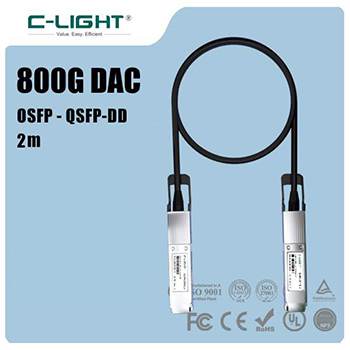
800G DAC is a high-speed interconnect solution based on copper cabling. It utilizes fixed QSFP-DD800 or OSFP form factors on both ends, enabling direct connection to switches, servers, or network storage devices. Its core working principle is remarkably straightforward: it transmits electrical signals directly through the copper cable, eliminating the need for any optical conversion process.
Unlike traditional optical modules and fiber optic patch cords, DAC integrates the transmission medium and interface into a single unit. Internally, it employs a coaxial copper cable structure, configured with multiple conductor pairs and shielding layers, significantly reducing electromagnetic interference and ensuring signal integrity. Essentially, an 800G DAC functions as an integrated high-speed network cable, ready for plug-and-play use without the need for additional optical components, cleaning, or maintenance.
2 Technological Evolution: A Four-Generation Leap from 10G to 800G
DAC technology has undergone a clear evolution across four generations:
First Generation (2010-2015): 10G SFP+ DAC, primarily used in Storage Area Networks (SAN).
Second Generation (2016-2020): 25G/100G QSFP28 DAC, supporting the cloud computing boom.
Third Generation (2021-2023): 400G QSFP-DD DAC, tailored for AI training clusters.
Fourth Generation (2024-present): 800G OSFP/QSFP-DD DAC, utilizing PAM4 modulation technology with a per-lane data rate of 112Gbps.
3 Passive vs. Active DAC
Based on whether signal conditioning chips are integrated, 800G DAC is divided into passive and active types:
Active DAC (also known as ACC, Active Copper Cable) integrates signal enhancement chips within the cable assembly. This allows it to maintain signal integrity over extended transmission distances, making it an ideal choice for connecting adjacent racks.
4 Form Factors: The OSFP vs. QSFP-DD Landscape
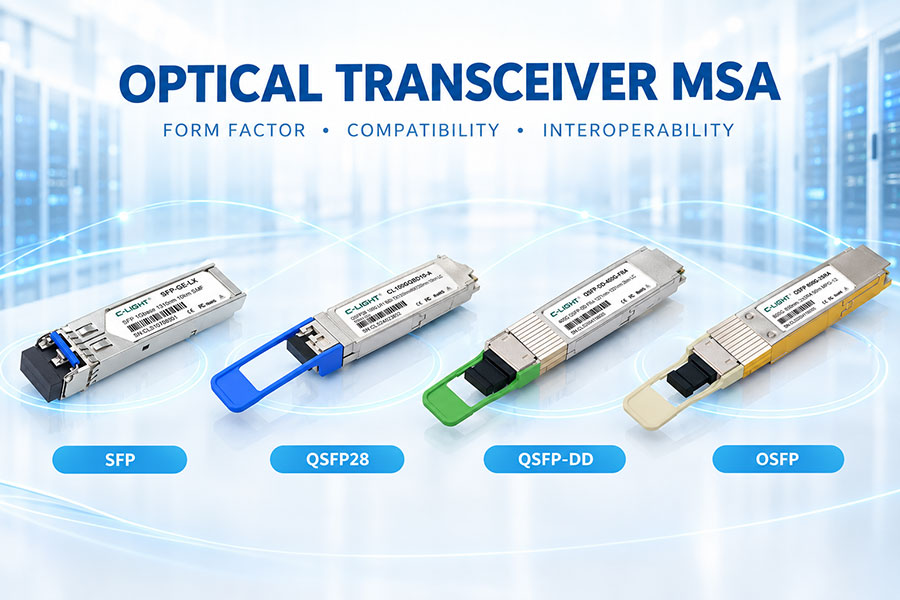
800G DAC primarily utilizes two main form factors, each with its own advantages:
OSFP (Octal Small Form-factor Pluggable):
Features a larger mechanical package, optimized for applications requiring high heat dissipation.
Supports power dissipation of 15-20W and natively supports 8 channels.
Excels in next-generation AI cluster interconnects, better suited for new deployments prioritizing long-term scalability.
QSFP-DD (Quad Small Form-factor Pluggable Double Density):
Offers a smaller module size, allowing for higher port density.
Provides backward compatibility with QSFP+, QSFP28, and QSFP56 standards, ensuring a seamless migration path.
Suitable for networks gradually upgrading from lower speeds; currently the most widely deployed standard in NVIDIA-based GPU clusters.
| C-LIGHT 800G DAC Features: |
●Compliant with IEEE 802.3CK ●Compliant with QSFP DD MSA ●RoHS compliant |
 ●
●5 Performance Specifications and Technical Advantages
The key performance specifications for 800G DAC are as follows:
Data Rate: 800Gbps, achieved by aggregating eight 100Gbps PAM4 modulated channels.
Power Consumption: Passive DACs consume less than 0.005W, drawing negligible power; active DACs also have significantly lower power consumption compared to optical module solutions.
Latency: Direct electrical signal transmission eliminates the need for optical-electrical conversion, resulting in ultra-low latency suitable for latency-sensitive applications like high-frequency trading and autonomous driving.
Reliability: Simple structure with few passive components; Mean Time Between Failures (MTBF) is significantly higher than that of optical module solutions.
Cost Advantage: Eliminates the need for expensive lasers, optical components, and fiber optic cabling. Deployment costs are substantially lower than optical module solutions, approximately 25%-35% of the cost of Active Optical Cables (AOC).
 >
>

 >
>
 >
>
 >
>
 >
>
 >
>
 >
>
 >
>