TEL:+86 132 6656 7067




TOSA and TO-CAN are both common terms in optical communication, but they describe different levels of an optical transceiver design. TOSA refers to a transmitter optical sub-assembly that performs the optical transmitting function, while TO-CAN refers to a package structure used to physically and hermetically contain an optical device such as a laser.
The relationship between the two can sometimes cause confusion because a TOSA can incorporate a TO-CAN packaged laser as one of its internal components. In other words, TOSA describes what the optical assembly does, while TO-CAN describes how an optical device is packaged.
1. TOSA vs TO-CAN at a Glance
| Feature | TOSA | TO-CAN |
|---|---|---|
| Concept | Optical transmitter sub-assembly | Optoelectronic device package |
| Full Name | Transmitter Optical Sub-Assembly | Transistor Outline CAN |
| Primary Role | Provides the optical transmitting function | Protects and packages an optical device |
| Typical Device | Complete transmitter-side optical assembly | Laser, photodiode or other optoelectronic device |
| Laser Included | Normally includes a laser source | May contain a laser chip or laser-related device |
| Optical Coupling | Yes | May be integrated depending on package design |
| Electrical Connection | Interfaces with the transceiver electronics | Uses package leads or other electrical interfaces |
| Hermetic Sealing | Application-dependent | Common in traditional hermetic implementations |
| Design Level | Higher-level optical sub-assembly | Component-level package |
2. What Is TOSA?
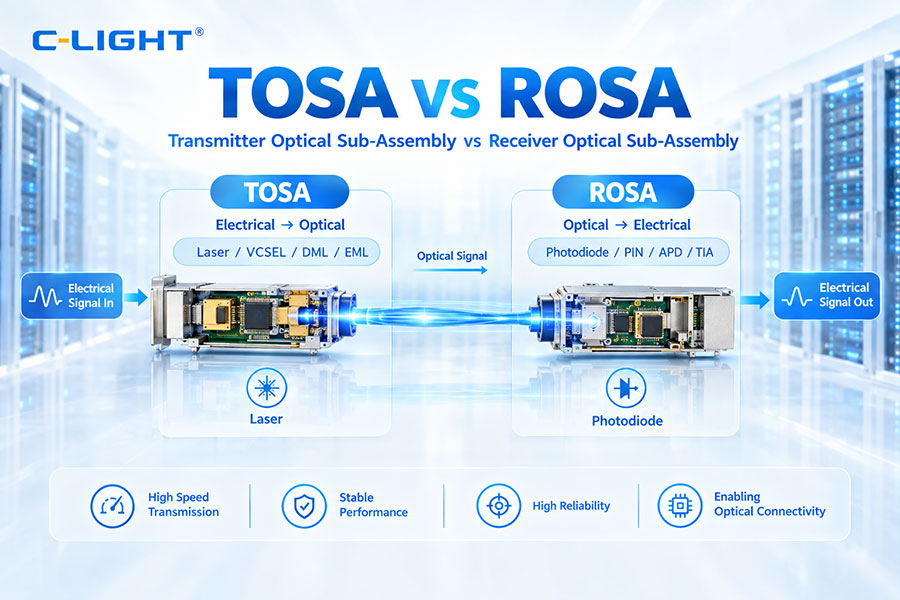
TOSA stands for Transmitter Optical Sub-Assembly. It is the transmitting section of an optical communication device and converts an electrical drive signal into an optical signal for transmission through a fiber.
A typical TOSA can include a laser source, optical coupling components and mechanical or electrical elements needed to deliver the required optical output.
Depending on the design, the laser inside the TOSA can itself be packaged in a TO-CAN structure.
3. What Is TO-CAN?
TO-CAN refers to a type of optoelectronic package derived from the Transistor Outline packaging family. It provides a compact mechanical and electrical enclosure for optical devices.
In optical communication, TO-CAN packages have traditionally been used for devices such as laser diodes, photodiodes and other optoelectronic components. The package can provide mechanical protection, electrical connection and, in hermetic versions, protection from environmental exposure.
TO-CAN therefore describes a package, not a complete optical transmission function.
4. The Fundamental Difference
The simplest distinction is:
TOSA = What the optical assembly does
TO-CAN = How an optical device is packaged
A TOSA can contain a TO-CAN packaged laser, which means the two terms are not mutually exclusive.
For example, a manufacturer may install a TO-CAN laser inside a TOSA and then couple the emitted light into an optical fiber. The entire assembly is the TOSA, while the small hermetically packaged laser is the TO-CAN component.
5. TOSA Internal Structure
A TOSA normally contains several elements working together to produce and launch an optical signal.
| Component | Typical Function |
|---|---|
| Laser Source | Generates the optical signal |
| Optical Coupling Lens | Directs optical energy into the required optical path |
| Monitor Photodiode | Monitors laser output in selected designs |
| Optical Isolator | Reduces unwanted optical feedback where required |
| Mechanical Housing | Maintains optical alignment and mechanical stability |
| Electrical Interface | Connects the optical source to the driver circuitry |
The exact structure varies according to wavelength, data rate, laser technology and module architecture.
6. TO-CAN Internal Structure
A TO-CAN package is centered on the device being packaged rather than on the complete transmitter function.
A typical optical TO-CAN may include an optical semiconductor chip mounted inside the package, electrical connections, a stem or header, a cap and an optical window or lens.
For laser applications, the package is designed to maintain stable mechanical positioning and reliable electrical and optical connections around the laser device.
7. Relationship Between TOSA and TO-CAN
The two concepts often exist at different levels of the same optical product.
A simplified hierarchy is:
Optical Transceiver → TOSA → Laser Device → TO-CAN Package
This hierarchy is not universal because modern optical engines and integrated photonic designs can use different packaging methods. However, it illustrates why TOSA and TO-CAN should not be treated as competing alternatives.
8. Laser Technology and Packaging
Different laser technologies can be packaged in different ways. DFB, FP, VCSEL and other laser types may use package structures selected according to wavelength, power, thermal requirements, reliability targets and manufacturing design.
A TO-CAN package can provide a standardized mechanical platform for a laser device, while the TOSA uses that device as part of a larger transmitter assembly.
The package itself does not determine the entire optical performance of the final TOSA.
9. Optical Coupling and Alignment
TOSA design places strong emphasis on coupling the generated optical signal into the intended fiber or optical path.
The laser position, lens alignment, fiber alignment and other optical components must be controlled to achieve the required coupling efficiency. When a TO-CAN packaged laser is used inside the TOSA, the package provides a stable foundation for the laser while the larger TOSA assembly completes the optical path.
10. Hermetic Packaging and Reliability
Traditional TO-CAN packages are often associated with hermetic sealing, which can protect sensitive optoelectronic devices from moisture and environmental exposure.
Hermetic packaging can be valuable in optical components where long-term environmental stability is important. However, not every modern optical device uses a conventional hermetic TO-CAN construction, so package selection depends on the specific product and manufacturing architecture.
11. Electrical Interface Differences
A TOSA interfaces with the electrical circuitry that drives the optical transmitter. Its electrical requirements are therefore related to the laser source, modulation method and transceiver architecture.
A TO-CAN, by comparison, is primarily a physical package with electrical leads or contacts that connect the packaged device to external circuitry. The electrical interface alone does not make a TO-CAN a complete optical transmitter.
12. Manufacturing Differences
Manufacturing a TO-CAN focuses on semiconductor attachment, wire bonding, package sealing, optical window or lens alignment and package-level reliability.
TOSA manufacturing involves additional optical and mechanical integration. The packaged or unpackaged laser must be aligned with the optical path, while other components may need to be positioned to achieve the required coupling efficiency and transmitter performance.
As a result, TOSA assembly is a higher-level integration step than TO-CAN packaging.
13. TOSA vs TO-CAN in Optical Transceivers
| Transceiver Layer | Example | Role |
|---|---|---|
| System | Optical Transceiver | Complete electrical-to-optical and optical-to-electrical interface |
| Sub-Assembly | TOSA | Provides the optical transmitting function |
| Optoelectronic Device | Laser Diode | Generates optical energy |
| Package | TO-CAN | Protects and electrically connects the packaged device |
14. Applications of TOSA and TO-CAN
| Application | TOSA | TO-CAN |
|---|---|---|
| Optical Transceiver | Complete transmitter-side sub-assembly | May package the laser inside the TOSA |
| PON Equipment | Used in transmitter optical paths | Can be used for packaged optical devices |
| Data Center Optics | Used in transmitter architectures | Can serve as a laser package depending on design |
| Telecom Equipment | Used as a transmitter sub-assembly | Can package lasers or detectors |
| Optical Components | Higher-level integration | Component-level packaging solution |
15. Can a TO-CAN Be Used Inside a TOSA?
Yes. A TO-CAN packaged laser can be used as the optical source within a TOSA.
In such a design, the TO-CAN provides the packaged laser device, while the TOSA combines that source with optical coupling, alignment and other components required to create the complete transmitter sub-assembly.
This is an important example of the difference between component packaging and functional optical integration.
16. Can TOSA and TO-CAN Be Compared as Alternatives?
They are generally not direct alternatives because they describe different levels of an optical system.
Choosing a TOSA is a decision about the transmitter architecture. Choosing a TO-CAN is a decision about how an optical device is physically packaged.
A TOSA can use a TO-CAN, another package type or a more integrated photonic structure depending on the product design.
17. How to Select Between Different TOSA and TO-CAN Designs
| Design Requirement | Key Consideration |
|---|---|
| Complete optical transmitter function | Evaluate the TOSA architecture |
| Laser device packaging | Evaluate the appropriate TO-CAN or alternative package |
| High optical coupling efficiency | Check lens, fiber alignment and TOSA optical design |
| Hermetic environmental protection | Consider whether a hermetic TO-CAN package is required |
| High-speed modulation | Check laser bandwidth, parasitics and complete TOSA electrical design |
| Compact integrated optics | Compare traditional packaged devices with newer integrated optical architectures |
18. TOSA vs TO-CAN: Summary
TOSA and TO-CAN are related but fundamentally different concepts in optical communication. TOSA describes a transmitter optical sub-assembly that converts an electrical drive signal into an optical signal and launches that signal into the optical path.
TO-CAN describes a package structure used to house an optoelectronic device such as a laser or photodiode. It provides mechanical protection, electrical connections and, in many traditional designs, hermetic environmental protection.
The relationship is hierarchical rather than competitive. A TO-CAN packaged laser can be one component inside a TOSA, while the TOSA integrates that laser with the optical coupling and mechanical structures needed to perform the complete transmitting function.
 >
>

 >
>
 >
>
 >
>
 >
>
 >
>
 >
>
 >
>