TEL:+86 132 6656 7067




Single-mode fiber and multimode fiber are the two fundamental types of optical fiber used in modern communications. The distinction lies in the core diameter and the number of propagation modes the fiber supports. Single-mode fiber has a core diameter of approximately 9 µm and carries only one propagation mode. Multimode fiber has a core diameter of 50 µm or 62.5 µm and carries many propagation modes simultaneously.
The core size determines the light source, the bandwidth, the reach, the connector tolerances, and the cost of the entire link. Single-mode fiber uses narrow-linewidth lasers and supports reaches from 10 km to thousands of kilometers, making it the standard for telecom, long-haul, and campus backbone. Multimode fiber uses VCSELs or LEDs and supports reaches up to a few hundred meters, making it the standard for intra-data center and short-reach links.
The two fiber types are not interchangeable. They require different transceivers, different connectors, different test equipment, and different installation practices. Choosing the wrong fiber type for an application leads to either excessive cost or insufficient reach. Understanding the characteristics of each fiber type is essential for designing optical networks that meet current needs and scale for the future.
1. What Is Single-Mode Fiber?
Single-mode fiber (SMF) has a small core diameter—typically 8 to 10 µm—surrounded by a cladding of 125 µm. The small core allows only one propagation mode, the fundamental mode, to travel through the fiber. Because there is only one mode, there is no modal dispersion, which is the primary limitation of multimode fiber.
Single-mode fiber is standardized as ITU-T G.652 (standard single-mode fiber), G.655 (non-zero dispersion-shifted fiber), and G.657 (bend-insensitive fiber). It is used with laser sources such as DFB, EML, and tunable lasers at wavelengths of 1310 nm, 1550 nm, and 1625 nm.
1.1 Single-Mode Fiber Characteristics
Core diameter: 8–10 µm.
Cladding diameter: 125 µm.
Propagation modes: One.
Modal dispersion: None.
Light source: DFB, EML, tunable laser.
Wavelengths: 1310 nm, 1550 nm, 1625 nm.
Reach: 10 km to 1000+ km.
Bandwidth: Effectively unlimited for current applications.
Connector tolerance: Tight (sub-micron alignment).
Cost: Higher transceiver cost, lower fiber cost.
2. What Is Multimode Fiber?
Multimode fiber (MMF) has a larger core diameter—50 µm or 62.5 µm—surrounded by a 125 µm cladding. The large core allows many propagation modes to travel simultaneously. Each mode travels a different path length through the fiber, arriving at the receiver at slightly different times. This phenomenon, called modal dispersion, spreads the optical pulses and limits the bandwidth-distance product.
Multimode fiber is standardized as OM1 (62.5 µm), OM2 (50 µm), OM3 (50 µm, laser-optimized), OM4 (50 µm, high-bandwidth), and OM5 (50 µm, wideband). It is used with VCSELs at 850 nm and, in older systems, with LEDs at 850 nm or 1300 nm.
2.1 Multimode Fiber Characteristics
Core diameter: 50 µm or 62.5 µm.
Cladding diameter: 125 µm.
Propagation modes: Many.
Modal dispersion: Present; limits reach.
Light source: VCSEL, LED.
Wavelengths: 850 nm, 1300 nm.
Reach: Up to 100–550 m depending on grade and data rate.
Bandwidth: Limited by modal dispersion and fiber grade.
Connector tolerance: Relaxed (larger core).
Cost: Lower transceiver cost, moderate fiber cost.
3. Core Size and Propagation
The core size is the defining physical difference between the two fiber types. It determines the number of propagation modes, the coupling efficiency from the light source, and the connector alignment tolerances.
| Parameter | Single-Mode Fiber | Multimode Fiber |
|---|---|---|
| Core Diameter | 8–10 µm | 50 µm or 62.5 µm |
| Cladding Diameter | 125 µm | 125 µm |
| Propagation Modes | 1 | Many |
| Modal Dispersion | None | Present |
| Connector Alignment Tolerance | Tight (sub-micron) | Relaxed (several microns) |
| Coupling from VCSEL | Difficult | Efficient |
| Coupling from DFB Laser | Efficient | Difficult |
4. Light Sources and Wavelengths
The light source differs between the two fiber types. Single-mode fiber uses narrow-linewidth lasers that couple efficiently into the small core. Multimode fiber uses VCSELs or LEDs that emit a broad beam and couple efficiently into the large core.
4.1 Single-Mode Light Sources
Single-mode fiber uses DFB lasers, EMLs, and tunable lasers at 1310 nm and 1550 nm. These lasers have narrow spectral width, low chirp, and high output power, which are essential for long-reach transmission and for DWDM and coherent systems. The small core requires precise alignment, but the laser's focused beam couples efficiently into the fundamental mode.
4.2 Multimode Light Sources
Multimode fiber uses VCSELs at 850 nm and, in legacy systems, LEDs at 850 nm or 1300 nm. VCSELs are surface-emitting lasers with a large emission area that couples efficiently into the large core. They are uncooled, low-cost, and high-reliability, which makes them the dominant light source for short-reach multimode links. LEDs are used in older, lower-speed systems.
| Parameter | Single-Mode Fiber | Multimode Fiber |
|---|---|---|
| Light Source | DFB, EML, tunable laser | VCSEL, LED |
| Typical Wavelength | 1310 nm, 1550 nm | 850 nm, 1300 nm |
| Spectral Width | Narrow | Broad |
| Cooling | Temperature-controlled | Uncooled |
| Cost | Higher | Lower |
5. Modal Dispersion and Chromatic Dispersion
Dispersion limits the bandwidth-distance product of an optical fiber. The two fiber types suffer from different forms of dispersion.
5.1 Modal Dispersion
Modal dispersion occurs only in multimode fiber. Different modes travel different path lengths, so they arrive at the receiver at different times. The pulse spreads, and adjacent pulses overlap, causing intersymbol interference. Modal dispersion is the primary limitation on the reach and bandwidth of multimode fiber. OM3, OM4, and OM5 fiber reduce modal dispersion through optimized refractive index profiles, but it cannot be eliminated entirely.
5.2 Chromatic Dispersion
Chromatic dispersion occurs in both fiber types. It is caused by the wavelength-dependent propagation velocity of light in the fiber. In single-mode fiber, chromatic dispersion is the dominant impairment because modal dispersion is absent. At 1310 nm, chromatic dispersion is near zero; at 1550 nm, it is approximately 17 ps/nm/km. In multimode fiber, chromatic dispersion is present but is usually secondary to modal dispersion at 850 nm.
| Parameter | Single-Mode Fiber | Multimode Fiber |
|---|---|---|
| Modal Dispersion | None | Present; dominant at 850 nm |
| Chromatic Dispersion | Dominant at 1550 nm | Secondary at 850 nm |
| Reach Limiting Factor | Chromatic dispersion and OSNR | Modal dispersion |
| Bandwidth-Distance Product | Very high | Limited by fiber grade |
6. Reach and Bandwidth
The reach and bandwidth of the two fiber types differ by orders of magnitude. Single-mode fiber supports reaches from 10 km to thousands of kilometers, while multimode fiber is limited to a few hundred meters.
6.1 Single-Mode Reach
Single-mode fiber supports 10 km with 10GBASE-LR, 40 km with 10GBASE-ER, 80 km with 400ZR coherent, and hundreds to thousands of kilometers with amplification and coherent detection. The reach is limited by chromatic dispersion, optical signal-to-noise ratio, and nonlinear effects, not by modal dispersion.
6.2 Multimode Reach
Multimode fiber supports 100 m at 100G over OM4, 100 m at 400G over OM4 with SR8 parallel optics, and 50–100 m at 800G. The reach is limited by modal dispersion, which increases with data rate. At higher data rates, the pulses are shorter, and modal dispersion causes greater overlap. OM5 fiber extends the reach slightly by supporting short-wavelength division multiplexing, but the fundamental limit remains a few hundred meters.
| Data Rate | Single-Mode Reach | Multimode Reach (OM4) |
|---|---|---|
| 10G | 10–40 km | 400 m |
| 100G | 10–80 km | 100 m |
| 400G | 80–120 km (coherent) | 100 m (SR8) |
| 800G | 80–120 km (coherent) | 50–100 m |
| 1.6T | 80–120 km (coherent) | 50 m (emerging) |
7. Connectors and Installation
The connector and installation requirements differ between the two fiber types. Single-mode fiber requires tighter tolerances because the core is small. Multimode fiber has a larger core, which relaxes the alignment requirements.
7.1 Single-Mode Connectors
Single-mode connectors must align the 9 µm cores to within sub-micron precision. The most common connector types are LC, SC, and FC, with UPC or APC polish. APC polish is used for high-reflection-sensitive applications such as PON video and DWDM. Single-mode connectors require careful cleaning and inspection because contamination on a 9 µm core can block a significant fraction of the light.
7.2 Multimode Connectors
Multimode connectors align 50 µm or 62.5 µm cores, which is less demanding than single-mode alignment. The most common connector types are LC and MPO. MPO connectors are used for parallel optics, where multiple fibers transmit and receive simultaneously. Multimode connectors are more tolerant of contamination because the core is larger, but cleaning is still required for reliable operation.
| Parameter | Single-Mode Fiber | Multimode Fiber |
|---|---|---|
| Connector Types | LC, SC, FC | LC, MPO |
| Polish | UPC, APC | UPC |
| Alignment Tolerance | Sub-micron | Several microns |
| Cleaning Sensitivity | High | Moderate |
| Typical Fiber Count per Link | 2 (duplex) or 1 (BiDi) | 2 to 16 (parallel) |
8. Cost Structure
The cost structure differs between the two fiber types. Single-mode fiber has lower cable cost but higher transceiver cost. Multimode fiber has higher cable cost for equivalent fiber count but lower transceiver cost. The total cost of ownership depends on the number of links, the reach, and the data rate.
8.1 Single-Mode Cost
Single-mode fiber cable is less expensive than multimode cable per meter, because the fiber is manufactured in higher volumes and the core is smaller. Single-mode transceivers are more expensive because they use DFB or EML lasers with temperature control and more precise optics. However, single-mode transceivers support longer reaches and higher capacities, so the cost per gigabit can be lower for long-reach applications.
8.2 Multimode Cost
Multimode fiber cable is more expensive per meter than single-mode cable, because the fiber has a larger core and a more complex refractive index profile. Multimode transceivers are less expensive because they use uncooled VCSELs and simpler optics. For short-reach, high-port-count applications such as intra-data center links, the lower transceiver cost dominates, making multimode the more economical choice.
| Cost Element | Single-Mode Fiber | Multimode Fiber |
|---|---|---|
| Fiber Cable Cost per Meter | Lower | Higher |
| Transceiver Cost | Higher | Lower |
| Connector Cost | Moderate | Moderate |
| Installation Cost | Higher (tight tolerances) | Lower (relaxed tolerances) |
| Cost per Gbps (Short Reach) | Higher | Lower |
| Cost per Gbps (Long Reach) | Lower | Not applicable |
9. Applications
Single-mode fiber and multimode fiber serve different segments of the network. The application determines which fiber type is appropriate.
9.1 Single-Mode Applications
Telecom long-haul: Metro, regional, and long-haul transport.
Data center interconnect: 400ZR, 800ZR, and 1.6T coherent DCI.
Campus backbone: Building-to-building links over 500 m.
PON access: GPON, XGS-PON, and 50G-PON outside plant.
DWDM and coherent: C-band and L-band systems.
Fiber sensing: Distributed acoustic and temperature sensing.
9.2 Multimode Applications
Intra-data center: Server-to-switch and switch-to-switch within a rack or row.
SR4/SR8 optics: 100G, 400G, and 800G multimode parallel optics.
Active optical cables: AOC for short-reach rack-to-rack connections.
Campus short-reach: Links under 100 meters.
Storage area networks: Short-reach SAN connectivity.
Consumer and industrial: HDMI over fiber, USB over fiber.
| Application | Single-Mode Fiber | Multimode Fiber |
|---|---|---|
| Intra-Data Center | Limited use | Primary |
| Data Center Interconnect | Primary | Not used |
| Telecom Long-Haul | Primary | Not used |
| PON Access | Primary | Not used |
| Campus Backbone | Primary for >500 m | For <500 m |
| Storage Area Network | Long reach | Short reach |
10. Fiber Grades and Standards
Both fiber types are standardized by ISO/IEC and TIA. The grades define the bandwidth, attenuation, and reach characteristics of the fiber.
10.1 Single-Mode Fiber Grades
| Grade | Standard | Description |
|---|---|---|
| OS1 | ISO/IEC 11801 | Standard single-mode, 1310/1550 nm |
| OS2 | ISO/IEC 11801 | Low-water-peak single-mode, 1310/1550/1625 nm |
| G.652 | ITU-T | Standard single-mode fiber |
| G.657 | ITU-T | Bend-insensitive single-mode fiber |
10.2 Multimode Fiber Grades
| Grade | Core Size | Bandwidth (850 nm) | Typical Reach at 10G |
|---|---|---|---|
| OM1 | 62.5 µm | 200 MHz·km | 33 m |
| OM2 | 50 µm | 500 MHz·km | 82 m |
| OM3 | 50 µm | 2000 MHz·km | 300 m |
| OM4 | 50 µm | 4700 MHz·km | 400 m |
| OM5 | 50 µm | 4700 MHz·km | 400 m (plus SWDM) |
11. Comparison Summary
| Dimension | Single-Mode Fiber | Multimode Fiber |
|---|---|---|
| Core Diameter | 8–10 µm | 50 or 62.5 µm |
| Propagation Modes | 1 | Many |
| Modal Dispersion | None | Present |
| Light Source | DFB, EML, tunable | VCSEL, LED |
| Wavelengths | 1310, 1550, 1625 nm | 850, 1300 nm |
| Typical Reach | 10–1000+ km | 100–550 m |
| Bandwidth | Very high | Limited by modal dispersion |
| Connector Tolerance | Tight | Relaxed |
| Transceiver Cost | Higher | Lower |
| Fiber Cost | Lower per meter | Higher per meter |
| Primary Application | Telecom, DCI, PON, long reach | Intra-data center, short reach |
12. Selection Framework
| Evaluation Factor | Recommendation |
|---|---|
| Reach under 100 m | Multimode fiber |
| Reach 100–500 m | Multimode (OM4/OM5) or single-mode |
| Reach over 500 m | Single-mode fiber |
| Data rate 10G–100G short reach | Multimode fiber |
| Data rate 400G+ short reach | Multimode (SR8) or single-mode |
| Long-haul and metro | Single-mode fiber |
| DWDM and coherent | Single-mode fiber |
| Cost-sensitive short reach | Multimode fiber |
| Future-proof backbone | Single-mode fiber |
| Existing multimode plant | Multimode fiber |
13. Emerging Trends
13.1 Multimode at Higher Speeds
VCSEL technology continues to advance, with 100G per lane VCSELs in development. These higher-speed VCSELs will extend the life of multimode fiber in data centers, but the reach will remain limited to 50–100 meters. Multimode fiber will continue to serve short-reach, high-port-count applications where its low transceiver cost is decisive.
13.2 Single-Mode in the Data Center
Single-mode fiber is increasingly used in data centers for reaches beyond 100 meters and for high-speed links where multimode reach is insufficient. Coherent pluggables at 400ZR and 800ZR, and direct-detect PAM4 at 100G per lane, are driving single-mode adoption in DCI and campus applications.
13.3 Bend-Insensitive Fiber
Bend-insensitive single-mode fiber (G.657) is increasingly used in indoor and space-constrained environments. Its tight bend radius allows fiber to be routed around corners and through small conduits, which is essential for FTTR and other in-building fiber deployments.
13.4 Co-Packaged Optics
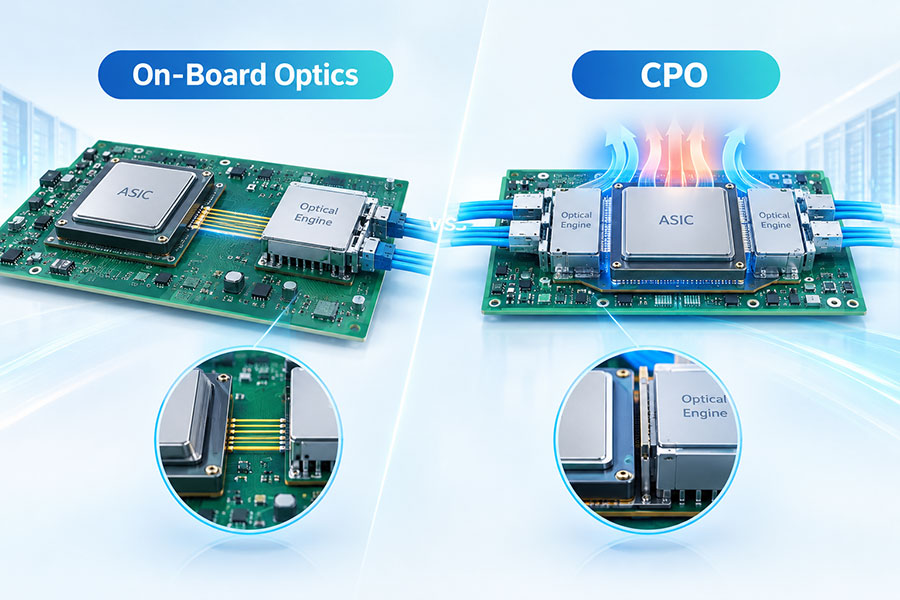
Co-packaged optics integrates optical engines with switch ASICs. Both multimode and single-mode fiber are candidates, depending on the reach requirement. Multimode is used for short-reach intra-rack links, while single-mode is used for longer-reach inter-rack and DCI links.
14. Summary
Single-mode fiber and multimode fiber are the two fundamental types of optical fiber. Single-mode fiber has a 9 µm core and carries one propagation mode, enabling reaches from 10 km to thousands of kilometers. Multimode fiber has a 50 or 62.5 µm core and carries many propagation modes, supporting reaches up to a few hundred meters.
Single-mode fiber uses narrow-linewidth lasers at 1310 nm and 1550 nm, supports DWDM and coherent transmission, and is the standard for telecom, long-haul, DCI, and PON access. Multimode fiber uses VCSELs at 850 nm, has lower transceiver cost, and is the standard for intra-data center and short-reach links.
The choice between the two fiber types is determined by reach, data rate, cost, and the existing fiber plant. Multimode fiber is the economical choice for short-reach, high-port-count applications. Single-mode fiber is the only viable choice for long-reach, high-capacity, and future-proof deployments.
 >
>

 >
>
 >
>
 >
>
 >
>
 >
>
 >
>
 >
>