TEL:+86 132 6656 7067




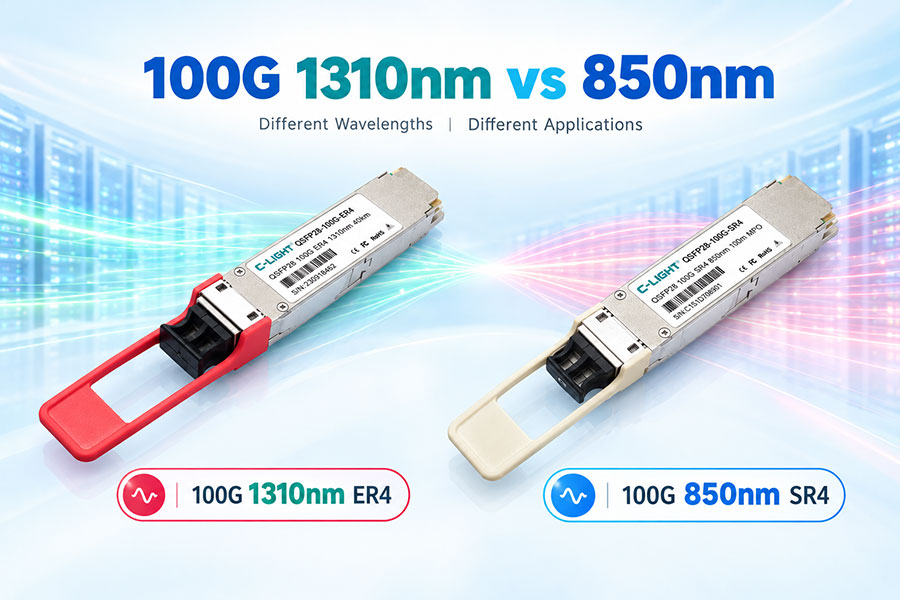
SR and LR are two optical reach classes for Ethernet transceivers. SR stands for Short Reach and supports distances up to 100 meters. LR stands for Long Reach and supports distances up to 10 kilometers. SR uses multimode fiber at 850 nm with VCSELs. LR uses single-mode fiber at 1310 nm with EMLs. Both are defined by IEEE 802.3 for 100G, 200G, 400G, and 800G Ethernet.
The distinction between SR and LR is the fiber type, the wavelength, the light source, the connector, and the reach. SR is optimized for intra-rack and adjacent-rack connections over multimode fiber, where cost per port and port density are the dominant constraints. LR is optimized for metro and regional connections over single-mode fiber, where the reach exceeds what multimode fiber or DR can support and the fiber plant is single-mode.
SR and LR are deployed in different segments of the network. SR connects servers to Top-of-Rack switches within a rack. LR connects leaf switches to spine switches across a campus or between data centers in a metropolitan area. The two reach classes are complementary, and the choice between them is determined by the distance and the fiber infrastructure.
1. What Is SR?
SR (Short Reach) is an optical reach class defined in IEEE 802.3 for multimode fiber transmission. It uses 850 nm VCSELs (vertical-cavity surface-emitting lasers) and PIN photodetectors. The interface is parallel optics: multiple lanes, each with its own transmit and receive fiber, operating simultaneously.
SR is defined for multiple data rates. 100GBASE-SR4 uses four lanes of 25G NRZ over eight multimode fibers at 850 nm, reaching 70 meters over OM3 and 100 meters over OM4. 400GBASE-SR8 uses eight lanes of 50G PAM4 over sixteen multimode fibers, reaching 100 meters over OM4. 800GBASE-SR8 uses eight lanes of 100G PAM4 over sixteen fibers, also reaching 100 meters over OM4. The connector for SR4 is MPO-12; for SR8 it is MPO-16 or dual MPO-12.
1.1 SR Characteristics
Fiber type: Multimode fiber (OM3, OM4, OM5).
Wavelength: 850 nm.
Light source: VCSEL.
Reach: 70–100 meters, depending on fiber grade and data rate.
Connector: MPO-12 or MPO-16.
Optical architecture: Parallel optics with one VCSEL and one PIN per lane.
Power consumption: Lower than single-mode equivalents.
Cost: Lower transceiver cost, higher fiber cost per meter.
2. What Is LR?
LR (Long Reach) is an optical reach class defined in IEEE 802.3 for single-mode fiber transmission. It uses 1310 nm EMLs (electro-absorption modulated lasers) and PIN photodetectors. LR is defined in two variants: single-lane LR1, which uses a single 1310 nm wavelength, and multi-lane LR4, which uses four LAN-WDM wavelengths multiplexed onto a single fiber pair.
LR is defined for multiple data rates. 100GBASE-LR1 uses one wavelength of 100G PAM4 over a single fiber pair, reaching 10 kilometers. 100GBASE-LR4 uses four wavelengths of 25G NRZ over a single fiber pair, reaching 10 kilometers. 400GBASE-LR4 uses four wavelengths of 100G PAM4 over a single fiber pair, reaching 10 kilometers. 800GBASE-LR4 uses four wavelengths of 200G PAM4 over a single fiber pair, reaching 10 kilometers. The connector for LR4 is duplex LC.
2.1 LR Characteristics
Fiber type: Single-mode fiber (OS2).
Wavelength: 1310 nm (LR1) or 1295–1309 nm LAN-WDM (LR4).
Light source: EML.
Reach: 10 kilometers.
Connector: Duplex LC.
Optical architecture: Single wavelength (LR1) or LAN-WDM (LR4).
Fiber count per link: 2 fibers (1 Tx + 1 Rx).
3. Fiber Type and Reach
The most visible difference between SR and LR is the fiber type and the reach each supports. SR uses multimode fiber and reaches 100 meters. LR uses single-mode fiber and reaches 10 kilometers. The reach difference is driven by the fiber itself: multimode fiber suffers modal dispersion, which limits the bandwidth-distance product, while single-mode fiber has no modal dispersion and can reach much farther.
| Parameter | SR | LR |
|---|---|---|
| Fiber Type | Multimode (OM3/OM4/OM5) | Single-mode (OS2) |
| Wavelength | 850 nm | 1310 nm (LR1) or LAN-WDM (LR4) |
| Light Source | VCSEL | EML |
| Reach at 100G | 100 m (OM4) | 10 km |
| Reach at 400G | 100 m (OM4, SR8) | 10 km (LR4) |
| Reach at 800G | 100 m (OM4, SR8) | 10 km (LR4) |
| Connector | MPO-12 / MPO-16 | Duplex LC |
The reach difference determines the application segment. SR is limited to connections within a rack or between immediately adjacent racks, where the distance is under 100 meters. LR extends the reach to 10 kilometers, covering metro DCI, regional DCI, and long campus backbone connections.
4. Wavelength and Light Source
SR uses 850 nm VCSELs. LR uses 1310 nm EMLs. The wavelength and light source differ because of the fiber type and the reach requirement.
4.1 SR Wavelength and Light Source
SR uses 850 nm VCSELs. VCSELs emit light perpendicular to the chip surface, which allows on-wafer testing and low-cost manufacturing. They operate uncooled over a wide temperature range. Each lane is a direct-modulated VCSEL, and the receiver is a PIN photodiode. SR uses NRZ modulation at 25G per lane and PAM4 modulation at 50G or 100G per lane.
4.2 LR Wavelength and Light Source
LR uses 1310 nm EMLs. EMLs integrate a DFB laser with an electro-absorption modulator on the same chip, providing high extinction ratio and low chirp. Each lane is an externally modulated laser, and the receiver is a PIN photodiode. LR4 uses LAN-WDM wavelengths: approximately 1295, 1300, 1305, and 1309 nm. Each wavelength carries 100G PAM4 or 200G PAM4, and the four wavelengths are multiplexed onto a single fiber pair using a LAN-WDM multiplexer inside the module. LR1 uses a single 1310 nm wavelength with no multiplexing.
| Parameter | SR | LR |
|---|---|---|
| Wavelength | 850 nm | 1310 nm (LR1) or LAN-WDM (LR4) |
| Light Source | VCSEL | EML |
| Modulation at 100G | 25G NRZ (SR4) | 100G PAM4 (LR1) |
| Modulation at 400G | 50G PAM4 (SR8) | 100G PAM4 (LR4) |
| Modulation at 800G | 100G PAM4 (SR8) | 200G PAM4 (LR4) |
| Multiplexing | None (parallel fibers) | LAN-WDM (single fiber pair) |
| Internal WDM | No | Yes |
5. Connector and Fiber Count
SR uses parallel fibers and an MPO connector. LR uses a single fiber pair and a duplex LC connector. The fiber count per link differs significantly.
| Interface | Lanes | Fiber Count | Connector |
|---|---|---|---|
| 100GBASE-SR4 | 4 | 8 fibers (4 Tx + 4 Rx) | MPO-12 |
| 400GBASE-SR8 | 8 | 16 fibers (8 Tx + 8 Rx) | MPO-16 or dual MPO-12 |
| 800GBASE-SR8 | 8 | 16 fibers (8 Tx + 8 Rx) | MPO-16 or dual MPO-12 |
| 100GBASE-LR1 | 1 | 2 fibers (1 Tx + 1 Rx) | Duplex LC |
| 400GBASE-LR4 | 4 | 2 fibers (1 Tx + 1 Rx) | Duplex LC |
| 800GBASE-LR4 | 4 | 2 fibers (1 Tx + 1 Rx) | Duplex LC |
LR is significantly more fiber-efficient than SR. A 400G LR4 link uses two fibers, while a 400G SR8 link uses sixteen fibers. An 800G LR4 link uses two fibers, while an 800G SR8 link uses sixteen fibers. In fiber-constrained environments, LR allows more links to be deployed on the same fiber cable.
6. Optical Architecture and Signal Modulation
SR uses parallel optics with one VCSEL per lane. LR uses wavelength division multiplexing with one wavelength per lane. The per-lane rate and the modulation format differ between the two.
6.1 SR Optical Architecture
SR uses parallel optics. Each lane has its own VCSEL and photodiode. 400GBASE-SR8 uses eight lanes of 50G PAM4, each on a separate fiber. 800GBASE-SR8 uses eight lanes of 100G PAM4, each on a separate fiber. The module contains eight laser drivers, VCSELs, photodiodes, and transimpedance amplifiers.
6.2 LR Optical Architecture
LR uses wavelength division multiplexing. 400GBASE-LR4 uses four wavelengths, each carrying 100G PAM4, multiplexed onto a single fiber pair. The module contains four EMLs, a LAN-WDM multiplexer, a LAN-WDM demultiplexer, and four photodiodes. 800GBASE-LR4 uses four wavelengths of 200G PAM4, multiplexed onto a single fiber pair.
| Parameter | SR | LR |
|---|---|---|
| Optical Architecture | Parallel optics | Wavelength division multiplexing |
| Per-Lane Rate at 400G | 50G PAM4 | 100G PAM4 |
| Per-Lane Rate at 800G | 100G PAM4 | 200G PAM4 |
| Laser Count at 400G | 8 | 4 |
| Internal WDM | No | Yes |
| FEC | Required at 50G/100G PAM4 | Required |
7. Power Budget and Reach
SR supports 100 meters, and LR supports 10 kilometers. The reach difference is driven by the fiber type and the optical power budget. Multimode fiber has higher attenuation and modal dispersion, which limits the reach. Single-mode fiber has lower attenuation and no modal dispersion, which allows longer reaches.
| Parameter | SR | LR |
|---|---|---|
| Rated Reach | 100 m | 10 km |
| Fiber Attenuation | 2.5–3.5 dB/km at 850 nm | ~0.35 dB/km at 1310 nm |
| Fiber Loss over Rated Reach | ~0.25–0.35 dB | ~3.5 dB |
| Modal Dispersion | Present; limits reach | None |
| Connector Loss | 0.2–0.5 dB per mated pair | 0.2–0.5 dB per mated pair |
| Typical Power Budget | ~3–5 dB | ~12–14 dB |
| Internal WDM Loss | None | 2–3 dB (LAN-WDM) |
LR has a higher power budget than SR because the link must span 10 kilometers instead of 100 meters. The additional 8 to 10 dB of budget is provided by higher transmitter output power and better receiver sensitivity. The LAN-WDM multiplexer in LR4 also has insertion loss, which is accounted for in the module specifications.
8. Power Consumption and Thermal
Power consumption differs between SR and LR because of the laser technology and the number of lanes. SR uses uncooled VCSELs, which are low-power. LR uses EMLs at 1310 nm, which require more drive current and more complex bias control.
| Module Type | Typical Power | Thermal Design |
|---|---|---|
| 400G SR8 | ~8.5–10 W | Air-cooled; MPO-16 |
| 400G LR4 | ~12–14 W | Air-cooled; duplex LC |
| 800G SR8 | ~14 W | Air-cooled; QSFP-DD or OSFP |
| 800G LR4 | ~16–18 W | Air-cooled or liquid-cooled; OSFP |
LR modules consume 2 to 4 watts more than SR modules of the same data rate. The higher power consumption is driven by the EML lasers, the higher transmitter output power, and the LAN-WDM multiplexer. In high-density switches, the additional power and thermal load must be included in the thermal design.
9. Application Scenarios
SR and LR serve different segments of the data center and metro network. The choice between them is determined by the link distance and the fiber infrastructure.
9.1 SR Application Scenarios
Server-to-ToR: Within-rack connections under 100 meters.
GPU-to-leaf in AI clusters: Short-reach connections within a rack or adjacent rack.
Storage area networks: Short-reach SAN connectivity over multimode fiber.
InfiniBand NDR: 400G SR4 for HDR/NDR InfiniBand within a rack.
Existing multimode fiber plant: Where OM3/OM4/OM5 fiber is already installed.
9.2 LR Application Scenarios
Metro DCI: Distances up to 10 kilometers.
Regional DCI: Between data centers in the same metropolitan area.
Campus backbone: Long building-to-building connections.
Carrier access: Metro access links up to 10 kilometers.
Longer leaf-to-spine runs: Where the distance exceeds 100 meters but is under 10 kilometers.
| Application | SR | LR |
|---|---|---|
| In-Rack Server-to-ToR | Primary | Not typical |
| GPU-to-Leaf (same rack) | Primary | Not typical |
| Leaf-to-Spine (within row) | SR if under 100 m | LR for 100 m–10 km |
| Metro DCI (≤10 km) | Not viable | Primary |
| Regional DCI (≤10 km) | Not viable | Primary |
| Fiber-Constrained Links | Not typical | Primary |
10. Cost Structure
The cost structure of SR and LR differs in module cost, fiber cost, and connector cost. SR modules are less expensive because VCSELs are low-cost and uncooled. LR modules are more expensive because 1310 nm EMLs and LAN-WDM multiplexers cost more. However, LR uses fewer fibers per link, which reduces the fiber and connector cost in fiber-constrained environments.
| Cost Element | SR | LR |
|---|---|---|
| Module Cost | Lower | Higher |
| Fiber Count per 400G Link | 16 (SR8) | 2 (LR4) |
| Fiber Count per 800G Link | 16 (SR8) | 2 (LR4) |
| Connector Cost | Moderate (MPO-16) | Lower (duplex LC) |
| Fiber Cost per Link | Higher (more fibers) | Lower (fewer fibers) |
| Cost per Gbps (Short Reach) | Lower | Higher |
| Cost per Gbps (Long Reach) | Not applicable | Lower |
The cost comparison depends on the deployment scale and the fiber plant. In a data center with abundant multimode fiber, SR is the lower-cost option because the modules are cheaper and the fiber is already installed. In a metro environment where fiber is scarce or expensive to install, LR is the lower-cost option because it uses only two fibers per link, reducing the fiber and connector cost.
11. Standard and Ecosystem
SR and LR are both IEEE 802.3 standards. SR is defined in 802.3ae (10GBASE-SR), 802.3bm (40GBASE-SR4, 100GBASE-SR4), 802.3cd (50GBASE-SR, 100GBASE-SR2, 200GBASE-SR4), and 802.3bs (400GBASE-SR16, later 400GBASE-SR8). LR is defined in 802.3ba (100GBASE-LR4), 802.3cu (100GBASE-LR1), 802.3bs (400GBASE-LR4), and 802.3df (800GBASE-LR4).
| Standard | Interface | Fiber | Reach |
|---|---|---|---|
| 802.3ae | 10GBASE-SR | MMF | 300–400 m |
| 802.3bm | 100GBASE-SR4 | MMF | 100 m |
| 802.3bs | 400GBASE-SR8 | MMF | 100 m |
| 802.3cd | 200GBASE-SR4 | MMF | 100 m |
| 802.3ba | 100GBASE-LR4 | SMF | 10 km |
| 802.3cu | 100GBASE-LR1 | SMF | 10 km |
| 802.3bs | 400GBASE-LR4 | SMF | 10 km |
| 802.3df | 800GBASE-LR4 | SMF | 10 km |
12. Comparison Summary
| Dimension | SR | LR |
|---|---|---|
| Full Name | Short Reach | Long Reach |
| Fiber Type | Multimode (OM3/OM4/OM5) | Single-mode (OS2) |
| Wavelength | 850 nm | 1310 nm (LR1) or LAN-WDM (LR4) |
| Light Source | VCSEL | EML |
| Optical Architecture | Parallel optics | WDM on a single fiber pair |
| Connector | MPO-12 / MPO-16 | Duplex LC |
| Fiber Count per 400G Link | 16 | 2 |
| Fiber Count per 800G Link | 16 | 2 |
| Reach | 100 m | 10 km |
| Module Cost | Lower | Higher |
| Fiber Cost per Link | Higher | Lower |
| Primary Application | Intra-rack, adjacent rack | Metro DCI, regional DCI |
13. Selection Framework
| Evaluation Factor | Recommendation |
|---|---|
| Reach under 100 m | SR |
| Reach 100 m to 10 km | LR |
| Fiber-constrained environment | LR (2 fibers per link) |
| Fiber-rich environment | SR (lower module cost) |
| In-rack connectivity | SR |
| Metro DCI | LR |
| MPO infrastructure available | SR |
| Duplex LC infrastructure available | LR |
| Cost-sensitive short reach | SR |
| Cost-sensitive long reach | LR |
14. Common Misconceptions
"SR and LR can be mixed on the same link." False. SR requires multimode fiber, and LR requires single-mode fiber. The two fiber types and wavelengths are incompatible. A link must use either SR or LR, not both.
"LR is always more expensive than SR." Not entirely true. LR modules cost more than SR modules, but LR uses only two fibers per link while SR uses eight or sixteen. In fiber-scarce or high-installation-cost environments, the total cost of ownership for LR can be lower than for SR.
"SR can reach 10 km." False. SR is rated for 100 meters. For links beyond 100 meters, LR or FR or DR modules are required.
"LR uses four fibers for 400G." False. 400GBASE-LR4 uses a single fiber pair (two fibers), with four wavelengths multiplexed onto the same fiber. One fiber carries the transmit direction, and the other carries the receive direction.
"LR replaces SR." False. SR and LR serve different distance segments. SR is used for intra-rack and adjacent-rack connections under 100 meters, while LR is used for metro and regional connections between 100 meters and 10 kilometers. The two coexist in data center and metro networks.
15. Summary
SR and LR are two IEEE-defined optical reach classes for Ethernet transceivers. SR uses multimode fiber at 850 nm with VCSELs, reaching 100 meters. LR uses single-mode fiber at 1310 nm with EMLs, reaching 10 kilometers. Both support 100G, 200G, 400G, and 800G Ethernet.
The choice between SR and LR is determined by the link distance and the fiber plant. SR is the lower-cost option for intra-rack and adjacent-rack connections under 100 meters, where the module cost dominates and the fiber plant is multimode. LR is the appropriate option for metro and regional connections between 100 meters and 10 kilometers, where the fiber count per link must be minimized and the duplex LC infrastructure is available.
SR and LR are not competing technologies. They are complementary reach classes that serve different segments of the data center and metro network. The most efficient network design uses SR where the distance is under 100 meters and the fiber plant supports MPO connections, and LR where the distance exceeds 100 meters and the fiber plant is built around duplex LC connections.
 >
>

 >
>
 >
>
 >
>
 >
>
 >
>
 >
>
 >
>