TEL:+86 132 6656 7067





High-speed copper interconnects remain important in data centers, AI clusters, and high-performance computing systems. Direct Attach Copper (DAC) cables provide a short electrical connection between compatible switches, servers, network adapters, and accelerators without requiring optical conversion. As lane rates increase, however, electrical channel loss and signal integrity become more challenging.
The terms Retimed and Retimerless describe different approaches to electrical signal processing. In practical product terminology, passive DAC is inherently retimerless, while copper cables incorporating retiming circuitry are generally classified as Active Electrical Cables (AEC). Active Copper Cables (ACC) occupy another position, typically using linear equalization rather than full retiming.
1. What Is a Retimerless DAC?
A Retimerless DAC is typically a passive Direct Attach Copper cable. It consists of copper conductors and high-speed connectors at both ends, creating a direct electrical path between two compatible network ports.
Because a passive DAC does not contain a retimer or active signal-processing circuitry, it does not independently recover and regenerate the incoming data stream. The host transmitter and receiver handle the electrical signaling through their SerDes interfaces.
The absence of active processing gives passive DAC several advantages:
Low power consumption: No retimer or active equalization circuitry is required inside the cable.
Low latency: The signal travels through a direct electrical path without an additional retiming stage.
Simple architecture: The cable does not require active signal-processing components.
Cost efficiency: Passive construction can reduce component cost for short-distance connections.
These advantages make passive DAC suitable for short connections within racks or between nearby devices. Its main limitation is electrical reach. As data rates increase, insertion loss and other channel impairments restrict the distance over which a passive copper cable can maintain the required signal quality.
2. What Is a Retimed Copper Cable?
A retimed copper cable incorporates active retiming circuitry into its connector assemblies. In the industry, this type of product is generally referred to as an Active Electrical Cable (AEC), rather than a conventional passive DAC.
A retimer receives an electrical data stream, recovers timing and data, and retransmits a regenerated signal. This process helps manage accumulated signal degradation across the electrical channel and can support longer copper connections than a passive cable under suitable conditions.
The actual implementation varies by product. Retiming may be implemented at one or both cable ends, and the supported signaling direction and lane architecture should be confirmed from the manufacturer's technical documentation.
Unlike passive DAC, AEC requires power for its active electronics. The additional circuitry can improve signal regeneration and extend the practical electrical reach, but it also introduces additional power consumption, thermal considerations, and processing latency.
3. DAC, ACC, and AEC: Understanding the Architecture
Retimed versus retimerless comparisons become clearer when passive DAC, ACC, and AEC are treated as separate cable categories. They all use copper as the transmission medium, but their electrical signal-processing methods are different.
No active signal-processing circuitry is installed in the cable. The host SerDes manages the electrical channel.
Active linear signal conditioning helps compensate for channel loss without full retiming.
Retiming circuitry recovers and retransmits data to improve electrical signal integrity.
| Characteristic | Passive DAC | ACC | AEC |
|---|---|---|---|
| Transmission Medium | Copper | Copper | Copper |
| Active Electronics | No | Yes | Yes |
| Signal Processing | Direct electrical transmission | Linear equalization / ReDriver | Retiming and signal regeneration |
| Clock and Data Recovery | No cable-side retimer | Generally no full retiming | Implemented in the retimer architecture |
| Power Requirement | Very low; passive cable | Requires active electronics | Requires active retiming electronics |
| Added Processing Latency | No active cable processing stage | Low, implementation-dependent | Includes retimer processing delay |
| Electrical Reach | Generally shortest | Can extend beyond passive DAC | Can support longer copper links |
| Typical Design Priority | Cost, power, and low latency | Linear signal conditioning | Signal regeneration and extended reach |
ACC and AEC are active copper technologies, but they are not interchangeable. A linear equalizer modifies the signal waveform to compensate for channel loss, whereas a retimer recovers data and timing before retransmission.
4. Retimed vs Retimerless: Key Performance Differences
The main engineering trade-off is between a simple, low-power electrical path and additional signal processing that can improve the usable channel margin. The best option depends on the host SerDes, cable length, lane rate, and system design.
| Parameter | Retimerless Passive DAC | Retimed AEC |
|---|---|---|
| Signal Path | Direct electrical transmission through copper | Electrical signal is recovered and retransmitted by retiming circuitry |
| Signal Regeneration | No cable-side regeneration | Provided by the retimer |
| Power Consumption | Extremely low | Higher because of active electronics |
| Latency | Very low, with no cable-side retiming delay | Includes retimer processing latency |
| Electrical Reach | Limited by passive channel loss and host capability | Can support longer reach depending on implementation |
| Signal Integrity | Depends on the complete host-to-host electrical channel | Retiming can restore signal quality at the regeneration point |
| Thermal Design | Minimal cable-side active heat generation | Requires thermal consideration for active components |
| Cost Structure | Generally lower for comparable short-reach configurations | Generally higher due to active components |
| Host Compatibility | Requires sufficient host SerDes capability for the cable channel | Requires compatibility with the AEC's retimer and interface design |
Retiming does not automatically make every link more reliable. A properly designed passive DAC can provide excellent performance within its supported reach. Likewise, an AEC must be compatible with the host equipment and the intended data rate to deliver its expected benefits.
5. Signal Integrity and Electrical Reach
At 400G and 800G, copper channels operate at high signaling rates and become increasingly sensitive to insertion loss, return loss, crosstalk, reflections, and jitter. These effects can reduce the receiver's ability to distinguish transmitted symbols correctly.
In a passive DAC, the host transmitter sends the electrical signal through the entire copper channel. The remote receiver must recover the data despite the accumulated channel impairments. The cable itself does not regenerate the waveform.
In an AEC, retiming circuitry creates an additional signal-recovery point. The retimer can receive a degraded signal, recover the data and timing, and generate a new electrical output for the next segment.
| Signal Integrity Factor | Passive DAC | Retimed AEC |
|---|---|---|
| Insertion Loss | Must remain within the supported end-to-end channel budget | Retiming can divide the channel into separate electrical segments |
| Accumulated Jitter | Handled by the host receiver within its tolerance | Can be reduced at the retiming point, subject to retimer performance |
| Equalization | Primarily handled by host SerDes | May include active equalization and retiming within the cable |
| Signal Regeneration | Not available inside a passive cable | Provided by the retimer |
| Channel Length | Restricted by cable loss and host capability | Can be extended through active signal regeneration |
For high-speed deployments, engineers should check the host SerDes specifications, transmitter output characteristics, receiver equalization capability, cable insertion loss, and relevant interface requirements. A cable's nominal data rate alone does not establish compatibility with every switch or network adapter.
6. Power Consumption and Latency
Passive DAC is particularly attractive when power efficiency and low latency are priorities. Because it has no active retimer or optical conversion components, its cable-side power requirements are minimal.
AEC adds power-consuming electronics to the cable ends. The retimer requires power to recover and retransmit data, and the active components generate heat. This additional processing can be justified when a passive electrical channel cannot meet the required signal-integrity margin.
| System Consideration | Passive DAC | Retimed AEC |
|---|---|---|
| Cable Electronics | No active signal-processing electronics | Active retiming electronics |
| Power Budget | Minimal cable-side power | Must include retimer power |
| Heat Generation | Minimal active heat generation | Active components add thermal load |
| Processing Latency | No retimer processing delay | Additional retimer processing delay |
| End-to-End Performance | Depends on channel quality and host SerDes | Depends on retimer behavior, host interfaces, and complete channel |
For AI and HPC networks, these differences matter when large numbers of connections are deployed. Passive DAC can reduce per-link power and cost where distances are short enough, while AEC can provide an alternative where longer copper reach is needed.
Actual power and latency values should be taken from the specific product datasheet. They vary with data rate, cable architecture, retimer implementation, and operating conditions.
7. Applications in 400G and 800G Networks
Passive DAC and retimed AEC serve different parts of a high-speed network. The physical distance between devices and the electrical capabilities of the host ports are often the first factors that determine which technology is appropriate.
Passive DAC is commonly considered for:
Short server-to-switch connections within the same rack.
GPU server connections to nearby top-of-rack switches.
Short switch-to-switch links in high-density racks.
AI and HPC clusters where low power and low latency are important.
400G and 800G connections that remain within the supported passive cable reach.
Retimed AEC is commonly considered for:
Longer copper connections that exceed practical passive DAC reach.
High-speed connections where additional signal regeneration is required.
Dense data center environments where copper cabling is preferred over optical links.
AI and HPC networks that require higher electrical reach while retaining a copper transmission medium.
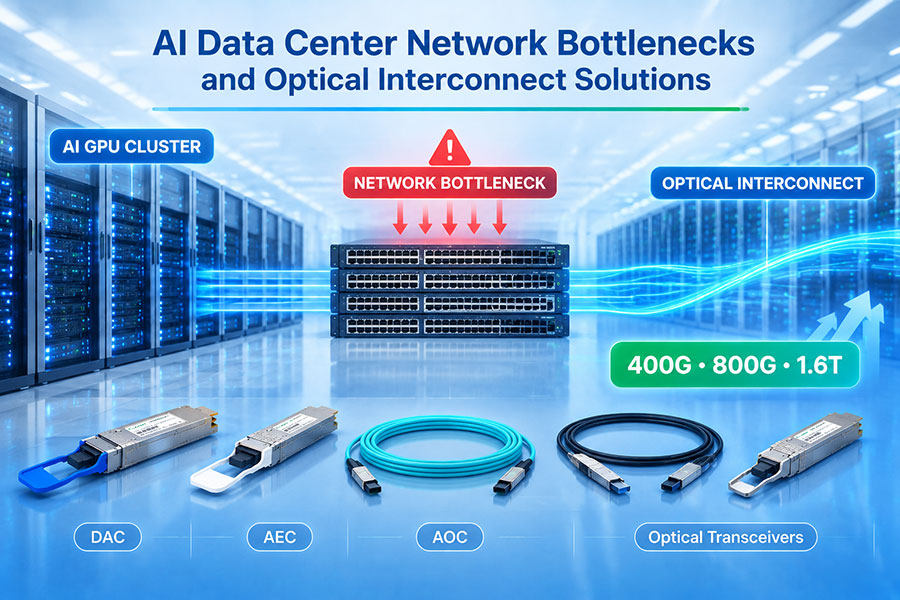
When the required connection distance exceeds the practical reach of copper, AOC or pluggable optical transceivers may be more appropriate. The decision should consider cable routing, power, port density, latency, and total deployment cost.
8. How to Select the Right Copper Cable
Choosing between passive DAC, ACC, and AEC should be based on the actual link requirements rather than treating all copper cables as equivalent.
| Selection Factor | What to Verify |
|---|---|
| Data Rate | Confirm 100G, 200G, 400G, or 800G support and the required lane configuration. |
| Cable Length | Check the supported length for the exact cable gauge, connector combination, and data rate. |
| Host SerDes | Verify transmitter and receiver capabilities, equalization, and supported electrical channels. |
| Signal Processing | Determine whether the cable is passive, linear active, or retimed active. |
| Power Budget | Check cable power consumption and port power availability. |
| Thermal Conditions | Confirm operating temperature and cooling requirements around densely populated ports. |
| Connector Type | Match QSFP-DD, OSFP, QSFP112, OSFP112, or other supported form factors. |
| Breakout Configuration | Verify lane mapping and compatibility for 400G-to-4×100G, 800G-to-2×400G, or other required configurations. |
| Equipment Compatibility | Validate the exact switch, NIC, server, or accelerator model and its supported cable types. |
A practical selection sequence is to establish the required data rate and cable length first, verify the host interface and channel budget, and then select the cable architecture. Passive DAC is generally the first option to evaluate for very short connections. ACC or AEC may be considered when additional electrical reach or signal conditioning is needed.
9. C-LIGHT 400G and 800G DAC Solutions
C-LIGHT provides high-speed DAC solutions for data centers, AI computing clusters, InfiniBand networks, and high-performance switching environments. Its product portfolio includes 400G and 800G copper cable configurations for different host interfaces and breakout topologies.
The 400G DAC product family supports multiple form factors, including QSFP112, OSFP112, OSFP56, and QSFP-DD. It is designed for short-distance electrical interconnections in compatible data center and high-performance computing equipment.
Data rate: 400G configurations
Interface options: QSFP112, OSFP112, OSFP56, and QSFP-DD
Listed cable lengths: approximately 0.5m to 3m, depending on configuration
Cable construction: 28AWG and 30AWG options, depending on model
Selected breakout configurations: 400G to 2×200G, 4×100G, and 8×50G
Applications: AI data centers, InfiniBand, Ethernet, and HPC interconnects
The 400G DAC range is suitable for short connections between compatible switches, servers, and network adapters. The exact supported interface, cable length, and breakout mapping should be checked against the selected part number.
The 800G DAC family is designed for next-generation AI data center and GPU cluster interconnects. It supports QSFP-DD and OSFP112 platforms, with direct and breakout cable configurations.
Data rate: 800G configurations
Interface options: QSFP-DD and OSFP112
Listed cable lengths: primarily 0.5m to 2m, depending on configuration
Cable construction: 28AWG copper configurations
Selected breakout configurations: 800G to 2×400G and 4×200G
Applications: GPU clusters, AI fabrics, HPC systems, and high-density switching
The direct copper architecture is intended for very short, high-bandwidth connections where avoiding optical conversion can help reduce link power and cost.
For applications that require active signal processing or greater copper reach, engineers can also evaluate C-LIGHT AEC cable technology. The appropriate choice depends on the host platform, required distance, power budget, and electrical channel specifications.
10. Conclusion
Retimed and retimerless copper connections differ mainly in how they manage electrical signal degradation. A passive DAC uses a direct copper path without active retiming, offering low power consumption, low latency, and cost efficiency for short connections. A retimed AEC adds signal recovery and regeneration, which can extend practical copper reach and improve signal margin at the cost of additional power, heat, and processing delay.
ACC provides another option by using linear signal conditioning without full retiming. Understanding the distinction between passive DAC, ACC, and AEC is essential when selecting high-speed copper interconnects for 400G and 800G networks.
For AI data centers, GPU clusters, and high-performance computing systems, the best cable is determined by the complete electrical channel, host SerDes capability, distance, and system power budget. Selecting the correct architecture and validating compatibility on the target equipment help maintain stable high-speed connectivity.
Contact C-LIGHT for copper cable configurations, host compatibility support, breakout options, and customized high-speed interconnect solutions.
Contact C-LIGHT >

 >
 >
 >
 >
 >
 >
 >