TEL:+86 132 6656 7067




ROSA and BOSA are important optical sub-assemblies used inside fiber optic communication equipment, but they are designed around different signal paths. ROSA is primarily a receiving assembly that converts an incoming optical signal into an electrical signal. BOSA combines optical transmission and reception within the same integrated assembly.
This difference influences the internal components, optical routing, wavelength management, packaging and application scenarios. ROSA is commonly used when the receiving function is required as a dedicated subsystem, while BOSA is particularly useful in PON, BiDi and other bidirectional architectures where transmit and receive functions need to coexist within a compact optical interface.
1. ROSA vs BOSA at a Glance
| Feature | ROSA | BOSA |
|---|---|---|
| Full Name | Receiver Optical Sub-Assembly | Bidirectional Optical Sub-Assembly |
| Primary Function | Optical reception | Optical transmission and reception |
| Signal Conversion | Optical Signal → Electrical Signal | Electrical → Optical + Optical → Electrical |
| Typical Components | Photodiode, optical coupling and receiver electronics | Laser, photodiode, optical coupling and wavelength-separation elements |
| Transmit Function | No | Yes |
| Receive Function | Yes | Yes |
| Wavelength Separation | Application-dependent | Commonly required in bidirectional systems |
| Typical Applications | Optical receivers and transceiver receive paths | PON, BiDi and integrated bidirectional optical interfaces |
| Design Complexity | Generally lower | Generally higher |
2. What Is ROSA?
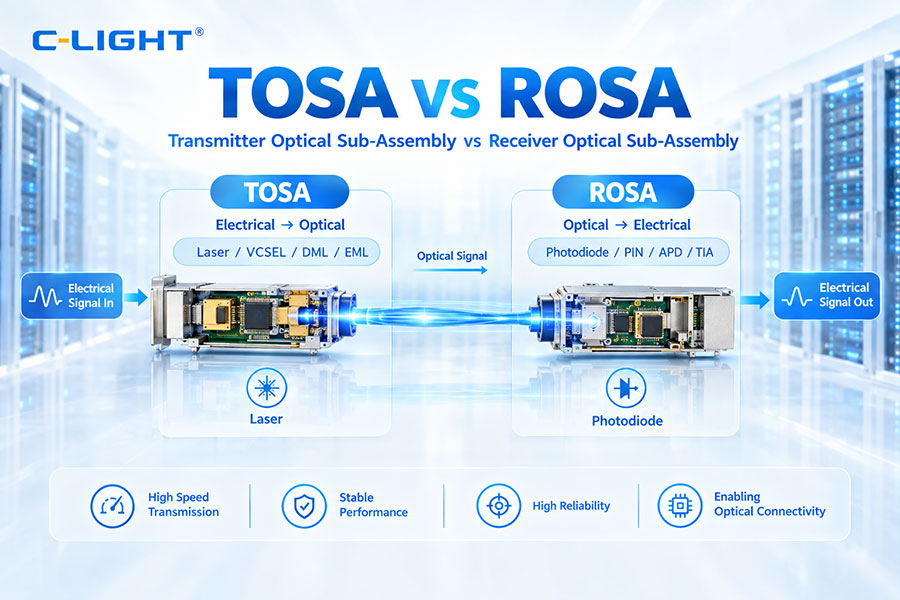
ROSA stands for Receiver Optical Sub-Assembly. It is the receiving section of an optical communication device and converts an incoming optical signal into an electrical signal for subsequent processing.
A typical ROSA contains a photodetector such as a PIN photodiode or APD, together with optical coupling and receiver-related components. Depending on the design, the assembly can also integrate a transimpedance amplifier or other receiver electronics.
ROSA is therefore focused on the receive path rather than optical transmission.
3. What Is BOSA?
BOSA stands for Bidirectional Optical Sub-Assembly. It combines optical transmitting and receiving functions within the same optical assembly.
A typical BOSA contains a laser for transmitting optical signals and a photodetector for receiving incoming signals. Optical filters, WDM components or other wavelength-selective structures can be used to separate the two directions when they share the same fiber.
This integrated structure makes BOSA particularly useful in compact bidirectional optical access equipment.
4. The Fundamental Functional Difference
The basic signal paths can be summarized as follows:
ROSA = Optical Signal → Electrical Signal
BOSA = Electrical Signal → Optical Signal + Optical Signal → Electrical Signal
ROSA performs the receive-side conversion. BOSA combines the receive path with an optical transmit path in the same assembly.
This is the most important distinction when determining which component belongs in a particular optical design.
5. ROSA Internal Structure
A ROSA is built around the optical receiving path. The incoming light is coupled toward a photodetector, which converts the optical signal into an electrical current.
Depending on the application, the detector can be a PIN photodiode for relatively straightforward receiver designs or an APD when higher receiver sensitivity is needed.
Receiver electronics such as a TIA can also be integrated or placed closely with the photodetector to amplify and condition the electrical signal.
6. BOSA Internal Structure
BOSA contains both transmitting and receiving optical paths. The transmitting side generally uses a laser, while the receiving side uses a photodetector and associated receiver circuitry.
Because the two directions can operate at different wavelengths, BOSA designs may incorporate wavelength-selective filters, thin-film filters, WDM structures or other optical separation components.
The need to accommodate two optical directions makes BOSA more complex than a receive-only ROSA.
7. ROSA Receiver Components
| Component | Function in ROSA |
|---|---|
| PIN Photodiode | Converts incoming optical power into electrical current |
| APD | Provides internal optical detection gain for selected receiver designs |
| TIA | Converts and amplifies the photodetector current into a usable electrical signal |
| Optical Coupling | Directs incoming light efficiently onto the detector |
| Optical Filter | Provides wavelength selection when required |
8. BOSA Transmit and Receive Components
| Component | Function in BOSA |
|---|---|
| Laser | Generates the outgoing optical signal |
| Photodiode | Detects the incoming optical signal |
| TIA / Receiver Electronics | Processes the received electrical signal |
| WDM / Optical Filter | Separates or combines transmit and receive wavelengths when required |
| Optical Coupling | Routes optical signals between the assembly and fiber |
9. Wavelength and Bidirectional Transmission
ROSA does not inherently require two wavelengths because its primary role is receiving. The incoming signal can be a single optical channel or one channel within a larger WDM architecture.
BOSA frequently operates in systems where the upstream and downstream directions use different wavelengths. Optical filtering then allows the transmitter and receiver to share a common optical interface while keeping the two signal paths separated.
The actual wavelength combination depends on the application and optical standard.
10. ROSA vs BOSA in PON Networks
PON is one of the clearest examples of where the two architectures differ.
In a PON system, upstream and downstream traffic are carried in different directions and normally use different wavelength ranges. A BOSA can integrate the ONU or ONT transmit and receive functions into a compact optical assembly, making it well suited to this type of bidirectional access interface.
ROSA can still be used when the receiving function is required separately, but it does not by itself provide the complete bidirectional transmit-and-receive function of a BOSA.
11. BOSA for BiDi and Single-Fiber Systems
BOSA is also closely associated with bidirectional optical systems in which both directions share one physical fiber.
The transmitter sends one wavelength and the receiver detects another wavelength. Optical filtering inside the BOSA manages the separation between the two channels.
This approach can reduce fiber count and is particularly useful where compact optical packaging and single-fiber bidirectional communication are important.
12. Performance Parameters
ROSA performance is mainly evaluated from the receiver side. Important parameters can include receiver sensitivity, responsivity, bandwidth, dark current, overload performance, wavelength range and optical coupling efficiency.
BOSA must meet requirements for both transmission and reception. In addition to receiver characteristics, engineers may need to evaluate transmitter output power, laser wavelength, extinction ratio, isolation, wavelength separation and optical crosstalk.
The exact specifications depend on the application and data rate.
13. Packaging and Integration
ROSA can be packaged as a dedicated receive-side sub-assembly and integrated with the electrical portion of a transceiver or optical engine.
BOSA combines more optical functions within one package. This can reduce the number of separate optical assemblies required elsewhere in the module, but it also increases the alignment and packaging requirements.
The practical package size depends on detector type, laser technology, wavelength architecture and application.
14. Manufacturing and Alignment Challenges
ROSA manufacturing primarily focuses on accurately coupling incoming light to the photodetector while maintaining the required receiver performance.
BOSA requires alignment of both the transmit laser and receive detector. The optical paths must also maintain appropriate isolation and wavelength separation.
These additional requirements can make BOSA assembly more demanding, particularly in compact high-volume optical access products.
15. Typical Applications
| Application | ROSA | BOSA |
|---|---|---|
| Optical Transceiver Receive Path | Widely used | Can be used when integrated bidirectional functionality is required |
| PON ONU / ONT | Suitable for dedicated receive functions | Commonly used for integrated optical interfaces |
| BiDi Systems | Receive section only | Suitable for combined transmit and receive operation |
| Dedicated Receiver Module | Direct application | Not necessary when transmission is not required |
| Compact Access Equipment | Useful for receive-side integration | Useful when both directions need to share one assembly |
16. Can BOSA Replace ROSA?
BOSA and ROSA are not direct substitutes in every optical design because their functions are different.
If a system requires only an optical receiving function, ROSA provides a dedicated receive-side solution. If the design needs both optical transmission and reception within one assembly, BOSA can provide the combined functionality.
The choice should therefore be based on the required optical architecture rather than treating BOSA as a universally upgraded version of ROSA.
17. ROSA vs BOSA: How to Select?
| Requirement | Suitable Component |
|---|---|
| Receive-only optical path | ROSA |
| Integrated transmit and receive functions | BOSA |
| Single-fiber bidirectional transmission | BOSA with suitable wavelength separation |
| Dedicated high-sensitivity receiver | ROSA with the appropriate PIN or APD architecture |
| PON ONU / ONT optical interface | BOSA is commonly used |
| Separate transmitter and receiver assemblies | ROSA can serve as the receiver-side assembly |
18. ROSA vs BOSA: Summary
ROSA and BOSA are both optical sub-assemblies, but they perform different roles within a fiber optic system. ROSA is dedicated to optical reception, converting incoming light into an electrical signal. BOSA combines optical transmission and reception in one integrated assembly.
The additional transmit path makes BOSA more complex, but it also enables compact bidirectional architectures. This is particularly valuable in PON and BiDi systems where upstream and downstream signals may share one fiber through different wavelengths.
ROSA remains an important building block for dedicated optical receivers and receive sections of transceivers. BOSA is more appropriate when transmit and receive functions need to be integrated into a single optical assembly.
 >
>

 >
>
 >
>
 >
>
 >
>
 >
>
 >
>
 >
>