TEL:+86 132 6656 7067




Fiber optic patch cords and trunk cables serve different roles in structured cabling systems. A patch cord provides a direct connection between individual interfaces, such as a switch port and a patch panel. A trunk cable consolidates multiple optical fibers into a single cable assembly, connecting distribution points across a rack, row, or data center.
The distinction is not simply cable length. Connector configuration, fiber count, routing requirements, and the position of the cable within the network determine which type is appropriate. Understanding these differences helps build a cabling layout that is easier to install, expand, and maintain.
1. What Is a Fiber Optic Patch Cord?
A fiber optic patch cord is a cable assembly terminated with connectors at both ends. It is used to connect optical transceivers, switches, patch panels, cassettes, and other fiber interfaces. Common connector types include LC, SC, and ST, while high-density applications may use MPO/MTP connectors.
Patch cords are available in simplex, duplex, and other configurations. Fiber type, connector type, polish, length, and optical performance must match the connected equipment and link requirements.
1.1 Key Characteristics
Point-to-point connection: Connects two optical interfaces or cabling components.
Connectorized at both ends: Commonly uses LC or SC connectors for duplex links.
Flexible deployment: Available in various lengths and fiber configurations for equipment patching.
Easy replacement: Individual cords can be changed during maintenance or network reconfiguration.
Multiple fiber options: Available in single-mode and multimode versions.
1.2 Typical Applications
Patch cords are commonly used between a switch and a fiber patch panel, between a patch panel and an optical transceiver, or between a cassette and equipment. They are especially useful where individual ports must be connected, disconnected, or rearranged without changing the main cabling infrastructure.
2. What Is a Fiber Optic Trunk Cable?
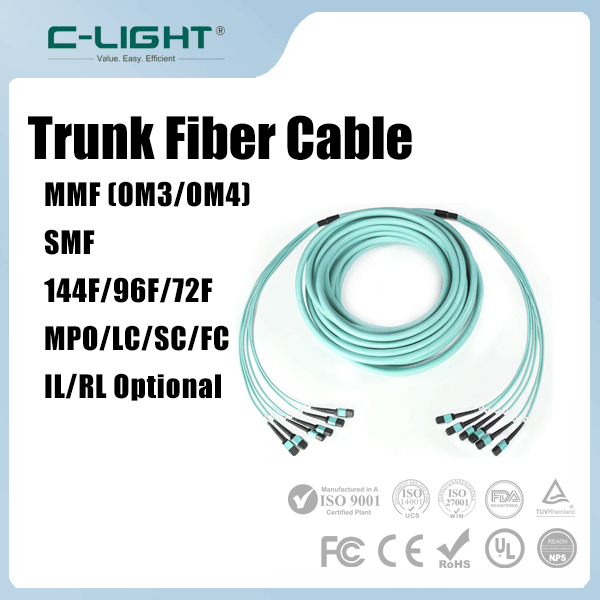
A fiber optic trunk cable is a multi-fiber assembly designed to carry a large number of fibers along a shared cable route. It is commonly used between patch panels, distribution frames, enclosures, or other fiber management locations.
High-density trunk cables may use MTP/MPO connectors at both ends, while other trunk designs can use different connector configurations or terminate in other ways according to the cabling system. Fiber counts commonly include 12, 24, 48, and higher-count options.
2.1 Key Characteristics
High fiber density: Combines multiple fibers within one cable assembly.
Consolidated routing: Reduces the number of individual cable runs across the installation.
Backbone connectivity: Connects distribution points across racks, rows, or equipment areas.
Defined termination: Connector type, fiber count, and polarity must match the destination interfaces.
Structured cabling support: Can connect patch panels, MTP/MPO cassettes, and other compatible components.
2.2 Typical Applications
Trunk cables are used to establish the main fiber paths within data centers, enterprise networks, and telecommunications facilities. For example, an MTP trunk may connect two high-density patch panels, with cassettes at one or both ends providing LC interfaces for individual equipment links.
3. Patch Cord vs Trunk Cable: Key Differences
| Comparison | Fiber Optic Patch Cord | Fiber Optic Trunk Cable |
|---|---|---|
| Primary function | Connects individual interfaces or ports. | Carries multiple fibers between distribution points. |
| Fiber count | Commonly one or two fibers, though multi-fiber versions are available. | Typically designed for multiple fibers in one assembly. |
| Typical connectors | LC, SC, ST, or other connectors suited to the interfaces. | Often MTP/MPO in high-density systems; other configurations are also available. |
| Network position | Equipment ports, patch panels, and cassette interfaces. | Between panels, enclosures, racks, or distribution areas. |
| Cabling role | Equipment or cross-connect patching. | Consolidated multi-fiber distribution or backbone routing. |
| Installation priority | Port compatibility, patching length, connector type, and bend radius. | Fiber capacity, route planning, connector configuration, polarity, and cable management. |
| Reconfiguration | Individual links can usually be changed independently. | Changes may affect a larger group of fibers or the planned distribution layout. |
| Typical relationship | Connects equipment to the structured cabling system. | Provides the shared fiber path that supports multiple connections. |
4. How Patch Cords and Trunk Cables Work Together
In a structured fiber network, trunk cables and patch cords often form different sections of the same end-to-end link. The trunk carries fibers through the main cable route, while patch cords connect the distribution infrastructure to the active equipment.
4.1 Example: MTP Trunk with LC Patch Cords
An MTP trunk can connect high-density patch panels or cassettes between racks. At the equipment end, an MTP cassette converts the multi-fiber connection into LC duplex interfaces. LC patch cords then connect those interfaces to compatible switch or server transceivers.
This arrangement separates backbone routing from equipment patching. It also allows individual equipment connections to be changed without replacing the main trunk cable, provided the cassette and fiber mapping remain suitable.
4.2 Direct Equipment Connections
Some networks use direct patch cords between compatible transceivers or between equipment and a nearby panel. A trunk is not necessary for every connection. The choice depends on distance, fiber count, port density, cable routing, and whether the design benefits from centralized fiber distribution.
5. Choosing the Right Cable for Data Centers
5.1 Choose a Patch Cord When
You need to connect an optical transceiver to a patch panel or cassette.
You need to link two compatible fiber interfaces directly.
The connection may need frequent changes during equipment replacement or network reconfiguration.
The required connector type, fiber type, and length are known.
5.2 Choose a Trunk Cable When
You need to route many fibers between racks or distribution points.
The installation uses high-density patch panels or MTP/MPO cabling infrastructure.
You want to consolidate multiple fiber links into a single managed cable route.
The network requires a planned fiber backbone that can support multiple downstream connections.
6. Technical Factors to Check Before Ordering
Connector compatibility is only one part of a reliable fiber connection. Check the following details before selecting a patch cord or trunk cable:
Fiber type: Confirm single-mode or multimode fiber based on the optical interface and link distance.
Connector type: Match the connector format and polish to the connected equipment or adapter.
Fiber count: Ensure the trunk has sufficient fibers for the planned connections and any required spare capacity.
Polarity and mapping: Verify end-to-end transmit and receive paths, especially for MTP/MPO parallel-optics systems.
Insertion loss: Account for connectors, adapters, cassettes, and other components in the optical link budget.
Length and routing: Allow for the actual cable path, service loops, bend radius, and cable management requirements.
Installation environment: Consider cable construction, fire rating, and applicable building or facility requirements.
 >
>

 >
>
 >
>
 >
>
 >
>
 >
>
 >
>
 >
>