TEL:+86 132 6656 7067





High-speed data center networks need reliable electrical connections between switches, servers, GPUs, and storage systems. Passive Direct Attach Copper (DAC) and Active Electrical Cable (AEC) both use copper conductors, but their internal architectures are fundamentally different.
Passive DAC provides a direct electrical path without active signal-processing components inside the cable. AEC integrates active electronics, typically including retimer technology, to recover and condition high-speed signals. This difference affects transmission distance, power consumption, latency, cable design, and deployment cost.
1. What Is a Passive DAC Cable?
A passive DAC cable is a factory-terminated copper interconnect designed to connect compatible high-speed equipment directly. It typically uses shielded twinaxial copper conductors with integrated connectors at both ends.
Unlike active cable designs, passive DAC does not contain powered signal-conditioning electronics in the cable assembly. The transmitter and receiver circuits in the connected equipment handle the electrical signal across the copper channel.
Direct electrical transmission: Signals travel through copper conductors without active processing inside the cable.
Low power consumption: The passive cable does not require power for signal-conditioning circuitry.
Low latency: The electrical path does not introduce an additional retiming stage inside the cable.
Lower cost: A simpler internal design generally reduces component and manufacturing costs.
Short-reach applications: Commonly used for connections within a rack or between closely positioned devices.
2. What Is an AEC Cable?
AEC, or Active Electrical Cable, is a copper-based interconnect that integrates active signal-processing components into its connector assemblies. These components improve the electrical signal quality and help support higher-speed transmission over longer copper connections.
Retimer technology is a defining feature of many AEC designs. A retimer recovers timing information and retransmits a retimed signal, helping address accumulated signal degradation across the electrical channel. Depending on the product architecture, AEC may also incorporate equalization, noise suppression, and gearbox functions.
Active signal processing: Integrated electronics condition and regenerate electrical signals.
Retiming capability: Retimer-based designs recover and retransmit signals to improve link integrity.
Extended copper reach: Active processing can support longer connections than comparable passive DAC designs.
Additional power requirements: Integrated electronics require power supplied through compatible host ports.
Higher design complexity: Active components introduce additional thermal, electrical, and compatibility considerations.
3. Passive DAC vs AEC: Key Technical Differences
Although both technologies use copper, passive DAC and AEC handle signal degradation differently. Passive DAC relies on the host electrical interfaces and the cable channel, while AEC adds active processing to improve signal integrity.
| Technical Parameter | Passive DAC | AEC |
|---|---|---|
| Transmission medium | Copper twinaxial cable | Copper twinaxial cable |
| Active electronics | None in the cable signal path | Integrated active electronic components |
| Signal processing | No active cable signal processing | Active conditioning and retiming in retimer-based designs |
| Signal regeneration | No | Yes, in retimer-based AEC architectures |
| Power consumption | Essentially zero active cable power | Requires power for integrated electronics |
| Transmission reach | Generally shorter | Generally longer than comparable passive DAC |
| Latency | Very low, without cable retiming | Low, with additional processing latency |
| Cost | Generally lower | Generally higher |
| Design complexity | Lower | Higher |
| Typical application | Short in-rack connections | Longer rack-level and selected cross-rack connections |
4. How Retimer Technology Changes AEC Performance
At high data rates, electrical signals are increasingly sensitive to channel loss, reflections, crosstalk, and timing distortion. These effects become more difficult to manage as copper cable length and signaling speed increase.
Passive DAC does not contain active circuitry to recover or regenerate the signal. Its performance depends on the combined electrical characteristics of the cable, connectors, host transmitters, and receivers.
AEC introduces active processing into the connection. In a retimer-based implementation, the incoming signal is recovered and retransmitted with improved timing characteristics. Equalization and other signal-conditioning functions can also help compensate for channel impairments.
Host transmitter → Copper conductors → Host receiver
A direct electrical channel without active signal regeneration inside the cable.
Host transmitter → Active retimer circuitry → Copper channel → Active circuitry / host receiver
Active electronics recover and condition the signal to support the specified link.
The exact implementation varies by product. Retimer placement, lane architecture, gearbox functions, equalization strategy, and host interface requirements should be checked in the manufacturer's technical documentation.
5. Transmission Distance at 400G and 800G
Transmission distance is one of the most important factors when choosing between passive DAC and AEC. Higher-speed electrical links generally have tighter channel requirements, making passive copper reach more difficult to maintain as data rates increase.
As a general deployment reference, passive DAC is commonly selected for the shortest connections, while AEC can extend copper connectivity where additional signal conditioning is required.
| Data Rate | Passive DAC | AEC | Deployment Consideration |
|---|---|---|---|
| 100G | Commonly used for short connections | Available for applications requiring active signal conditioning | Check lane rate, host electrical budget, and cable length |
| 200G | Suitable for qualified short-reach links | Can support longer electrical channels when specified | Verify connector and platform support |
| 400G | Commonly used for short in-rack connections | Useful when additional copper reach is required | Evaluate PAM4 signal integrity and retimer compatibility |
| 800G | Designed for very short, qualified connections | Supports selected longer copper configurations | Check OSFP, QSFP-DD, or OSFP112 specifications |
| 1.6T | Potentially limited to very short qualified links | Depends on the availability and qualification of specific active cable designs | Confirm platform-level electrical requirements |
For example, C-LIGHT lists 800G AEC configurations with cable lengths from 0.5m to 5m, depending on connector and cable construction. Its 800G DAC portfolio includes short-reach configurations for compatible platforms. These product ranges illustrate why cable length should be checked against the exact part number rather than assumed from the data rate alone.
6. Power Consumption, Latency, and Thermal Considerations
Passive DAC has a clear advantage in active cable power consumption because it does not contain powered signal-processing electronics. This is useful in high-density environments where many connections operate simultaneously and overall port power is an important design consideration.
AEC requires power for its retimer and other active components. The additional power must be included in the host port budget and considered when evaluating connector temperature, airflow, and system thermal performance.
Latency also differs. Passive DAC provides a direct electrical path without a retiming stage inside the cable. AEC introduces processing latency through its active circuitry, although retimer-based solutions are designed for low-latency high-speed connectivity.
| Consideration | Passive DAC | AEC |
|---|---|---|
| Active cable power | Essentially zero | Higher due to active components |
| Thermal design | Minimal heat from cable electronics | Requires consideration of active component temperature |
| Signal processing latency | No cable retiming delay | Additional retiming and processing delay |
| Electrical signal conditioning | Handled by host interfaces and channel design | Additional active conditioning within the cable |
| Cost structure | Lower component complexity | Higher due to retimers and active electronics |
7. Application Scenarios in AI Data Centers
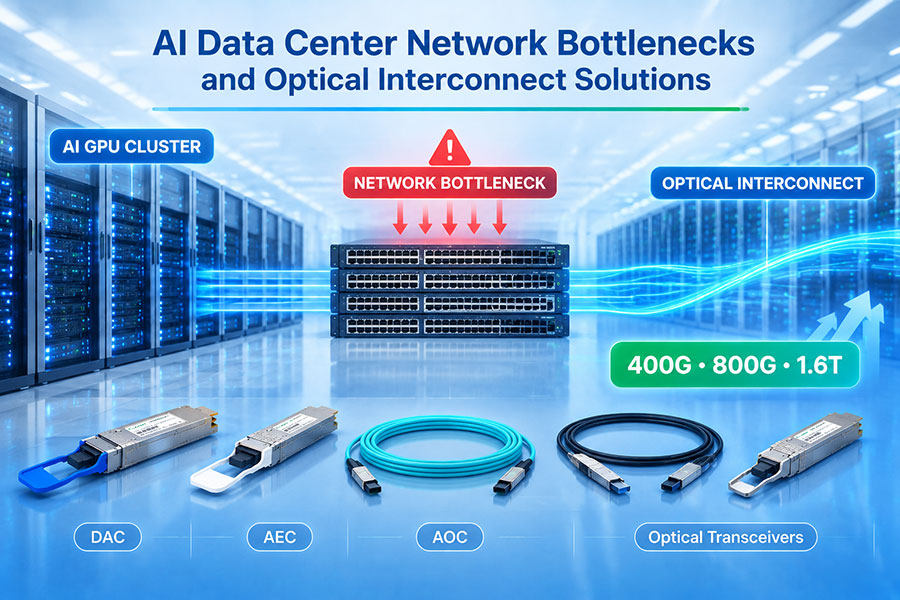
AI infrastructure uses high-bandwidth connections between GPUs, network adapters, switches, and storage systems. The physical distance between devices and the required electrical performance determine whether passive DAC or AEC is more suitable.
Passive DAC is attractive for short connections because it minimizes cable power and cost. AEC becomes relevant when equipment placement requires a longer copper connection than the passive channel can reliably support.
GPU-to-switch connections: Passive DAC is suitable for short links when the GPU server and switch are positioned within the supported electrical reach. AEC can be considered when a longer cable is needed.
Server-to-ToR connections: Passive DAC is commonly used for nearby server and top-of-rack switch connections. AEC provides another option for longer qualified layouts.
Switch-to-switch links: AEC can support selected electrical connections between switches when the required distance exceeds the passive cable budget.
Distributed rack architectures: AEC can help maintain copper connectivity across selected rack arrangements without immediately moving to optical cabling.
High-performance computing: Both technologies can be used in Ethernet and InfiniBand environments, subject to interface and system qualification.
8. When Should You Choose Passive DAC or AEC?
The decision should begin with the required cable length, followed by data rate, host interface, power budget, and compatibility requirements.
The connected devices are physically close.
The required length is within the qualified passive channel budget.
Low power consumption is a priority.
Lower cable cost is important.
The host equipment supports the selected passive cable.
The passive cable cannot meet the required electrical reach.
Active signal regeneration is needed.
The equipment supports the AEC architecture and power requirements.
A copper connection is preferred over an optical cable.
The required cable length is covered by the product specification.
If the required distance exceeds the practical reach of qualified copper solutions, an Active Optical Cable (AOC) or optical transceiver with a separate fiber connection may be more appropriate. Optical connectivity is generally better suited to longer links and environments requiring stronger immunity to electromagnetic interference along the transmission path.
9. C-LIGHT Passive DAC and AEC Cable Solutions
C-LIGHT provides high-speed copper interconnect solutions for data center, Ethernet, and InfiniBand applications. Its product portfolio includes passive DAC and retimer-based AEC options for different data rates, connector configurations, and cable lengths.
Designed for short-reach 400G connections. Available configurations include QSFP112, OSFP112, OSFP56, and QSFP-DD interfaces, with selected cable lengths from approximately 0.5m to 3m.
View 400G DAC ProductsHigh-bandwidth copper connectivity for compatible 800G platforms. Connector options and supported lengths depend on the specific QSFP-DD or OSFP112 configuration.
View 800G DAC ProductsIntegrates high-performance retimer chips and Gearbox technology for supported 400G/800G dual-rate operation. Listed configurations cover 0.5m to 5m, depending on interface and cable construction.
View 800G AEC ProductsThe C-LIGHT 800G AEC product family includes QSFP-DD, OSFP, and OSFP112 configurations. Its retimer-based design provides signal retiming, noise suppression, and equalization compensation for supported high-speed applications.
For additional copper and optical connectivity options, visit the C-LIGHT AOC and DAC product portfolio.
10. Conclusion
Passive DAC and AEC are both important copper interconnect technologies, but they address different electrical channel requirements. Passive DAC offers a simple, low-power, and cost-effective connection for short distances within the supported signal-integrity budget. AEC integrates active electronics, including retimer technology in retimer-based designs, to improve signal quality and extend the practical reach of copper connectivity.
For short in-rack connections, passive DAC is often the preferred choice when its electrical performance meets system requirements. For longer high-speed copper links, AEC can provide additional signal-conditioning capability without requiring a transition to optical transmission.
The final selection should be based on the data rate, cable length, connector type, host compatibility, power budget, and qualified operating conditions of the complete link.
Looking for a Suitable DAC or AEC Solution?
C-LIGHT supports high-speed passive DAC and active electrical cable solutions for AI data centers, Ethernet, InfiniBand, and high-performance computing networks. Share your equipment models, interface types, data rate, and required cable length to identify a suitable configuration.
Contact C-LIGHT >

 >
 >
 >
 >
 >
 >
 >