TEL:+86 132 6656 7067




Passive CWDM (Coarse Wavelength Division Multiplexing) is a technology that allows multiple different data signals to be sent simultaneously over a single optical fiber by using different colors (wavelengths) of light. The term "passive" means the system uses no electrical power—it relies on simple optical components to combine, separate, and manage these light signals.
Key Components & How It Works
Imagine a single fiber as a highway. Passive CWDM creates multiple non-interfering lanes on this highway, each lane being a specific wavelength of light.
Transmitters
At the starting end, you have separate optical transceivers (e.g., in switches or routers). Each emits a laser signal at a **specific, standardized CWDM wavelength (e.g., 1270nm, 1290nm, 1310nm... up to 1610nm).
Multiplexer (Mux)
This is a passive, unpowered device. It acts like a combiner or funnel. It takes all the different colored light signals from the multiple transceivers and merges them onto a single outgoing fiber.
The Fiber
The single fiber now carries all the combined wavelengths over long distances (typically up to 80 km, depending on optics).
Demultiplexer (Demux)
At the receiving end, another passive device acts as a color filter or prism. It separates the combined light back into its individual wavelengths.
Receivers
Each separated wavelength is directed to its corresponding optical receiver, which understands only that specific color.
Why is it Coarse?
The wavelength channels in CWDM are spaced 20 nanometers (nm) apart (e.g., 1270, 1290, 1310 nm...). This wide spacing is coarse compared to Dense WDM (DWDM), where channels are spaced 0.8 nm or even 0.4 nm apart.
Advantage of Coarse Spacing:Much cheaper components (lasers, filters). The lasers don't need to be as thermally stable.
Trade-off:Fewer total channels. The standard CWDM grid defines 18 channels but in practice, 8 channels (1470nm to 1610nm) are most commonly used because of fiber attenuation characteristics.
Why is it Passive?
The key devices—the Multiplexer and Demultiplexer—are based on passive optical filter technology (like thin-film filters). They:
●Require no electrical power.
●Have no active electronics to process or amplify the signal.
●Are highly reliable and have a long operational life.
●Introduce very low insertion loss.
Passive CWDM Optical Networking FAQ
Q1: What is a Passive CWDM system?
Answer: A Passive CWDM system is a wavelength division multiplexing solution that uses passive optical components such as CWDM MUX/DEMUX devices to combine and separate multiple optical signals with different wavelengths over a single fiber. Unlike active optical systems, passive CWDM does not require external power, reducing network complexity and operating costs.
Q2: How does Passive CWDM improve fiber resource utilization?
Answer: Passive CWDM improves fiber utilization by allowing multiple independent optical channels to share the same fiber infrastructure. Instead of deploying additional fiber cables for network expansion, operators can add more services by using different CWDM wavelengths, increasing the capacity of existing fiber networks.
Q3: What are the main components of a Passive CWDM network?
Answer: A Passive CWDM network typically consists of CWDM MUX/DEMUX modules, CWDM optical transceivers, single-mode fiber, and related passive optical components. The MUX combines multiple wavelength channels into one fiber, while the DEMUX separates them at the receiving end for individual network connections.
Q4: What are the advantages of Passive CWDM compared with active optical transport solutions?
Answer: Passive CWDM provides several advantages, including:
No external power requirement
Lower deployment and maintenance costs
Simple network architecture
High reliability due to fewer active components
Efficient use of existing fiber resources
These features make Passive CWDM suitable for cost-sensitive optical network expansion.
Q5: What is the difference between Passive CWDM and DWDM?
Answer: Passive CWDM and DWDM both use wavelength division multiplexing technology, but they target different applications. CWDM uses wider wavelength spacing and provides a cost-effective solution for metro networks, enterprise networks, and access applications. DWDM uses tighter wavelength spacing and supports higher channel density for long-distance backbone and high-capacity optical transport networks.
Q6: What optical transceivers are required for Passive CWDM systems?
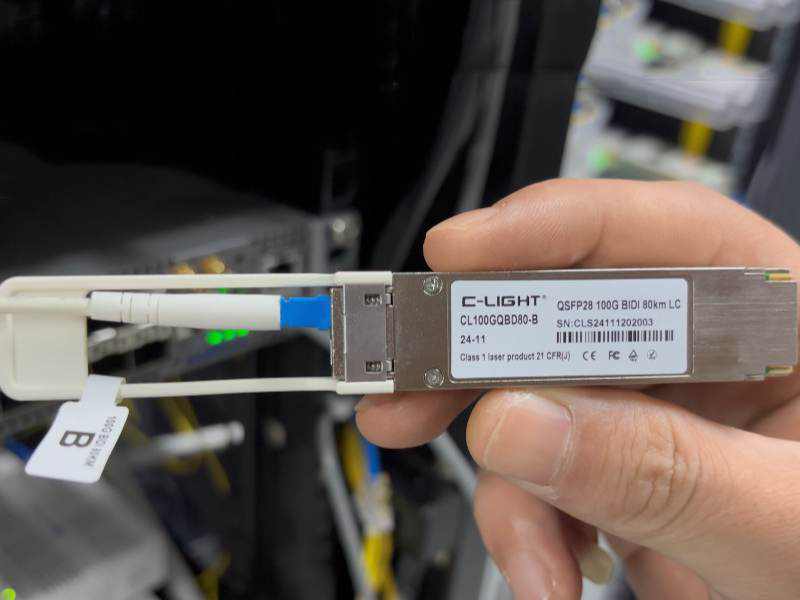
Answer: Passive CWDM systems require CWDM optical transceivers that match the wavelength channels supported by the MUX/DEMUX devices. Available solutions include CWDM SFP, SFP+, SFP28, QSFP+, and other CWDM optical modules supporting different data rates and transmission distances. C-LIGHT provides CWDM optical modules from low-speed applications to high-speed networking requirements.
Q7: What are the typical applications of Passive CWDM networks?
Answer: Passive CWDM networks are widely used in:
Metro optical networks
Enterprise backbone networks
Data center interconnect (DCI)
Telecom access networks
5G transport networks
Fiber resource optimization projects
They are especially suitable for scenarios where additional bandwidth is required but new fiber deployment is expensive or difficult.
Q8: How do I choose the right Passive CWDM solution for my network?
Answer: Selecting a Passive CWDM solution depends on several factors, including required channel number, wavelength plan, transmission distance, optical budget, data rate, fiber type, and compatible optical modules. Network designers should select the appropriate CWDM MUX/DEMUX and transceiver combination based on current bandwidth requirements and future expansion plans.
 >
>

 >
>
 >
>
 >
>
 >
>
 >
>
 >
>
 >
>