TEL:+86 132 6656 7067




ONU and ONT are two of the most commonly used terms in Passive Optical Network (PON) systems. Both devices are located on the customer side of the optical access network and convert optical signals from the PON into electrical interfaces and services for end users.
In many modern FTTH deployments, ONU and ONT are used almost interchangeably. However, the terms originated from slightly different concepts, and the equipment can differ in the services, interfaces, management functions, and deployment scenarios they provide.
1. What Is a PON ONU?
ONU stands for Optical Network Unit. It is a device that connects to the optical distribution network and converts the optical PON signal into user-side electrical or service interfaces.
An ONU can provide Ethernet, voice, video, Wi-Fi, or other interfaces depending on its design. ONU is a broad term and can be used for different types of PON networks, including GPON, EPON, XG-PON, and XGS-PON.
2. What Is a PON ONT?
ONT stands for Optical Network Terminal. It performs a role similar to an ONU but is generally associated with equipment located directly at the subscriber or end-user premises.
An ONT may integrate multiple functions such as Ethernet ports, Wi-Fi, telephone interfaces, IPTV support, routing, and management features into one customer-premises device.
3. ONU vs ONT at a Glance
| Feature | ONU | ONT |
|---|---|---|
| Full name | Optical Network Unit | Optical Network Terminal |
| Basic role | PON optical-to-electrical conversion | PON optical-to-electrical conversion at the customer premises |
| Deployment | Access, enterprise, residential, FTTB and other scenarios | Commonly used at FTTH customer premises |
| Interfaces | Varies by product | Often integrates multiple customer-facing interfaces |
| Management | Depends on vendor and PON technology | Often includes extensive subscriber service management |
| Meaning in practical use | Broad device category | Often refers to a subscriber terminal |
4. Is ONU the Same as ONT?
In practical PON deployments, the answer is often yes in terms of basic network function. Both connect to the OLT through the passive optical network and provide the user-side service interface.
The main distinction is terminology and application context rather than a completely different optical transmission principle.
5. Why Are the Terms Used Differently?
The term ONU describes the optical network unit from a broader access-network perspective. It can refer to customer-side optical equipment used in different network architectures.
ONT is commonly used when the optical terminal is deployed directly at an end user's premises, particularly in FTTH networks.
As a result, a residential FTTH device may be described as an ONT by one vendor and as an ONU by another vendor even when their basic PON functions are similar.
6. Where Is the ONU or ONT Located?
Both devices are located downstream of the optical splitter and communicate with the OLT through the optical distribution network.
A simplified PON architecture is:
OLT → Optical Fiber → Passive Splitter → Fiber Distribution → ONU/ONT → User Equipment
The ONU or ONT provides the conversion between the provider's optical access network and the customer's local network.
7. The Role of the OLT
The OLT, or Optical Line Terminal, is normally located at the service provider's central office, data center, or access aggregation site.
It controls communication with multiple ONUs or ONTs and manages upstream transmission, downstream transmission, bandwidth allocation, registration, and other PON functions.
8. The Role of the ONU or ONT
The ONU or ONT receives downstream optical traffic from the PON and converts it into usable service interfaces.
In the upstream direction, it converts customer-side electrical traffic into optical signals and transmits them to the OLT during its assigned transmission opportunities.
9. ONU vs ONT in FTTH
FTTH means Fiber to the Home. In a typical FTTH deployment, the fiber reaches the customer's home and connects to an ONT or ONU.
The device may then provide Ethernet ports, Wi-Fi, telephone service, or other interfaces. Because it is installed at the customer's premises, the term ONT is particularly common in FTTH product descriptions.
10. ONU in FTTB
FTTB means Fiber to the Building. In this architecture, the optical fiber may terminate inside a building rather than inside each individual apartment or office.
An ONU can be installed in a communication room or equipment area and then connect to users through copper Ethernet, telephone wiring, or other media.
11. ONU in FTTC
FTTC means Fiber to the Curb or Cabinet. The optical network unit can be located closer to the users while the final section uses another transmission medium.
This illustrates why ONU is a broader term: an ONU does not necessarily have to be installed inside a customer's home.
12. Residential ONT
A residential ONT often combines several functions into one device.
A typical product may include one or more Gigabit Ethernet ports, higher-speed Ethernet ports, Wi-Fi, telephone interfaces, optical access, routing, DHCP, VLAN, firewall, and remote management features.
Such devices are sometimes called ONT routers, fiber gateways, or residential gateways depending on their additional functions.
13. Simple ONU Devices
Not every ONU is a full residential gateway.
Some ONUs provide only the basic optical-to-Ethernet conversion needed to connect a customer or downstream switch to the PON. These devices are useful when routing, wireless networking, or other services are handled by separate equipment.
14. ONU vs ONT Interfaces
The optical PON interface is only one part of the device. The user-facing interfaces depend heavily on the application.
| Device Type | Possible User Interfaces |
|---|---|
| Basic ONU | Ethernet |
| Residential ONT | Ethernet, Wi-Fi, POTS, IPTV and management interfaces |
| Enterprise ONU | Ethernet, SFP, voice and business service interfaces |
| Industrial ONU | Ethernet, optical uplinks and industrial interfaces |
15. GPON ONU
A GPON ONU is designed to communicate with a GPON OLT according to the GPON protocol and optical specifications.
GPON ONUs are widely used for residential broadband, enterprise access, fiber gateways, and other access-network applications.
16. GPON ONT
A GPON ONT is essentially a customer-premises implementation of GPON optical network termination.
Many broadband routers supplied by telecom operators are technically GPON ONTs because they include the GPON optical interface together with Ethernet, Wi-Fi, voice, and other subscriber functions.
17. EPON ONU
EPON ONU devices operate with EPON OLT equipment and use an Ethernet-oriented PON architecture.
They are commonly found in FTTH, enterprise access, building access, and Ethernet-oriented broadband networks.
18. EPON ONT
In practical product terminology, an EPON customer terminal can also be described as an EPON ONT when it is installed at the subscriber premises.
The important point is that the device must be compatible with EPON rather than GPON simply because both devices may use similar optical connectors or SFP-style packages.
19. GPON and EPON Compatibility
ONU and ONT terminology does not determine PON protocol compatibility.
A GPON ONU or ONT is designed for GPON, while an EPON ONU or ONT is designed for EPON. The OLT and customer-side device must use compatible PON technology unless the terminal explicitly supports dual-mode operation.
20. Dual-Mode ONU
Some products support more than one PON technology and may automatically detect or be configured for GPON or EPON operation.
This type of equipment is often used where network operators need deployment flexibility or where the final PON technology may vary between access networks.
21. ONU Optical Interface
The optical interface of an ONU or ONT includes the transmitter, receiver, optical filter or diplexer, monitoring functions, and other components required for PON communication.
The optical specifications depend on the PON generation and include wavelength, transmit power, receiver sensitivity, optical budget, and operating temperature.
22. SFP ONU
Not every ONU is a standalone box.
An SFP ONU is a compact optical network device integrated into an SFP-form-factor module. Instead of connecting a separate ONT gateway, the PON interface can be inserted directly into a compatible router, switch, or other host equipment.
This approach is particularly useful in enterprise and specialized deployments where the host device already provides routing or switching functions.
23. ONU Stick
An ONU Stick is another compact implementation in which PON functionality is integrated into a pluggable module.
This design can reduce the need for an external optical terminal and allows the host equipment to communicate directly with the PON access network.
24. GPON SFP ONU
A GPON SFP ONU can provide the optical network interface while using an SFP-style form factor.
Although it physically resembles a conventional optical transceiver, the module performs PON-specific functions and must communicate correctly with the target GPON OLT.
25. Why SFP Packaging Does Not Mean Standard Ethernet
A major source of confusion is that both Ethernet optical transceivers and PON ONU modules can use similar SFP packages.
The physical package does not define the communication protocol. A PON SFP ONU can contain PON-specific processing, registration mechanisms, management functions, and optical characteristics that are completely different from a standard Ethernet SFP transceiver.
26. ONU Registration
An ONU or ONT normally has to be recognized and authorized by the OLT before normal service can be established.
Depending on the PON system and operator configuration, registration can involve identifiers, serial numbers, passwords, authentication parameters, profiles, VLAN settings, and other provisioning information.
27. ONT Management
Residential ONTs often provide extensive remote management capabilities because the operator may need to configure, monitor, diagnose, and update thousands of subscriber devices remotely.
Management functions can include service provisioning, optical diagnostics, interface status, firmware operations, alarms, and configuration of customer-facing services.
28. OMCI in GPON Networks
GPON commonly uses OMCI, or ONT Management and Control Interface, for management and control between the OLT and ONT.
OMCI enables the operator to configure and monitor functions within compatible ONTs and supports structured management of subscriber-side services.
29. ONU Management Depends on the PON System
Management mechanisms vary between PON technologies and vendor implementations.
Therefore, when selecting an ONU or ONT, it is not enough to verify the optical wavelength and speed. The management and provisioning model must also be compatible with the target OLT.
30. ONU vs ONT for Home Networks
For a home broadband subscriber, the device may perform several functions simultaneously:
PON termination + Ethernet switching + routing + Wi-Fi + voice + service management
In this type of product, ONT is often used because the device acts as the terminal point of the provider's fiber access network.
31. ONU vs ONT for Enterprise Networks
Enterprise networks may use a simpler optical terminal connected to a separate router or firewall.
For example, an enterprise ONU may convert the PON connection into Ethernet, while the downstream network equipment handles routing, security, VLANs, and other functions.
32. ONU vs ONT for Operators
For an operator, the distinction between ONU and ONT may depend more on product architecture and deployment terminology than on a completely different access technology.
The more important technical questions are the supported PON standard, optical budget, management model, service interfaces, and interoperability with the OLT platform.
33. Optical Power Budget
The optical power budget is an important specification for both ONU and ONT devices.
The available budget must accommodate fiber attenuation, splitter loss, connector loss, splice loss, and engineering margin. A device with a suitable protocol but insufficient optical budget may still fail to provide a stable link.
34. Splitter Compatibility
ONU and ONT devices normally operate through passive optical splitters in a PON network.
The splitter divides downstream optical power among multiple customers and combines upstream signals from multiple ONUs or ONTs. As the split ratio increases, splitter loss also increases, making optical budget planning increasingly important.
35. ONU vs ONT and Bandwidth
The term ONU or ONT does not indicate the actual bandwidth of the PON system.
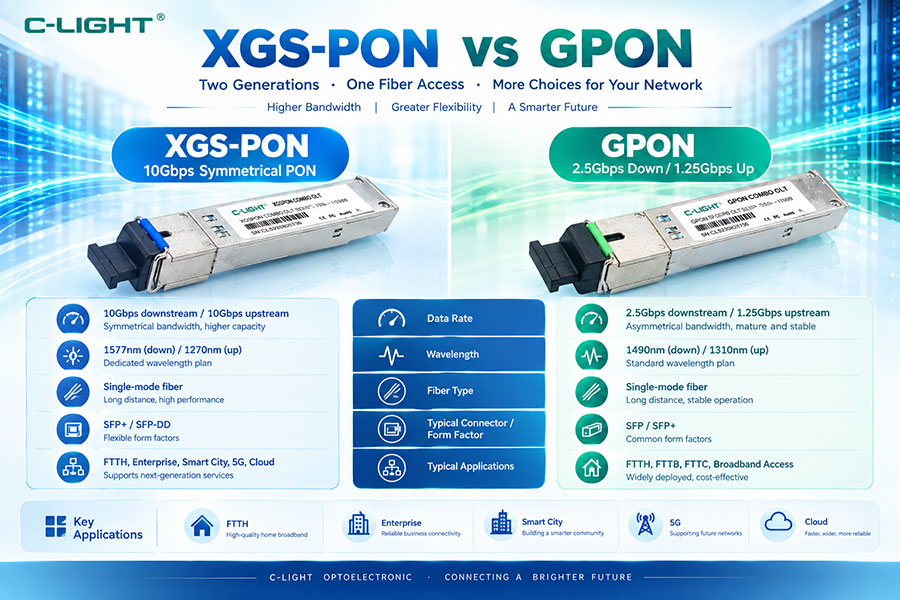
A terminal may support GPON, EPON, XG-PON, XGS-PON, or another PON technology. Therefore, the actual speed must be determined from the supported PON standard and device specification.
36. PON Generation Matters More Than the Name
| PON Technology | Typical Downstream Line Rate | Typical Upstream Line Rate | Common Customer Device |
|---|---|---|---|
| EPON | 1.25 Gb/s | 1.25 Gb/s | EPON ONU/ONT |
| GPON | 2.488 Gb/s | 1.244 Gb/s | GPON ONU/ONT |
| XG-PON | 10 Gb/s | 2.5 Gb/s | XG-PON ONU/ONT |
| XGS-PON | 10 Gb/s | 10 Gb/s | XGS-PON ONU/ONT |
37. How to Choose an ONU or ONT
The first step is to determine the PON technology supported by the OLT. Then check the optical wavelength, optical budget, reach, connector, temperature range, service interfaces, authentication method, management functions, and host or platform compatibility.
For a residential gateway, Wi-Fi, voice, routing, and subscriber-management functions may be important. For an enterprise SFP ONU, host-device compatibility and module management may be more important.
38. Common ONU and ONT Selection Mistakes
One common mistake is treating ONU and ONT as universal PON devices. They are not. A GPON terminal cannot automatically work with an EPON OLT.
Another mistake is checking only the optical connector while ignoring wavelength, power budget, protocol, registration requirements, and OLT interoperability.
39. Why Optical Module Compatibility Matters
For pluggable ONU products, compatibility is not limited to the optical interface.
The host device may require specific EEPROM information, management behavior, vendor identification, temperature monitoring, or other software and hardware characteristics. This is particularly important for OEM, ODM, replacement, and customized PON modules.
40. ONU vs ONT: Practical Difference
| Question | ONU | ONT |
|---|---|---|
| Optical termination | Yes | Yes |
| Can be used in FTTH? | Yes | Yes |
| Can be used in FTTB? | Yes | Depending on terminology and product design |
| Can provide Ethernet? | Yes | Yes |
| Can include Wi-Fi? | Some models | Common in residential products |
| Can be an SFP module? | Yes | Product terminology varies |
| Defines GPON or EPON? | No | No |
41. ONU vs ONT Is Mainly a Terminology Difference
At the practical device level, the difference between ONU and ONT is often smaller than the terminology suggests.
ONU emphasizes the optical network unit as part of the access network, while ONT often emphasizes the terminal located at the subscriber premises. Product specifications and industry usage do not always maintain a strict boundary between the two terms.
42. Focus on Compatibility Rather Than the Name
When deploying or replacing a PON terminal, the word ONU or ONT should not be the primary selection criterion.
The key parameters are the PON standard, OLT compatibility, optical budget, wavelength, service interface, authentication method, management protocol, and physical environment.
43. ONU vs ONT Summary
| Item | ONU | ONT |
|---|---|---|
| Meaning | Optical Network Unit | Optical Network Terminal |
| Basic function | Terminates the PON connection and provides service interfaces | Terminates the PON connection at the customer premises |
| Typical deployment | Broad access-network applications | FTTH and subscriber premises |
| Product form | Standalone, embedded, SFP and other formats | Standalone residential gateway and other terminal formats |
| Protocol dependency | GPON, EPON, XG-PON, XGS-PON and others | GPON, EPON, XG-PON, XGS-PON and others |
| Key selection factor | OLT and PON compatibility | OLT, PON and subscriber-service compatibility |
44. Conclusion
ONU and ONT perform fundamentally similar optical termination functions in PON networks, but the terminology is commonly used in different ways. ONU is the broader term for an optical network unit, while ONT is often used for a customer-premises optical terminal, especially in FTTH deployments.
For actual network deployment, the more important distinction is not the name printed on the product. The PON technology, OLT compatibility, optical budget, wavelength, management system, authentication method, service interfaces, and host-device compatibility determine whether an ONU or ONT can operate correctly in a particular network.
 >
>

 >
>
 >
>
 >
>
 >
>
 >
>
 >
>
 >
>